The Hebrew Scriptures speak of royal personhood being a sign of the messianic times. For example, Psalm 2 sings:
“You are my son, today I have begotten you.”
Psalm 110 also celebrates this passing on of the divine, royal kingship. In Israel, the king is responsible above all for justice and therefore survival of the community.
Christians believe that such a royal person occurred in the person of Jesus who is with the people and calls for both love and justice. Above all, he calls people to the kingdom/queendom of God; that is, Jesus invites all peoples to be royal persons. He calls them to their dignity as images of God—a theology of human dignity and royal personhood.
The Yahwist author and Jesus call people to two things in reminding them of their royal personhood:
First, their dignity.
Next, their responsibility.
A royal person has dignity, a nobility, that proves a starting point for their release from captivity. By reclining with them at table Jesus made the dispossessed feel “clean and acceptable,” in God’s eyes. As Albert Nolan observes, Jesus offers the poor “the full recognition of their dignity as human beings,” and it is by this power that the poor become empowered. “He gave them a sense of dignity and released them from their captivity.” The Good News that Jesus brings is News that all are considered royal persons by God, all have rights, all have divine dignity. He is sensitive to the pain that the oppressed undergo but insists that no one can rob them of their divine and royal dignity.
All of Jesus’ teaching on the kingdom represents a crescendo in the Jewish teaching of royal personhood. This teaching includes the assurance that Yahweh would make the anawim (those without a voice) a royal people.
But with the dignity of all persons—who are all royal persons—comes responsibility: The responsibility for justice-making and preserving creation. On the part of the poor, this means being actively involved in asserting one’s dignity and therefore one’s rights, and of letting go of internalized oppression created by negative self-images that others may have handed on. On the part of those who are comfortable, this means letting go of privilege and siding with the afflicted. This challenge of Jesus is put forth in many parts of the gospels.
Queries for Contemplation
In prayerful meditation, sit with the following questions: what are the insights that they open within you?
Have you had issues with ‘self-esteem’? How might knowing you are of ‘royal personhood’ assist your healing?
How is your nobility or royal personhood inspiring you to contribute to the struggles for ecological, gender, racial, economic justice today?
I’ve never been one of your number, though I’ve always been a fan. I grew up Pentecostal (among other things), where we found your personal and social holiness traditions to be fertile soil to grow our experiences of the Spirit stirring in our midst. During my years fermenting intentional house church communities, I discovered HowardSnyder’sThe Radical Wesley: The Patterns and Practices of a Movement Maker. Snyder’s portrait of your co-founder John Wesley’s great love for his mother Anglican Church, combined with his powerful encounter with the Radical Reformation lineage in the Moravians, was encouraging to me as I was trying to plot trails between my many spiritual homes. In my current life, my 7,000-volume theology, spirituality and history library is being hosted by Haw Creek Commons, a partnership between Bethesda United Methodist Church and the Missional Wisdom Foundation in Asheville. And—perhaps most significantly—my late maternal biological grandfather, Dave Robb, was a UMC minister and prolific hymn-writer. So while I’ve never officially been a part, we roll deep.
Your Recent Decision to Further Exclude the LGBTQ Community
At 7 million or so U.S. members, you’re the largest Mainline Protestant denomination in the United States. Your practices and your policies matter. Since around the turn of the 21st century, you’ve had a—I hope this isn’t too crass a way to frame it—marketing slogan, Open Hearts, Open Minds, Open Doors. Many folks from many backgrounds took you at your word, and have found spiritual solace in your spaces. But this inclusion has never been un-contested space, has it? Officially, “on the books,” your denomination only had about four years since its merger-founding in 1968 where you had no official stance on the status of lesbian, gay, bisexual, transgender, or otherwise queer (LGBTQ) folks in your congregational life. But beginning in 1972, there has been some variety of restriction—and, my LGBTQ friends would say, discrimination—inscribed in your Book of Discipline, even though there have always been dissenting ministers, congregations, and entire regions.
There was hope that at last week’s worldwide meeting of representatives of your 12-million-member global denomination—your General Conference—that you would approve something my LGBTQ friends and allies called the Simple Plan, whose “primary purpose is to remove the language that excludes LGBTQ persons from full participation in the church.” If this was too far a reach, they at least hoped you’d approve the One Church Plan, which, again in the words of Methodist reporter Jeremy Smith, “attempts to resolve the current impasses over church unity and the inclusion/exclusion of same-gender-loving people by giving annual conferences, congregations, and clergy greater flexibility to make decisions based on individual and communal convictions as well as the needs of specific ministry contexts.”
But this isn’t what ended up happening last week. Your Conference—made up of ministers and congregants, but notably not bishops—voted instead for the Traditional Plan, one which greatly intensifies restrictions against LGBTQ folks and their allies within your denomination, opening the door to discrimination, ordination removal, lawsuits, and ministers, individuals, and congregations departing The United Methodist Church in droves.
I can’t encapsulate my response better than my friend, Islamic Sufi and U.S. Civil Rights scholar, Omid Safi:
To all #LGBTQ friends with broken hearts over the decision in #UnitedMethodistChurch, I see you & I love you.
And to the friends and allies of all LGBTQ friends whose hearts are also broken over delegates’ decision, I see you, and I love you.
More importantly, God loves you.
To see your #Methodist church, the place where you call home, the place where you go to bow before the Divine, exclude human beings is heartbreaking.
What We Have in Common
If you’re reading this and have been part of the United Methodist Church, it’s quite likely that you share in my heart-break over this recent decision. You’re likely wrestling in your soul with whether you’re going to stay and continue creating beloved community in the church you’ve loved, or go to a space where your gifts, story, and being will be implicitly honored.
But if you’re a Methodist who takes comfort in the Traditional Plan, or perhaps a long-time friend or reader of mine from another Christian background who’s tracked with me since before I woke up to my own complicity in the dampening of our LGBTQ siblings in Christ, it’s you that I’d like to address in the rest of this Open Letter. Because I’m guessing that you’re wrestling, too: with what it means to love God, love people, and have a grounded sense of what’s good, true, and beautiful in our shared life together.
If that’s the case, we have this in common. Me, too!
Like you, I also share a love and respect for the Scripture of our faith. From my faith-formation growing up amid the various Protestant streams of the Bible Belt in the U.S. South, I know what it’s like to be with each other in the messy, important work of interpretation. Because I take Scripture seriously, I find it part of my calling as a spiritual communicator (and…gulp…teacher?) to question my answers and look past easy assumptions of what I hear second-hand that ‘the Bible says.’
How to Change Your Mind…If You Want To
I’m going to level with you: I’m guessing we see the biblical witness differently when it comes to whether Scripture affirms the giftedness, dignity, worth and qualification of LGBTQ folks to be full participants in the life of the Church. My study, interpretation, and conscience is clear that the Bible does indeed bless consensual and convenatal love between all varieties of people. If you’re curious how I—as someone who immerses myself in the narrative and teaching of Scripture—can arrive at this place without reservation, I’ll share three resources with you.
Even if you don’t end up agreeing, these resources can help you see why United Methodists and other aspiring Jesus-followers feel so strongly that we’re all in this together, regardless of who we love.
How the Wesleyan Quadrilateral Makes Me a More Loving Christian
At the same time, I’d be telling you an incomplete truth if I said that the manifold witness Scripture was the only reason I’ve come to the convictions that I have about our LGBTQ sisters, brothers, and non-binary siblings. Growing up a fundamentalist in the Bible belt with a vague nod to Magisterial Reformation notions of ‘Sola Scriptura,’ I thought that the Bible was the only tool in my tool belt, and I naïvely thought that our (whichever ‘our’ I happened to belong to at the time) interpretation of the Bible was the Spirit-led, common-sense interpretation, held by Real Christians™ from Jesus’ resurrection onward.
I was so grateful in college to discover a framework that named the multiple ways that people of faith do, in practice, come to our respective conclusions—including Scripture, of course, but other key elements as well.
And so a fuller truth-telling of my journey to full embrace of our LGBTQ family would actually be grounded in that quintessential Methodist discernment tool, the Wesleyan Quadrilateral. It’s one of the richest ideas in the Methodist tradition, brilliant in its simplicity. In a nutshell, the Quadrilateral illuminates how we hear from God in the life of the Church—imperfectly, ‘through a glass darkly’ and always in-process, but still in ways that we can reliably discern.
The Quadrilateral names four key avenues of hearing God speak as being:
Scripture
Tradition
Reason, and
Experience.
Scripture we’ve already briefly discussed above.
Tradition as you know contains multitudes. The history of religion contains both those who abuse the ‘faith handed down to the saints’ to reinforce the power of those who oppress, as well as those who see in our history the power to bring about change. Christians sadly were involved in the slave trade and civil rights suppression of people of color on our continent, but aspiring disciples—including Wesleyans, including Methodists—were among those who joined with indigenous Black Church traditions (including the African Methodist Episcopal Church) to struggle for abolition and civil rights. The same can be said for the rights, dignities, and gifts of women to participate in the life of the church, and the same can be said for LGBTQ liberation movements within the church.
Reason is a God-given facility; I don’t think that as disciples we’re asked the check our brains at the door. Quite the opposite! John Wesley knew this, Francis and Clare knew this…there’s alot we can discern through reason simple observation of the world around us. Nature—called by our tradition the other Sacred Book of revelation—teaches us that there’s an endless variety of gender and sexual expression across species, including fish, reptiles, amphibians, birds, and mammals—even primates, even us, created in the image of God. As a communicator called to name the Good News of God’s reconciling all things in Christ, who am I to tear asunder what God has called “very good” in the ongoing act of Divine creativity? This is where reason, grounded in the very best of scientific exploration and consensus, brings me.
And experience…oh, friend. I don’t know what sorts of friendships you’ve been blessed to experience. But if you were privileged to know the same-sex loving, same-gender loving or otherwise non-confirming peers, mentors, and co-congregants that I have, you’d have a rich life, indeed. You see, for me saying “yes and amen” to the presence of LGBTQ folks among us—not even as a ‘them’ that we even get to ‘decide’ on including but always among us, always ‘us’—is not just a matter of equity, not just a matter of justice. It’s a matter of what the Psalmist called “commanded blessing”:
Behold, how good and how pleasant it is
When families dwell together in unity! …
It is like the dew of Hermon, Descending upon the mountains of Zion;
For there the Lord commanded the blessing— Life forevermore. (from Psalm 133)
Vitality in Difference
There is genuine strength when we affirm unity, not only amid but of difference; without this many-corded strand, we’re missing out. Absent this, we are spiritually anemic. Misfits, ragamuffins, and those who don’t quite fit in ‘proper’ society—including those whom culture considers ‘queer’—have been present from the very birth pangs of Pentecost, the reversed curse of Babel affirming Divinity amid difference. I’m continually challenged, inspired, and straight-up blessed by the presence of the Queer Divine in the life of my faith community, Circle of Mercy church in Asheville. I’m encouraged by the early (and varied) signs of holy resistance I’m seeing this week across the United Methodist family, including GLIDEMemorial, Costa Mesa First UMC, the Missional Wisdom Foundation, and indeed, the entire Western Jurisdiction of the United Methodist Church. I wouldn’t have it any other way.
This is my heart, friend. This is my hermeneutic. This is what it looks like for me to publicly embody what I aspire to in my private life—a friend of God, a follower of Jesus, a person animated by Holy Spirit to love my neighbor as my self.
While I’m saddened that you are seeing this differently, there’s something I here I respect: that you felt a conviction, and acted accordingly. In seeking to maintain a faith community that can edify you, challenge you, meet your needs, and give you opportunities to serve, I get it. I resonate. And if you’ve been blessed to find such community in your United Methodist Church, hopefully you can see why it’s so important that my Methodist friends struggle so valiantly to co-create this same brave space for them. Many believers across North America with convictions mirroring yours have no difficulty finding like-minded congregations. But for those in the LGBTQ community, it can be far more challenging to find real discipleship, spiritual formation, and Christian community amid the clamor of culture wars.
We might never come to a meeting of the minds about this matter, whose very framing we probably see so very differently. But if we can agree that, minds being what they are, it’s God who has our hearts, can we commit to pray for each other? That mind and heart alike continue to seek truth in love? I’d like that.
I saw no temple in the city, for the Lord God, Ὁ Παντοκράτωρ, he is its temple, he and the Lamb. Neither was there sun nor moon in its vaulted sky, for the city is lit by God’s lambent glory, the Lamb its everlasting radiance. The nations come to its brightness, bringing the wealth of the seas. The city’s gates are not shut by day and there is no night. Within it lie all nations’ praise and honor. Nothing unclean or detestable shall be found in it, neither any lie, and those alone may enter whose names are written in the Lamb’s Book of Life.
Then he showed me a river of living water lucent as polished glass flowing from the throne of God and the Lamb. In the midst of the city’s street and on both sides of the river stood the Tree of Life. It bore twelve kinds of fruit, yielding its fruits every month. And the leaves of the tree were for healing of the nations.
There will be nothing cursed in the city, for in it is the throne of God and the Lamb and there will his people serve him. They will see his face. His name will be on their foreheads. Night shall be no more neither shall they need any lamp nor the light of the sun – for the Lord God himself shines upon them. And they shall reign forever and ever, ages without end.
He said to me, “These words are faithful and true: The Lord God sent his messenger, imbued with the spirits of the prophets, to reveal to his servants the things that soon must be.”
“Behold, I am coming quickly. Blessed is she who guards the words of the prophecy of this book.”
“I view this as a ‘literary’ translation in that I took the Greek text as its baseline, of course, but from there tried to break free from the normal constraints of English grammar and vocabulary in an effort to capture in words what the author of the work – the Apostle John living in exile on an island – himself says cannot be expressed in words. So it is the inherent impossibility of seeing things that John says can’t be seen and saying things that John says can’t be said that presented the challenge.”
Michael Straus was born and raised in New Jersey and, after a number of years practicing law in New York, undertook graduate studies in classical languages there and in England. He is intermittently engaged in translations from Greek, such as this volume, as well as Spanish, including Las Uvas y el Viento, a long but previously untranslated poem by Pablo Neruda, soon forthcoming.
Jennifer May Reilandwas born in Texas and raised in the shadow of the End Times. She studied art at Cooper Union and lives and works in New York City. She has been awarded residencies at the Sharpe- Walentas Studio Program; the Fondation des Etats-Unis as a Hale Woolley Scholar; and the Drawing Center’s Open Sessions Program. Her work has recently been described in The New Yorker as “draws with a vengeance … exquisite.” But she has yet to escape the threat of the End Times.
The ancient Vedas of India tell us that “The One Existence the wise call by many names.”
How many names for Divinity are there? Do the names for God change? Ought they change as humans evolve and as circumstances of life evolve around us? Are we among the “wise” that the Vedas speak of who are eager to call the One Existence by many names? Do we have permission—and maybe a serious responsibility—to change our understanding and naming of God as we mature as individuals and as we evolve as a species and as we face a critical time – a ‘turning time’ – in human and planetary history?
The great medieval mystic Meister Eckhart declared: “I pray God to rid me of God.”
Apparently he was so convinced in the need to allow God and our names for God to evolve that he actually prayed to God to move on from being “God.” He challenges us further when he declares: “The highest and loftiest thing that a person can let go of is to let go of God for the sake of God.”
How many names for God have humans come up with? And which ones might serve us besttoday and what new ones beckon us? One answer to that question is a simple one:There are as many names for “God” as there are languages in the world, for each language calls God by a different word. Examples: God (English); Gott (German); Dieu (French); Dios (Spanish); Allah (Arabic); Gut (Norwegian);Theos (Greek); Deus (Portuguese); Bog (Russian);Dia (Irish); Elohim (Hebrew); Marta(Polish); Kalou (Fijian), etc. etc.
But that is by no means the whole story. For one thing, each language may well have multiple words for “God.” For example in English we can talk of Divinity; Spirit; Creator; Deity; Godhead; Goddess; and much more. If this is true in English no doubt it is true in other languages as well.
Every Religion offers its name for the Divine: Brahmin; Krishna; Tao; Buddha; Tara; Allah; Yahweh; Adonai; Tagashala; Wankan Tanka; Oshun; Isis; Christ – to name but a few.
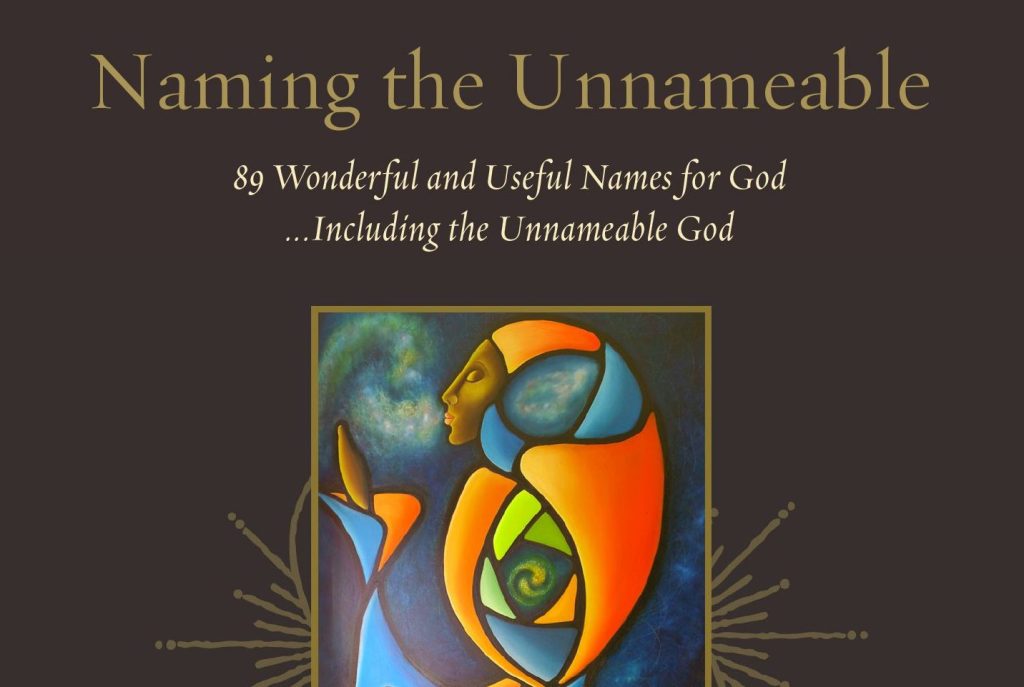
So where else do we come up with alternative names or images of God? The Sacred Scriptures of the world are one such place; and the mystics of the world are another; and science is another. The Muslim tradition boasts a powerful practice of reciting the “99 Most Beautiful Names” of God; in many ways, this practice has inspired my newest book, Naming the Unnamable, wherein I present 89 current names for Divinity that I think are most beautiful and wonderful and useful for our times. I am grateful for that Muslim practice to which I am indebted and which I have often prayed myself.
The ancient scriptures of Hinduism known as the Bhagavad Gita tell us this: “God has a million faces.”
St Thomas Aquinas, medieval theologian and mystic, goes even further. He says that every being is a name for God when he says: “Even the very ones who were experienced concerning Divinity, such as the apostles and prophets, praise God as the Cause of all things from the many things caused.” Aquinas, in this amazing passage,goes on to name 49 names for God that sixth century Syrian monk Dionysius the Areopagite found in Scripture alone and discussed in his foundational work, The Divine Names.
What follows from his statement is that there are literally multiple trillions upon trillions upon trillions of names for God. Countless creatures—therefore,countless faces, countless names. But at the end of his treatise he says nobeing is a name for God because “God surpasses all things.”
If there are trillions upon trillions of names for God, who am I – and who are you – to dare to choose only 89?
Well, first of all, my book is unfinished. It is open-ended, and the last pages of each section are left blank so that you may add your own most wonderful and useful names for God.
Secondly, while there may be trillions upon trillions of names for God, it is clear that we humans are limited. We can only take so much input, and reflect deeply on avery finite number of thoughts, concepts and names. So this book presents avery finite number, a working number, of possible names for God. Hopefully they might prove useful and inspire other useful names from the reader.
In this book I seek to offer a finite number of names for God that I sense might be useful for us in the difficult ‘in-between’ times in which we find ourselves at this dawning of the post-modern era. I include a modest meditation with each name to assist a kind of ‘unraveling’ and unpacking of each name. I invite the reader to deepen the experience by his/her own meditation and investigation. Some have called our times ‘apocalyptic’ and philosopher Theodore Richards points out that ‘apocalypse’ also means ‘revelation.’ Perhaps, in dire times, deeper mysteries are revealing themselves, unveiling themselves, to us. But we need to listen deeply. We need to develop our muscles of contemplation. We need to cease projecting and to learn anew to let go so that we can listen truthfully to the ‘hidden Word’ of silence. From this hidden place of silence, this “cave of the heart” as Father Bede Griffiths calls it, might emerge some new and fresh language for a spiritual awakening, for rich names for Divinity, for a global renaissance. Hopefully, Naming the Unnamable can assist that important task.
As humans undergo deep changes, so too does our understanding of God or Divinity. Both Meister Eckhart, a medieval mystic activist, and Alfred North Whitehead, a twentieth century scientific philosopher, agree that Divinity evolves. “God Becomes where all creatures express God,” notes Eckhart. Thus, our names for God increase in possibilities and evolve as evolution continues all around us. Deepak Chopra sees God’s evolution this way: “What actually evolved was human understanding….we think that God changes, because our own perception waxes and wanes. The messages keep coming though and God keeps showing different faces….as awareness evolves, so does God. This journey never ends.”
Which, among the trillions upon trillions of God-names might serve us the best today? And serve the planet the best? And therefore serve God the best? That is the question that this book is presenting. Hopefully, it will be useful, for as Aquinas insisted, a “little knowledge about important things is far more important than a lot of knowledge about unimportant things.”
A fresh understanding and language about Divinity may assist us to come up with fresh understandings of ourselves and thus the societies and institutions we feel called to give birth to as we struggle to assist other species to survive and to survive ourselves, to be sustainable, even to thrive and become beautiful and worthy of our holy existence.
Meister Eckhart warns us that when we talk about God we stutter and stumble. This is important information, that no word does God justice and no person or ideology holds a trademark on the word “God.” Humility and reverence are required evento enter into the conversation. A certain receptivity is required to enter into authentic God-talk. Hopefully that spirit of reverence, humility and receptivity imbues Naming the Unnamable and those who pick it up.
Here are but two of the 89 names and facets of God we explore…
God is the Newest and Youngest Thing in the Universe
In the ancient Vedas from India, God is called “most youthful.” Meister Eckhart says that “God is novissimus,” meaning the newest and youngest thing there is in the universe. He also says that “when we say God is eternal we mean God is eternally young.” There is something youthful and “in the beginning” about God—this is why both the Hebrew Bible and the Christian Bible (John 1.1) begin with the words “In the beginning….” To return to the beginning is to return to God therefore. And we do return to the beginning, to our “unborn selves,” as Eckhart puts it, and to the person you were before you were born. Buddhism tootalks of recovering our “original face” which we possessed before we were born.”
God is the Ancient One of Ancient Days, the ‘One Beyond Time’
Not only is Divinity young and youngest; it is also ancient and before time; and beyond time. Eckhart says: “God is eternity” who dwells in “the fullness of time. There everything is present and new.” But what is eternity? “Eternity is the peculiarity “that being and being young are one.” Because “both newness and life are proper to God,” our dwelling in the eternal now is dwelling in newness and life, vitality and the source of energy.
Hart says that “God is eternal, not in the sense of possessing limitless duration but in the sense of transcending time altogether. Time is the measure of finitude, of change, of the passage from potentiality to actuality. God, however, being infinite actual being, is necessarily…the One beyond time, comprehending all times within his eternal ‘now’.” We have glimpses of this “eternal now” when we undergo mystical experiences in moments of creativity or of great joy and ecstasy. At such times the past and future come together in the deep present and they are often accompanied by a deep Presence and a suspension of time—“Where did the time go?” we ask. This deep Presence can also communicate as a very ancient presence.
“Naming the Unnamable offers a smorgasbord of spiritual delights that will enrich the prayer life of both believers and nonbelievers. Fox’s radiant images and creative appellations transform the generic “God” into a vibrant, intimate Source for personal communion. Even those who have abandoned conventional religion will find wisdom and inspiration in these beautifully articulated reflections.” — Estelle Frankel, author of Sacred Therapy and The Wisdom of Not Knowing
“How refreshing! Fox shows how we can think about God in so many different ways, freeing our minds and liberating our imaginations. It is easy not to believe the narrow conception of God that atheists do not believe in, but it is hard not to be inspired by a God who is energy, breath, life, flow, love, joy and the cause of wonder. This book is timely, important and admirably brief, it is also open ended.” — Rupert Sheldrake, author of Science Set Freeand Science and Spiritual Practices: Transformative Experiences and Their Effects on Our Bodies, Brains, and Health
“These are not just names but 89 theories of God across the ages and the planet, each focusing on the characteristic it deems most divine. Matthew Fox leads us on a startling and beautiful journey through humanity’s capacity to envision God, showing every way of looking at God is legitimate if it raises the aspirations of its adherents and their ability to carry them out. Is there objectively a God? What ‘God’ even means explodes in this little book like fireworks in the mind.” — Nancy Abrams, author of A God That Could be Real: Spirituality, Science, and the Future of Our Planet
“This is a simple book written by a brilliant man who gives us a democratic vision of the names of God. It will be sure to appeal to readers of many faiths, scientists, and nature lovers as well.” — Steven Herrmann, author of Spiritual Democracy
“Matthew Fox leads us on an important yet easily absorbable exploration of the multiplicity of forms in which we perceive the Divine in our lives. While we so readily seek to differentiate, define or even dispel the sacred, we desperately need teachers like Fox who show us the unity in diversity. I suspect that anyone can find some names in this book that resonate for them, whether scientist or artist, believer or atheist, old or young, female or male. Fox’s depth of insight and abundant compassion is felt throughout the pages as he helps us embrace and share in the wholeness of who We are.” — Sky Nelson-Isaacs, M.Sc. Physics and author of Living in Flow
“I’ve always experienced the Divine as expressing through everything around me: the squirrel chattering up the oak tree, the waves crashing on the shore, my baby boy looking me in the eyes. Matthew Fox in Naming the Unnameable allows us to explore all of the many and dynamic ways that God speaks and breathes and plays in the world.” ―Jennifer Berit Listug, co-author with Matthew Fox and Skylar Wilson of Order of the Sacred Earth
“In Naming the Unnameable, Matthew Fox generously brings ‘God’ down to Earth and us into contact with the Great Mystery that dances all around and within us. He brings the arch of Western Religion back home …and with it, opens up a sense of the sacred for all to experience all-ways.” ―Skylar Wilson, co-author with Matthew Fox and Jennifer Berit Listug of Order of the Sacred Earth
The following is an excerpt of Christianity Without the Insanity, a bold-yet-gentle, psychologically-informed and biblically-rooted examination of the idea of hell: What’s in integrity with our spiritual traditions, and what makes for emotionally-healthy spirituality. It’s a featured Speakeasy selection, and there are still limited review copies available for qualified reviewers.
Symbolism in The Holy Bible is bountiful, beautiful, timeless, and cross cultural. Many words, therefore, are not literally true. Thus, fire is a very prominent and significant symbol in the sacred writings of Christianity and other religions. One of the four Biblical definitions of The Supreme Being is “God is a consuming fire” (Deut. 4:24; Heb. 12:29).
In religious literature, suffering and punishment in fire are symbolic of the spiritually corrective nature of metaphorical fire. A literal interpretation of the symbolism of fire is a major cause of fear, spiritual insanity, and spiritual abuse—especially spiritual terrorism, spiritual abuse in its most extreme form.
Tasker, General Editor of the Evangelical Tyndale New Testament Commentaries, stated, in regard to “aeonian” in Mt. 25:46 having been mistranslated as “eternal,” it would be “difficult to exaggerate” the harm that is done “…when ‘fire’ is understood in a literal rather than in a metaphorical sense.”
Judaism
The metaphorical use of fire is a significant feature of Judaism, which includes sulfur and salt symbolism. The story of the destruction of the cities of Sodom and Gomorrah is an excellent case in point (Gen. 19:24-26).
Here we have in Genesis, written about 1,500 years before Christ, a preview of God’s redemptive strategy. This is the whole metaphorical and allegorical picture. Literalists are so driven to prove that this story literally happened that they miss the big symbolic picture. In the previous chapter of Genesis, the Lord informed Abraham that he was going to destroy those two cities due to their wickedness. For those who contend one must not question God, Abraham must have not gotten that message!
Abraham asked two very profound philosophical and theological questions:
“Will you destroy the righteous with the wicked” (18:23)?
And: “Will not the Judge of all the earth do right” (18:25)?
The answers were that God would not destroy the righteous, and He would do right. The Lord thus sent two angels to Abraham’s nephew, Lot, to warn him and save him and his family, since they were the only righteous ones in either city. The angels escorted Lot, his wife and daughters out of range of the fire and brimstone/sulfur and told them not to even look back. But his wife did look back and was turned into a pillar of salt.
What are the spiritual lessons to be learned? God gives ample warning to the righteous and does what is right. Lot and his daughters were saved by grace, the easy way through obedience.
Lot’s wife was turned into salt for disobedience. A question which reveals my analytical bent, I have asked many people, “Why was Lot’s wife turned into salt rather than into some other substance such as petrified wood, stone, bronze, iron, steel, etc.?”
Virtually all Christians know the story; most say the message is to obey God to the letter and never look back. I have yet for anyone to tell me that he or she has ever thought about why she was turned into salt rather than some other substance.
The answer is that salt is a preservative which preserves by purifying!
The Law of Moses required salt to be offered with meat offerings. This was the salt of the Covenant made with fire, symbolizing purification (Lev. 2:13-16). Lot’s wife was saved the hard way of being “salted,” which is also a means of grace.
The backdrop of this metaphorical drama was the wicked people of Sodom and Gomorrah being destroyed by burning sulfur for time, not eternity. Since burning sulfur symbolizes healing/ purification, the wicked will be healed of their sins and eventually accepted into heaven. The ancients readily understood this metaphorical use of fire and sulfur—burning sulfur. Indeed, it is a shame that many modern people, especially conservative Christians, are so literal-minded that they fail to grasp the truth in this beautiful, timeless, cross-cultural symbolic language.
Such symbolism is like international travel signs—no words are needed, just the visual image. To use a modern analogy, if the Bible would have said that, after The Final Judgment, all those infected with sin will be cast into a fiery lake of penicillin, would that not logically symbolize healing sin infection? Sulfur was the wonder drug in the ancient world as penicillin is today.
Isaiah uses fiery language to describe the fury of God toward sin. He comes burning with anger; His lips are full of indignation, and His tongue is as a devouring fire. The breath of God is like a stream of burning sulfur (30:27-33). Isaiah also declared that the judgmental fire of God will be unquenchable (66:24). It will, therefore, purify those who have rebelled against God and have been resisting God’s saving grace. The result will eventually be universal worship of the one living God as evidenced by every knee bowing and every tongue confessing faith in God (45:21-25; 66:23). Zechariah (13:9) and Malachi (3:1-3) also describe the fiery judgment of God. Malachi closes with this commission. The people of the Covenant are told to go forth and tread down the wicked. The symbolism of the consuming fire is continued with assurance that the wicked shall be “ashes” under their feet (4:3).
Christianity
With the final-prophetic message of Malachi, there were 400 years in which no prophet of Israel was heard. This span of four centuries is known by Christians as “The Intertestamental Period.”
Suddenly the long-prophetic silence was shattered by the cry of a baby—the Jewish Messiah who was born of the Blessed Virgin Mary. Jesus was Jewish in every sense. His parents were Jews, His culture was Jewish, and His religion was Judaism. He prophetically proclaimed to his people that the first commandment is, “Hear O Israel; The Lord our God is one Lord” (Mark 12:29). This, of course, is a quotation from the Law of Moses (Deut. 6:4).
Jesus acted totally within the Jewish tradition of great prophets by castigating the people for their sin of failing to live up to their calling as the people of the Covenant. He, like all Jewish prophets of The Torah before him, called the covenantal people to a higher standard. He also continued the metaphorical use of fire.
John the Baptist was in that same-great Jewish-prophetic tradition in the symbolic use of fire. Referring to the people of the Covenant and calling them to be faithful and fruitful, he declared to them, just prior to his baptism of Jesus, that the Messiah would baptize with the Holy Spirit and with fire, and there would be a judgment of unquenchable fire (Mt. 3:10-12).
We can say three things with certainty about Jesus’ use of the word “fire.” He used fire in a metaphorical—not a literal—sense.
He used it not to instill a morbid fear of God in the people of the Covenant but to convey the purifying message of God as the consuming fire in order to call them to a higher standard. Jesus used fire in the same sense as Moses, Isaiah, Zechariah, Malachi, John the Baptist, as well as other Jewish prophets.
Not one used fire in a literal or negative sense, which must be kept in mind as one reads Jesus’ words in regard to hell fire that may appear to teach eternal punishment. A good example of that is Jesus’ teaching about the unrighteous being consigned to the “aeonian” fire prepared for the devil and his angels (Mt. 25:41). Jesus validated the Jewish prophets’ metaphorical use of fire when he stated that the fire of hell will not be quenched (Mark 9:48). Unquenchable does not mean that the fire will never go out, only that it will not be put out or extinguished. But it will burn out when it has accomplished the purifying purpose for which God created it. Jesus left absolutely no doubt about his symbolic use of fire when He stated the purpose of hell:
“For every one shall be salted with fire, and every sacrifice shall be salted with salt” (Mark 9:49).
In the Aramaic which Jesus spoke, speakers expressed themselves in the strongest words possible to make their point. Thus, Jesus used strong though not literal-meaning words.
Mild Accuracy Weakness
Dr. Rocco Errico, a scholar in Aramaic, said in And There Was Light that an Aramaic speaker’s purpose was not to deliver the message in scientifically accurate terms. “He piles up his metaphors and superlatives, reinforced by a theatrical display of gestures and facial expression in order to make the hearer feel his meaning. He speaks as it were in pictures…It is also because he loves to speak in pictures and to subordinate literal accuracy to the total impression of an utterance, that he makes such extensive use of figurative language…he is fond of metaphor, exaggeration, and positiveness in speech. To him, mild accuracy is weakness.”
This understanding of the Aramaic language and culture explains exactly why Jesus’ used all these strong picture words in general and, especially in regard to hell—weeping, wailing, gnashing of teeth, cutting off one’s hands and feet and gouging out one’s eyes, unquenchable fire, being salted with fire, etc., because He needed to communicate in the manner His audience would have readily understood. They would not have taken such word pictures literally. On the other hand, they would have considered mild accuracy weakness! If Jesus had spoken in a mild manner, He may have lost his audience as they became bored and walked away. Even if they had not walked away, they may have missed His point if He were speaking in a style unfamiliar to them.
When trying to correct the inconsistency between what the Pharisees taught and what they did, Jesus could have said in our Western-world abstract style, “Your teachings and your behavior are incongruent.” But Jesus, as an excellent Aramaic speaker, exclaimed, “blind guides,” “child of hell,” “fools,” “hypocrites,” “serpents and generation of vipers,” “strain out a gnat and swallow a camel,” “whitewashed tombs” [clean on the outside but a stench on the inside], and “How can you escape the damnation of hell” (Mt. 23:13-33)?
Doubtlessly, Jesus deliberately mixed the metaphors of fire and salt to make it impossible for literalists to logically interpret this metaphorical language literally. It is, of course, impossible to literally salt anyone or anything with fire. And yet literalists, locked into a mindset of literalism, still interpret Jesus’ words literally.
This is a major cause of spiritual abuse/terrorism and spiritual insanity. Some victims of spiritual insanity become spiritually and mentally insane and homicidal and/or suicidal!
Christian Conceptions of Hell
Extremely Abusive
Hell is worse than literal fire for eternal torture of sinners. This is the view of Bill Wiese in his book, 23 Minutes in Helland Robert Morey in his book Death and the Afterlife.
Hell is literal fire for eternal torture of sinners. This is the view of Fundamental and many Evangelical Christians.
Moderately Abusive
Hell is not literal fire but symbolizes a torturous existence with sinners in it. This is the view of some Evangelical and most mainline Protestant Christians [if they believe in hell].
Hellfire is for the purpose of annihilating sinners so they will cease to exist. The annihilation may be instant or progressive, but no one will be tormented forever. This is the view of the late Drs. Clark Pinnock and John Stott.
Mildly Abusive
Hell symbolizes nonexistence, but God will not annihilate sinners. They will go to “sleep” at death and never awaken. This view is called “Conditional Immortality.” God will bestow immortality on those who accept Christ as Savior.
Hellfire symbolizes purification of sinners. But sinners will not be saved due to them forever saying “No” to God’s offer of salvation and God not violating their free will. This is the view of Rob Bell in his best-selling book, Love Wins: A Book About Heaven, Hell, and the Fate of Every Person Who Has Ever Lived [whose fate Bell laves uncertain].
Hell fire is for purification, and almost all sinners will be saved. But not all will be saved, because after God, as fire, has consumed all the sin in some people there will be nothing good in them, so the fire that consumes sin will then consume such sinners. This is the view of Sharon Baker in her book, Razing Hell: Rethinking Everything You’ve Been Taught About God’s Wrath and Judgment.
Non-Abusive
Hell fire symbolizes purification of sinners. And, eventually, without coercing or violating free will, all sinners will say, “Yes” to God’s offer of salvation and be saved. Theoretically, in this view, sinners in hell could say “No” to God’s offer of salvation forever, since God will never violate free will. Yet it is certain that they will not say “No” forever, as evidenced by Christ drawing all to Himself (John 12:32), universal submission and confession of faith in Christ (Phil. 2:9-11), all living in Christ and God being all in all (I Cor. 15:22, 28), and universal worship (Rev. 5:13). This is my view and that of these authors who believe in Christian Universalism: Gerry Beauchemin in Hope Beyond Hell: The Righteous Purpose of God’s Judgment; Bob Evely in At the End of the Ages: The Abolition of Hell; Kalen Fristad in Destined For Salvation: God’s Promise to Save Everyone; Eric Stetson in Christian Universalism: Good News For All People; and Thomas Talbott in The Inescapable Love of God.
With all of these views of hell, and perhaps variations of these, among those who believe the Bible is the Word of God, cannot we Christians just agree to disagree agreeably on the issue of hell? Mature faith will trust God to do the right – not the wrong – thing.
Praise for Christianity Without Insanity
“Boyd C. Purcell Ph.D. has written a book about Christianity that in my opinion is the best I’ve ever read. With over 40 years of ministry in counseling: agency, clinical, pastoral, psychiatric hospital, school, substance abuse, private practice, and chaplaincy—providing spiritual care at the end of life for hospice patients, he is uniquely qualified to address the topic of Christianity Without Insanity. It’s been said that if the shoe fits … It not only fits, it fits like a glove! Boyd paints a beautiful Scriptural picture of what existed for at least the first 500 years of Christianity. This awesome glorious good news is available for everyone. It’s the greatest truth ever told. Christian Universalism! All humanity will ultimately be reconciled to God.”
— David Black, Amazon reviewer
“I rarely read books twice, but this one I am getting ready to read again. It had freeing effect on me—so thorough and hopeful. Boyd brought up points I have not heard in the Universalist movement, and one (I won’t spoil it for you) has continually refreshed me. Boyd starts off the book with a rather shocking and extreme example that I didn’t think related to me, but it turned out to be dead right and incredibly revealing as to effects that have been influencing me that I never would have noticed. This book has helped me to be gentle with myself and others; we are all healing from an incomplete picture that dominant doctrine has provided for so long.”
— Amy H., Amazon reviewer
“This is a really good book for anyone with doubts or concerns about hell and eternal damnation as it is traditionally taught in most of Christendom. Boyd Purcell shares his passion for people of all faiths and denominations to be set free from the insanity preached from the pulpits of of the Christian church, come to the knowledge of the truth that all humanity will eventually be saved and none will forever be burning in an endless torture chamber of fire called hell. Even if you already are aware of the truth about hell as I was before reading this one, I found Dr Purcell’s book very encouraging and filled with information I did not know.”
— John, Amazon reviewer
About the Author
Boyd C. Purcell, Ph.D. is a National Board Certified Counselor, a Licensed Professional Counselor, an Ordained Honorably Retired Presbyterian Minister, and a Board Certified Chaplain. Educationally, he has a Bachelor of Science Degree in Comprehensive Social Studies (World/European/American History, Economics, Geography, Political Science, etc.). He also has a Master of Arts Degree in Counseling, a Master of Divinity Degree in Biblical Studies, and a Doctor of Philosophy Degree in the integration of psychology and theology. In terms of experience, Dr. Purcell has over 40 years of ministry in counseling: agency, clinical, pastoral, psychiatric hospital, school, substance abuse, private practice, and chaplaincy—providing spiritual care at the end of life for hospice patients.