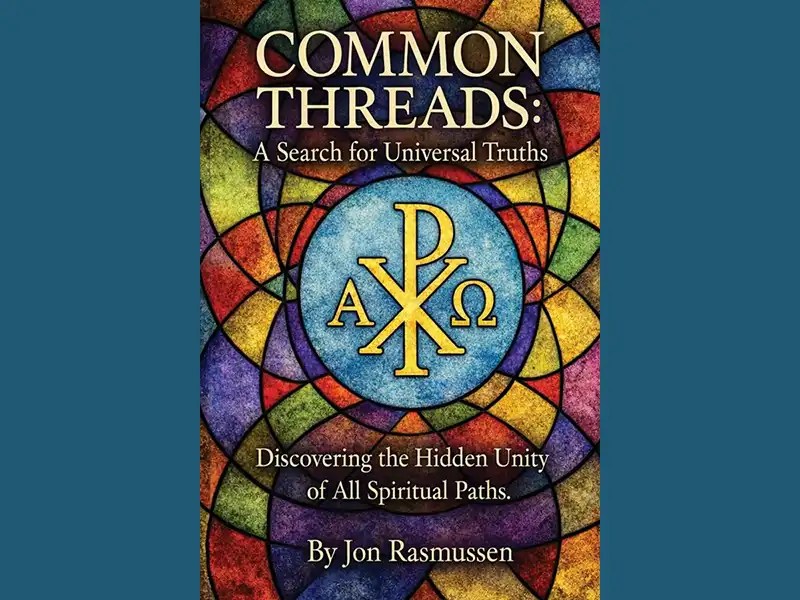
The following is an excerpt from Common Threads by Jon Rasmussen. It’s a featured Speakeasy selection, and there are still limited review copies available for qualified reviewers.
This work is not the result of an academic project. It is the result of trying to understand, study, practice, and make sense of and find truth in everything I was being taught about this world and the world of spirit.
For decades I have walked inside two worlds that many people believe cannot be reconciled: the sacramental life of the Catholic Church and the direct, initiatory encounter with the living structure of reality that many would call shamanic and scientific. In lived experience they are not in opposition. They are describing the same alignment from different entry points.
On one side was the immense, living tradition of the Catholic Church —sacramental, historical, embodied, anchored in the Incarnation and the Eucharist, shaped by saints, guarded by doctrine, luminous with beauty.
On the other side was the vast landscape of the world’s spiritual wisdom —the Upanishads and the Tao Te Ching, the Buddha’s awakening and the Sufi’s burning heart, the insights of contemplative psychology, the language of consciousness, the discoveries of modern science, and the testimonies of people whose experiences did not fit within any single inherited framework
I did not experience these as enemies. I experienced them as converging. Again and again, in prayer, in study, in conversation, and in the lives of people whose holiness could not be confined to a single vocabulary – like my Q’ero Shaman teachers who were isolated since 1492 AD high in a remote area of the Andes Mountains of Peru, who have spoken only the unwritten language of Quechua and share stories going back 15,000 years of originally coming from the stars, and who seem to me like the most Christ-like people I have ever met – I began to see the same pattern:
The same depths of silence.
The same transformation of the heart.
The same movement from ego to love.
The same intuition that reality is communion.
At first this convergence created a crisis. How could I remain fully, faithfully Catholic and at the same time acknowledge the real presence of truth, holiness, and transformation outside the visible boundaries of the Church, or any of the many Christian-based denominations?
How could I avoid reducing the uniqueness of Christ to one symbol among many — and also avoid denying the evident work of the Spirit in the world?
How could unity be real without becoming vague? This book is the fruit of living inside those questions. It is not an attempt to create a new system. It is an act of contemplation. It is the result of discovering that the Catholic mystical and sacramental vision does not close the circle of truth — it opens it.
What I came to see is simple and inexhaustible: Every authentic search for truth is already held within the Logos through whom all things were made, also known as the Source, the Universe, the Om, the Wiracocha (wellspring) and IntiTaiTai (the sun behind the sun). Every real movement toward love participates in the life of the Trinity in Catholicism: God, God in human form (Namaste), and the Holy Spirit (God Source in all of the forms both physical and non-physical).
Every transformation into compassion is a participation in the Paschal Mystery, which is Jesus’ passion to take on the suffering of the world (like Sidhartha the Budha), his death on the cross, and his resurrection, which are similar to the death and rebirth practice in shamanism and many other traditions for the primary purpose of freeing us from our mistakes and guilt and giving our soul the clarity to live consciously forever in the state of heaven within. You can go through this yourself, or you can accept and thank Jesus for doing it for you – like the ultimate shaman session, but rather completely free and unconditional.
The Incarnation of God through Jesus does not narrow the spiritual universe.
It reveals its center. This book was written for several kinds of readers. For the Catholic who senses that the Holy Spirit has been at work far beyond what they were taught to see, and who longs for a vision large enough to hold both fidelity and openness.
For the seeker who has encountered real light in many traditions and wonders whether there is a home in which those lights are not extinguished but rather gathered
For the contemplative who recognizes the same silence behind many different names.
For the modern person who can no longer divide science, spirituality, psychology, and daily life into separate compartments and who longs for a single, living synthesis.
This work does not attempt to erase differences between traditions. Those differences are real, and they matter. Nor does it pretend that every teaching is equally true?
Instead, it asks a more demanding question: What do we discover when we listen at the deepest level — the level at which the human person is actually transformed into love?
At that depth, the common threads appear. And at the center of those threads stands not an idea, but rather a presence:
The One in whom the Absolute becomes intimate,
the cosmos becomes sacrament,
the human person becomes communion,
and history becomes Eucharist – a true embodiment of Christ in all of us.
If this book has any value, it is not because it offers a new theory.
It is because it points toward a way of seeing — and ultimately a way of living— in which unity is no longer something we construct, but rather something we recognize as already given in Christ, who is “all and in all.”
This is not the end of a conversation. It is an invitation to one. What I am presenting here is not a theory about unity. It is the recognition of a pattern and common threads of teachings that repeatedly produces the same results in human lives across cultures: greater coherence between feelings and thoughts, power and integrity to ask for what you prefer and experience it, greater freedom from distortion and negative influences, greater capacity to love, and measurable protection from the forces that fragment the soul and seek to take from us all that we have – our power, our life force and will to live, our health, and our good relationships.
The Catholic mystical vision that I was originally born into and then left in my early twenties, is now clearly the incarnational center of this map because with a life of experience and now clearer understanding it is the place where what other traditions experience interiorly becomes historically embodied, sacramentally participatory, and communally lived. And the full circle for me going from Catholic to every other religion, spiritual tradition, and the most ancient continuous forms of Shamanism as both a practice and a vocation, is that I now see the value, beauty, grace, efficiency and commonality of all of my favorite aspects of all that I’ve learned and experienced are truly present in the Catholic Church. In other words, if I had applied the same time and effort of study, understanding and practice I put into everything else into my Catholic Faith, I might have come to this conclusion decades earlier. And then again, my purpose here seems to be a bridge for all things, for which I am now more qualified having taken this long and circuitous route.
With this book, I hope to take the decades of work and understanding that I’ve accumulated and pass it on as a more quick and efficient bridge to those who may be on a similar journey. This book is written for those who are no longer satisfied with inspirational language but rather want to understand the operational structure of transformation — what actually changes a human life and what does not.
If you read it slowly and apply it, it will function not only as a text but rather as a stabilizing alignment in your life that will allow you to focus your mind and energies to get to that experience of “heaven within” for this life and hereafter with greater ease and grace.
A good way to start is to take a measure of what portion of your life’s inner experiences would you consider to be heavenly (peace, pleasure, joy, comfort, love and etc.), hell-like (pain, anguish, confusion, fear and etc.) or purgatory, which is trying to get from hell-like to more heavenly with a lot of struggle, hard healing, spiritual, and psychological work, feeling lost and directionless, etc. Take note and write down what percentage of each of those you think is your current reality.
Then do it again after reading this book and maybe using the associated Common Threads Project App for a little while, and/or maybe joining or re-joining the Catholic Church if it makes sense to you. And with any spiritual tradition, healing tradition including western doctors and therapists, and everywhere else, it is critical to keep your power with it – in other words, nobody is above you, even in the man-made hierarchies. This way, you can participate in anything and not throw any babies out with the bath water – in other words, get the best of what it has to offer regardless of the flaws. Like I learned in my Shaman training, don’t confuse the message with the messenger, and certainly don’t give up on a valuable practice and non-physical team like the Eucharist, Jesus, Mary, and the Angels and Saints, the powerful sacred space and protection of the Church and years of powerful prayers just because, like in everything else, some deeply flawed humans are involved. In the end, it is about aligning YOUR Kingdom Within, with the best of the Kingdom of God aka the Source of All-that-Is. This is not the end of a conversation. It is an invitation to one.
Humanity is not suffering from a lack of spiritual information. It is suffering from fragmentation.
Common Threads reveals the single pattern that has produced authentic transformation across the great traditions of the world — and shows how that pattern becomes fully embodied in the Catholic sacramental vision.
This is not comparative religion.
This is a map of reality.
Drawing from decades of lived experience in contemplative practice, sacramental life, and direct work with the dynamics that either empower or fragment the human person, Jon Rasmussen presents a structure that allows the reader to:
- recognize authentic transformation
- discern false unity and ego-based spirituality
- stabilize alignment with the Good
- understand why the Eucharist is the operational center of communion
This book is for the reader who wants more than inspiration — it is for those who want a life that becomes coherent, protected, and capable of love.
Praise for Common Threads
“This book is an interesting and easy read that offers a personal perspective on identity, attraction, and self-understanding. The author writes in a simple and conversational style, which makes the topics approachable even when discussing more complex ideas. I liked how the book encourages readers to think beyond labels and reflect on how personal experiences can shape the way people understand themselves over time.”
—Amazon Review
“Common Threads has been such a gift for my soul at a time in our modern society where I’ve craved faith, truth, and hope. The author does a remarkable job laying bare so many answers to questions I haven’t known how to formulate with my own words.”
—Amazon Review
“Common Threads by Jon Rasmussen offers readers an introspective journey into the similarities that connect spiritual traditions across cultures and time periods. Rasmussen approaches spirituality with curiosity and openness, encouraging readers to look beyond differences in doctrine and focus on the recurring themes of compassion, purpose, connection, and human understanding.”
—Amazon Review
About the Author
 Jon Rasmussen is a Catholic contemplative practitioner, shamanic initiatory guide, and teacher of the structural dynamics of transformation and consciousness. His latest projects include a Catholic Life Coach web-based App called Veritas Life Guide, and his Common Threads project includes the book: Common Threads: A Search for Universal Truths – Discovering the Hidden Unity of All Spiritual Paths, the associated website and web-based app.


No comments yet.