Does the future need faith? Do we have a future, as a species? Will we merge with artificial intelligence and experience unfathomably long lives, or will we go extinct before we even get the chance?
In his sweeping historical analysis The Empathic Civilization, economist and social theorist Jeremy Rifkin summarized the millennia-long human drive of innovation as one of entropy versus empathy. Each successive technological adaptation—the printing press, radio, telephone, airplane, computer, internet—has the paradoxical effect of being more and more resource-intensive, consuming precious elements of our environment (depleting us entropically), while also making it more and more possible to connect to each other across difference, drawing the circle of compassion ever-wider (enriching us empathetically). Rifkin—at least, a decade ago when The Empathic Civilization was published—expressed hope that the very powers of increased empathy would mobilize humanity to create energy solutions that would transcend the depletions of entropy for the foreseeable future, averting climate catastrophe and social disintegration.
How are we doing on this score? What’s ‘winning’—empathy or entropy?
The Christian Transhumanist Association is seeking to answer this question as a part of Team Empathy. Founded by my friend Micah Redding in Nashville, the CTA sees the human drive to innovate, learn, and grow, as part and parcel of the continuing work of Jesus on planet earth—the Christ Whose incarnation re-affirmed that this world, this life, as very good, and Whose resurrection affirms that death in all its forms is a condition whose days are numbered. And thus, the CTA is made up of members—in science, technology, theology, philosophy, biblical studies, spirituality, teaching, and everyday life—who are keenly interested in a robustly life-affirming spirituality rooted in a creation-affirming theology, paired with an innovation optimism that often characterizes the growing, global Transhumanist movement.
When I was asked to join the Board of Directors of the CTA a year and a half ago, I couldn’t resist. I find myself deeply ambivalent to the broader ideals of Transhumanism, to be perfectly honest. One the one hand, I love the infectious optimism that looks with wonder on advances in science, technology, and creativity to respond to humanity’s oldest questions and greatest challenges. But sometimes, the promise of progress can be dangled in front of us as a panacea, a form of social bypassing that enables us to externalize our responsibility to show up for change in the here-and-now. Why hold corporations responsible for their outsized role in creating our current climate catastrophe (for instance) when these same corporations promise that they’re working on nanobots that will be able to clean up our atmosphere and re-set carbon in our atmosphere, ‘any year now’?
For all the ways that some of my pubic sparring partners might wish to paint me as a ‘raving liberal,’ the truth is, when it comes to the life and planet I envision, I’m actually quite conservative…or conservationist, at least. While honoring our human drive to innovate, I vastly prefer channeling our creativity in the direction of learning from the ancestral grace of our deep past, gleaning from 200,000+ years of our species being immediate-return foragers, aka hunter-gatherers. The global, growing slow food, slow money, co-housing, transitiontown, foraging, garden church, dinner church, foodandfaith, freedomfarming, regenerative agriculture and permaculturemovements speak to a resurgence of moving forward by drawing deeply from what’s come before, to be sure we don’t lose the humanity amid all the transcendence. We’re becoming civilized to death, as Christopher Ryan outlines in his incisive, just-released book. In order to survive and thrive as a species, we need to let go as much as climb up, to descend as much as ascend.
Thankfully, the Christian Transhumanist Association is open to these concerns. Indeed, the CTA often acts as the conscience of the larger transhumanist movement, holding it accountable to its own highest values of ubiquity of access, and inclusion of the wonders it foresees. Indeed, it’s part of the CTA’s mission to “work against illness, hunger, oppression, injustice, and death”—not an emphasis you’re likely to see at Humanity+!
Which brings us to right now. In just a couple weeks, the Christian Transhumanist Association will be hosting our second annual gathering—all day on Saturday, October 19th at Lipscomb University in Nashville, Tennessee. We’re setting the table for a far-ranging conversation on everything from radical life extension to transhuman and transgender futures to Christian eschatology and pluralism to—yes—the ethics of our rapidly-transitioning world. Presenters include my friend ‘Science’ Mike McHargue of The Liturgists fame, ‘Human GMO’ Liz Parrish, BioLogos Vice President Jim Strump, filmmaker, activist, and educator Cheryle Renee Moses, Professor of Theology and Ethics at Pittsburgh Theological Seminary Ron Cole-Turner, queer Mormon transhumanist philosopher Blaire Ostler, and a bunch more. I’ll be emceeing, helping get this party started.
Here’s a taste of what you can expect. Last year, I participated in a roundtable conversation on Douglas Rushkoff‘s controversial essay Survival of the Richest: The wealthy are plotting to leave us behind. It’s a candid chat about the promise and perils of innovation that offer to enrich life on Earth…and take us off-planet. Tune in here:
Sound interesting to you? Then come to the CTA Gathering this October 19th, and let’s continue a conversation like no other! It’s vital to our future as people of faith, and people on a planet…period.
If you haven’t heard, or if you need confirming that it wasn’t all a terrible dream, Rachel Held Evans—beloved author, truth-teller, and icon for a generous Christianity—passedawayyesterdaymorning, after a brief and unexpected storm of health complications. She was only 37—two years younger than me.
I first met Rachel over a hamburger in Raleigh nearly a decade ago, in the summer of 2010. She was in town to speak at a student gathering of one of our bazillions of local colleges, one of the few women among a sea of guys. She joined four of us whom she knew online, two fellow conference speakers and two locals: Matthew Paul Turner, Jimmy Spencer, Hugh Hollowell and me, respectively. We headed to MoJoe’s. Over burgers and fries we talked about writing—and blogging, specifically—as well as our shared frustrations with the contours of Christianity in early 21st-century America, and what we each planned to do to try to live into a new way of being.
It was a short meal together; Rachel had a bus to catch, if memory serves. We said our goodbyes.
A few months later, I saw Rachel again, and met her husband Dan, as we were all at gathering that George and Tripp Fuller were put together, Big Tent Christianity. Neither Rachel nor I were speaking; we were both hanging out in the Book Room. (Rachel writes about her Big Tent anticipations here.) Me, running the main conference book table, and she, with her husband, hand-selling her just-released first memoir about growing up at the intersection of religion and science and faith and doubt in the shadow of the Scopes Trial, Evolving in Monkey Town. I was hawking the latest from speakers like Brian McLaren, Philip Clayton and Nadia Bolz-Weber (whose own debut about binge-watching TBN, Salvation on the Small Screen?, I had endorsed), and reminding folks on their way out to say hi to Rachel and check out her book, too. At the end of Big Tent, we had the official after-party at my house. Over a hundred folks spilled out of our back-yard, animatedly discussing new possibilities for faith and spiritual practice over drinks in the glow of tiki torches on a warm September night. In the kitchen we were selling raffle-tickets, to support Love Wins, Hugh’s start-up space of hospitality and dignity for those who lived outside, aka ‘the homeless.’ The grand-prize? A signed copy of Evolving in Monkey Town.
Rachel and I stayed in touch over the years, some years better than others. I, like so many of her admirers, marveled at her generous heart, fiery honesty, and ability to both prophetically critique the faith that birthed her as well as advocate for the immense value of re-imaginging and staying true to the same. Rachel embodied something that I personally aspire to, a way of living that I’m convinced is quite counter-cultural in this day and age:
Being spiritual and religious.
Being transparent to my doubts, while utterly sincere in my faith. Aiming to live out both in a flesh-and-blood community dedicated to loving mercy, doing justice, and walking humbly with God. It’s a challenging, deeply-rewarding path to attempt, fail utterly at, open myself to grace and start all over again. And Rachel was one of the comparatively few voices of my generation seeking to advocate for this ‘narrow road that leads to life.’ And I get it: there are broad roads of religious-nationalist true believers to our right, and nihilist cynics who’d utterly given up on faith to our left.
So when I saw Rachel’s tweet a few weeks ago mentioning not feeling well and asking for prayer, I’m pretty sure I mumbled a somewhat absent-minded ‘flare prayer’:
If you’re the praying type – I’m in the hospital with a flu + UTI combo and a severe allergic reaction to the antibiotics they gave me. (I’m totally going to miss GOT! 😢)
— Rachel Held Evans (1981-2019) (@rachelheldevans) April 14, 2019
When I heard, a few days later, that Rachel began having constant brain seizures and was placed in a medically-induced coma because of the same complications she mentions in this tweet, I began to pray more in earnest. And I wasn’t the only one: the hashtag #PrayForRHE began trending on Twitter.
Outpoured prayers, from across the planet, flowing her way. Bathing her in love, kindness, and healing energies.
I fully expected Rachel to make a comeback. Between the globally-trending prayer and the brain seizures, I expected my friend to be more mystical than ever, having breathtaking and difficult-to-decode Divine visions that she’d spend the rest of her long life contemplating and writing about, for the enrichment of us all.
But yesterday morning, I received a text.
This wasn’t to be.
Rachel had gone.
I felt devastated, as I imagine you did. I fought back tears as I prepared my daughters’ lunch. And in the midst of my grief, I wondered:
Why did she of all people have to leave us, God? What about all that prayer?
I wasn’t alone in asking this question. My friend Chris Boeskool asked it, even before she passed away, and I was annoyed at the time:
It feels to me like these prayers for healing paint a picture of a God on a throne… A God who has plenty of water for a kid dying of thirst, but who is like, “Sorry, you didn’t say PLEASE.” It feels like a physician who has the cure for a deadly disease, but requires the sick person to get 10,000 signatures first. Or to get a hashtag trending. It feels like being back at that Holy Spirity, charismatic church, and having to listen to people talk about “Storming the Gates of Heaven,” or “Holding God to his promises.”
It feels like “Everything happens for a reason” and “All part of God’s plan” and “God never gives us more than we can handle.” And if I’m being honest, it feels like the reason I can’t go to church anymore.
It feels like what led me to read Rachel’s work in the first place.
But I got it. Even Rachel has expressed similar wrestlings:
I became a stranger to the busy, avuncular God who arranged parking spaces for my friends and took prayer requests for weather and election outcomes while leaving thirty thousand children to die each day from preventable disease. (In her amazing Searching for Sunday: Loving, Leaving, and Finding the Church.)
I, too, have estranged myself from this allegedly-omnipotent god who capriciously holds back saving lives, while simultaneously passing out Divine party-favors to the already-privileged.
If this image of God was my only option, I’d surely be an atheist by now.
But is this our only option—to proclaim and pray to this kind of god?
I was chatting about this last night with an inspiring minister friend. Expressing her grief at how cruel it seemed that Rachel passed so close to Easter, we mutually reflected on how her death might impact so many we care about, who are somewhere in a process of deconstructing their faith. I demurred:
“Welp, another few thousand exvangelicals have now been born. Who may never pray again.”
I also admitted to her:
“My Pentecostal roots being what they are, I haven’t stopped praying for Rachel. I asked God to resurrect her, glam-rock style, to restore her to her family and kick off that big end-times revival that was always prophesied at church growing up. Because wouldn’t that make the cynics speechless! Y’know, if God’s even remotely into that sort of thing.”
But as of this writing, Rachel has not yet made her spectacular return…in this mode of perception, at least.
And so: the grief, questions, and doubt keep coming.
“Rachel Held Evans died this morning, and I’m not okay. I really thought she would pull through this. And…I know that this is not about me, but I can’t help but feel like whatever faith I had left in prayer is gone. She had so many people praying for her. what’s the f#$%ing point?”
Oof. I get it. The Psalms are filled with the righteous rage of our finitude in the face of what so often feels so vast and arbitrary. If the Psalmist were writing in 2019, I think they might very well inquire of Elohim: “What’s the f#$%ing point?”
And yet, in the face of losing Rachel—and in the face of losing my grandfather and great-aunt in the two months preceding—I still pray. And not just the “I used to pray to change God, but now I pray because prayer changes me” high-minded iteration of this practice, either.
I still ask for stuff, including healing…even when those dear to me die.
Why?
It’s because of what I keep discovering to be true.
As a contemplatively-inclined Way-farer, I agree with God’s affirmation in Creation, and re-affirmation in Incarnation, that this visible world of flesh and bone and soil and air, is “verygood.” The sensible and tangible are vitally important in the scheme of things, something that less-healthy iterations of religion and spirituality tend to obscure, maligning matter in favor of the ‘sweet by-and-by.”
At the same time, the sensate world that we know is simply one part of the scheme of things, one instantiation of what mystics have perennially named the GreatChain of Being, what Integral theorist Ken Wilber calls the Nested Holarchy of Being, Gurdjieff the Ray of Creation, and Cynthia Bourgeault The Cosmic Order.
When it comes to what’s contained in the next horizon, I realize that more is Mystery than the religiously-certain are comfortable with. But even so, I simply can’t (with some of my more reductive friends) constrain myself into thinking that the material plane is all there is.
I really do think Rachel is being lovingly guided onto bigger and grander adventures, which include joining that Great Cloud of Witnesses: just outside our ordinary perception, but ever-present to encourage us in “throw[ing] off everything that hinders” (See Hebrews 12:1) as we continue our journeys in this octave of existence.
None of this negates the real sadness we’re experiencing right now, if we let ourselves. If Jesus, upon discovering his dead friend Lazarus, can be trusted as a template for grief, confidence in ultimate resurrection (on this or any plane) shouldn’t be used to spiritually bypass the very real grief that comes with a gut-punch that our loved ones have breathed their last.
Indeed, the unique disclosure of God stewarded in the Christian revelation doesn’t claim that we’re spared from suffering, but that Christ reveals Godself as co-suffering love.
Nobody gets out of this world alive, but we’re all in this together.
And so, I keep praying. My take on prayer might be overly simplistic for some, even clichéd, but here it is:
Dropping unnecessary (and unbiblical) totalizing adjectives alone has improved my prayer life a great deal.
Taking the lead of Tripp, Monica Coleman, Thomas Jay Oord and other process people, I experience God’s presence in my life as the Most-Relational Relater, uniquely present in reality while still but one relational being in the Great Chain of Being, effecting and being affected by everything and everyone else.
And so in prayer, I relate to God as I do a lover, or a friend—I can simply be with Them in silence, or dialogue, or (yes) make requests. And, just like requests made to a friend or romantic partner, I can make them known in vulnerability, and the person I’m speaking with also has Their agency intact—their reasons for responding or not responding, including varying degrees of ability to respond.
As I result, I’ve found two clichés from my Pentecostal-Evangelical past to be strangely redeemed. They are:
God always answers my prayers. The answer that comes is either ‘Yes,’ ‘No,’ ‘Not yet.’, or silence.
and
God always heals. Either on this plane, or the next.
Your mileage may vary, friend. And I’m not attempting to short-circuit your anger or your grief.
But by relating to God consistently as real but not absolute, alot of my angst toward the Divine has abated. On good days, I’m able to approach a second naïveté on the other side of deconstruction.
It’s like a sad country music song played backwards: I get the Friend of my soul back, feel my place in the Nested Ecosystem of Being, and even remain connected to my departed loved ones, just on the other side of the Great Cloud of Witnesses.
Whatever cosmology you choose to enact, I’m with you in incredible sadness today. And I’ll be praying for us. ❦
Finally, if you want to explore Rachel’s impact online and share your own story, check out the #BecauseofRHE hashtag on Twitter and Facebook. I’m sure a ton of blog posts exploring Rachel’s impact will be emerging in the coming days; for now, check out my friend Morgan Guyton’s Rachel Held Evans and the Democratization of Theology and I’m Here Because of Her by new friend (whom I met at Rachel’s Evolving Faith conference last October) Laura Jean Truman.
And please: Share your own reflections on Rachel, or prayer, or both, in the comments below.
We dive into her life and inspirations over the course our hour-long conversation. What I most wanted to know is this: how does one go from a New Jersey Catholic upbringing, to PhD studies in pharmacology, to a traditional Carmelite monastic life to a Franciscan community with a penchant for Medievalism, culminating in a ‘Second Axial Age’ renewed understanding of God and cosmos? How does all this fit together in one life??
Dr. Delio graciously indulged my curiosity, and in the process we also talked about:
If we robustly embrace an evolutionary understanding of the universe, what about Adam and Eve?
How can we embrace both a God of love and the process of evolution, which is ostensibly ‘red in tooth and claw’?
What do we do when ‘revelation’ and ‘science’ apparently conflict?
How can we encounter a personal God on the other side of deconstruction?
The idea of God as Trinity: Does it help or hold us back?
In a pantheistic world where God is all and all, is the Incarnation redundant?
If we’re entering a new understanding of cosmology, what are the gifts – and shortcomings – of specific religious traditions, including our own? Would we be better off giving them up to form some new universal spirituality? Why or why not?
It was an incredible conversation. Be sure to watch it above, and check out some of her books in her bio, here…
AND: While Dr. Delio won’t be able to join us in-person at the Cosmic Campfire Gathering, she will be sharing a Cosmic Query for us to ponder there, together!
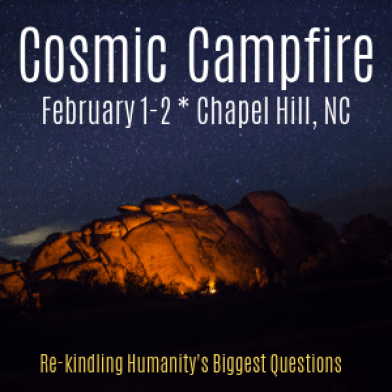
Speaking of: Early Bird Tickets are now on-sale for the Cosmic Campfire Gathering, this February 1-2 in Chapel Hill, North Carolina. (And stay for Sunday morning February 3 if you can, for extra Cosmic Campfire goodness at our host space, Holy Trinity Lutheran!). Early Bird tickets are $129 through January 15th, saving $70 on the at-the-door price, if they even last that long. Seats are limited, so if you’re looking for the perfect Christmas gift for loved ones, yourself, or best-yet all of you, please get yours now.
If this is your first time hearing about this one-of-a-kind gathering, Tripp, Mike McHargue and I are creating space to talk about the Big Questions:
Who are we as a species?
What does it mean to inhabit these bodies, on this planet, in this universe?
How are we so beautiful?
How do we find ourselves in such a multi-lateral mess ?
Does being a friend of God, aspiring follower of Jesus, and student of Scripture have anything meaningful to add to this conversation?
Do the inquiries of biology, physics, psychology, archaeology and anthropology have anything meaningful to add to this conversation?
We’ll be exploring these questions, specifically as framed in the emerging cosmological projects Big History and the New Universe Story, with some of our favorite scientists, philosophers, and theologians. Buying your Early Bird Ticket now helps us plan for the full breadth of contributors to your experience, so we really appreciate it.
Confirmed dialogue partners include:
Barbara Holmes, PhD, is a theologian, writer and scholar who publishes books about the intersection of ethics, spirituality, mysticism, science, cosmology and African American religious culture.She is president emerita of United Theological Seminary of the Twin Cities and formerly professor of ethics and African American religious studies and vice president of Academic Affairs at Memphis Theological Seminary.In addition to her work with law firms, she has worked with homeless missions, HIV/AIDS ministries, and international ministries in Kenya (the Presbyterian Church of East Africa) and Japan. Her published work includes Liberation and the Cosmos: Conversations with the Elders, Race and the Cosmos: An Invitation to View the World Differently, Joy Unspeakable: Contemplative Practices of the Black Church, and other publications. Want to hear from Dr. Holmes? Listen to her on theseepisodes of Homebrewed Christianity and Contemplify!
Robyn Henderson-Espinoza, PhD, has been described in a myriad of ways: a scholar-activist, scholar-leader, thought-leader, teacher, public theologian, ethicist, poet of moral reason, and word artist. Among these ways of describing Dr. Robyn, they are also a visionary thinker who has spent two decades working in the hybrid space of church, academy, and movements seeking to not only disrupt but dismantle supremacy culture by focusing their PhD studies on new concepts of being and becoming, decolonizing knowledge production, and bridging with radical difference. Named one of ten Faith Leaders to watch by the Center for American Progress in 2018, Dr. Robyn is currently at work helping co-create Activist Theology. Dr. Robyn is a non-binary Transqueer Latinx who calls Nashville, TN home. (Dr. Robyn is one of Homebrewed Christianity’s favorite guests. Check them out in this interview archive!)
And while we’ll be having fascinating conversations with experts in their fields, the conversations continue with you…we’re building in plenty of space for all of us to explore the questions that drive us…together.
So…will you join us? You can find out even more info, and grab your early bird tickets, at CosmicCampfire.party.
The following is an excerpt from The Seventh Story, a brand-new release from Gareth Higgins and Brian McLaren about the six stories that divide us and the Seventh Story that unites. It’s paired with a unique, beautifully-illustrated children’s book they’ve also written, both of which are available for order in time for Christmas at TheSeventhStory.com.
Violence doesn’t create anything.
That’s a radioactive statement. When I say it in certain circles, the negative reaction is swift and unambiguous. It’s ironic that conversation about reducing violence often results in a fight. But the outcome of even that fight proves the point: violence doesn’t create anything. Except suffering, of course.
People react to this suggestion with such intense opposition for a number of reasons. We have been taught from the earliest age the opposite: that violence works.
We have been inculcated through our national and community rituals that violent sacrifice is noble, and that our freedoms were not only secured by the deaths of our forebears (and the killing they carried out), but that such death and killing was the only way it could have happened.
And we have been nurtured into a catechism of fearing the world, so that we must always have violence as a recourse, because we never know when they are going to target us.
It’s perfectly reasonable, if such premises were true, to live fearful and ready to kill.
But the premises are false.
The suffering caused by violence, even in the most noble of causes, does not end when the shooting stops.
The current global crisis is a crisis of storytelling.
The threat of the world today is lied about every time you open your computer or switch on your phone. Terror lives in your pocket on a device that does not differentiate between wisdom, information, propaganda, and deceit. The good news is that you can learn more than ever before, connect quicker, and heal yourself (some of the world’s great healers and healing techniques are mobile apps). The challenge (and the invitation) is that you need to learn how to edit what you’re seeing. No one else will do that for you. It is in the interests of the military-industrial-entertainment-gossip-complex that you stay unconscious, and click on as many links as possible.
We have become possessed by the myth of redemptive violence, manifesting through six old stories that keep us apart, cause more suffering by attempting to avoid it, and simply do not work. Telling the story in those ways exaggerates fear, and violence will increase. The redemption of the myth of redemptive violence is not to destroy it by beating the “bad guys” at their own game. No.
The way to redeem the myth of redemptive violence is to de-story it: to refuse to play the game at all.
To invent a new game. Tell the story in a new way that decreases fear, and violence will reduce.
To continue reading, and to order the children’s book edition in time for Christmas, visit TheSeventhStory.com.
Gareth Higgins was born just outside Belfast in 1975, grew up during the northern Ireland Troubles, and now lives in North Carolina. As a storyteller, retreat leader, and festival director, co-founder of the Wild Goose Festival, Movies & Meaning, and The Porch Magazine, and the New Story Festival, Gareth writes and speaks about the power of stories to shape our lives for better or worse, connection to the earth, cinema and the power of dreams, peace and making justice, and how to take life seriously without believing your own propaganda. He’s happy to be a work in progress, and you can find him at garethhiggins.net.


 Does the future need faith? Do we have a future, as a species? Will we merge with artificial intelligence and experience unfathomably long lives, or will we go extinct before we even get the chance?