If you’re arriving at this post in 2022, I hope you register for Alexander John’s free virtual session, Discover the Mystical, Feminine Map to Transformation Hidden in Christianity’s Four Gospels. Register here.
I hope you’ve been having a restful and reflective season. And, I realize that, for many of us, this has been a difficult season – whether simply feeling the weight of national and global tensions and tragedies, or the pain often borne uniquely in our immediate context.
I carried this paradox with me in my conversation with my dear friend Alexander John Shaia yesterday. It was our final Make Advent Great Again dialogue, and it’s too good not to share with you, here:
In this dialogue, we discuss:
Embracing the gifts of radiant darkness
Living now in the presence of the future
Moving from ‘hope’ to conviction
How to create space for Divine promise in your life on the other side of deconstruction
The hidden wisdom of the early Jesus movement that can guide us to human transformation, whether you’re conventionally religious or not
Here’s a written reflection Alexander wrote to accompany this, beginning with the Lectionary Scripture reading for this week:
In these days Mary sets out and goes with haste to a Judean town in the hill country, where she enters the house of Zechariah and greets Elizabeth.
When Elizabeth hears Mary’s greeting, the child leaps in her womb. And Elizabeth is filled with the Holy Spirit and exclaims with a loud cry, “Blessed are you among women, and blessed is the fruit of your womb. And why is this happening to me, that the mother of the Most High comes to me? For as soon as I heard the sound of your greeting, the child in my womb leaped for joy. And blessed is she who believes that there will be a fulfillment of what has been spoken to her by the Most High.”
And Mary says,
My soul magnifies the Most High -and my spirit rejoices in You, my Savior, for You look with favor on the lowliness of your servant. Surely, from now on all generations will call me blessed; for the Mighty One has done great things for me, and Holy is Your Name.
Your mercy is for all who are in awe of You from generation to generation. For You have shown strength with your arm; have scattered the proud in the thoughts of their hearts. have brought down the powerful from their thrones, and lifted up the lowly; have filled the hungry with good things, and sent the rich away empty. have helped your servant, Israel, in remembrance of Your mercy, according to the promise you made to our ancestors, to Abraham and to Sarah and their descendants forever.
And Mary remains with Elizabeth about three months and then returns to her home.
– Luke 1:39-56, New Revised Standard Version, adapted by Alexander John Shaia
********
As you read this text, please note that I have changed the tense from past to present. Reading scripture in the present tense is a significant change that we can all make. Whenever I share a gospel text, I read it in present tense. Without fail, someone will come to me later, sharing that they have never heard that particular text before. The truth is that when we read in past tense, we think in terms of history rather than spiritual experience. Present tense moves us into the story as something happening right now. In my book, Heart and Mind: The Four-Gospel Journey for Radical Transformation, I stress that changing the text to “here and now” is vitally important to an experience of the gospel fresh and new.
And tense plays an enormous significance in Mary’s Canticle. Have you ever noticed that Mary prays future actions of the Most High as if they have already taken place? In psychology, we might term this as a person having a positive outlook on the future. However, I see more than mere positive psychology at work here. As Elizabeth states, “blessed is she who believes the fulfillment will happen.” Note that the word Elizabeth uses is “believes.” Belief is a step beyond hope. And Mary goes beyond hope in this canticle. She proclaims the Most High’s promise as something that has already happened. (For more, see pages 306-320 in Heart and Mind.)
How may we take on the level of service needed in today’s world? As we come to the close of this Advent, Luke gives us great succor. Ponder Mary’s canticle. Pray all of our needs for mercy and justice today – as having already happened. Notice the grace and inner strength that grow within you from this practice.
As the outer calendar tips from Advent to Christmas, I pray that you may savor the inner experience of fruitful darkness, know it is the only place from which grace is able to move us a belief, or a knowing that is beyond hope. And that knowing is the deep font of our non-anxious, consistent and persevering work in the world. And non-anxious work is the salvific action that the Most High calls us to offer each other and our world.
By our lives may we “Christmas” (Christ-Missa) which literally means: The Christ Be Sent! Alleluia.
AlexanderJohnShaia, PhD, is a thoughtful and poetic man, living the ancient rhythms of his Lebanese and Aramaic heritage. With deep conviction, he invites us into a practice of spirituality (and Christianity) for the twenty-first century—one that crosses traditional boundaries, encourages vital thinking and inhabits a genuine community of the heart. As a spiritual director, educator, anthropologist, psychologist, ritualist and Sandplay therapist, Alexander is a holistic, cross-discipline visionary and passionate professional speaker. He founded The Journey of Quadratos, as well as the Blue Door Retreat in Santa Fe, New Mexico. Now he travels internationally, speaking, leading seminars and conducting retreats on Quadratos, the Four-Gospel Journey and Gateway to Oneness (The 72 Hours of Easter). Each autumn Alexander guides an intimate band of pilgrims on the Camino, the West’s most ancient path of transformation. He’s just released the updated edition of Heart and Mind: The Four-Gospel Journey for Radical Transformation, which this post is based on. See Quadratos.com for more about his work and offerings.
We dive into her life and inspirations over the course our hour-long conversation. What I most wanted to know is this: how does one go from a New Jersey Catholic upbringing, to PhD studies in pharmacology, to a traditional Carmelite monastic life to a Franciscan community with a penchant for Medievalism, culminating in a ‘Second Axial Age’ renewed understanding of God and cosmos? How does all this fit together in one life??
Dr. Delio graciously indulged my curiosity, and in the process we also talked about:
If we robustly embrace an evolutionary understanding of the universe, what about Adam and Eve?
How can we embrace both a God of love and the process of evolution, which is ostensibly ‘red in tooth and claw’?
What do we do when ‘revelation’ and ‘science’ apparently conflict?
How can we encounter a personal God on the other side of deconstruction?
The idea of God as Trinity: Does it help or hold us back?
In a pantheistic world where God is all and all, is the Incarnation redundant?
If we’re entering a new understanding of cosmology, what are the gifts – and shortcomings – of specific religious traditions, including our own? Would we be better off giving them up to form some new universal spirituality? Why or why not?
It was an incredible conversation. Be sure to watch it above, and check out some of her books in her bio, here…
AND: While Dr. Delio won’t be able to join us in-person at the Cosmic Campfire Gathering, she will be sharing a Cosmic Query for us to ponder there, together!
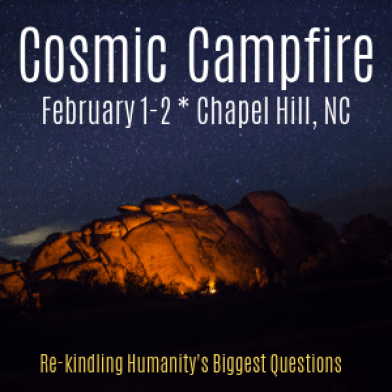
Speaking of: Early Bird Tickets are now on-sale for the Cosmic Campfire Gathering, this February 1-2 in Chapel Hill, North Carolina. (And stay for Sunday morning February 3 if you can, for extra Cosmic Campfire goodness at our host space, Holy Trinity Lutheran!). Early Bird tickets are $129 through January 15th, saving $70 on the at-the-door price, if they even last that long. Seats are limited, so if you’re looking for the perfect Christmas gift for loved ones, yourself, or best-yet all of you, please get yours now.
If this is your first time hearing about this one-of-a-kind gathering, Tripp, Mike McHargue and I are creating space to talk about the Big Questions:
Who are we as a species?
What does it mean to inhabit these bodies, on this planet, in this universe?
How are we so beautiful?
How do we find ourselves in such a multi-lateral mess ?
Does being a friend of God, aspiring follower of Jesus, and student of Scripture have anything meaningful to add to this conversation?
Do the inquiries of biology, physics, psychology, archaeology and anthropology have anything meaningful to add to this conversation?
We’ll be exploring these questions, specifically as framed in the emerging cosmological projects Big History and the New Universe Story, with some of our favorite scientists, philosophers, and theologians. Buying your Early Bird Ticket now helps us plan for the full breadth of contributors to your experience, so we really appreciate it.
Confirmed dialogue partners include:
Barbara Holmes, PhD, is a theologian, writer and scholar who publishes books about the intersection of ethics, spirituality, mysticism, science, cosmology and African American religious culture.She is president emerita of United Theological Seminary of the Twin Cities and formerly professor of ethics and African American religious studies and vice president of Academic Affairs at Memphis Theological Seminary.In addition to her work with law firms, she has worked with homeless missions, HIV/AIDS ministries, and international ministries in Kenya (the Presbyterian Church of East Africa) and Japan. Her published work includes Liberation and the Cosmos: Conversations with the Elders, Race and the Cosmos: An Invitation to View the World Differently, Joy Unspeakable: Contemplative Practices of the Black Church, and other publications. Want to hear from Dr. Holmes? Listen to her on theseepisodes of Homebrewed Christianity and Contemplify!
Robyn Henderson-Espinoza, PhD, has been described in a myriad of ways: a scholar-activist, scholar-leader, thought-leader, teacher, public theologian, ethicist, poet of moral reason, and word artist. Among these ways of describing Dr. Robyn, they are also a visionary thinker who has spent two decades working in the hybrid space of church, academy, and movements seeking to not only disrupt but dismantle supremacy culture by focusing their PhD studies on new concepts of being and becoming, decolonizing knowledge production, and bridging with radical difference. Named one of ten Faith Leaders to watch by the Center for American Progress in 2018, Dr. Robyn is currently at work helping co-create Activist Theology. Dr. Robyn is a non-binary Transqueer Latinx who calls Nashville, TN home. (Dr. Robyn is one of Homebrewed Christianity’s favorite guests. Check them out in this interview archive!)
And while we’ll be having fascinating conversations with experts in their fields, the conversations continue with you…we’re building in plenty of space for all of us to explore the questions that drive us…together.
So…will you join us? You can find out even more info, and grab your early bird tickets, at CosmicCampfire.party.
The world slowly divested from South Africa during Apartheid and banned them from the Olympics. Because the resistance was both external and internal, embodied perhaps most in Nelson Mandela, the era ended without military intervention although the country suffered decades of violent repression of its black-majority population and frequent volatile pushbacks from freedom fighters.
Before Apartheid the global community, including the United States, failed Jews by refusing them refuge, and millions were murdered. Some of the history’s greatest Americans were—and are— subjugated today by their own society, simply because they are not white, and we need allies. We have seen, time and again, that the community of western Christians is selective in its service. Some of them certainly will rise to the occasion. We cannot afford to wait for their initiative, though, because we can’t wait. We must raise our voices and be broadly visible to those who want to know who we are. Humans are famous for coming together, becoming more generous and helpful when under duress; there’s nothing like a disaster to create heroes. We must remain committed to the understanding that community is far superior to empire.
People who are comfortable with the policies of the powers are never satisfied with nonviolent resistance. What they want is no resistance. They are infuriated by Ferguson protestors, Colin Kaepernick, Black Lives Matter, Standing Rock and pretty much anything else. We can’t afford to let their patronizing smirks or pelting sneers put out our flame. Stay strong. You are saving lives. And, world? We need you to do all you can—now. This is an invitation to the community of nations to arise with us.
My Resistance
Recently wed Patrisse Khan-Cullors, co-founder of Black Lives Matter, said in an interview with Esquire, “We reflected on the time when marriage was illegal for black people and remembered when it was illegal, just months earlier, for LGBTQ people. We understood our love as an act of political resistance.” Love is resistance. Hope is resistance. Joy is resistance. Let’s live our lives as fully as we can and raise our voices when we get the chance.
I have often heard the statement, “God has a wonderful plan for your life.” There are multiple, joyful pathways before us. A woman asked me once, “Our family is moving to the Midwest, and I don’t know if it’s God’s will,” to which I replied, “if it doesn’t work out, move back, or somewhere else.” Rigid adherence to the idea of “a plan for your life” evades the spontaneity of God. There are surprises out there waiting to be experienced.
My friend, Ashley is Afro-Latina, and it is hard for her to think in binary when it comes to race matters. She also sees that people like her are our hope—in sort of a reverse Tower of Babel way—because of sharper chops for diplomacy. An hour with her might convince anyone that she is right, which gives reason for hope. The prerequisite is awareness. When a person is ashamed of herself, or a part of herself, her capacity to enter effectively into the tumultuous and sometimes raging debate will be limited.
People deprived of their social dignity cannot be satisfied. Free people imagine they are satisfied because their perception is a study in comparisons. Poet Emma Lazarus is known mainly for her sonnet, “The New Colossus,” on the Statue of Liberty’s base. She once wrote, “Until we are all free, we are none of us free.” We will therefore be in restive motion until that day comes because those on the bottom will cry, “I can’t breathe,” and when the stranglehold is not released their children will have the same chant. It is not a country, but its citizens, who will find relief by opening our hearts. I get frustrated, I get tired, I feel like giving up sometimes. And so I am looking for your help.
There’s Enough For The Entire World
A couple of centuries ago diamonds were a rare resource. Then extremely abundant diamond mines were “discovered” in South Africa and other countries of Africa. These reserves threatened to make diamonds cheap. While others trafficked in African slaves, the opportunist Cecil Rhodes said, “I prefer land to n*****s.” He upended and butchered families and nations in a land grab that rivals the worst the world has seen. Zimbabwe was once named Rhodesia for him, because he led British South Africa Company, and because today’s heroes can be tomorrow’s scoundrels. Rhodes established the DeBeers cartel, collaborating with other cartels in order to control international prices of diamonds, otherwise the diamond in your ring wouldn’t cost much more than its gold mount.
Diamonds are artificially expensive. They are not the only thing that should be affordable.
Energy should not be costly. There’s plenty of food. Medical care and education don’t have to be expensive. A proper understanding of the message of Jesus reveals that he died because the powers wanted to limit the supply to their own benefit. They were determined to eliminate any threat to a status quo that lined the pockets of the few and kept the many wanting.
More of us around the world are seeing that we can all do well. When Jesus said, “You will always have the poor among you,” he knew his hearers would remember Deuteronomy 15:11 which says, “There will always be some in the land who are poor. That is why I am commanding you to share freely with the poor and with other Israelites in need.” This was his life’s mission. He identified with the poor. He was the embodiment of the poor and he wanted them to see that. By honoring Jesus’ body, the poor were instituted forever.
Away with graceless Christianity, so full of suspicion and devoid of mercy! Out with the old and in with the new hope of Jesus. Even with its persistent sorrows, ubiquitous disappointments and lingering aches of the soul, life is hopeful. This will be realized increasingly in the days to come as more of us discover how not alone we are. Faith is generous. Hope is strong. Love is limitless. There’s no need to be selfish and stingy because the supply only increases, and access to it, as we share.
Are you lonesome tonight? Powerless people feel less powerless when they know they are not alone. If you would but tease them out, you will find your friends everywhere. You need to know this because the challenge ahead is formidable and we can’t take it on alone if we expect to prevail.
Praise for Making America Great Again
“… an impassioned call for solidarity and unity in a time of political and social uncertainty.”
— Santa Barbara Independent
“I dare you to open this book and take a journey filled with border crossings. At times this journey will make you cry over our silence and blindness to intolerance, but all along the way, you will discover love and be filled with hope. Without finger wagging, David’s unvarnished history helps us connect the dots of our nation’s complicity in oppression. David invites me—a person of white privilege—into his world knowing we are all in this together. Standing in this strange new world of 2017, David calls the Christian community to join with all people of good faith or no faith to be bridge builders and not wall builders.”
— Mark E. Asman, Rector Emeritus, Trinity Episcopal Church, Santa Barbara
“Every ‘woke’ white person I know has truth-telling African-American friends to thank for their awakening. No one speaks the truth in love better than David Moore does. What could the world be like if all white Americans had such trusty friends? Read this book, grow in understanding, and help to heal the world!”
— Carren Sheldon, Interim Rector, Episcopal Church of St. Martin, Davis, California
“Pastor David Moore understands what Dr. King called the ‘fierce urgency of now.’ He is a dedicated and fearless nonviolent activist who consistently fights for the ‘least of these.’ He is engaging, energetic, and prophetic.”
— Ralph Armbruster-Sandoval, Chicana/o Studies Professor University of California, Santa Barbara
“In this thoughtful exploration of race, injustice, Christian spirituality and the complex divisions of our day, Pastor David Moore does something extraordinary. In a time when pointing an accusatory finger is akin to being prophetic, oversimplified statements are the currency of the day, and ingroup/outgroup dynamics dominate our social geography, Pastor David resists dual thinking at every turn. Instead, he beckons us to follow him as he integrates unity with justice, a commitment to orthodoxy with a humble openness to other perspectives, and balances love and truth. May we all listen and learn from this wise scholar-pastor.”
— Christena Cleveland, Associate Professor of the Practice of Organizational Studies Duke Divinity School
About the Author
The Rev. Dr. David N. Moore, Jr. is an ecumenical teacher who tries to be a contemplative and passionate defender of the defenseless. He graduated from UC Santa Barbara with a major in Communication Studies. He earned his Master’s degree from St. Stephen’s University in New Brunswick, Canada, and currently holds an appointment to adjunct faculty there, teaching Ancient Mediterranean History. He holds a Doctorate in Theology from the University of South Africa. David and his wife, Diane, live in Santa Barbara, California. They have 5 adult children.
A prophet? Are you kidding me? Thirty years ago I would have been right there with you. Believe me, I would never have called myself a prophet. Prophets are special. I am not. They have a direct line to God and the go-ahead and where-with-all to do all kinds of miraculous things. I do not. They rail at people for being idiots. Well, sometimes. They declare impending doom. The most I can claim about impending doom is that I’m often scared. Prophets occasionally foretell the future. Not me. They are righteous in the extreme and above the fray and trials of this messy business we call life. Again, not me. Not in any lifetime. Not on any planet.
Boy, was I wrong. In seminary I learned just how wrong I was. I discovered that prophets are wonderfully flawed and chaotic people. Just like me. Folks often thought they were crazy. True here. Eventually I got to know the prophets as chums who spoke passionately and acted hyperbolically. I identified. I am not above the bedlam of life. I am neither a soothsayer who predicts the future nor a miracle worker. I am not particularly righteous, though I have been known to be self-righteous. To be honest I am a flock of flaws, surrounded by a majesty of misunderstandings, hobbled together with an impediment of imperfections. I am not special in any way to anyone except, maybe, to my mom and dad and daughter. I don’t have a direct line to God and when the party line is open, I often don’t hear—or more truthfully, don’t listen—to what God is saying. I am strong willed and sometimes lazy. I get stuff wrong. A lot.
But I am in good company. The thing about prophets is that when God calls they head the other way. Take Jonah. “God, you’re knocking on the wrong door.”
Moses told God “Let someone else do it, maybe my brother Aaron. He is a much better choice and besides, I stutter.” Jeremiah came right out and said, “I don’t want to. People make fun of me and don’t invite me to their parties. They think I’m crazy . . . but (damn it) there is a fire burning inside me and I can’t shut up.” Or, like me. “I’m busy and there are lots of other things I want to do and besides, I’m mad at the church over the Viet Nam War, civil rights, and the women’s movement. I want to act and write and have sex. You’ve really got this one wrong, God.”
Becoming a prophet is not a career option. Children will tell you they want to be a teacher, doctor, lawyer, or firefighter when they grow up but never, as far as I know, a prophet. When you get right down to it, there is nowhere to go to fill out an application. It’s a call. An irritating and irresistible call. And if I have in any way lived a prophetic life I have to admit that only some of it has been responding to God’s call. The rest has been giving in. Let me repeat, I am not very good either at responding or giving in.
Prophets love people and they’re pissed off. Their appeals to repentance are for the community to return to its source. To love God. To do justice. To remember who they are to God and to one another. Sure, they’re bitchy and angry. Injustice makes them angrier than a bee swarm in a tornado. Prophets tend to make people uncomfortable. They irritate, intimidate, challenge, and enrage the general population. Actually, those are things at which I excel.
A prophet will stir up a shit storm or stand against one—and always on the side of the oppressed. They champion unpopular causes. The passion of their anger and grief makes them hard to be around. They are hair-brained vision-holders who refuse to give up on God’s dream for us and who we can be as a people of justice and compassion. Prophets challenge the certainty of doctrine with the uncertainty of what happens when God is unleashed. They offer hope. I only pray my witness offers hope, advocates for justice, insists on compassion. If it does, then that must be enough because I have come to understand that faithfulness is not tied to measurable outcomes.
I tell you all this to give context to my story of a queer calling that took years to untangle. I speak out for justice for the LGBT, and later QI, community both in the church and out of it. I spent years banging on sacred doors hollering, “Let me in!”
Frankly, I am the very last person you would consider to be a prophet. Even writing that feels grandiose. My life is untidy. I don’t always do my best. There are times I’ve wanted to give up. More times than I’d like to admit. And even though I am driven by grace I can be harsh in my opinions of others and harsher in estimations of myself. Or worse, I give myself a pass but find it hard to allow for the frailty of others. And there are times I get so pissed off at God I could spit. I am like Jonah who sat under that bush and groused because God extended compassion to the people he despised.
And so I wrote a book about it. A Gracious Heresy is about how I got myself—or God got me—into the heresy of challenging the church to justice over doctrine and compassion over polity. You might think I’m a heretic and you might be right. I’ve been called worse.
It is a story about the gracious heresy of my life and an unlikely call to prophetic ministry. Nothing grand. Nothing large. Mostly it’s a story about the risk and the price of being faithful and learning to trust that somehow it makes a difference.
“Connie welcomes us into her personal and communal faith explorations from her childhood to adulthood. We experience her call call to ministry as well as her search for her true identity where she embraces both in the face of systemic opposition.”
— Janie Spahr, Presbyterian minister and activist
“Filled with artful description and steeped in the tumultuous social politics that forged her, the Rev. Tuttle’s passionate, life-affirming story speaks truth to power. Hers has been a fully-engaged life, from an idyllic childhood in France, where her exuberant appreciation for the world develops, to her youth as an Army brat in the American South.”
— Faith Adiele, Author of Meeting Faith: The Forest Journals of a Black Buddhist Nun
“Prophetic voices come from the margins, and Connie Tuttle’s is no exception. Joyful, radically inclusive, and infused with holiness. Love, human and divine, triumphs on every page of this memoir. Thanks to Tuttle, I’m convinced the prophetic tradition is alive and well.”
— Elizabeth Jarrett Andrew, Author of Swinging on the Garden Gateand Living Revision: A Writer’s Path as Spiritual Practice
“Connie Tuttle’s memoir of her nontraditional spiritual trajectory, A Gracious Heresy, is a delight to read—entertaining, funny, provocative, captivating, and heartfelt. This memoir will not disappoint any who value a good storyteller, containing as it does extraordinary stories extraordinarily well told. ”
— Chris Glaser, activist, author, Coming Out as a Sacrament
“In A Gracious Heresy, Connie Tuttle invites readers into her story of call. More than a memoir of church and justice, A Gracious Heresy is a spiritual odyssey taking the reader of a journey of past historical events, across international geographies, from girlhood escapades to adult decisions … Everyone is called to a life before God should read this book.”
— Rev. Monica A. Colman, Phd. professor at Claremont School of Theology, author of Bipolar Faith: A Black Woman’s Journey with Depression and Faith
About the Author
Connie L. Tuttle is the pastor of Circle of Grace, a small, progressive, ecumenical, feminist, Christian house church in Atlanta, Georgia. After seminary and before founding the church with a group of spiritual renegades, she directed the Atlanta Hunger Walk and later worked with the Southern Prisoners’ Defense Committee. She is committed to social justice and has a passion for cooking and providing hospitality. You can connect further with her vital work at ConnieTuttle.com.
Mike’s note: This is part of a guest series by Alexander John Shaia, sharing his insights gleaned from a lifetime of studying (and living) personal transformation, closely based on his explosive book Heart and Mind. Want to meet him in person? Join Alexander, Mona Haydar, Jasmin Morrell, Bushi Yamato Damashii, myself and others at Wisdom Camp this July 12th! Details and registration here. In the meantime, enjoy this reflection!
In 315 CE, Emperor Constantine legalized Christianity. As Roman oppression lifted, communication became easier among various Christian communities; as a result, Christians realized that wide differences in belief existed between them. Theological arguments erupted. Over the fourth century, various councils were held, beliefs were standardized, and practices were developed, refined, and formalized. Gospel texts were one of the many things systematized. At the time, there were at least fifty texts called a gospel!
A number of historians have suggested that sexism, power, and privilege had a great hand in the winnowing to four texts. And of course all of these could have been factors.
Nonetheless, one question remains a puzzlement:
Why were multiple gospels selected?
If the point was to tell the story of Jesus’ life, death, and resurrection, one account would be sufficient to accomplish that purpose. Or, if more than one account was desired for some reason, one would think they should substantially agree with each other. However, four texts – Matthew, Mark, John, and Luke – were affirmed as “true” gospels, and they have significant discrepancies. Why were four accounts chosen, and why these four? There are no written documents that definitively answer these questions, but there are some significant clues.
We do know that Irenaeus, the bishop of Lugdonum (Lyon, in today’s France), attached divine and universal significance to the number four. In 180 CE, he pronounced, “The Gospels could not possibly be either more or less in number than they are. Since there are four zones of the world in which we live, and four principal winds…it is clear that the Word…gave us the gospel, fourfold in form but held together by one Spirit.” The four texts together were entitled Euaggelion, which means “the good news of the kingdom.” Furthermore, Eusebius, bishop of Caesarea and a church historian, labeled Matthew, Mark, John, and Luke “the holy quaternion of the gospel” (singular) in about 300 CE.
Most importantly, as Christian evangelists walked from village to village in those early centuries, it seemed that these four gospels (of all the accounts then available) were the ones most often shared to open new hearts and minds. Believers chose to pray and pass these words on to others. The early communities appear to have found a power in these four gospels that was not present in the other texts. It is my belief that the efficacy of these particular gospels in the transformation of people’s lives, transmitted using the vitality of the oral ‘here and now’ gospel form, went hand-in-hand with the rapid and powerful spread of a new path of living called The Way.
Subsequent to the various councils, five lectionaries (books of mandatory Sunday readings) were adopted—one in each region of Christendom. While each region had variations in the chosen text from Sunday to Sunday, the five were broadly consistent. From the fourth through the seventh centuries, in Sunday services throughout the Christian world, all four gospels were chanted or read aloud in a similar progression over a three-year cycle. This also maintained a Judaic custom called the Palestinian Cycle that called for chanting the entire Torah over three years of Shabbat.
The widespread use of this reading progression meant that hearing the four gospels in a sequence was a bedrock element of early Christian practice. The first year was dedicated to the Gospel of Matthew, the second to Mark, and the third to Luke. These gospels have clear story lines, and are called ‘synoptic’ gospels. John’s gospel—less a story and more a series of thematic meditations—was reserved for a special purpose. From the late second century onward, major portions of the Gospel of John were read primarily during Lent and Easter. However, during the Seasons of Christmas, Epiphany, and the Sundays after Pentecost, small portions of John were interspersed amongst readings from the other three gospels to more deeply illuminate and complete their messages.
Exactly how did the idea of combining a general belief in the fourfold journey with the selection of specified gospels in a clear sequence occur? Did they see the journey reflected in these four gospels, as I have? Maybe this was a customary way the four were already read? Were lots drawn? I do not pretend to know.
Happenstance or calculation, an individual or a committee? My belief is that people who were charged with discernment and decision-making converged with a sequence of spiritual practices already known to work well. The pressures, realities, and needs of the society at that particular point in history played their part, as they always do. Then grace intervened and the pattern was set.
I doubt we will ever be certain how the pattern came to be created, but undeniably the four-gospel journey set in the three-year Sunday cycle held a great design, and that design went far beyond the stories and lessons told by the individual gospels. This great pattern seemingly worked very well for hundreds of years. Then, abruptly it was cast aside.
Sometime in the 600s, the Christian church apparently decided that it needed a simpler story. Christendom had been under attack for two centuries from northern warlords, and its cities were crumbling wrecks. Weakened churches were largely the only remaining centers for education, food distribution, and often law and order. I don’t know which of the several popes who ruled very briefly and followed the long reign of Gregory the Great actually changed the reading cycle, but one ofthemdid.
I suspect that the impulse came from Gregory’s influence, which derived from his reliance on the views of the holy monk Benedict of Nursia, the founder of the Benedictine Order. Benedict believed in and taught “nothing too harsh and nothing too burdensome.” It is easy to see that in a time when few people could read and when the church was totally overcome with demands and was focused on peoples’ survival, a short, straightforward Jesus story would seem very appealing, and this is the probable basis for the change.
Regardless of the precise history and the exact theological reasons, which we will never know for certain, both the beautiful and complex three-year cycle, and the four-gospel journey it held were abandoned. To replace them, the first uniform lectionary for Western Christendom was issued: fifty-two Sunday lessons selected from all four gospels that, in combination, told a succinct sacred and linear biography of Jesus’ life and teachings. Gradually, understandably and unfortunately, Christianity became concentrated on the details of Jesus’ personality and life, a focus which remains today.
Subsequent centuries saw the rise of education, the invention of the printing press, the wide dissemination of books, and the Protestant Reformation. People began reading the scriptures, fresh translations appeared, and many Reformation congregations returned to reading the entirety of the four gospels at Sunday services, although none of them followed the ancient sequence except inadvertently. Sadly, no one seemed to know of the ancient three-year reading sequence. The great design had been lost.
More centuries passed. In the 1940s, the Roman Catholic Church re-opened its immense library for general research. The ancient three-year cycle was rediscovered; and after much study, but seemingly without grasping the pattern’s deeper significance, the Roman Catholic Church reinstated the three-year cycle in 1969. They saw it as a way that all four gospels would be read, communicated, used for worship—and that a more complete text of the gospels might aid their members’ spiritual lives. Within ten years, the Episcopal, Anglican, Lutheran, Presbyterian, United Church of Christ, Disciples of Christ, and Methodist churches followed suit. Today, these Christian churches, with minor exceptions, all read the same gospel passages on Sunday mornings, yet lack connection to the deeper intention in the cycle and its transforming potential.
Unknown to me at the time of that long ago “aha!” in the high desert, the pattern disclosed then was only a beginning. My studies since have led me to discover its long history and the five keys, which when understood together, offer us a deep perspective that might entirely transform the gospels—even for those of us who know the words by heart.
The great name of Jesus the Christ and the ‘here and now’ witness of Paul keep the living presence of the Christ awake and vital in our understandings and our practices. The historical dilemmas of the four early Christian communities lovingly answered in the texts of Matthew, Mark, John and Luke speak with equal compassion as they help us forge a deeper life as we journey along each of the four paths today.
The Followers of The Way become our early predecessors, laying out the steps we can be guided by now, following in a practice that joins heart and mind. And the early leaders of Christianity? What gifts of foresight, practice and inspiration blessed them to formally choose these four texts and establish the Sunday cycle? Though that mystery will likely never be fully explained, our thanks and blessings can certainly be prayed.
AlexanderJohnShaia, PhD,is a thoughtful and poetic man, living the ancient rhythms of his Lebanese and Aramaic heritage. With deep conviction, he invites us into a practice of spirituality (and Christianity) for the twenty-first century—one that crosses traditional boundaries, encourages vital thinking and inhabits a genuine community of the heart. As a spiritual director, educator, anthropologist, psychologist, ritualist and Sandplay therapist, Alexander is a holistic, cross-discipline visionary and passionate professional speaker. He founded The Journey of Quadratos, as well as the Blue Door Retreat in Santa Fe, New Mexico. Now he travels internationally, speaking, leading seminars and conducting retreats on Quadratos, the Four-Gospel Journey and Gateway to Oneness (The 72 Hours of Easter). Each autumn Alexander guides an intimate band of pilgrims on the Camino, the West’s most ancient path of transformation. He’s just released the updated edition of Heart and Mind: The Four-Gospel Journey for Radical Transformation, which this post is based on. See Quadratos.com for more about his work and offerings.