Dr. Martin Luther King’s vision provides a tangible example of how we might stand against the powers. His legacy of love is unrivaled in our country for good reason. However, we needed to find a living sage of the power of love. We had to find someone who was formed in the way of resistance that King embodied. A little less than two years after King was shot, John Perkins was working on his own nonviolent resistance movement in Mississippi. He was not simply following King but was observing him while trailblazing his own path for freedom and equality.
On February 7, 1970, John led a nonviolent march in protest of the racial inequality in Mendenhall, Mississippi. A group of students who participated in the march left to return home and were followed by police. Once they crossed over the line separating Simpson County from Rankin County, a police car pulled one of the vans over. All of the students were ordered out of their van and were arrested, then taken to the county jail in the town of Brandon. Doug Huemmer, who had been driving the van of students, was taken in a police car by himself, and was beaten the entire way to the jail by Frank Thames, the officer who had pulled them over. The students were kicked, stomped, and beaten with blackjacks and billy clubs at the police station in Brandon. Their nonviolence was met with violence. After the students had been arrested, the driver in the other van contacted John to tell him what happened. He quickly connected with two other protesters and set out for Brandon, even though they were worried about another ambush from the police. When they arrived at the police station, a highway patrolman met them in the parking lot. He told them to wait outside for the sheriff. Instead, a dozen officers poured out of the station to arrest them. From this point on, five of the deputy sheriffs and seven to twelve highway patrolmen beat them within an inch of their lives. In and out of consciousness, Perkins recalls seeing a lot of blood, and remembers being forced to clean it up while they beat him some more. (For the entire harrowing story, see John Perkins, Let Justice Roll Down.)
The anger I (Kyle) felt when I first read John’s story churned my stomach and made my fists clench. I cannot imagine enduring this kind of indignity and pain. I found myself bubbling with rage against these men. And yet, John’s own reaction to this horrific story of dehumanization differs from mine. He recalls, “They were like savages—like some horror out of the night. And I can’t forget their faces, so twisted with hate. It was like looking at white-faced demons. Hate did that to them.”
Like King before him, Perkins saw how evil defiled human beings. Evil power had destroyed them. While there is no question that John was being abused and dehumanized, he saw men who had been abused and dehumanized by evil. The very thing they turned to for power to control was warping them and making them less than human. John recalls, “I couldn’t hate back. When I saw what hate had done to them, I couldn’t hate back. I could only pity them. I didn’t ever want hate to do to me what it had already done to those men.” That night, in and out of consciousness as the students cared for him, John prayed. “God, if You will let me get out of this jail alive . . . I really want to preach a gospel that will heal these people, too.” (See John Perkins, With Justice for All: A Strategy for Community Development.)
John’s devotion to reconciliation and his witness against evil led us into the nature of the powers and principalities – systems of evil and sin in the world – and it became clear that we had to relate these to the question of power in weakness. What does it mean to bear witness against the powers, and how are we called to stand firm in this evil day?
Thanksgiving just happened, and Christmas is coming…how are you feeling?
Overwhelmed? Resolute? Confused? Curious?
From the latest mass shootings to ongoing political turmoil, from the revelatory heartbreak of #MeToo to cascading ecological devastation, for many of us it’s a tough year to hold out for hope.
I want to await the arrival of God, and welcome family and friends unconditionally – and yet if I’m honest, I have some withholds: What will ‘home for the holidays’ mean this year?
So many of my friends tell me that these holiday dates that used to bring such joy…the ones that once set the steady rhythm of their spiritual journey each year…suddenly feel emptied of meaning and comfort.
Many of us are wondering: What does ‘Emmanuel’ – God-come-near – mean when the world’s going mad?
The reason for the season – like many of our highest ideals – have been hijacked by politicians and preachers who want to ‘Make America Great Again’ in a way that excludes a great many of God’s most vulnerable creatures.
But we don’t have to take this war on Advent hope lying down.
I realized this last month while having coffee in Raleigh with a couple good friends: Tripp Fuller (of Homebrewed Christianity fame) and John Pavlovitz (of one-of-the-most-popular-blogs-on-the-planet fame, and the just-released best-selling book A Bigger Table). We were talking about the state of the nation, and the state of our Christian faith, and realized that while (let’s be honest) things look bleak, we could combine the ancient resources of prophetic truth-telling, holy resistance, divine surrender, and the miracle of forgiveness with the modern marvel of the Internet to convene a four-week pop-up community to shift this holiday season…together.
Just like friends of God once turned the empire’s propaganda ‘Caesar is Lord’ inside-out and proclaimed that a Baby in a manger came to change everything, we want to Make Advent Great Again. And we can’t do that without you!
MAGA – the redeemed one – is an online community running the month of December where we can fellowship, share encouragement, and explore better practices that just might keep us sane, healthy…and even joyous.
In other words, we’re creating a temporary autonomous zone for holiday resistance and renewal.
Who’s ‘we’? Amazing friends like:
Diana Butler Bass
Robyn Henderson-Espinoza
Grace Ji-Sun Kim
Micky ScottBey Jones
Donna Bowman
Paul Fromberg
Jasmin Pittman Morrell (okay…she’s more than a friend… 😉 )
Sara Miles
Jesse Turri
Sarah Heath
Carlos Rodriguez
Trey Pearson
Alexis Waggoner
John Caputo
Jason Micheli
…and more!
We want you to be a part of this. What’s it going to run you, $-wise? Well, it does take resources to pull all of this together, but no one is turned down for lack of funds. Contribute whatever you can to help make this possible for everyone, or ‘if you haven’t got a six-penny’ then please come on in anyway – on us.
This holiday season is challenging, for so many of us. But together? We’ve got this.
Have you noticed it? We’re entering a sea-change. For generations, our unconscious actions and ways of being toward women went unnoticed, were accepted by default, or even celebrated.
Clearly, we men have a behavioral problem: All of us. Conservative, progressive. Religious, spiritual-but-not-religious, and evenatheist. And if we’re not actively sexually harassing or assaulting women, our ignorance and silence are enabling it. And this general culture of enabling is hurting women (obviously) and is also having negative social and vocational consequences for men who actually care and strive to not treat women like things.
If you haven’t paid as much attention to the above-cited news (and you can be forgiven – with mass-shootings, devastating hurricanes, racist marches and tensions escalating at home and abroad, it can be challenging to keep our empathy trained on any one tragedy at any given moment), I doubt you’ve been able to miss your social media feed:
The nigh-ubiquitious presence of the simple phrase – or hashtag – #MeToo.
The typical version of the online prompt reads thus:
If all the women who have been sexually harassed or assaulted wrote “Me too.” as a status, we might give people a sense of the magnitude of the problem. #MeToo
A (helpfully) expanded version reads like this:
If all the people – especially women, trans and nonbinary folks (as all these are some of the people most impacted by rape culture) – who have been sexually harassed or assaulted wrote “Me too,” as a status, we might give people a sense of the magnitude of the problem. Please copy/paste. And if you can’t because it is not safe to do so, or you’re not ready, please know you’re still seen and held. Safety and survival come first.
What started as a response to the latest reports of sexual assault and harassment by men in power has mushroomed into a global phenomenon of truth-telling and solidarity. This sea change has washed upon the shores of our everyday lives.
(Haven’t seen the posts yet? Just look here. Or here. You should read a few, or a few dozen. I’ll wait.)
The question is, brothers, how are we to respond?
Let’s be quick to listen and (very) slow to speak.
It should go without saying that we’re not to minimize, justify, or even too-quickly jump in with our own stories of harassment. (In other words, let’s not #AllLivesMatter this one. Right now, we’re focusing on the experience of women.)
But if you’re a relatively conscientious guy (like me), who thinks of himself as a feminist (like me), you’re probably not going to fall into that ditch. Awesome. But what can we proactively do that will actually be helpful?
Please, whatever we do, let’s not interject our easy ally-ship virtue signalling; our words matter, but our examples and actions matter more.
Could we have a conversation among ourselves?
Let’s dig in deep. Have you ever stopped to wonder…
Why do we so often feel that women are ‘our’ blank canvases, on which to paint:
Our loneliness
Our feelings of inadequacy
Our social proof
Our stress relief
Our aggression
Our need for emotional or physical validation
Our craving for acceptance, adventure, and conquest
Our personal legend?
What in us makes us think that we get to do that with – and upon – these other human beings?
I’m not here to shame you, guys: Our needs for companionship, mastery, belonging, peace, healthy expression of anger, emotional and physical validation, acceptance, and adventure are 💯 legit.
But for God’s sake – and our own soul’s: These needs are first and foremost an inside job. These needs are to be witnessed without condemnation, fully felt, and then sought: In our God, path, and/or integrated self – pick your remedy, and work it.
But let’s not transmit our unchecked, disowned and dis-integrated shadow on these precious femme, female-bodied, and feminine beings who share this planet with us.
Women. Are. Not. Our. Canvases. To be painted (or scribbled) on, then thrown away.
I’m really not $#!tting all over you, fellas. I’m enrolled in this remedial men’s school, too. I misstep. I screw up.
(Want a through-line to my unique flavor of failing the feminine? Being adopted from birth, I have two amazing mother figures in my life, biological and adoptive. They’re both awesome, and have given their very best to life, but despite it all I’ve inherited abandonment wounds from one and feelings of being smothered/over-protected from the other. I grew up longing for and being fascinated by feminine energy, only to experience it as elusive most of the time, and overpowering in those moments when I landed squarely in its (Her) grace. I’ve experienced a lifetime of push/pull, at times projecting manicpixiedreamgirl personas on various women in my life.
A few years ago, I was on a small retreat with a trusted circle of friends. During our time together, we put ourselves in a prayerful and receptive state to get in touch with what was really real for each of us. During this time, in the woods, I found myself planted face-down in the mossy space where a large tree met the earth. It was here that I clearly heard a feminine emanation of the Divine – for biblical and personal reasons, I don’t hesitate in using the term Goddess – speaking to me clear as day:
There is no earth-born angel / Who will save you from what ails you.
And there it is. Salvation – in my cosmology – arrives from God alone, and is worked out in generous grace via real effort amid daily life, here and now. This is an inside job, and I’m still learning the truth of what I heard that night in the woods. I’m also still learning how to best honor, consider, support, appreciate, and be nourished by the women in my life in open-handed, non-co-optive ways.)
Brothers, we can help each other out. I encourage you to check out a pro-men, pro-women men’s work group, if you haven’t already – like The ManKind Project or Illuman.
If you have sons or are willing to mentor boys, please check out Journeymen and Boys to Men – these communities are like Boy Scouts with emotional intelligence/flourishing merit badges!
Please reach out in the comments if you want – I can likely connect you with a circle of compassionate, brave, truth-telling men in your area, if you don’t find communities here or here.
Because women shouldn’t have to bear the burden of overcoming toxic masculinity alone. Healthy, flourishing masculinity exists, and we can be part of it.
Will you join me in this quest?
Other Voices By and For Men on #MeToo and Sexual Harassment & Assault:
Today I’m sharing a powerful reflection from the late Bayard Rustin, notable change-maker for civil rights, nonviolence and a reconciled world. I have to state up-front that I share this reflection with some trepidation. If you’re white and reading this, I invite you to resist with me the temptation to idealize Rustin’s courageous nonviolent approach as the ‘ideal behavior’ for people of color and other oppressed peoples, while leaving the violent normalcy of our own structures of white supremacy intact. In my experience this weaponizes the ideal of nonviolence itself, against black and brown movements for justice that don’t pass the muster of our armchair criticism.
Instead, I invite you to see yourself in the various white folks in Rustin’s account: the belligerent bus driver, the sadistic ‘law enforcement,’ and – yes – the people who intervened and stayed on as witnesses to ensure that justice would be served. If you’re most tempted – as am I – to identify with the latter interveners and witnesses, then I encourage you to pay greater attention in your life, actively putting yourself in the harm’s way that our black, brown, immigrant, and non-Christian sisters, brothers, and non-binary siblings face on a routine and involuntary basis. If you see something, say something. And if you’re not seeing anything, consider making a change of venue part of your routine. This post by Chris Crass is an excellent starting point for aspiring allies like you and me.
Now: Please read Brother Bayard’s painful, dignified, and transformational account with your whole heart.
RECENTLY I WAS PLANNING to go from Louisville to Nashville by bus. I bought my ticket, boarded the bus, and, instead of going to the back, sat down in the second seat. The driver saw me, got up, and came toward me.
“Hey, you. You’re supposed to sit in the back seat.”
“Why?”
“Because that’s the law. N****** ride in back.”
I said, “My friend, I believe that is an unjust law. If I were to sit in back I would be condoning injustice.”
Angry , but not knowing what to do, he got out and went into the station. He soon came out again, got into his seat, and started off. This routine was gone through at each stop, but each time nothing came of it. Finally the driver, in desperation, must have phoned ahead, for about thirteen miles north of Nashville I heard sirens approaching. The bus came to an abrupt stop, and a police car and two motorcycles drew up beside us with a flourish . Four policemen got into the bus, consulted shortly with the driver, and came to my seat.
“Get up, you n*****!”
“Why?” I asked.
“Get up, you black -”
“I believe that I have a right to sit here,” I said quietly. “If I sit in the back of the bus I am depriving that child” – I pointed to a little white child of five or six – “of the knowledge that there is injustice here, which I believe is his right to know. It is my sincere conviction that the power of love in the world is the greatest power existing. If you have a greater power, my friend, you may move me.”
How much they understood of what I was trying to tell them I do not know. By this time they were impatient and angry. As I would not move, they began to beat me about the head and shoulders, and I shortly found myself knocked to the floor. Then they dragged me out of the bus and continued to kick and beat me.
Knowing that if I tried to get up or protect myself in the first heat of their anger they would construe it as an attempt to resist and beat me down again, I forced myself to be still and wait for their kicks, one after another. Then I stood up, spreading out my arms parallel to the ground, and said,
“There is no need to beat me. I am not resisting you.”
At this three white men, obviously Southerners by their speech, got out of the bus and remonstrated with the police. Indeed, as one of the policemen raised his club to strike me, one of them, a little fellow, caught hold of it and said, “Don’t you do that!”
A second policeman raised his club to strike the little man, and I stepped between them, facing the man, and said, “Thank you, but there is no need to do that. I do not wish to fight. I am protected well.”
An elderly gentleman, well-dressed and also a Southerner, asked the police where they were taking me.
They said, “Nashville.”
“Don’t worry, son,” he said to me. “I’ll be there to see that you get justice.”
I was put into the back seat of the police car, between two policemen. Two others sat in front. During the thirteen-mile ride to town they called me every conceivable name and said anything they could think of to incite me to violence. I found that I was shaking with nervous strain, and to give myself something to do, I took out a piece of paper and a pencil, and began to write from memory a chapter from one of Paul’s letters.
When I had written a few sentences, the man on my right said, “What’re you writing?” and snatched the paper from my hand. He read it. then crumpled it into a ball and pushed it in my face. The man on the other side gave me a kick.
A moment later I happened to catch the eye of the young policeman in the front seat. He looked away quickly, and I took renewed courage from the realization that he could not meet my eyes because he was aware of the injustice being done. I began to write again, and after a moment I leaned forward and touched him on the shoulder. “My friend,” I said, “how do you spell ‘difference’?”
He spelled it for me – incorrectly – and I wrote it correctly and went on.
When we reached Nashville, a number of policemen were lined up on both sides of the hallway down which I had to pass on my way to the captain’s office. They tossed me from one to another like a volleyball. By the time I reached the office, the lining of my best coat was torn, and I was considerably rumpled. I straightened myself as best I could and went in. They had my bag, and went through it and my papers, finding much of interest, especially in The Christian Century and Fellowship.
Finally the captain said, “Come here, n*****.”
I walked directly to him.
“What can I do for you?” I asked.
“N*****,” he said menacingly, “you’re supposed to be scared when you come in here!”
“I am fortified by truth, justice, and Christ,” I said. “There’s no need for me to fear.”
He was flabbergasted and, for a time, completely at a loss for words. Finally he said to another officer, “I believe the n*****’s crazy!”
They sent me into another room and went into consultation. The wait was long, but after an hour and a half they came for me and I was taken for another ride, across town. At the courthouse, I was taken down the hall to the office of the assistant district attorney, Mr. Ben West. As I got to the door I heard a voice, “Say, you colored fellow, hey! ” I looked around and saw the elderly gentleman who had been on the bus.
“I’m here to see that you get justice,” he said.
The assistant district attorney questioned me about my life, the Christian Century, pacifism, and the war for half an hour. Then he asked the police to tell their side of what had happened. They did, stretching the truth a good deal in spots and including several lies for seasoning. Mr. West then asked me to tell my side.
“Gladly,” I said, “and I want you” – turning to the young policeman who had sat in the front seat – “to follow what I say and stop me if I deviate from the truth in the least.”
Holding his eyes with mine, I told the story exactly as it had happened, stopping often to say, “Is that right?” or “Isn’t that what happened ?” to the young policeman. During the whole time he never once interrupted me, and when I was through I said, “Did I tell the truth just as it
happened?”
And he said, “Well … ”
Then Mr. West dismissed me, and I was sent to wait alone in a dark room. After an hour, Mr. West came in and said, very kindly, “You may go, Mister Rustin.”
I left the courthouse, believing all the more strongly in the nonviolent approach. I am certain that I was addressed as “Mister” (as no Negro is ever addressed in the South ), that I was assisted by those three men, and that the elderly gentleman interested himself in my predicament because I had, without fear, faced the four policemen and said, “There is no need to beat me. I offer you no resistance.”
My dear friend and occasional collaborator, queer Northern Irish writer and activist Gareth Higgins, first introduced me to Bayard Rustin. He offers us this reflection:
Bayard Rustin was born on March 17th, St. Patrick’s Day, which is a happy coincidence, for he did something in his life that warrants if not sainthood, st least a parade in his honor. But given that probably his greatest achievement was managing the 1963 Civil Rights March on Washington, I’m not sure he really needs another parade. Some would say that Rustin was the person who taught Gandhian nonviolence and to Martin Luther King; if you watch the footage of the rally at the Lincoln Memorial, you might spot Rustin in the background, not taking an upfront role.
He didn’t get the public profile that his wisdom, experience and courage deserved, partly because of one other fact of his life. He was gay, and his sexuality was seen by some as a reason to keep his profile low. St. Patrick has become an excuse for kitsch parties, dyeing rivers green, and drinking to oblivion. That’s sad, because what St. Patrick really did was to champion the dignity of Irish people. At a time when most others considered us to be primitive, sub-human, or otherwise less-than, Patrick taught that we were worthy of the human dignity inherent in the teachings of Jesus. Whether or not you’re religious, such a teaching could be life-giving.
Bayard Rustin embodied just such a teaching: that at a time when his people were oppressed, he helped lead a movement centered on the dignity of all people. The humanity he called for was surely not unconnected to his experience as a gay man, whom others sought to marginalize not just for the color of his skin, but for whom he loved. On March 17th – coming up next week – I celebrate St Patrick, and Bayard Rustin: men who saw the healing of our most oppressed people as bound up with the healing of us all.
And next month, from April 27-30, I’ll be co-creating the third annual Movies & Meaning Festival for a long weekend of art, storytelling, and tooling up for social justice work and community healing. Over one weekend, participants will be inspired and challenged by artists, activists, and spiritual leaders who work at the intersection of creativity, peace, spirituality, and social change.
We’ll hear from Alice Walker, Pulitzer Prize-winning author of The Color Purple; Brian McLaren, author, activist, and theologian; Malidoma Somé, West African Elder and international teacher; Mona Haydar, poet and Muslim interfaith activist; and myself. My hope is that we’ll be reenergized by the brilliant diversity of human stories and experiences, and renewed in our work to undo suffering and oppression in all its forms—both inside and out.
Alice Walker says of the festival, “This is exactly what we should be doing. Unless we really start to fortify ourselves spiritually, and affirm who we are and what it is we really value, a lot of our energy is going to seep away in the froth of resistance, and we won’t be able to move very far. I have no doubt whatsoever that this is the right thing to do. We are actually creating something that will have some strength.”
A master strategist and tireless activist, Bayard Rustin is best remembered as the organizer of the 1963 March on Washington, one of the largest nonviolent protests ever held in the United States. He brought Gandhi’s protest techniques to the American civil rights movement, and helped mold Martin Luther King, Jr. into an international symbol of peace and nonviolence.
In the pacifist Fellowship of Reconciliation (FOR), Rustin practiced nonviolence. He was a leading activist of the early 1947–1955 Civil Rights movement, helping to initiate a 1947 Freedom Ride to challenge with civil disobedience racial segregation on interstate busing. He recognized Martin Luther King, Jr.’s leadership, and helped to organize the Southern Christian Leadership Conference to strengthen King’s leadership; Rustin promoted the philosophy of nonviolence and the practices of nonviolent resistance, which he had observed while working with Gandhi’s movement in India. Rustin became a leading strategist of the civil rights movement from 1955–1968. He was the chief organizer of the 1963 March on Washington for Jobs and Freedom, which was headed by A. Philip Randolph, the leading African-American labor-union president. Rustin also influenced young activists, such as Tom Kahn and Stokely Carmichael, in organizations like the Congress on Racial Equality (CORE) and the Student Nonviolent Coordinating Committee (SNCC).
Despite these achievements, Rustin was silenced, threatened, arrested, beaten, imprisoned and fired from important leadership positions, largely because he was an openly gay man in a fiercely homophobic era.
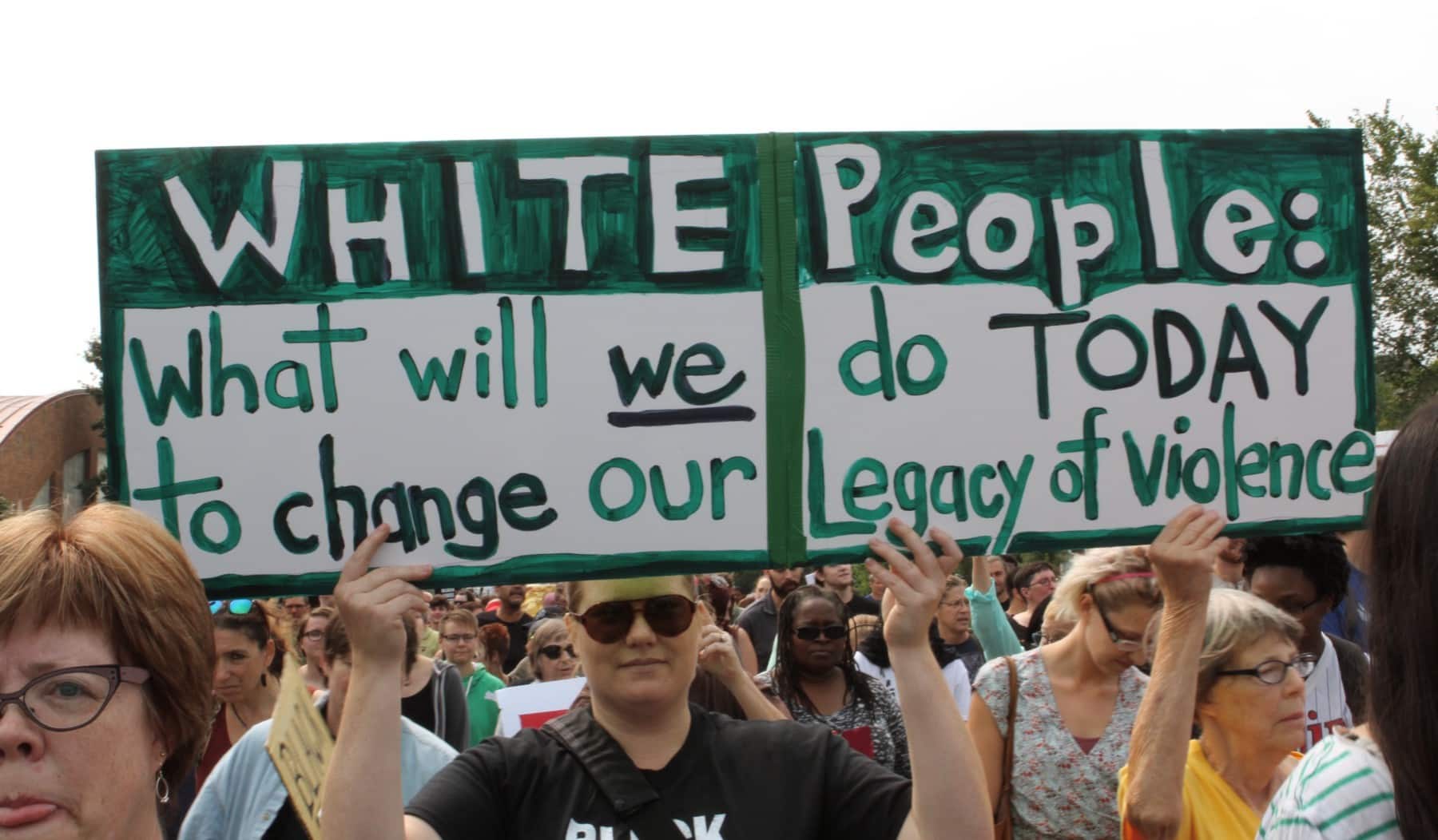
We who are the descendants of indentured European servants and of European working-class immigrants who fought back against bosses and their police to form unions and fight for better pay, better working conditions, the weekend, benefits, that few my age and younger have,
We who are the descendants of peoples who became white as a ruling class strategy to divest us of our shared humanity and solidarity with all working and oppressed people, and gave us entitlements, rights, the social and cultural wages of whiteness, as W.E.B DuBois wrote, that ultimately kept many of us economically down, politically weak, and spiritually impoverished,
We who are the descendants of people who became white through our collective consumption of hundreds of years of toxic anti-Black racist culture from the minstrel show to COPS that reinforces anti-Black laws, policies, and de facto rules that allow every form of brutality and insult to be unleashed against those who became Black in the process of extracting the wealth and power that built the United States,
We who are raised to be white in a white supremacist capitalist society must remember that white privilege was both a granting of access to resources and rights, while also a strategy to warp our worldview in anti-Black racism. This strategy channeled our our anger and resentment about working everyday to make someone else rich, deflecting it from the bosses and the ruling elite who imposed these conditions onto us, redirecting it onto other working people who are Black and of color. A strategy of maintaining structural inequality by granting non-ruling class white people the opportunity to regain a sense of our own power through our socially-encouraged, protected and often-rewarded ability to desecrate the dignity, humanity and life of Black people.
We who are raised white must realize that this society that devours the lives of Black people, everyday, is also a society that systematically raises us to be either butchers of Black life or the defenders and supporters of those doing the butchering. We are raised in a culture where white parents brought their “becoming” white children to watch the lynching and participate in the private rioting of socially acceptable white violence against Black bodies. We who are raised to be white, are raised in a death culture to be soldiers inflicting daily dehumanization against Black people in a capitalist society that profits from the slow (and sometimes quick) taking of Black life that maintains the monstrosity of the status quo.
While the most devastating and brutal consequences of anti-Black racism take place against Black communities, anti-Black racism is also core to what it means to be white in this society — to be emotionally and spiritually malnourished, fed hate, fear, envy, and resentment that deliberately replaced the sustenance of solidarity, love, friendship, community and mutually-affirming authentic human interactions across what became the color lines of a white supremacist society.
Every murder of a Black person by the police, every justification of how ‘scary’ and ‘threatening’ that person was to armed, trained, law enforcement, every media account that assumes innocence on the part of the police and guilt on the part of the murdered, every justification for endless anti-Black racist war, is also a continuation of the campaign to turn descendants of European servants, descendants of insurgent European immigrants, into patriotic white people who fight for the agenda of the rulers and denounce all who strike out for a world that affirms the inherent worth and dignity of all people, that embraces our shared humanity, that centers economic, racial, disability, gender, and environmental justice for all.
Anti-Black racism is war against Black communities. It is a cancerous, solidarity-poisoning, justice-denying process of straightjacketing the hearts, souls, and liberatory imaginations of those of us who have been raised white, so that we will be butchers, soldiers, and ‘good white people’ who call for ‘calm’ over ending violence when it’s Black lives being taken.
Anti-Black racism is a structural nightmare that white people must wake up from. We must wake up and fight back against it. The fight for white people against anti-Black racism is one of solidarity with Black communities and Black people in our lives and in our hearts, but it is also a fight to break free from the death culture suffocating and malnourishing us – and everyone raised white – whom we love.
When indentured Europeans joined with enslaved Africans to overthrow the tyranny of the slave master, the goal was to all get free. When the descendants of indentured servants, of exploited working-class immigrants, descendants of those who became white, join with the Black-led multiracial Black Lives Matter movement today, we must remember that in our confrontation with anti-Black racism, in our efforts to dismantle white supremacy, in our work for racial justice, we are also working to all get free and reclaim our shared humanity and the power of our solidarity, to build a world where liberation rather then supremacy guides all of our lives.
Chris Crass is the author of the new book Towards the ‘Other America’: Anti-Racist Resources for White People Taking Action for Black Lives Matter. He writes and speaks widely on anti-racist organizing, feminism for men, strategies to build visionary movements, and creating healthy culture and leadership for progressive activism. He was a founder of the anti-racist movement building center, the Catalyst Project, and helped launch the national white anti-racist network, SURJ (Showing Up For Racial Justice). Rooted in his Unitarian Universalist faith, he works with congregations, seminaries, and religious and spiritual leaders to build up the Spiritual Left. He is also the author of Towards Collective Liberation: Anti-Racist Organizing, Feminist Praxis, and Movement Building Strategy. He lives in Louisville, KY with his partner and their two sons. You can learn more about his work at ChrisCrass.org.



 To journey along with Kyle and Jamin as they sit at the feet of sages like John Perkins, Marva Dawn, and Jean Vanier, see their book The Way of the Dragon or the Way of the Lamb: Searching for Jesus’ Path of Power in a Church that has Abandoned It (Thomas Nelson, 2017).