Jewish And Christian Views On Bodily Pleasure | Robert Cherry

Jewish And Christian Views On Bodily Pleasure

The following is an excerpt from Jewish And Christian Views On Bodily Pleasure by Robert Cherry. It’s a featured Speakeasy selection, and there are still limited review copies available for qualified reviewers.

The Religious Setting

Increasingly, Republican politicians point to the “Judeo-Christian tradition” to rally the nation to their view of America’s uniqueness. During his 2012 presidential campaign, Mitt Romney credited America’s world stature to “our Judeo-Christian tradition, with its vision of the goodness and possibilities of every life.” This association only grew with the 2016 presidential campaign and Trump presidency. Not surprisingly, candidate Ted Cruz claimed his policy proposals were based on Judeo-Christian traditions but so did the more moderate John Kasich. In a 2015 speech to the National Press Club, he said,

US public diplomacy and international broadcasting have lost their focus on the case for Western values and ideals and effectively countering our opponents’ propaganda and disinformation.I will consolidate them in a new agency that has a clear mandate to promote the core, Judeo Christian Western values and ideals that we and our friends and allies share: the values of human rights, the values of democracy, freedom of speech, freedom of religion and freedom of association.

In his July 2017 speech in Poland, President Trump spoke more generally about defending Western values but his then chief political advisor, Steve Bannon, has often explicitly stated that its source are Judeo-Christian values. By tracing the evolution of foundational Christian and Jewish beliefs, this book forceful questions the very notion of a unifying Judeo-Christian tradition.

There are certainly many similarities between the foundational tenets of Judaism and Christianity but the attitude towards bodily pleasures is not one of them. At the end of the fourth century, the Babylonian Talmud completed the religious transformation into rabbinic Judaism. It firmly rejected ascetic behavior, presenting a positive view of festive activities and female sexuality. At the same time, Augustine was finalizing the foundational doctrines of Christianity. He labeled the Jews “carnal Israelites” because Augustine believed that Jews were “of the flesh” rather than “of the spirit;” they satisfied bodily pleasures at the expense of enhancing the spirituality of their souls.

Both rabbinic Judaism and Christianity evolved through their understanding of the history and traditions of biblical Israel. From the Dead Sea through the Sea of Galilee, an Israelite kingdom was carved out a millennium before the Common Era. This backwater fiefdom was of little consequence to the various empire builders that contested for domination in the greater region. As a result, for most of the following centuries, except for the sixty-year Babylonian captivity, Israelites were able to select their own Jewish rulers complemented by religious leaders in charge of their Great Temple in Jerusalem.

The situation changed substantially with the Roman conquest of Judea in 63 BCE, ending Jewish rule. Now an administrator selected by Rome governed. The Jewish populace first looked to the priestly class for leadership. That segment, however, lost favor when Jews witnessed its siding with the wealthy-owning class instead of impoverished farmers and tradesmen. Many looked towards Jewish renewal movements that offered alternatives to the priestly class. The two most significant were Jesus’ ministry and the Pharisees.

This book will trace the evolution of these two movements through the end of the fourth century, particularly their views on bodily pleasures. It will indicate how the eighteenth century Hasidic movement in Eastern Europe and the nineteenth century devotional movement in Ireland reestablished these contrasting bodily pleasures beliefs. The book concludes by exploring how these religious differences help explain why Jewish immigrants rather than Irish Catholics came to dominate early twentieth century popular culture and how they contrasting views bring into question contemporary notions of unifying Judeo-Christian values.

Praise for Jewish and Christian Views on Bodily Pleasure

“Too few scholars of religion are brave enough to draw connections between the ancient and the modern worlds. Cherry’s exploration of the evolution of Jewish and Christian attitudes towards bodily pleasure demonstrates the true value of such work. Hopefully, others will follow his example.”
—J. Christopher Edwards, St. Francis College, Brooklyn

“The book is fascinating! As noted in the book, the topic of pleasure was central to the rabbis at the time of the beginning of the common era and writing of the Mishna. It was also extremely central to the earliest Christians from Jesus and on. I was deeply impressed by the primary and secondary sources. I loved reading about the contemporary implications and exploring the great contemporary relevance of this topic.”
—Elchanan Poupko, president of EITAN-The American Israeli Jewish Network

“Robert Cherry takes us on a thought-provoking journey from Biblical times to the modern era, showing how religious teachings that were set out long ago continue to influence the ways Jews and Christians understand sexual pleasure. In his intriguing account, what happened in the ancient streets of Jerusalem echoes in the movies, songs and dance halls of early twentieth-century New York, where contemporary mass entertainment finds its origins.”
—Paul Moses, author of An Unlikely Union: the Love-Hate Story of New York’s Irish and Italians

About the Author

Robert Cherry is Brueklundian Professor at Brooklyn College and City University of New York Graduate Center. He has published eight books, primarily on economic discrimination and poverty, and more than 100 articles in professional journals, including a number on religious themes, most recently ”Jesus and the Baal Shem Tov: Similar Roles but Different Outcomes.”


The Disfiguration Of Nature | James G. Krueger

The Disfiguration Of Nature

The following is an excerpt from The Disfiguration Of Nature by James G. Krueger. It’s a featured Speakeasy selection, and there are still limited review copies available for qualified reviewers.

Preface

An addicted man has little reason to decry drunkenness until his ailing liver, his overdrawn accounts, or his estranged wife lead him to close the barroom door behind him for the final time. Outside in the quiet night, a bolted door behind him and as yet no open doors ahead, he must smash his treasured bottle with its amatory allure upon the gravel of his own brokenness, his own deficiency, his own suffering, all of which will indeed be his salvation if he persists. He must shatter one thing so that he might be whole. He must withdraw himself from one object, in order to restore communion with another. The everyday American, going about his business half-drugged by the endless assaults and seductive posturing of advertisers, media genies, and sham prophets of progress and productivity—his cords of addiction spread far and wide—cannot have anything of value to say of his own culture until he, too, steps away from his treasured amenities that nevertheless may be killing him. Anyone who would offer a robust assessment of his society must volunteer him- or herself to a sideline to watch the strange spectacle of that society with some measure of detachment.

In addition, because the environmentalist (along with the religious person) agrees that, despite the tremendous good that rarely fails to well up when human beings gather in common purpose, human society as it stands is nevertheless somehow broken, somehow prone to corruption, somehow inclined to mutiny against larger contexts that would remind it of its limitations. Therefore, the environmentalist, as with the religious person (if he would be worth his salt), is doubly called to make a break from the social order—a break not only with visible things or with the outward forms of society, but chiefly with the buried value structures and assumptions that undergird it. The whole vision of both the environmentalist and the religious person must be born anew, that they may speak it truly to their people.

Nature cannot be protected, honored, cared for, loved, participated in from within a system of values that scrape against her. Many of the values and standards forming the normative fibers of American liberal thought grow out of an inherent disdain for the routine limitations of nature (perhaps in part the strange fruits of an orchard planted in the restless city and not in quiet fields) and such value structures only work in the end to destroy and disfigure her. Since to love is to offer oneself for the sake of the other, authentic love for nature would express itself in sacrifice. The ease and predictability of an engineered environment, and elitist fantasies of leisure unwed to labor; the immediate gratification of every whim, and being waited on at the press of a button—an encounter with raw nature puts a swift end to these. In boiling life down to the basics, little room remains for the adolescent amplification of personal predilections and the positivistic but (in the end) perennially discontented and insubordinate spirit of progressivism that now appears to be the bedrock of popular liberal thinking. Certainly, an authentic love for nature would require their swift sacrifice. These do not stand much better in the contexts of any authentic relationship, be it a marriage, a family, or a community—especially when such a relationship is lived in conscious acknowledgment of the bonds by which it subsists, intergenerational bonds not only with the living, but with the dead and with those yet to come. Real relationships, real communion, real belonging is limiting to individualistic tendencies, which is why relationships on every level are faltering in our day and age: we simply refuse to surrender to their constraints. But the alternative to these constraints, it seems to me, is not any better. Indeed, it is far worse. The alternative is a world of self-seekers, constantly vying for the kill. It is a world of incessant clamor, disaffection, atomization, faithlessness, exploitation—a spiritual and environmental nightmare. We cannot have communion without limitation and surrender, and we cannot in turn have conservation without communion.

It betrays the very laws of nature to think that we can have it all. Global citizenry is no citizenry. Our best hope is to have one thing fully, our best intention to care for one place well. As it now stands, the environmental movement is undermined not mainly by its opponents, but by itself. It is undermined by a confusion of political language, a confusion that leads us to think that earth-care is somehow congruent with a liberal, progressivist agenda when the task at hand is anything but expansive and progressive, but is rather conservative. Today’s environmental movement is undermined also by its refusal to volunteer itself to the sidelines of contemporary American culture, and from there to offer an incisive critique of that culture. It cannot issue a call to greatness when it is unwilling to embrace for itself a courageous moral vision that is as outwardly honorable as it is internally coherent, a vision received in the place from whence all true prophets come—the bareness, the routine simplicity, of the wilderness.

We may here understand wilderness broadly or even metaphorically, as the place that is least propitious to our egocentric lives; the place that at once reveals the minuteness of our atomized selves and the steadfast solidity of that in which these little selves reside. Settled, domestic life is very much a wilderness in this sense, where we discover our belonging to the larger contexts of family, community, and land only to the degree that we also discover the dead ends of self-absorption. The limitations of self-expression inherent in peaceable domestic life, marriage, communal integrity, and husbandry of the land are in harmony with the prophet’s wilderness, and the prophet’s wilderness, in any case, is not a wilderness cut off from, or in some romanticized opposition to, human culture. The prophet’s wilderness is the wilderness that surrounds human culture and gives it definition, for the prophet’s concern is ultimately the health of his or her own people; a health best assessed by the givenness of creation’s robust but stable fellowship, in which human culture partakes according to the unique characteristics of the human kind. Unless the prophet considers the lilies of the field and the birds of the air, he cannot properly consider his fellow men. All religious accounts, and so all traditional moral and ethical frameworks, begin with the account of creation. Man finds no place except within the broader household of nature.

The Disfiguration of Nature is my small offering to help in these tasks; the tasks, that is, of cultural critique and the reestablishment of human culture within an ordered and given cosmos, and one which imposes real limitations upon our lives and desires. Such is a cosmos that demands our fidelity and is worthy of it, and presents us (in the end) with little choice in the matter. This book is, at the same time, an invitation to disconnection. Particularly, it is an invitation to disconnect from destructive illusions about both nature and ourselves in favor of a humble yet constructive—and eventually powerful—understanding, the kind that can create a desperately-needed common ground in service not only of our shared American landscape, but of the promise of sound and peaceable human culture upon it.

Praise for The Disfiguration of Nature

“Orthodox theology and spirituality have traditionally advanced the concept of transfiguration as the ultimate aspiration of all people and all things. This book demonstrates how ignoring the far-reaching implications of our vocation to conserve God’s creation leads to the disfigurement of nature.”
—John Chryssavgis, author of Earth as Sacrament

About the Author

James G. Krueger is founder of Mons Nubifer Sanctus, a center for training in the Christian spiritual life rooted in contemplative prayer. He lives with his wife Maureen in the Catskill Mountains, where he is Priest in Charge of a small congregation. In the throes of establishing a modest farmstead, Krueger has also contributed essays and poems to numerous periodicals and is an award-winning songwriter.


The Grace of the Present Moment: Talking to Alexander John Shaia

If you’re arriving at this post in 2022, I hope you register for Alexander John’s free virtual session, Discover the Mystical, Feminine Map to Transformation Hidden in Christianity’s Four Gospels. Register here.

I hope you’ve been having a restful and reflective season. And, I realize that, for many of us, this has been a difficult season – whether simply feeling the weight of national and global tensions and tragedies, or the pain often borne uniquely in our immediate context.

I carried this paradox with me in my conversation with my dear friend Alexander John Shaia yesterday. It was our final Make Advent Great Again dialogue, and it’s too good not to share with you, here:

In this dialogue, we discuss:

  • Embracing the gifts of radiant darkness
  • Living now in the presence of the future
  • Moving from ‘hope’ to conviction
  • How to create space for Divine promise in your life on the other side of deconstruction
  • The hidden wisdom of the early Jesus movement that can guide us to human transformation, whether you’re conventionally religious or not

Here’s a written reflection Alexander wrote to accompany this, beginning with the Lectionary Scripture reading for this week:

In these days Mary sets out and goes with haste to a Judean town in the hill country, where she enters the house of Zechariah and greets Elizabeth. 

When Elizabeth hears Mary’s greeting, the child leaps in her womb. And Elizabeth is filled with the Holy Spirit and exclaims with a loud cry, “Blessed are you among women, and blessed is the fruit of your womb. And why is this happening to me, that the mother of the Most High comes to me? For as soon as I heard the sound of your greeting, the child in my womb leaped for joy. And blessed is she who believes that there will be a fulfillment of what has been spoken to her by the Most High.”

And Mary says, 

My soul magnifies the Most High -and my spirit rejoices in You, my Savior,
for You look with favor on the lowliness of your servant.
Surely, from now on all generations will call me blessed;
for the Mighty One has done great things for me, and Holy is Your Name. 

Your mercy is for all who are in awe of You from generation to generation.
For You have shown strength with your arm;
have scattered the proud in the thoughts of their hearts.
have brought down the powerful from their thrones, and lifted up the lowly;
have filled the hungry with good things, and sent the rich away empty.
have helped your servant, Israel, in remembrance of Your mercy, according to the promise you made to our ancestors, to Abraham and to Sarah and their descendants forever. 

And Mary remains with Elizabeth about three months and then returns to her home.

– Luke 1:39-56, New Revised Standard Version, adapted by Alexander John Shaia 
 
********
 
As you read this text, please note that I have changed the tense from past to present.  Reading scripture in the present tense is a significant change that we can all make. Whenever I share a gospel text, I read it in present tense. Without fail, someone will come to me later, sharing that they have never heard that particular text before. The truth is that when we read in past tense, we think in terms of history rather than spiritual experience. Present tense moves us into the story as something happening right now. In my book, Heart and Mind: The Four-Gospel Journey for Radical Transformation, I stress that changing the text to “here and now” is vitally important to an experience of the gospel fresh and new.  
 
And tense plays an enormous significance in Mary’s Canticle. Have you ever noticed that Mary prays future actions of the Most High as if they have already taken place? In psychology, we might term this as a person having a positive outlook on the future. However, I see more than mere positive psychology at work here. As Elizabeth states, “blessed is she who believes the fulfillment will happen.” Note that the word Elizabeth uses is “believes.” Belief is a step beyond hope. And Mary goes beyond hope in this canticle. She proclaims the Most High’s promise as something that has already happened. (For more, see pages 306-320 in Heart and Mind.) 
 
How may we take on the level of service needed in today’s world? As we come to the close of this Advent, Luke gives us great succor. Ponder Mary’s canticle. Pray all of our needs for mercy and justice today – as having already happened. Notice the grace and inner strength that grow within you from this practice.  
 
As the outer calendar tips from Advent to Christmas, I pray that you may savor the inner experience of fruitful darkness, know it is the only place from which grace is able to move us a belief, or a knowing that is beyond hope.  And that knowing is the deep font of our non-anxious, consistent and persevering work in the world.  And non-anxious work is the salvific action that the Most High calls us to offer each other and our world.  
 
By our lives may we “Christmas” (Christ-Missa) which literally means: The Christ Be Sent!  Alleluia.   
 
********

If you find this inspiring, be sure to read Alexander John Shaia’s magisterial tome, Heart and Mind: The Four-Gospel Journey for Radical Transformation. 

Consider bringing your faith community or circle of friends on this life-journey with the Heart and Mind Community-Formation Guides.

And check out Alexander’s Advent interview with Rob Bell!

Register for Alexander John’s free virtual session, Discover the Mystical, Feminine Map to Transformation Hidden in Christianity’s Four Gospels!


Alexander John Shaia, PhD, is a thoughtful and poetic man, living the ancient rhythms of his Lebanese and Aramaic heritage. With deep conviction, he invites us into a practice of spirituality (and Christianity) for the twenty-first century—one that crosses traditional boundaries, encourages vital thinking and inhabits a genuine community of the heart. As a spiritual director, educator, anthropologist, psychologist, ritualist and Sandplay therapist, Alexander is a holistic, cross-discipline visionary and passionate professional speaker. He founded The Journey of Quadratos, as well as the Blue Door Retreat in Santa Fe, New Mexico. Now he travels internationally, speaking, leading seminars and conducting retreats on Quadratos, the Four-Gospel Journey and Gateway to Oneness (The 72 Hours of Easter). Each autumn Alexander guides an intimate band of pilgrims on the Camino, the West’s most ancient path of transformation. He’s just released the updated edition of Heart and Mind: The Four-Gospel Journey for Radical Transformation, which this post is based on. See Quadratos.com for more about his work and offerings.

Personal God, Loving Evolution: My Conversation with Ilia Delio

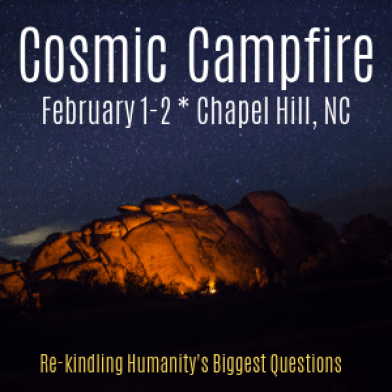
As part of our prelude to the Cosmic Campfire Gathering this February 1-2 in Chapel Hill, North Carolina (co-hosted with Tripp Fuller of Homebrewed Christianity and ‘Science’ Mike McHargue of The Liturgists), I got to sit down with one of my favorite theologians, Ilia Delio:

We dive into her life and inspirations over the course our hour-long conversation. What I most wanted to know is this: how does one go from a New Jersey Catholic upbringing, to PhD studies in pharmacology, to a traditional Carmelite monastic life to a Franciscan community with a penchant for Medievalism, culminating in a ‘Second Axial Age’ renewed understanding of God and cosmos? How does all this fit together in one life??

Dr. Delio graciously indulged my curiosity, and in the process we also talked about:

  • If we robustly embrace an evolutionary understanding of the universe, what about Adam and Eve?
  • How can we embrace both a God of love and the process of evolution, which is ostensibly ‘red in tooth and claw’?
  • What do we do when ‘revelation’ and ‘science’ apparently conflict?
  • How can we encounter a personal God on the other side of deconstruction?
  • The idea of God as Trinity: Does it help or hold us back?
  • In a pantheistic world where God is all and all, is the Incarnation redundant?
  • If we’re entering a new understanding of cosmology, what are the gifts – and shortcomings – of specific religious traditions, including our own? Would we be better off giving them up to form some new universal spirituality? Why or why not?

It was an incredible conversation. Be sure to watch it above, and check out some of her books in her bio, here…

About My Dialogue Guest

Ilia Delio, PhD, OSF, currently holds the Josephine C. Connelly Endowed Chair in Theology at Villanova University and has authored or co-authored many books including Care for Creation: A Franciscan Spirituality of the Earth, which won two Catholic Press Book Awards in 2009. Her recent books include A Hunger for Wholeness: Soul, Space and Transcendence, Making All Things New, and The Unbearable Wholeness of Being: God, Evolution and the Power of Love, which received the 2014 Silver Nautilus Book Award. She lectures nationally and internationally in the areas of science, religion and culture and is the general editor for the series Catholicity in an Evolving Universe published by Orbis Books. Visit her website at OmegaCenter.info.

AND: While Dr. Delio won’t be able to join us in-person at the Cosmic Campfire Gathering, she will be sharing a Cosmic Query for us to ponder there, together!


Speaking of: Early Bird Tickets are now on-sale for the Cosmic Campfire Gathering, this February 1-2 in Chapel Hill, North Carolina. (And stay for Sunday morning February 3 if you can, for extra Cosmic Campfire goodness at our host space, Holy Trinity Lutheran!). Early Bird tickets are $129 through January 15th, saving $70 on the at-the-door price, if they even last that long. Seats are limited, so if you’re looking for the perfect Christmas gift for loved ones, yourself, or best-yet all of you, please get yours now.

If this is your first time hearing about this one-of-a-kind gathering, Tripp, Mike McHargue and I are creating space to talk about the Big Questions:

  • Who are we as a species?
  • What does it mean to inhabit these bodies, on this planet, in this universe?
  • How are we so beautiful?
  • How do we find ourselves in such a multi-lateral mess ?
  • Does being a friend of God, aspiring follower of Jesus, and student of Scripture have anything meaningful to add to this conversation?
  • Do the inquiries of biology, physics, psychology, archaeology and anthropology have anything meaningful to add to this conversation?

We’ll be exploring these questions, specifically as framed in the emerging cosmological projects Big History and the New Universe Story, with some of our favorite scientists, philosophers, and theologians. Buying your Early Bird Ticket now helps us plan for the full breadth of contributors to your experience, so we really appreciate it.

Confirmed dialogue partners include: 

Barbara Holmes, PhD, is a theologian, writer and scholar who publishes books about the intersection of ethics, spirituality, mysticism, science, cosmology and African American religious culture.She is president emerita of United Theological Seminary of the Twin Cities and formerly professor of ethics and African American religious studies and vice president of Academic Affairs at Memphis Theological Seminary.In addition to her work with law firms, she has worked with homeless missions, HIV/AIDS ministries, and international ministries in Kenya (the Presbyterian Church of East Africa) and Japan. Her published work includes Liberation and the Cosmos: Conversations with the Elders, Race and the Cosmos: An Invitation to View the World Differently, Joy Unspeakable: Contemplative Practices of the Black Church, and other publications. Want to hear from Dr. Holmes? Listen to her on these episodes of Homebrewed Christianity and Contemplify!

Joan Roughgarden, PhD, is an evolutionary biologist, transgender, and described by the New York Times as “one of the world’s most influential theoretical ecologists.” She is well-known for her unique perspective on theistic evolution, and bold and pioneering work on sexuality in humans and the rest of the animal kingdom. She the author of numerous books and studies; for a popular readership, she has written Evolution’s Rainbow: Diversity, Gender, and Sexuality in Nature and People and Evolution and Christian Faith: Reflections of an Evolutionary Biologist. Dr. Roughgarden is no stranger to podcasts – check her out on Just Plain Sense, BBC Analysis (‘Why Are Even Women Biased Against Women?’), and her insights in the just-released Science Vs. episode The Science of Being Transgender.

Robyn Henderson-Espinoza, PhD, has been described in a myriad of ways: a scholar-activist, scholar-leader, thought-leader, teacher, public theologian, ethicist, poet of moral reason, and word artist. Among these ways of describing Dr. Robyn, they are also a visionary thinker who has spent two decades working in the hybrid space of church, academy, and movements seeking to not only disrupt but dismantle supremacy culture by focusing their PhD studies on new concepts of being and becoming, decolonizing knowledge production, and bridging with radical difference. Named one of ten Faith Leaders to watch by the Center for American Progress in 2018, Dr. Robyn is currently at work helping co-create Activist Theology. Dr. Robyn is a non-binary Transqueer Latinx who calls Nashville, TN home. (Dr. Robyn is one of Homebrewed Christianity’s favorite guests. Check them out in this interview archive!)

And while we’ll be having fascinating conversations with experts in their fields, the conversations continue with you…we’re building in plenty of space for all of us to explore the questions that drive us…together.

So…will you join us? You can find out even more info, and grab your early bird tickets, at CosmicCampfire.party.

The INTRAfaith Conversation | Susan Strouse

The INTRAfaith Conversation

The following is an excerpt from The INTRAfaith Conversation by Susan Strouse. It’s a featured Speakeasy selection, and there are still limited review copies available for qualified reviewers.

What is an intrafaith conversation and how is it different from interfaith?

The simplest explanation is that the prefix matters. “Inter” means “between,” “among,” “together.” Therefore, interfaith is different religions being together. “Intra,” on the other hand, means “within, inside.” So, intrafaith is one religion looking within itself in light of its interfaith experience.

The conversation begins when we ask ourselves: what does it mean to be a Christian in our religiously diverse society? This is not merely an academic question. In my experiences in both congregational ministry and interfaith dialogue, I have come to appreciate the people “on the ground” who wrestle with the implications of openness to other religions and how this affects their own beliefs and practices.

The seeds of my desire to create a user-friendly process for interfaith and intrafaith engagement were planted in the days after 9/11, when many congregations wanted to learn about other religions. At North Park Lutheran Church in Buffalo, NY, where I was serving as pastor, our adult forum decided to begin a study of the world’s religions. They decided on Hinduism as their first venture into an interfaith encounter.

In light of the fact that we would be looking at another tradition solely through our own lenses, I asked the group if they would be open to inviting a Hindu guest to one of our sessions, someone who was willing to share her story as well as answer any questions. Their answer was an enthusiastic “yes” and I invited a Hindu woman who was active in interfaith activities to come to our next meeting. The visit went well. However, after the session one of the participants, Elsie, asked if she could stay and talk about something that was bothering her. She began by saying how much she was enjoying the study. She had appreciated meeting our guest and hearing her personal story. But she had a big concern. “If I accept the Hindu path as equal to Christianity,” she said, “I’m worried that I’m betraying Jesus.”

Elsie had presented me with both a pastoral and a theological quandary and I realized that she had raised an important theological issue for Christians today (and this book is dedicated to her). Her worry about “betraying Jesus” by meeting and respecting a person of another religion confronts us all with the question raised by Marjorie Suchoki in Divinity and Diversity: “How do Christians deal with this phenomenon?

“Our Christian past has traditionally taught us that there is only one way to God, and that is through Christ. But we are uneasy. Our neighborliness teaches us that these others are good and decent people, good neighbors, or loved family members! Surely God is with them as well as with us. Our hearts reach out, but our intellectual understanding draws back. We have been given little theological foundation for affirming these others – and consequently we wonder if our feelings of acceptance are perhaps against the will of God, who has uniquely revealed to us just what is required for salvation.”1

As pastors and lay leaders we are responsible to our congregations to provide the theological foundation for affirming “these others.” Rather than succumbing to what John Cobb calls “the danger that sensitive Christians will simply delete central beliefs rather than transform them,”2 I believe that we have some serious theological and Christological work to do in defining, or perhaps re-defining, ourselves in light of our interfaith milieu.

The good news is that there is a great deal being written and discussed at the academic level; books, essays and articles by theologians and biblical scholars abound. However, an exclusively academic approach will not suffice for a task that enters so deeply into the life and religious identity of all Christians. My intention in this book is to provide a practical approach as a parish pastor. To do this, I will 1) relate stories from my own evolving journey; 2) share accounts from people I’ve met in congregations, workshops, retreats and other circumstances; 3) ask questions to help you reflect on your own situation; and 4) offer resources that might help you in your own setting.

While I do not go into great theological detail, this book can easily be used in conjunction with more academic resources for those who want to explore in more depth.

My intended audience is intentionally broad: from lay members of congregations with little or no theological training to seminarians and clergy with extensive theological backgrounds, albeit not necessarily in this area. Some sections may seem more academic, others more practical. I hope that you will read with this in mind. If a difficult section engenders lively discussion, my goal has been accomplished.

Since my first struggling attempt to answer Elsie’s question, I have been following a quest to learn and grow in my own understanding of my faith in relationship to those with different beliefs and practices. After seventeen years of parish ministry, I left Western NY to pursue a Doctor of Ministry degree in interfaith studies at the Pacific School of Religion in Berkeley, CA. I also became actively involved with the Interfaith Center at the Presidio in San Francisco and served as interim executive director in 2011-12.

I have been blessed to serve congregations that love to explore matters of interfaith and intrafaith as much as I do. They have been willing partners in this quest and I am grateful for their willingness to stretch and grow.

I hope that you will find this book helpful. Many people who become involved in interfaith activities say that meeting and learning about other religious traditions transforms their rootedness in their own tradition and makes it stronger. This has certainly been true for me. I hope it will be so for you.

1 Suchocki, Marjorie, Divinity & Diversity: A Christian Affirmation of Religious Pluralism, Nashville: Abingdon Press, 2003, 9.

2 Cobb, John, Lay Theology  (St. Louis: Chalice Press, 1994), 96.

Praise for The INTRAfaith Conversation

“I personally have been involved in interfaith work in the Bay Area for over 35 years and have never seen a book quite like The INTRAfaith Conversation. It addresses a very real issue with depth, humor, and pastoral sensitivity. I highly recommend it not only to pastors and other leaders in Christian churches, but to lay people who may be asking some of the same questions. Further, although it is specifically aimed at a Christian audience, it offers a model for how similar questions might be raised and wrestled with in non-Christian contexts as well.”
—The Rev. D. Andrew Kille

“This crisp and cogent book by the Rev. Dr. Strouse is published at a time when both interfaith and intrafaith dialogue are critical to the vitality of spiritual life in our nation. As a parish pastor in a small, struggling congregation I have become increasingly aware of the insularity and isolation of many of our parishioners. This seems less the result of inadequate parish education as it is the byproduct of too many people getting their information from biased TV networks, so-called social media or word-of-mouth. We parish pastors need to examine our internal (intra-congregational) conversations about diverse faith traditions and how they bear on congregational mission.”
—Richard G. Eddy

This book was written so that in this pluralistic world in which we now live, we, as Christians can better understand our own faith, and the issues involved with interfaith dialogue, so that we might be more comfortable being in conversation with our neighbors who are not Christian. While this book was written to the larger interfaith dialogue within the broader culture, I find the insights in this book to be very applicable in the clinical pastoral care setting in which I minister. I hope the saying is true that we are judged by the company we keep so by keeping company with this book I might be somewhat smarter than before I read this book. I thoroughly enjoyed reading The INTRAfaith Conversation. Susan’s writing style is engaging, easy, and conversational, yet theologically intelligent.
—The Rev. Barbara Peronteau, M.Div., Interfaith Chaplain Resident

About the Author

Susan M. StrouseSusan M. Strouse is a native of Pottstown, PA (near Philadelphia) and a graduate of Antioch University/Philadelphia (B.A. in Human Services) and the Lutheran Theological Seminary in Gettysburg (Master of Divinity) She has previously served congregations in Buffalo, NY and Novato, CA. She served at First United Lutheran Church in San Francisco from 2004 to 2017.

In 2005 she received a Doctor of Ministry degree from the Pacific School of Religion in Berkeley. Her area of study and interest is interfaith theology, particularly working with congregations and clergy to explore the meaning of being a Christian in our religiously diverse world. She is a member of the board of directors of the Interfaith Center at the Presidio and served as Interim Executive Director in 2011-2012. You can follow her work here.