
A Declaration of Interdependence Part Two: The Road Not Taken

The Evolutionary Revolutionary — a three-part series for America’s 250th

Be anything you want. Be madmen, drunks, and bastards of every shape and form. But at all costs avoid one thing: success.
—Thomas Merton

The sword is never really countercultural, but the cross always is.
—Brian Zahnd

Previously: I lit a candle and named a wound — a country two hundred and fifty years old, founded on a half-revelation and carrying an unpaid debt, its bells and its clanking chains riding the same currents of air. But I also went digging in the crawlspace of our history and found a stranger, more hopeful America down there: Johannes Kelpius scanning the stars, Marcus Garvey’s mind-power, Jean Toomer’s Harlem mystics trying to dissolve racism at the level of consciousness itself, the Wide Awakes marching under a single watching eye. An America forever convinced it could be remade. I promised you that this buried dream never perished — it only went underground, the way seeds do. Now let me show you one of the times it broke ground and caught fire.

IV. Flipping the Coin on Futures Past

Let’s hop into the Delorean and go back exactly fifty years, because I think 1976 has something to tell us that we urgently need to hear.

When I was a kid, I was weird. (Some things never change.) I collected things. (Some things never change.) I collected stamps and coins and baseball cards and comic books, in part because I was fascinated by how change carried itself through time. Typographies and images and phrases and colors, they’d shift as the years and decades marched on. I loved holding history in my hands, imagining what it would feel like to be alive in the era of Mickey Mantle’s rookie year, mod Archie Comics fashions, or the Walking Liberty half-dollar.

So one day I was given a quarter by my parents, and it wasn’t like the other quarters in my growing coin collection. Don’t get me wrong, it looked much like a brand-new quarter. But rather than a single date, it displayed two: 1776-1976, as though this coin was itself a time traveller, forged of two eras at once and containing everything in-between. And rather than an eagle on its reverse side, there was what looked to me as a kid like a cowboy, which I gradually realized was a young drumming revolutionary. Occurring just a few years before I drew my first breaths in this world, I wondered what this Bicentennial was all about.

Today we remember USAmerica’s Bicentennial — if we remember it at all — as bunting drapes and tall ships and Schoolhouse Rock. But this is the airbrushed version. The America that turned 200 was, in the words of one writer, a “Bicentennial basket case.” Richard Nixon had resigned in disgrace two years before, taking with him whatever public trust Watergate hadn’t already incinerated. The last helicopter had lifted off the Saigon embassy roof only the previous spring. The economy was mired in something new and ugly enough to need a new and ugly word — stagflation, prices and unemployment climbing together, the Misery Index sitting north of thirteen. The country limped to its own birthday party wondering if the whole experiment had been a fraud.

Sound familiar?

Because history might not repeat itself exactly, but it does rhyme. The particulars have changed — the war is now a war we underwrite rather than fight, the corruption wears better suits, the surveillance is in our pockets — but it’s the same song, different verse:

A republic gnawed hollow by graft. A people ground down by costs they did not choose. Institutional trust free-falling. Cruelty toward the stranger is elevated to policy. By 1976 King had already named it and been dead eight years: “there are literally two Americas,” he said. “One flowing with the milk of prosperity and the honey of equality,” and the other with “a daily ugliness about it that transforms the buoyancy of hope into the fatigue of despair.” Fifty years on, the milk has curdled for even more of us, and the two Americas have only moved farther apart.

But here’s the thing about 1976 that the fireworks blinded us to: That desolate, disillusioned, malaise-soaked year was also one of the most spiritually fertile moments in modern American history. In the very soil of despair, something verdant was sprouting.

V. The Jesus Movement — and the Road Not Taken

Fifty years ago, a genuine revival was sweeping the American landscape. Pundits and proponents named it the Jesus Movement — hippies and runaways and dropouts and druggies getting baptized in the Pacific Ocean, coffeehouses and communes and street preachers preaching dire and ostensibly good news; a whole generation deciding that the Jesus of the Gospels had more to offer than the Nixon of the news.

But what is ‘revival’? Growing up Pentecostal, promised revival was around every corner, lurking in Scriptures and in daily headlines; revival was going to enliven our personal connections with God, drive us to remorse for the wrongs we committed, stir up supernatural spiritual gifts and wonders among us, and — most importantly — trigger mass conversions to allegiance to Jesus Christ and swell the ranks of his cosmic Bride, the Church. 

This was the vision much-promised by visiting Wednesday-night preachers and extended Sunday-morning altar calls, it was apparently already happening according to the missionaries from Mexico, or China, or Peru. It haunted our sanctuaries and denominational magazines and tape ministries.

But revival isn’t always elusive, and something like it seemed to arrive in the decade before my birth. Sociologists of religion have their own definitions; they treat revival not as a single dramatic event but as a period of intensified religious life — a rapid, measurable surge in conversions, fervor, and communal participation that briefly interrupts the slow drift of secularization. They tend to bracket the theological question of whether God is ‘really’ moving and look instead at the social machinery: what the historian William McLoughlin, borrowing anthropologist Anthony Wallace‘s term, called a “revitalization movement,” a people’s collective reach for a more satisfying way to live; what Émile Durkheim called “collective effervescence,” the almost electric energy a community generates when it gathers around something it experiences as holy. And revivals, these sociologists note, tend to erupt in precisely the conditions of 1976 — seasons of anomie and economic stress, when the old order feels hollow and consumer culture has stopped answering the questions that keep people awake at night. Which is to say: the national malaise happening then wasn’t the opposite of a revival. It was the compost.

Growing up, I learned to  love this movement that swept the US and receded, just before my time. I grew up singing its songs throughout the Baptist, Pentecostal, and even conservative Presbyterian churches I was part of, and aspects of its history were lionized as part of the DNA of the neighborhood-based house church movement I spent my twenties in.

But I also grieve what most of it became.

I’m not the only one holding love and grief simultaneously. Brian Zahnd — pastor of Word of Life Church in St. Joseph, Missouri since 1981, and one of the voices who teaches me this cruciform way of seeing — was a Jesus Movement kid directly, a seventeen-year-old “Jesus freak” running a coffeehouse called the Catacombs in the basement of a dive bar. In Postcards from Babylon: The Church in American Exile he remembers what was genuinely electric about it: “a bunch of long-haired Jesus freaks were realizing that the Sermon on the Mount was thrilling, demanding, and dangerous as dynamite. The Jesus Movement was making Jesus revolutionary again.” They weren’t doing civic religion; they read the Gospels as “a direct challenge to the assumed cultural values of America.” And then Brian names, from the inside, the aspect I’m grieving: “eventually the Jesus Movement was absorbed by the Charismatic Movement and would be slowly seduced by the siren songs coming from the prosperity gospel and the religious right.” 

It all felt compelling at the time. Brian adds: “And I went along for the ride.”

You want the human face of that grief? His name was Lonnie Frisbee. If you saw the glossy 2023 film Jesus Revolution, you met a version of him — the barefoot, Christlike hippie (played, with no small irony, by the actor who plays Jesus in The Chosen) who walked into Chuck Smith‘s buttoned-down Calvary Chapel in 1968 and lit the fuse. That much is true, and then some: Lonnie Frisbee was the charismatic spark behind not one but two global movements — Calvary Chapel and, later, John Wimber‘s Vineyard. He baptized thousands in the Pacific surf, prophesied, prayed for healing, pulled the ‘lost’ kids in by the busload. It is not an exaggeration to say that without this one luminous, strung-out, wounded young man, we would likely never have heard of either.

What the movie leaves out — and what the movements themselves spent decades airbrushing out — is that Lonnie Frisbee was gay. A survivor of childhood sexual abuse who had come up through the Laguna Beach gay scene, he tried, in his early testimony, to name that he had “come out of the homosexual life” — and then discreetly deleted it, because, he said, people started treating him like a leper. When his sexuality could no longer be hidden, both movements he had founded wrote him out of their official histories as though he had never existed. He died of AIDS in 1993, at forty-three, in a state of profound self-loathing — a man who had led thousands to a Jesus of radical welcome and could not, in the end, believe that welcome reached as far as himself. The 2023 film honors him just enough to borrow his charisma and just little enough to avoid his wound: it never names his sexuality, and it omits even the cause of his death from the closing title card. The erasure, fifty years on, was performed one more time — on camera, allegedly for our edification.

Now, look: I don’t want to throw out Baby Jesus with the bigoted bathwater, nor throw these earnest seekers under the tie-dyed Volkswagen Bus! The conservative wing of the Jesus Movement is not some cartoon supervillain. The hippie movement, at its inception a revolutionary force to be reckoned with, was arguably depoliticized by the strategic U.S. governmental introduction of mind-altering drugs, making the eternal party and tuning in, turning on, and dropping out its establishment-bolstering aim rather than a remaking of the social order in more just and equitable ways. Capitalism was scared of how millions of draft-resisters and Communist-sympathizers could reshape the national fabric, so they un-clenched their pearls just enough to introduce LSD and other substances to the scene. Arguably these same capitalist forces, undergirding U.S. Evangelicalism since the 1950s, were behind what could have been the further domestication of hippies by corralling them into ‘safe’ church structures. But this didn’t happen, at least not right away. What had become hippie ecstasy had no floor under it; evangelicals offering structure, sobriety, a rhythm of discipleship, a bed and a hot meal were meeting real needs the counterculture (as it was distorted) had left bleeding in the street. There is a genuine corrective in here that let the hippies change the conservative evangelical church, too — namely, by reading the Gospels and the Red Letters. Somehow, the fusion of hippies and evangelicals created a prefigurative politics of the Kingdom of God “here on earth as it is in heaven,” embodying their fervently-desired future within sanctuaries, parachurch organizations, songs and streets right here, right now. 

If only this fusion of evangelicalism and hippie culture had been more Jesus-joined, more Sermon on the Mount-shaped, more in keeping with the Upside-Down Kingdom instead of monarchy writ large. Instead, evangelical captivity pendulum-swung hippie culture all the way to fundamentalist’s familiar sex-negativity, bifurcating sexuality from sanctification — telling people their bodies and the Gospel were at odds, that their desires were the enemy of their souls. This swing took its toll, and Lonnie Frisbee’s grave is part of the bill. 

Evangelicalism, even in its allegedly countercultural form, learned to sanctify by subtraction — purifying by erasure, cherishing the gift while disowning the giver. Keep this in your pocket as we walk toward the fork ahead. A movement that can edit out its own queer prophet has already told you something about which branch it’s going to take.

So here we go: This towering movement, bringing millions to life-changing faith in the ‘One Way’ of a Jesus who chooses death rather than retaliation and enemy-love rather than violence, itself feeds the hungry, stirs urgent existential questions, starts hundreds of communes across North America, and stood at a genuine fork in the road. It mostly took the road more tragic. 

One path — the one that came to dominate — was the path of Hal Lindsey’s just-mentioned The Late Great Planet Earth, a bestselling theology of planetary planned obsolescence: the world is doomed, the rapture is imminent, so cooperate with the authorities, save souls off a sinking ship, and leave the “thornier social issues” — racism, war, poverty, the machinery of empire — to burn along with the earth.

And that path had a destination. Larry Eskridge, whose definitive God’s Forever Family surveyed former Jesus People decades later and asked them to place themselves on the political map, before and after. Before their conversion, they had skewed decisively toward a socially-engaged left: 42 percent called themselves liberal, only 22 percent conservative. By the time they responded, the whole spectrum had inverted — progressives diminished to 10 percent, conservatives up to 57. Eskridge’s careful conclusion is that the movement “may have played an important role in moving many young people into the conservative ranks.” The revolutionary energy of the counterculture got baptized, dried off, and sedately re-enlisted on the banks of status-quo respectability.

The historian Preston Shires puts it even more bluntly in Hippies of the Religious Right: the Religious Right “owed no small debt for its political success in the late seventies to the hippie movement of the sixties.” The counterculture didn’t simply die when the troops came home and Nixon flew off in disgrace; its activist soul, Shires writes, “would live on in another avatar.” All that seeker energy, that hunger for authenticity and total commitment, the willingness to reorganize your whole life around a conviction — it got poured, eventually, into a movement that would spend the next forty years fighting against most of what the sixties had fought for. You want a single image for the turn? Franklin Graham, who’d plunged into the counterculture as a teenager, gave his life to his father’s faith in July 1974 — the very month his father’s friend Richard Nixon faced impeachment. The prodigal came home just as the empire’s disgrace peaked, and brought the counterculture’s fire back into the furnace of his father.

But this was never the only path the Jesus Movement embarked on. 

Another wing of this same revival, radical and rooted, and it’s the wing I’m tethering my newsletter’s upcoming rechristening on. Have you seen my counterculture-inspired rebrand yet? It’s really fun; I worked with Adventure Time and The Midnight Gospel lead animator Andy Ristaino, who did a gorgeous job:

Coming soon to Substack!

Now let me introduce you to the radical wing of the Jesus Movement that evangelicalism’s Ministry of Nostalgia and Whitewashed Tombs doesn’t want you to know about.

Go to Berkeley, 1969, ground zero of the New Left. Four former staffers from Campus Crusade for Christ — led by a farm-raised Army vet and statistics professor named Jack Sparks — decided the radical students everyone else had written off were exactly the people Jesus would be with. So they grew their hair and beards, traded in for jeans and workshirts, and waded into the Third World Liberation Front strike with hand-lettered placards reading “Pig State No, Anarchy No, Jesus Yes!” and “It Takes Guts to Follow Jesus the Real Revolutionist!” The marchers cursed them and spat on them; when the police charged, the Jesus freaks got teargassed and beaten right alongside the radicals. They stayed anyway. They called themselves the Christian World Liberation Front, published a paper called Right On!, and baptized their converts in the fountain on Sproul Plaza. Eskridge’s verdict: “Meeting the radical left on its own ground, the CWLF held their own.” One of Sparks’s old Pennsylvania backers was so scandalized by the look and the tactics that he pulled his money, warning that Sparks was “cutting himself off from the good people of America… the people who are the backbone of this country.”

(Check out this archive of Right On!, published by the CWLF in Berkeley from July 1969 to June 1976. And see this ambitious oral history project of the Jesus Movement in general.)

The CWLF wasn’t a fluke; it was a seed. Out of it came people like Sharon Gallagher, who argued that the New Left’s aims were admirable, but they were failing precisely because it had thrown away “the resources of orthodox religion” in their scramble to rebuild a broken society. In David Swartz‘s telling, the CWLF became a genuine rival to Students for a Democratic Society on that campus, fusing Jesus-People piety with a “small is beautiful,” anti-technocratic, communitarian ethic. Conversion and commune. Born-again and anti-empire. The two things we’ve been told can’t coexist, coexisting.

And then came the moment when this scattered energy nearly cohered into a movement. Thanksgiving 1973, a run-down YMCA hotel on South Wabash in Chicago. Fifty evangelical leaders gathered around a young, unknown organizer named Ron Sider with “the echoes of stray gunfire from outside” ringing through the hall. Over several days they hammered out the Chicago Declaration of Evangelical Social Concern, and it aimed, in Swartz’s words, “to the left, not the right.” They confessed evangelical complicity and condemned American militarism, sexism, economic injustice, and — by name — President Nixon’s “lust for and abuse of power.” Calvin College’s Paul Henry stood up and said evangelicals “dare no longer remain silent in the face of glaring social evil.” The Washington Post covered it and speculated that these “young evangelicals” might be “the wave of the future.”

But as history would tell us, these young evangelicals swelled, then crested. The Post had the intensity right and the direction backwards; it was the Religious Right, not this Chicago remnant, that would build the machine that would come to define evangelicalism in the last quarter of the 20th century (and beyond). This is the ache Swartz organizes his Moral Minority The Evangelical Left in an Age of Conservatism around — a question I think we have to sit inside if we’re going to avoid repeating it: why, when the early 1970s were so “politically up for grabs,” did evangelicalism end up “so closely identified with conservative, rather than progressive, politics”? The road not taken was, for one shimmering moment, wide open and well-lit. And we didn’t take it.

Some who were there tried. One of the youngest delegates at that Chicago meeting was a suburban-Detroit kid named Jim Wallis, who had come to faith through the antiwar movement — his politics were forged in the Michigan State chapter of Students for a Democratic Society before they were ever baptized. But Wallis didn’t do it alone, and I want to name another early figure, because he became a mentor and a friend to me and his fingerprints are on my work more than he knows. In 1971, seven young seminarians at Trinity Evangelical Divinity School — among them a twenty-three-year-old named Bob Sabath — pooled a hundred dollars each, rented a typesetter for twenty-five dollars a night above a noisy bar, and printed twenty thousand copies of a newspaper they called The Post-American: an open indictment of the civil religion then blessing the war in Vietnam. They melded, as Swartz puts it, “the rhetoric and activist style of New Left politics with evangelical piety and theology,” hauled the bundles to campus student unions in their own cars, and collected the subscriptions in a shoebox.

Just before the Bicentennial the community had moved to inner-city Washington and taken the name Sojourners — fully present in the world, but citizens of a different order. And they meant it: for more than a decade they held their money in common, early-church style, allowing themselves five dollars a month for personal spending, so that the highest-paid person on staff was a neighborhood woman who wanted an evening cleaning job. When Bob and his wife Jackie brought their first son home, it was to a Columbia Heights row house they shared with eighteen other people — including an African-American family and a Lakota couple with kin visiting from the reservation in South Dakota. “You had to be a bit crazy to be in the early community,” Bob wrote later. “And yes, we were poor. And we were small.”

This is the revolutionary thread of Bob’s life, inspiring in its own right as Bob and Jackie have now lived nearly-continuously in intentional community life, in one setting or another, for over half a century now. But this isn’t the only reason I keep him close: he did not stop there, nor did he curdle into cynicism the way so many movement people do. In the decades since, Bob turned inward as fiercely as he’s turned outward — devoting himself to the evolution of consciousness as a contemplative student-teacher of the very Fourth Way that ran through Jean Toomer’s Harlem, offering silent retreats in the West Virginia hills and writing about how we might “both seek social justice and do justice to our souls.” His personal ambition, he likes to say, inverts everything the empire worships: “poorer, poorer; slower, slower; smaller, smaller; quieter, quieter.” 

Bob, in his mature years, challenges us: “So much of the day is carried along by habit that we rarely notice we’ve been swept away until much later. But even a brief moment of willingly returning to ourselves can quietly change the quality of the next moment. Not by striving, but by simply becoming present. Perhaps today there is one ordinary moment that is waiting for your attention.”

One person, holding the outer revolution and the inner evolution together, across fifty years. When I tell you this dynamism is possible, I am not speaking theoretically. I learned it, in part, from him.

And Bob is not the only place that inner current surfaces in these radical communities. Down the road from Sojourners in D.C., Gordon Cosby‘s Church of the Saviour had spent thirty years braiding together what it called the “inward journey” and the “outward journey” — intensive spiritual formation and concrete mission among the poor, forming one inseparable whole.

And when that community’s great chronicler, Elizabeth O’Connor, wrote its curriculum of inner work — most of all in her 1971 book Our Many Selves — she reached, like Bob would, for Maurice Nicoll‘s Psychological Commentaries on the Teaching of Gurdjieff and Ouspensky. Her premise is rooted in Fourth Way anthropology: we are not one settled “I” but a crowd of competing selves, mostly asleep at the wheel of life. Transformation begins the moment we learn to watch ourselves without flinching. “If I respect the plurality in myself,” she wrote, “and no longer see my jealous self as the whole of me, then I have gained the distance I need to observe it… and let it acquaint me with a piece of my own lost history. In this way I come into possession of more of myself and extend my own inner kingdom.”

Can you feel the circuit completing? This same current of waking up running through Jean Toomer’s Harlem circle surfaces again in the inner life of a racially-integrated radical Christian community in Washington. The reason?

Revolutionary action requires evolutionary being.

Outward motion unmoored from sustained inner work — the sort the evangelical Jesus Movement too often skipped, mistaking a high-point conversion for the totality of spiritual formation — tends to burn hot and then burn out, eventually curdling into the very domination it set out to resist. 

And the contemplatives among us need the opposite reminder: Inner work was never meant to be a private escape hatch into serene detachment, but a furnace forging us fit to love in public. The mystic and the activist are not two people. They are one person — awake, awake.

Back to the bicentennial…In 1976, rather than grow bigger and richer, Church of the Saviour did something beautifully countercultural: it deliberately multiplied itself into six little churches — one for housing, one for children, one for hospitality, one for the poor, one for public policy, one for retreat — choosing to stay “small and poor” on principle. While the country celebrated largesse, these disciples chose embeddedness. While empire consolidated, they scattered like seed.

Behind them stood older, tougher traditions still. The Catholic Worker houses Dorothy Day and Peter Maurin had run since 1933 — voluntary poverty, radical hospitality, peace-making, a treasury held in common. Koinonia Farm in Georgia, living interracially and sharing everything, decades before it was safe. And a Black-led evangelical conscience that had been calling the white church to something truer to Jesus: John Alexander’s Freedom Now, and voices like Tom Skinner, Bill Pannell, and John Perkins — Perkins welding evangelism to racial reconciliation and the redistribution of wealth in Mississippi — refusing to let their white brethren pretend the gospel had nothing to say about power.

And here’s the plot twist the Nostalgia Machine incinerates in the memory hole: the deepest challenge to American evangelical complacency in those years came not from within, but from the Global South, running northward. In August 1972, the Ecuadorian evangelical René Padilla wrote a letter to Carl F. H. Henry, the dean of American evangelical theology, that ought to be carved over the door of every comfortable church in this country: “Young people [ask] questions regarding the Christian attitude towards a Marxist regime, while the pastors [discuss] the length of the skirts that girls are wearing in church. A social ethic — we have none.” Padilla actually warned Henry to stay off the subject when he toured Latin America — precisely because he was an American, and Americans had forfeited the right to lecture the poor about justice. Through the Latin American Theological Fraternity, Padilla and Samuel Escobar were developing what they called misión integral — integral mission, the whole gospel for the whole person in the whole world — and they were, in the historian David Kirkpatrick‘s striking phrase, marketing that social Christianity to a rising generation of global evangelicals, “including many in the United States.” The son evangelizing the father. The mission field sending missionaries back to the empire.

That current fed the Ecclesial Base Communities too — the comunidades eclesiales de base spreading through barrios and shantytowns after the bishops met at Medellín in 1968, poor families reading Scripture together. Their central question wasn’t “how do I get saved before the world ends?” like their hippie cousins to the north, but “what does this text reveal about our suffering, our liberation, right here-and-now?” When Padilla and Escobar marched into the 1974 Lausanne Congress and told the assembled might of Western evangelicalism to its face that a gospel severing personal salvation from social justice was no gospel at all; they were speaking for a whole hemisphere the American church had assumed it was there to save.

Not all of the radical wing burned out or sold out, either. Some of it is still standing. Jesus People USA — the movement’s great survivor, chronicled in Shawn David Young‘s Gray Sabbath: Jesus People USA, the Evangelical Left, and the Evolution of Christian Rock — has held on for half a century in poor Uptown Chicago, braiding the hippie aesthetic and loud music with shelters for the homeless and a determined effort to “reestablish left-leaning principles of social justice” against the tide of the Religious Right. Proof the communal impulse didn’t have to curdle into quietism. And Catholic Worker houses have spanned nearly the past century — before, during, and after the Jesus Movement moment — joyfully rebellious witnesses that another world is possible.

And so, here’s the paradox this revival contained: disposable planet and Beloved Community. The chaplaincy of empire and the church of the poor. Hal Lindsey counting down to Armageddon and Jack Sparks getting teargassed for Jesus in Berkeley. 

One movement, fanning its revolutionary fire in radically opposite directions — and the branch that burned hottest was not the one deepest-rooted in Jesus’ primordial call.

We are standing at this same fork today. Same disillusioned country, same malaise, same young people hungry for something worthy of their finitude. The same choice between a faith that urges you to evacuate the world and a spiritual current that rolls up its sleeves to cultivate it. 

Do you have eyes to see?

The living Christ holds out a nail-scarred hand, a twinkle in his eyes.

Now as a half-century ago and two thousand years ago, he dares us to accompany him on the road less traveled.

Next time — Part Three: Evolutionary, Revolutionary. Wherein I raise the only question that finally matters: How? How do we choose a steadier road without losing our souls on it — without burning out, selling out, or baptizing a new cruelty? What holds our inner evolution and outer revolution together, and what does it actually ask of you, this week, where you live? In the final installment I’ll bring in an unlikely fellow-traveler from the psychedelic left, lay out the theology of belonging I’ve been circling all along — and then, if you’ll forgive an old Pentecostal, give you an alter call. Sign up here if you don’t already get these in your inbox.

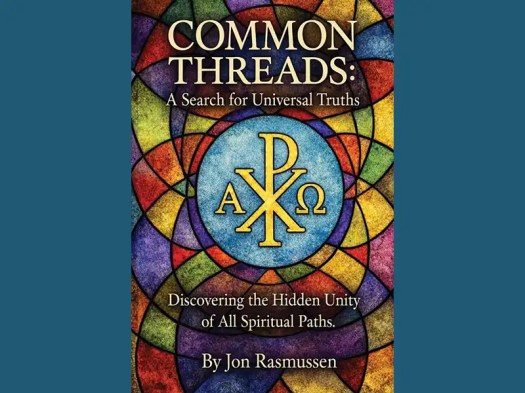
Common Threads | Jon Rasmussen

Common Threads

The following is an excerpt from Common Threads by Jon Rasmussen. It’s a featured Speakeasy selection, and there are still limited review copies available for qualified reviewers.

This work is not the result of an academic project. It is the result of trying to understand, study, practice, and make sense of and find truth in everything I was being taught about this world and the world of spirit.

For decades I have walked inside two worlds that many people believe cannot be reconciled: the sacramental life of the Catholic Church and the direct, initiatory encounter with the living structure of reality that many would call shamanic and scientific. In lived experience they are not in opposition. They are describing the same alignment from different entry points.

On one side was the immense, living tradition of the Catholic Church —sacramental, historical, embodied, anchored in the Incarnation and the Eucharist, shaped by saints, guarded by doctrine, luminous with beauty.

On the other side was the vast landscape of the world’s spiritual wisdom —the Upanishads and the Tao Te Ching, the Buddha’s awakening and the Sufi’s burning heart, the insights of contemplative psychology, the language of consciousness, the discoveries of modern science, and the testimonies of people whose experiences did not fit within any single inherited framework

I did not experience these as enemies. I experienced them as converging. Again and again, in prayer, in study, in conversation, and in the lives of people whose holiness could not be confined to a single vocabulary – like my Q’ero Shaman teachers who were isolated since 1492 AD high in a remote area of the Andes Mountains of Peru, who have spoken only the unwritten language of Quechua and share stories going back 15,000 years of originally coming from the stars, and who seem to me like the most Christ-like people I have ever met – I began to see the same pattern:

The same depths of silence.
The same transformation of the heart.
The same movement from ego to love.
The same intuition that reality is communion.

At first this convergence created a crisis. How could I remain fully, faithfully Catholic and at the same time acknowledge the real presence of truth, holiness, and transformation outside the visible boundaries of the Church, or any of the many Christian-based denominations?

How could I avoid reducing the uniqueness of Christ to one symbol among many — and also avoid denying the evident work of the Spirit in the world?

How could unity be real without becoming vague? This book is the fruit of living inside those questions. It is not an attempt to create a new system. It is an act of contemplation. It is the result of discovering that the Catholic mystical and sacramental vision does not close the circle of truth — it opens it.

What I came to see is simple and inexhaustible: Every authentic search for truth is already held within the Logos through whom all things were made, also known as the Source, the Universe, the Om, the Wiracocha (wellspring) and IntiTaiTai (the sun behind the sun). Every real movement toward love participates in the life of the Trinity in Catholicism: God, God in human form (Namaste), and the Holy Spirit (God Source in all of the forms both physical and non-physical).

Every transformation into compassion is a participation in the Paschal Mystery, which is Jesus’ passion to take on the suffering of the world (like Sidhartha the Budha), his death on the cross, and his resurrection, which are similar to the death and rebirth practice in shamanism and many other traditions for the primary purpose of freeing us from our mistakes and guilt and giving our soul the clarity to live consciously forever in the state of heaven within. You can go through this yourself, or you can accept and thank Jesus for doing it for you – like the ultimate shaman session, but rather completely free and unconditional.

The Incarnation of God through Jesus does not narrow the spiritual universe.

It reveals its center. This book was written for several kinds of readers. For the Catholic who senses that the Holy Spirit has been at work far beyond what they were taught to see, and who longs for a vision large enough to hold both fidelity and openness.

For the seeker who has encountered real light in many traditions and wonders whether there is a home in which those lights are not extinguished but rather gathered
For the contemplative who recognizes the same silence behind many different names.

For the modern person who can no longer divide science, spirituality, psychology, and daily life into separate compartments and who longs for a single, living synthesis.

This work does not attempt to erase differences between traditions. Those differences are real, and they matter. Nor does it pretend that every teaching is equally true?

Instead, it asks a more demanding question: What do we discover when we listen at the deepest level — the level at which the human person is actually transformed into love?

At that depth, the common threads appear. And at the center of those threads stands not an idea, but rather a presence:

The One in whom the Absolute becomes intimate,
the cosmos becomes sacrament,
the human person becomes communion,
and history becomes Eucharist – a true embodiment of Christ in all of us.

If this book has any value, it is not because it offers a new theory.

It is because it points toward a way of seeing — and ultimately a way of living— in which unity is no longer something we construct, but rather something we recognize as already given in Christ, who is “all and in all.”

This is not the end of a conversation. It is an invitation to one. What I am presenting here is not a theory about unity. It is the recognition of a pattern and common threads of teachings that repeatedly produces the same results in human lives across cultures: greater coherence between feelings and thoughts, power and integrity to ask for what you prefer and experience it, greater freedom from distortion and negative influences, greater capacity to love, and measurable protection from the forces that fragment the soul and seek to take from us all that we have – our power, our life force and will to live, our health, and our good relationships.

The Catholic mystical vision that I was originally born into and then left in my early twenties, is now clearly the incarnational center of this map because with a life of experience and now clearer understanding it is the place where what other traditions experience interiorly becomes historically embodied, sacramentally participatory, and communally lived. And the full circle for me going from Catholic to every other religion, spiritual tradition, and the most ancient continuous forms of Shamanism as both a practice and a vocation, is that I now see the value, beauty, grace, efficiency and commonality of all of my favorite aspects of all that I’ve learned and experienced are truly present in the Catholic Church. In other words, if I had applied the same time and effort of study, understanding and practice I put into everything else into my Catholic Faith, I might have come to this conclusion decades earlier. And then again, my purpose here seems to be a bridge for all things, for which I am now more qualified having taken this long and circuitous route.

With this book, I hope to take the decades of work and understanding that I’ve accumulated and pass it on as a more quick and efficient bridge to those who may be on a similar journey. This book is written for those who are no longer satisfied with inspirational language but rather want to understand the operational structure of transformation — what actually changes a human life and what does not.

If you read it slowly and apply it, it will function not only as a text but rather as a stabilizing alignment in your life that will allow you to focus your mind and energies to get to that experience of “heaven within” for this life and hereafter with greater ease and grace.

A good way to start is to take a measure of what portion of your life’s inner experiences would you consider to be heavenly (peace, pleasure, joy, comfort, love and etc.), hell-like (pain, anguish, confusion, fear and etc.) or purgatory, which is trying to get from hell-like to more heavenly with a lot of struggle, hard healing, spiritual, and psychological work, feeling lost and directionless, etc. Take note and write down what percentage of each of those you think is your current reality.

Then do it again after reading this book and maybe using the associated Common Threads Project App for a little while, and/or maybe joining or re-joining the Catholic Church if it makes sense to you. And with any spiritual tradition, healing tradition including western doctors and therapists, and everywhere else, it is critical to keep your power with it – in other words, nobody is above you, even in the man-made hierarchies. This way, you can participate in anything and not throw any babies out with the bath water – in other words, get the best of what it has to offer regardless of the flaws. Like I learned in my Shaman training, don’t confuse the message with the messenger, and certainly don’t give up on a valuable practice and non-physical team like the Eucharist, Jesus, Mary, and the Angels and Saints, the powerful sacred space and protection of the Church and years of powerful prayers just because, like in everything else, some deeply flawed humans are involved. In the end, it is about aligning YOUR Kingdom Within, with the best of the Kingdom of God aka the Source of All-that-Is. This is not the end of a conversation. It is an invitation to one.


Humanity is not suffering from a lack of spiritual information. It is suffering from fragmentation.

Common Threads reveals the single pattern that has produced authentic transformation across the great traditions of the world — and shows how that pattern becomes fully embodied in the Catholic sacramental vision.

This is not comparative religion.

This is a map of reality.

Drawing from decades of lived experience in contemplative practice, sacramental life, and direct work with the dynamics that either empower or fragment the human person, Jon Rasmussen presents a structure that allows the reader to:

  • recognize authentic transformation
  • discern false unity and ego-based spirituality
  • stabilize alignment with the Good
  • understand why the Eucharist is the operational center of communion

This book is for the reader who wants more than inspiration — it is for those who want a life that becomes coherent, protected, and capable of love.

Praise for Common Threads

“This book is an interesting and easy read that offers a personal perspective on identity, attraction, and self-understanding. The author writes in a simple and conversational style, which makes the topics approachable even when discussing more complex ideas. I liked how the book encourages readers to think beyond labels and reflect on how personal experiences can shape the way people understand themselves over time.”
—Amazon Review

“Common Threads has been such a gift for my soul at a time in our modern society where I’ve craved faith, truth, and hope. The author does a remarkable job laying bare so many answers to questions I haven’t known how to formulate with my own words.”
—Amazon Review

“Common Threads by Jon Rasmussen offers readers an introspective journey into the similarities that connect spiritual traditions across cultures and time periods. Rasmussen approaches spirituality with curiosity and openness, encouraging readers to look beyond differences in doctrine and focus on the recurring themes of compassion, purpose, connection, and human understanding.”
—Amazon Review

About the Author

Jon Rasmussen is a Catholic contemplative practitioner, shamanic initiatory guide, and teacher of the structural dynamics of transformation and consciousness.  His latest projects include a Catholic Life Coach web-based App called Veritas Life Guide, and his Common Threads project includes the book: Common Threads: A Search for Universal Truths – Discovering the Hidden Unity of All Spiritual Paths, the associated website and web-based app.

Common Threads on Bookshop

Jon Rasmussen’s YouTube

Shamen Radio Podcast

Common Threads Project Website

Common Threads Project App

Just Love | Wayne Jacobsen and Tobie van der Westhuizen

Just Love

The following is an excerpt from Just Love by Wayne Jacobsen and Tobie van der Westhuizen. It’s a featured Speakeasy selection, and there are still limited review copies available for qualified reviewers.

Excerpt from Chapter 2 & 3 of Just Love:
How One Mistranslated Word Distorted the Gospel

In my early forties, after a betrayal of a close friend and ministry colleague, I found myself on a different trajectory. God began to reveal how much he loved me, even in my feelings of failure and confusion. Over the next few years, he took me through a remarkable transition, from seeing God as someone I had to appease by my good behavior to a Father who already loved me, even in my struggles. Instead of waking up every morning trying to be loved by God, I started waking up as his beloved, a journey I chronicled in my book He Loves Me.

As that transition took place, I began to discover the relational joy and transforming power of engaging in an affection-based relationship with the Father through the Son. This was the life of Jesus I had long sought but my vigorous religious activities had failed to produce. I was amazed to watch struggles and temptations I’d fought for decades slowly fade away as love took hold. I found myself thinking and living differently; the joy I found in him displacing the temptations that I once wrestled with so stringently. This connection to his love became the predominant influence in my life, shaping how I treated myself and those around me.

For the past thirty years, I’ve traveled the world, helping people explore a relationship with Jesus that grows out of a confidence in his love for them, even in their darkest struggles. I want people to discover the joy of an affectionate relationship with God the Father, which is both personally liberating and redemptive for those around them. We can’t do that through our own efforts; it results from God’s love and goodness transforming how we think and live inside a growing relationship with him. 

Then one day, I received a fascinating email from South Africa. I had no idea who Tobie van der Westhuizen was or why he wanted to share with me a discovery he had been exploring for eight years. He wanted to know if his conclusions resonated with me.

Did they ever!

But it did take us some time to get there. His initial statement made me wonder if he was yet another kooky amateur theologian with some half-baked theological novelty. Tobie’s initial email cut right to the chase: “The word righteousness is not in the Bible.” 

Of course it is, I thought and immediately recalled two dozen Scriptures off the top of my head that speak of righteousness. However, I was intrigued enough to keep reading and discovered that his point was not that our English translations don’t include the word righteousness, but rather that it is a mistranslation of the original Greek. Then he laid out a compelling case that the word should have been translated to justice or justness, not righteousness.

At first glance, that would seem a minor distinction, but throughout this book, we will show you it is not. Why translators got that wrong and what it did to diminish our view of the life in Jesus is a compelling tale and opens the door to a more powerful gospel than what many embrace today. If true, this wouldn’t change the Gospel we’ve come to know, but it would give it a very different emphasis, making it richer and more transformative. 

Did Jesus say, “Seek first his kingdom and his righteousness, and all these things will be given to you as well?” Or did he say, “Seek first his kingdom and his justice, and all these things will be given to you as well?” (Matthew 6:33) The first naturally draws our eyes inward, focusing on our personal piety and individual morality. The second focuses on how we consider others around us. Am I seeking to be just in my dealings with them, or do I exploit them to get what I want? 

That’s how we’ll speak of justice in this book. Many people think of justice as punishment for crime. When someone is convicted and sentenced to death, we say the family of the victim got justice. Others think of it negatively because it has been co-opted by the political left to talk only about their view of social justice. But the Bible speaks early and often about being just in our dealings with people, and all the more so if righteousness is a mistranslation.

C. S. Lewis provided a powerful definition of the justice we’re discussing by listing his seven virtues in Mere Christianity: “Justice means much more than the sort of thing that goes on in Law courts. It is the old name for everything we should now call fairness; it includes honesty, give-and-take, truthfulness, keeping your promises, and all that side of life.” This is the justice of God that cannot be institutionalized in governments or religion by simply encoding it in rules.

The more Tobie and I explored this together, the more I realized that over the previous thirty years, love had already taught me to live in harmony with Tobie’s discovery. He offered a piece that has gone missing since the Reformation, when Protestants became more focused on imputed righteousness than on treating others justly.

Many follow the rituals and disciplines without ever discovering the fullness of joy that comes from living in tune with his presence in us. What I’ve been most struck by is how Tobie’s research unites the Old and New Testaments in a breathtaking way as one continuous story of God’s purpose unfolding in human history by connecting the coming of God’s kingdom on earth with the purpose of salvation. It also shows how Jesus transforms people from the inside out, not steeped in human effort but through the power of love to rewrite our story inside God’s redemption.

What Tobie shared with me highlighted in the Scriptures what I’d come to discover over the previous thirty years. Love had already taught me the reality of what he described, and now I had the Scriptural thread that brought it together. As we spoke, we both sensed that God had brought our two stories together to share something with the world that could help us embrace a more vibrant faith that expresses the kingdom of God.

As we’ll see, only the love of Jesus working in us can make us just. This isn’t something we can accomplish through human effort. When we experience his love, we’ll find ourselves increasingly treating others with compassion, integrity, honesty, fairness, and mercy. This is how the kingdom of God becomes visible in our world. The just person living in an unjust world will carry a weight of character and graciousness wherever he goes and will also scandalize a world built on selfishness.


What if one mistranslated word split the Gospel in two — and kept it broken for five hundred years?
In a high school chemistry classroom in Bloemfontein, South Africa, Tobie van der Westhuizen asked his students what “karma” meant. They leaned forward. They had opinions. They argued. Then he said: “There’s another word that means the same thing.”

Silence.

“Righteousness,” he said.

The class slumped back in their chairs. Faces twisted. Murmurs of protest went up across the room. “No, sir.” “That’s about entitlement.” “That’s when people think they’re better than others.”

And Tobie realized something seismic had just been confirmed: the very word English-speaking Christianity has used for five centuries to translate the heart of the Gospel is unintelligible — even repellent — to the people the Gospel was meant to reach.

Just Love: How One Mistranslated Word Distorted the Gospel is the fruit of that classroom moment and the decades of linguistic, theological, and personal reckoning that preceded it. Written by Tobie van der Westhuizen and beloved author Wayne Jacobsen (He Loves Me), it makes a case that is at once scholarly and devastating in its simplicity: the Greek word dikaiosynē, translated as “righteousness” in every major English Bible, is rendered as justice in every other language — German, Afrikaans, Spanish, French, Dutch. Every single one. The English deviation traces directly to the Norman Conquest of 1066, which severed English legal vocabulary from its Germanic roots, creating a religious word — “righteousness” — that conveyed personal moral status instead of right relationship, inner purity instead of just action, individual salvation instead of communal transformation.

In short: what we call the “social gospel” and the “personal gospel” were never meant to be two things. The split was a translation accident. And its consequences have been catastrophic.

This is not a book about scoring theological points. Wayne Jacobsen opens with one of the most vulnerable passages you’ll read this year — the story of discovering that his wife of forty-seven years carried buried childhood trauma that had nearly destroyed their marriage, and how finding that “missing piece” transformed everything he thought he understood. That’s the register of this book: personal, pastoral, luminous with grace, and quietly revolutionary.

Tozer sensed it. N.T. Wright and Nicholas Wolterstorff have written about it in academic papers few will ever read. Just Love brings it home — not to theologians with PhDs, but to the “plain man and woman, the insignificant, the widow and the orphan, the poor and oppressed” for whom the justness of God was always intended.

What changes when you read justice instead of righteousness?
Everything. “Blessed are those who hunger and thirst for justice.” “Seek first the justice of God.” “The Golden Rule” becomes the Golden Life — not a rule to follow, but a love to inhabit, overflowing into the world.

Perfect for readers who:

  • Have felt the tension between “personal salvation” and “social justice” — and suspected it was a false dichotomy
  • Are drawn to N.T. Wright, Dallas Willard’s critique of the “Gospel of Sin Management,” or Scot McKnight’s kingdom theology
  • Hunger for a Gospel that transforms from within rather than managing behavior from without
  • Find “righteousness” language alienating, moralistic, or weaponized — and want to know why
  • Work in justice ministry and want deeper theological roots for what they already know in their bones
  • Are tired of Christianity that produces converts but not transformed lives

Praise for Just Love

“Not since Luther nailed his ninety-five theses to the door of the Church has there been such an important rediscovery of truth. This changes everything!”
—Brad Cummings, co-author, publisher, and movie producer of The Shack

“Perhaps the most important spiritual discovery during my time on this earth. Prepare to be challenged and hopefully, changed.”
—Bob Prater, co-author of A Language of Healing for a Polarized Nation

“A most helpful, readable, wonderful book. You thought you knew it, but Wayne and Tobie offer eye-opening insight into the layers of God’s justice and love.”
—Dr. Stephanie Bennett, communication professor and author

About the Authors

Wayne Jacobsen has traveled the world helping people embrace a relationship with God deeply rooted in his affection for them. His numerous books include He Loves Me, So You Don’t Want to Go to Church Anymore, and A Language of Healing for a Polarized Nation, and was coauthor of The Shack. A former pastor, Wayne hosts Lifestream.org, which provides resources for spiritual growth, and a podcast at TheGodJourney.com.

Tobie Van Der Westhuizen is a Bible teacher, educator, and learning designer from South Africa, holds a PhD in Higher Education and has spent decades teaching, writing, and communicating complex ideas with clarity and imagination. He is the owner and principal of Ridgefield Academy and blogs at JusticeofGod.com.

Just Love on Bookshop

Just Love Trailer

Just Love on The God Journey Podcast

Insight Interview with Wayne Jacobsen and Tobie van der Westhuizen

Wayne Jacobsen’s Website

Tobie Van Der Westhuizen’s Website

Not to a Flag, but to a Flame: Introducing The 1526 Project — Resistance at 500 | Ben Boswell

An interlude before we go on.

Part Two of my Interdependence Day trilogy — The Road Not Taken — is nearly complete and will land in your inbox soon. But before it does, I want to hand the mic to my friend Rev. Dr. Ben Boswell, because what he’s weaving belongs in this conversation too. My trilogy argues that real freedom in USAmerica has never trickled down from our founding document — it has been seized, again and again, by the people this declaration was written to exclude. Ben takes this claim and builds a twenty-week spiritual-formation curriculum on it, tracing the true American founding not to 1776 but to a revolt of enslaved people in the Georgia woods in 1526. It’s called the 1526 Project, it’s already underway (you can still join mid-stream — each week stands alone), and the whole thing costs $15.26.

If you skim nothing else: get the curriculum here, or read three sessions free first. Now — here’s Ben.


The arc of the moral universe is long, but it bends toward justice — and the bending is being done by hands you have not yet learned to honor.
— after Theodore Parker, with maroon corrections

What, to the American slave, is your Fourth of July? I answer: a day that reveals to him, more than all other days in the year, the gross injustice and cruelty to which he is the constant victim.
— Frederick Douglass, Rochester, July 5, 1852

We who believe in freedom cannot rest until it comes.
— Ella Baker, by way of Sweet Honey in the Rock

I hate, I despise your religious festivals. Your assemblies are a stench to me.
— the prophet Amos (5:21)

Fifty years ago, on the bicentennial of the signing of the Declaration of Independence, my mother was not in the mood to celebrate. A graduate student at the University of Virginia, steeped in the Black intellectual tradition, she told my father — then her boyfriend — that she would not join the jingoistic pageantry of parades and fireworks. Instead of celebrating two hundred years of freedom for white male landowners, they agreed to see Aerosmith, Bob Seger, and Jeff Beck, and get high.

The apple doesn’t fall far from the tree.

Like my parents, I’m in no mood to celebrate the semiquincentennial of American independence, and I have no interest in the white nationalist propaganda festival masquerading as “Freedom 250.” There was no semblance of true freedom in this country until Juneteenth 1865 — and even that was partial and temporary. What “freedom” are we celebrating?

Whose Freedom?

There is a massive contradiction at the heart of the American experiment: what America calls freedom was built on, and continues to be dependent upon, the unfreedom of others. Freedom for white people was built on the enslavement of Africans, the genocide of Indigenous nations, Jim Crow apartheid, mass incarceration, mass deportation — and the beat goes on.

The Founding Fathers were capitalist landholding colonizers who declared independence chiefly from any constraint on their accumulation of wealth and power. They had no intention of extending freedom to women, to Indigenous nations, or to enslaved Africans. Their pseudo-enlightenment understanding of freedom was severely limited by a white colonial imagination.

Why would we celebrate the genocidal settler-colonialist enslavers who founded this nation?

Scholar Saidiya Hartman claims the end of slavery should be considered “the nonevent of emancipation” because the freedom received arrived burdened and hollowed out. In Scenes of Subjection, she shows how emancipation transferred the formerly enslaved into a new architecture of subjection: the debt of the sharecropper, the binding labor contract, the “burdened individuality” of a liberty that conferred blame without land, power, or protection. Liberty became one more instrument of domination.

According to Eddie Glaude Jr., American freedom is white freedom — an imposter freedom, treated as the white man’s possession and a revocable gift he can grant or withdraw at will. Every advancement toward freedom for non-white Americans meets a season of white backlash, like the one we are living through now, which serves as a horrific reminder that American freedom has always been for whites only.

Whose Democracy?

I am also in no mood to indulge attempts by “moderate” or “progressive” Christians to redeem the semiquincentennial as proof of a sacred bond between Christianity and American democracy. What Christianity are we talking about? What democracy?

In an age of extreme White Christian Nationalism, it is disingenuous to speak of that bond without specifying which Christianity we mean. There are many different versions of Christianity and democracy in America. Most of them are fraudulent.

Over the last 250 years, Christianity has most often been an enemy of democracy and a partner in oligarchy, patriarchy, colonialism, capitalism, and white supremacy, blaspheming their support for these evils in the name of Jesus. The only reason we have anything resembling a democracy in this country today is because of the resistance by the people to whom white freedom was never intended to extend.

What would Indigenous Americans, the descendants of enslaved Africans, women, LGBTQIA+ people, immigrants, and AAPI communities make of our 250 festivities and think pieces? These are not rhetorical questions. They force us to ask whether the word freedom means anything when Americans say it.

Honesty requires us to confess that true freedom has never been handed down by this nation. It has always had to be seized, repeatedly, by the very people the nation was built to own and oppress.

Freedom is not a gift an oppressor can give, because oppressors can only offer the freedom they possess — one built on the slavery of others, which is not freedom at all but domination in disguise. As Ursula Le Guin’s “The Ones Who Walk Away from Omelas” reminds us, real freedom cannot be based on oppression, and we must walk away from false white freedom to pursue a liberty that is not dependent on anyone’s bondage.

Frederick Douglass tore off that mask on July 5, 1852 — not July the Fourth, but the day after. He faced a hall of white abolitionists expecting an Independence Day oration and delivered an indictment: “What, to the American slave, is your Fourth of July?… To him, your celebration is a sham.” And: “This Fourth of July is yours, not mine. You may rejoice, I must mourn.”

He was not refusing to love freedom; he refused to let a complicit Christianity counterfeit the word.

Personally, I am not satisfied, as my mother had to be, in refusing the counterfeit alone. Sacred memory is among the holiest practices of any spiritual tradition.

A More Worthy Celebration

Watch Night New Year’s Celebration, 19th-century

I reject the Fourth of July as a day of independence, but that does not leave me without a celebration — only free to keep a truer and more liberative one, which took place five hundred years ago.

Two hundred and fifty years before the founding enslavers and colonizers signed their declaration, in the summer of 1526, a Spanish nobleman named Lucas Vázquez de Ayllón set out with roughly six hundred would-be settlers, three Dominican friars, and about one hundred enslaved Africans, and planted the first European colonial settlement in what would become the United States — the original sin of the American project, eighty-one years before Jamestown. He called it San Miguel de Gualdape, on the coast of what is now Georgia.

The colony lasted three months. Disease swept through it. The settlers fought each other. Ayllón died on October 18. And within weeks the whole thing lay in ruins — because the enslaved Africans rose up, killed their enslavers, burned what could be burned, and walked into the woods to live free with the Guale people. They were the first enslaved Africans to revolt against slavery on this soil, and when they joined with the Guale they formed, in all likelihood, the first maroon community on the North American mainland. Scholars now believe the descendants of that 1526 revolt also played a critical role in the massive Guale Revolt of 1597, a coordinated uprising that nearly dismantled the Spanish colonial system across Georgia’s Sea Islands.

These brave revolutionaries signed no parchment. Their names have been lost to history. Yet they engaged in the first of a long line of slave revolts on this continent; they formed the first maroon community on this soil; they gave birth to Afro-Indigenous solidarity; and they established a true multiracial community of freedom two hundred and fifty years older than America itself. They began the real American revolution — the only one that has ever mattered — and it has been going on, in maroon swamps and slave quarters and Indigenous councils and Black churches and Pentecostal storefronts and on the Standing Rock prairie, for five hundred years without stopping.

This is what I intend to celebrate this year: the anniversary of the first enslaved rebellion, the first resistance to settler-colonialism, the first maroon community, the first true birth of freedom. Freedom did not begin in 1776. It began in 1526, in the woods of coastal Georgia, in the hearts of the enslaved, in the hospitality of the Guale people, and in the courage of those who resisted.

So this year, while the United States throws itself the most expensive birthday party in the history of empires, I am keeping a different feast — and I have built a way for you to keep it with me. It’s called the 1526 Project.

A Debt to The 1619 Project

The 1526 Project takes its name, and much of its method, in homage to The 1619 Project — the landmark work created by Nikole Hannah-Jones with The New York Times Magazine in 2019, which reframed the American story around the arrival of the first enslaved Africans in the English colony of Virginia in 1619 and insisted that slavery and Black resistance belong at the center of the national narrative rather than its margins. The 1526 Project would not exist without it.

Where The 1619 Project reckons with the year slavery’s enduring American institution took root, The 1526 Project reaches back another ninety-three years — to the first European colonial settlement on the mainland, the first enslaved Africans, and, decisively, the first rebellion — and asks the church in particular to keep a different anniversary. We do not offer this as a correction to Hannah-Jones’s work; we offer it as a continuation of it, into the territory of liturgy, theology, and spiritual formation, and with profound gratitude. The argument that the true American founding belongs to the resisted and the resisting is hers before it is ours.

What the Project Is

The 1526 Project: Resistance at 500 is a twenty-week spiritual-formation curriculum that began on Independence Day 2026 and runs through the First Sunday of Advent (November 29) — a calendar arc that opens on the day America tells itself freedom was born, peaks on Sunday, October 18 (the day a different America was actually born, in the woods of coastal Georgia), and carries the work forward to the opening of the Christian liturgical year at Advent.

The curriculum is intended for use by:

  • Individuals seeking a personal devotional — a guided rule of life to read, pray, and practice alone, one session a week from Independence Day to Advent.
  • Local church small groups and adult Sunday school classes seeking a serious, biblically grounded engagement with the histories their pews were not built to remember.
  • Seminary classrooms and theological reading groups who want a primary-source-rich syllabus on the long tradition of liberatory resistance.
  • Faith-rooted organizers, abolitionist communities, and movement chaplains forming the spiritual lives of people doing the work.
  • Ecumenical public-facing networks running a parallel article and podcast series across the same months.

Each weekly session is built around the same six-fold pattern, derived from the spiritual practices of the maroon communities themselves — gather, remember, examine, lament, celebrate, and act — and is paired with a Sunday in 2026, a passage of Scripture, and a moment in the Christian liturgical year. Where the church’s calendar offers an opening — St. Mary Magdalene, the Transfiguration, Michaelmas, St. Francis, St. Luke — we have walked through it.

Five monthly deep-dives — one each for July, August, September, October, and November — provide longer, essay-length studies for those who want to go further. Use them as optional fifth-week gatherings, weekend retreats, podcast deep-cuts, or solo reading.

The arc has two peaks. The first is Sunday, October 18 — the Feast of St. Luke, the gospel of the poor, the day Ayllón died and the day the first rebels walked free — in a gathering we call simply The Feast of Maroon Freedom. The second is Sunday, November 29 — the First Sunday of Advent, also the anniversary of the start of Jamaica’s Baptist War of 1831–32 — in a closing liturgy that hands the fugitive tradition forward into the Christian year. The five weekly sessions between those peaks — Part V: The Long Continuance — carry the story across the rest of the great Atlantic-world rebellions of the nineteenth century: the German Coast Uprising, Amistad, the Creole mutiny, the St. John insurrection, and the Baptist War itself.

A Theological Framework: Maroon and Fugitive Christianity

The theology that animates this project is what we are calling — with the help of theologians and ancestors named in the appendices — maroon Christianity, and, in close conversation with it, fugitive theology. The two terms name the same gospel from slightly different angles:

The maroon escapes and builds a place. The fugitive escapes and keeps the escape itself sacred.

The maroon is the community in the swamp. The fugitive is the disposition in the heart.

We need both.

The framework rests on six convictions:

  1. The God of the Bible is the liberating God of the people who leave, walk, run, hide, and escape. From the Hebrew midwives who lied to Pharaoh, to the Israelites who walked out of Egypt, to Mary who fled to the hill country and then to Egypt with her child, to the early church scattering from Jerusalem under persecution — the Scriptures are saturated with the holiness of escape. Maroonage and fugitivity are not deviations from biblical faith. They are among its native forms.
  2. Freedom is the running, not only the arrival. The political theorist Neil Roberts has argued that freedom is best understood as marronage itself — the movement of fleeing, not the eventual settlement in a free place. Fred Moten and Stefano Harney, in The Undercommons, have shown how the fugitive constitutes another way of being in the meanwhile, beneath and alongside the institutions that cannot capture it. Kelly Brown Douglas has named what this looks like in the church: a fugitive faith, never fully settled, always on the way toward the kingdom. To be a maroon Christian is to recover the fugitivity of running.
  3. The cross is not a license for empire; it is empire’s defeat. When the Doctrine of Discovery turned the cross into a property deed, it inverted the gospel. The cross is the place where Rome’s project failed, where the lynching tree was made into a tree of life, where the executioners learned that they had killed someone who would not stay killed. A theology that uses the cross to justify conquest has stopped being Christian; it has become Caesarist — empire religion.
  4. Resistance is a spiritual discipline. The enslaved Africans who set fire to San Miguel de Gualdape were not engaged in a political act distinct from their religious lives. They were practicing the discipline of refusal. Like prayer, fasting, almsgiving, and worship, refusal is something Christians do — and it is something we have to learn.
  5. Land is liturgy. The first communities of resistance on this continent — Indigenous and maroon — knew themselves to be in covenant with particular places. The swamps that hid them, the rivers that fed them, the soil they planted: these were not backdrops to their faith but participants in it. Any spirituality of resistance has to relearn how to be in relationship with land, which means relearning how to follow the lead of those who have always known how.
  6. The eschaton has already broken in among the fugitive people. Where two or three gathered in the Great Dismal Swamp, the kingdom was there. Where Palmares stood for a hundred years, the kingdom was there. Where a Black church sang under the trees in hush harbors and a Lakota grandmother prayed at a pipeline gate, the kingdom is there. We are not waiting for the new heaven and the new earth. We are joining people who have been living in it the whole time — and who, in the tradition that runs from the maroons of San Miguel de Gualdape through Harriet Tubman through the scholars of fugitivity in our own day, have always known that the gospel is on the move.

Interested? Here’s how to join us.

The 1526 Project is not a document to admire; it is a practice, and it is already underway. It began on Independence Day and runs every Sunday through the First Sunday of Advent — which means the two great peaks are still ahead of us: the Feast of Maroon Freedom on October 18 (the day Ayllón died and the first rebels walked free), and the Advent liturgy on November 29 that hands the fugitive tradition forward into the Christian year. Every week stands on its own, so it is not too late to begin. Start today and walk the rest of the way with us.

Get the full curriculum — $15.26. Priced at fifteen dollars and twenty-six cents in honor of the anniversary, a single congregational license gives you all twenty weekly sessions, the five monthly deep-dive essays, the Feast of Maroon Freedom and July 4 liturgies, the reading and guest-list guides, and permission to reproduce the whole thing for your community. (Not ready to buy? Read three sessions free — San Miguel de Gualdape, the anatomy of a failed empire, and the maroons’ fugitive theology — before you decide.)

And however you come, come to do something. There are three ways in:

  • Run the series. Gather a circle, a class, or a whole congregation and walk the twenty weeks together — then tell the project you’re running it, so you can be woven into a network of communities keeping this anniversary across the country.
  • Pay reparations. Every session ends in action. Build durable, recurring support for Indigenous-led and Black-led organizations in your own region. Reparation begins with relationship.
  • Amplify the voices. If you run the companion podcast or article series, center Indigenous, Black, Caribbean, and Latin American scholars and elders as your primary voices — and pay them for their time.

The empire is throwing itself the most expensive birthday party in history. You are invited to keep a truer feast — one that is five hundred years old and still running. Come find your place in it.

Learn more and begin at resistance500.com.


Rev. Dr. Benjamin Boswell is the co-creator of the Resistance 500 curriculum and the author of For the Facing of This Hour: Preaching That Resists White Christian Nationalism and Confronting Whiteness: A Spiritual Journey of Reflection, Conversation, and Transformation. He is the former pastor of Myers Park Baptist Church in Charlotte, N.C., and is currently the lead pastor of a new church in Charlotte called Collective Liberation Church.

USAmerica at 250: A Declaration of Interdependence

Part One: From American Dreaming to Wide Awake

A three-part series for America’s 250th

“A nation is not a thing so much as a process; we’re not a particle, but a wave.” —Marianne Williamson

“We may be able, handful that we are, to end the racial nightmare, and achieve our country.” —James Baldwin

I. The Candle and the Wound

USAmerica turned two hundred and fifty this month, and I have been trying to figure out what to feel.

I know what the fireworks wish to evoke. I know what feelings the flags folded into car windows and the beer commercials and the drone shows spelling 250 against the night sky want to swell in my chest. But a birthday is a strange thing to celebrate when the birthday-subject is not sure whether it wants to keep lurching forward in a zombified half-life, or whether it’s willing to let the parts of itself that are perishing finally die so that something truer can be born.

I’m not going about this perfectly at all, but I aim to inhabit the full range of life, from Spirit to sinew. So when it comes to reflecting on my country of birth, let me light a birthday candle for this aging, contradictory, God-haunted country — while I also refuse to look away from our national wound, which is deep, and old, and bleeding through its bandages afresh.

Here’s the unflinching truth as I see it in this summer of our two hundred and fiftieth year: we’re living through a season of graft dressed up as governance, of oligarchs seated at the head of the national table while the price of eggs and rent and ground beef climbs past the reach of the people who actually make our country work from day to day. We’re watching masked agents pull our neighbors out of courthouses and shopping centers, off factory floors and from the arms of their children, the administration in charge having the chutzpah to call it ‘order’ while the ostensible ‘opposition’ party sits nearly-mutely in the cuck chair. We de-fund vital aid projects the world over in the name of ‘government efficiency’ while millions of children starve. We are funding, arming, and shrugging at a butchery in Gaza that history will not let us un-see. We deny and dismantle vital common-good programs at home and abroad, running these ‘savings’ to war chests, mass-surveillance, billionaires and our world’s first newly-minted trillionaire, daring to call this massive wealth grift ‘big’ and ‘beautiful.’ We have made cruelty efficient and called it ‘strength.’

I do not pen this truth to stoke despair. I write it because lament is often the beginning of prayer; A broken spirit is my sacrifice, God. You won’t despise a heart, God, that is broken and crushed (Psalm 51:17, CEB) I don’t know how to reach credible hope without walking through this valley of the shadow of national death. As the author of Scripture’s Lamentations sorrowed,

“My eyes are spent with weeping;
my stomach churns;
my bile is poured out on the ground
because of the destruction of my people,
because infants and babes faint
in the streets of the city.”
(Lamentations 2:11, NRSVUE)

The prophets don’t look away, so I guess I won’t either.

But I want to propose something to you across this series — something I’ve come to believe deep in my belly: I believe the document this country was founded on was only ever half of the revolution. I believe the other half has been waiting, patient as a seed, in the soil of our shared history the entire time. And I believe the birthday gift this nation actually needs is not some tired reiteration of the Declaration of Independence.

It is a Declaration of Interdependence.

Let me show you what I mean.

II. The Debt in the Declaration

Let’s start with what we’re supposedly celebrating.

True confession: I’m not the most patriotic person. But the Declaration of Independence is a genuinely riveting artifact. Marianne Williamson, in Healing the Soul of America, calls it one of “the miracles of modern history” — the founders, heirs to the Enlightenment’s conviction of the inherent goodness of the human person, prying open “a doorway in a seemingly impenetrable wall of history. The Western world was stuck, and they unstuck it.” This strikes me as true, and I won’t let cynicism snatch it from me.

But Williamson is also honest enough to name the crack that ran through USAmerica’s foundation from the first pour of concrete: the majority of the men who signed the Declaration of Independence enslaved people. The men who wrote that “all men are created equal” held human beings as property while they wrote it. The USAmerican ideal was luminous. The practice was theft, and worse.

You want to know how that contradiction sounded to the people crushed beneath it? Open the Narrative of Sojourner Truth. Before Isabella’s own story even begins, the abolitionist preface that frames her Narrative turns the Fourth of July into an indictment:

“We hear your boasts of liberty, your shouts of independence… but, mingling with all these, and rising above them all, we also hear the clanking of chains! the shrieks and wailings of millions of your own countrymen, whom you wickedly hold in a state of slavery.”

That is the sound the founding made in the ears of the enslaved. Merry peals of bells and, underneath, the clanking of chains. The same air carrying both.

A century and a half later, James Baldwin gave this contradiction its most precise name. In Notes of a Native Son he wryly called it innocence — the American refusal to know what we have done. “It is only now beginning to be borne in on us,” he wrote, “very faintly… and very much against our will,” that our habit of painting the world in “glaring black and white” has cost us our “grasp of reality.” Baldwin levels an indictment I can’t contradict: “Anyone who insists on remaining in a state of innocence long after that innocence is dead turns himself into a monster.”

This is the debt in the founding document. The ideals themselves have legs, but we shackled them. We wrote a promissory note to the human race and then spent two and a half centuries finding reasons not to pay. In his iconic I Have a Dream speech on the steps of the Lincoln Memorial in 1963,  Martin Luther King, Jr., put it unforgettably: 

We have come to our nation’s capital to cash a check. When the architects of our republic wrote the magnificent words of the Constitution and the declaration of Independence, they were signing a promissory note to which every American was to fall heir. This note was a promise that all men would be guaranteed the inalienable rights of life, liberty, and the pursuit of happiness. It is obvious today that America has defaulted on this promissory note insofar as her citizens of color are concerned. Instead of honoring this sacred obligation, America has given the Negro people a bad check which has come back marked ‘insufficient funds.’ But we refuse to believe that the bank of justice is bankrupt. We refuse to believe that there are insufficient funds in the great vaults of opportunity of this nation. So we have come to cash this check — a check that will give us upon demand the riches of freedom and the security of justice. We have also come to this hallowed spot to remind America of the fierce urgency of now. This is no time to engage in the luxury of cooling off or to take the tranquilizing drug of gradualism. Now is the time to rise from the dark and desolate valley of segregation to the sunlit path of racial justice. Now is the time to open the doors of opportunity to all of God’s children. Now is the time to lift our nation from the quicksands of racial injustice to the solid rock of brotherhood.

In the last year of his life, King diagnosed our ills with a physician’s exactness: America suffers “a high blood pressure of creeds and an anemia of deeds.”

USAmerica overflows with declarations, but seems to believe good intentions are enough. As the Neville Brothers sang in their haunting 1989 rendition of Bob Dylan’s With God on Our Side:

Oh, the history books tell it
They tell it so well
The cavalries charged, and the Indians fell
The cavalries charged, and the Indians died
Oh, the country was young then, with God on its side

The Spanish-American War had its day
And the Civil War to us, was soon laid away
And the names of the heroes, I was made to memorize
With guns in their hands, and God on their side

So before we blow out any candles, let us at least be a country grown-up enough to admit whose blood is in the cake.

III. Wide Awake and Seeking Rebirth

But here’s where the candle reignites: there has always been another America firing beneath the official one, like a bunsen burner keeping our casserole warm. Not the United States of conquest and contract, but a stranger, more mystical country, forever convinced it could be born again.

Mitch Horowitz tells this secret history in his first book, Occult America. Before there was a United States, there was a twenty-one-year-old mystic named Johannes Kelpius leading forty German pilgrims to the banks of the Wissahickon Creek outside Philadelphia in 1694 — where they lived in caves and a log tabernacle, scanning the stars through a telescope for signs of a new age. Before there was a Constitution, the Burned-Over District of upstate New York was already boiling with utopian communes and perfectionist experiments, people who believed heaven could be built, here, out of timber, shared property, and sheer spiritual audacity.

Even our currency carries the code. Turn over a dollar bill and you will find this Great Seal — this unfinished pyramid, all-seeing eye, and the Latin motto Annuit Coeptis Novus Ordo Seclorum, “God Smiles on Our New Order of the Ages.” Horowitz notes that the design was begun, fittingly, on July 4th, 1776, under a committee that included Franklin, Jefferson, and Adams. Williamson reads that seal as our unique national scripture, a country declaring at its birth that it was not finished — it was a becoming.

I know what you might be thinking. Say “pyramid and all-seeing eye” and half of us flinch Illuminati — the ostensible millenia-spanning conspiracy at once above-top-secret yet somehow littering AM radio, YouTube rabbit holes, and our gaudiest music videos. Or maybe you’re flinching in the other direction, seeing Egypt’s pyramids inextricably as monuments to imperial power, quarried on the backs of enslaved and conscripted labor, the very Egypt the Hebrew captives fled with Pharaoh’s chariots at their heels. Pyramids, like crosses and other archetypal symbols, can have so many valid readings, including as logos of hidden or imperial force. I’m not asking you to un-see any of these.

But I invite you to consider that the founders may have intended yet a third reading on the Seal: a pyramid deliberately left unfinished, its capstone not resting in human hands but floating free, an eye of Providence hovering over the gap. That is not the tomb of a god-king, but its opposite — a monument confessing its own incompleteness, a nation admitting at its birth that it could not finish itself; worldly achievement is nothing without a blessing it cannot manufacture. The empire-pyramid says we built this and we own it. The unfinished pyramid says we are not done, and we are not God. 

One is a boast, but the other is a prayer. I’m interested in the prayer.

This current of holy restlessness runs straight through the people this country tried hardest to break. Horowitz shows us Marcus Garvey harnessing the “mind power” of American metaphysics as a path to Black liberation, teaching disenfranchised people to feel, in his presence, “a spiritual awakening.” He shows us one-time Methodist minister Wallace D. Wattles — the man whose little book The Science of Getting Rich later spawned the infamous manifest-o The Secret — who actually intended his “science of getting rich” as a doctrine of wealth redistribution, mind-power aimed at overthrowing the barons of industry. (This was after he penned a pair of books about Jesus from a New Thought and Socialist point of view) Horowitz shows us Henry Wallace, FDR’s mystically-oriented vice president, staring at that unfinished pyramid and dreaming aloud of a “spiritual New Deal,” a “New Deal of the Ages” that would place “that which is fine in humanity above that which is low and sordid and mean and hateful and grabbing.”

And then there’s a story that sustains the fires of my own practice, the one Jon Woodson tells in To Make a New Race. In 1920s Harlem, a circle of the Renaissance’s most brilliant writers — Jean Toomer, and around him figures like Nella Larsen, Wallace Thurman, George Schuyler, Melvin Tolson — surreptitiously became students of the Greco-Armenian mystic G. I. Gurdjieff.

Gurdjieff’s Fourth Way seeks to integrate heart, mind, and strength into heightened attentiveness, recognizing the field of reciprocal participation he proposes is an all-encompassing ‘Ray of Creation.’ This esoteric wing of the Harlem Renaissance had as their aim nothing less than to dissolve the entire architecture of American racism at the level of consciousness itself. They believed, Woodson writes, that they could “thoroughly transform American culture” — because racism was, in their eyes, a kind of sleep, and their work was to wake people up. Toomer put it as a creed: “Above race values there are culture values. Above culture there are conscious values. The values of Mankind and Consciousness are identical.” They were trying, in the most literal sense, to make a new race — a humanity beyond the lie of division and opression based on race — by evolving a new kind of awareness.

Here’s what I find strange thing about this word — awake. It keeps surfacing in the American story whenever justice is at stake, as if the whole struggle could be reduced to a quarrel between sleepers and the wide-awake.

Eighty years before Toomer’s circle set out to wake America from her race-based trance, a different movement was making wakefulness its literal name. In the spring of 1860, a handful of young dry-goods clerks in Hartford lit torches to escort an antislavery speaker safely home, throwing on black capes to keep the oil from ruining their clothes and calling themselves the Wide Awakes. Within months their ranks swelled to half a million, marching in silent midnight columns from Bangor to San Francisco — a youth movement named, as one of them put it, for their vigilance against the slave system. They were interracial where that was dangerous; a company of two hundred Black men marched as the West Boston Wide Awakes under a banner that read God Never Made a Tyrant or a Slave. And on their membership badge, above the broken shackles, they printed a single open, watching eye. (Wide Awake: The Forgotten Force That Elected Lincoln and Spurred the Civil War by Jon Grinspan is well-worth reading.) A good stirring is hard to put back to sleep: the Wide-Awakes inspired a resurgence in 2020 when pandemic and racial awakening gripped our nation afresh; our attention spans seem far more numbed and overwhelmed now, but this new iteration seeks to keep us alert with art and provocation to this day.

Speaking of our stretched attention: Even more recently, a Brooklyn collective called the Strother School of Radical Attention, together with its wider circle of Friends of Attention, has taken up a similar vigil under a banner they call attention activism — the work of resisting what they name the “fracking of human attention” by coercive digital technologies.

Their 2026 manifesto Attensity! treats our scattered, monetized minds not as a personal failing but as a genuine front in the fight for our humanity, calling us back toward study, sanctuary, and one another. When they reached out to me — fittingly, through the very social media feeds we’re all trying to look up from — I recognized kin.

It’s quite the evolution: the same eye the empire stamped on its money, reclaimed here as the emblem of a people refusing to look away. Vigilance as a spiritual discipline. Attention as resistance. It is the oldest instruction in the Black freedom tradition — stay woke, keep your eyes open — a watchword for staying morally awake in a country forever tempted back to sleep. Reactionary forces in our own moment turning “woke” into a sneer, a slur hurled at anyone who insists on seeing what power would rather we not see, is not an accident. It is exactly what you would expect the sleepers to say. Gurdjieff and Toomer had the diagnosis right; so did the abolitionists, and so did our grandmothers: the first sin is soul-sleep, and the first act of resistance is simply to wake up, and to help each other stay that way.

These phrases provide a shock to my system:

A new order of the ages.

A Spiritual New Deal.

To make a new race.

Befriending Attention.

Wide-Awake.

As I said, I’m not terribly patriotic. But this is the Deep American Dream that fires my moral imagination and political will. The stirring underneath the impoverished American Dream of ‘getting mine.’

It’s like Leonard Cohen sang, full of wit and hope:

It’s coming to America first,
the cradle of the best and of the worst.
It’s here they got the range
and the machinery for change
and it’s here they got the spiritual thirst.

It’s here the family’s broken
and it’s here the lonely say
that the heart has got to open
in a fundamental way:
Democracy is coming to the U.S.A.

Maybe more than a ‘dream,’ it’s the American Wakefulness of being remade — inwardly and outwardly, personally and collectively, all at once.

This is the tradition I am claiming today. This is the country I am lighting her birthday candle for.


Stay tuned for Part Two:The Road Not Taken. A candle needs a night to burn in. And exactly fifty years ago, this country stumbled through a night much like our own: a disgraced president, a lost war, an economy in free-fall, a people wondering if the whole experiment had been a fraud. Out of that darkness came a revival I’ve spent my whole life warming my hands at — and grieving. Because it stood at a fork in the road, and it mostly chose the broad path of spiritual and national destruction. (I’m referring, of course, to the Jesus Movement of the 1970s.) Next time, I’ll take you to that fork, introduce you to the ones who took the road less traveled, and tell you why I think we’re standing in the very same crossroads right now on the road to genuine interdependence. Subscribe here if you don’t already so you don’t miss it.