

 A couple of weeks ago I was dog-sitting for my friend Jake who was out of town. At one point after breakfast, I found myself prostrate on the ground, weeping and talking with an intimate stranger…the Goddess, in fact.
But before I go into all that, it’s probably helpful if I rewind a bit and share a less-known slice of my personal history with the Good Lord.
As longtime readers of this blog might know, my family and I live in Raleigh, North Carolina, where we moved from our native Atlanta are in 2006. We moved here with over a dozen of our friends from undergrad days at Berry College, as well as with new friends and co-dreamers from across the country to ‘seed’ the planting of an ‘organic’ expression of church life – what some variously know as house church, simple church, or intentional community. We were part of a national movement that began to come apart at the seams right around the time we moved; we lasted ‘till about 2008.
Back to me and the Goddess for a second: What caused a nice Jesus-lovin,’ evangelical-reared boy like me to be weeping in front of the Sacred Feminine on my friend’s linoleum floor, a Lassie-looking pup looking docilely on? I was going to write an original explanation of all this, but then I looked back into my ‘Writings’ folder here on the computer, and found something I shared with our house church community back in 2007, on the topic of…
What You Might Not Know About The Lord & Me
You see, our church structure (ideally, at least) was open, participatory, egalitarian and interdependent with others in our ‘family’ or network of churches. Our typical gathering was initiated by singing, and then any number of us sharing for 3-5 minutes, drawn from what we reflected on throughout the week – our “portion of Christ” as we saw it. From time to time, we were given outside direction. We were ‘planted’ and ‘watered’ by those we called ‘workers,’ what those in other traditions might call anything from ‘circuit riders’ to ‘apostles.’ (But we in the Watchman Nee/T. Austin-Sparks post-Brethren lineage that we were, we called them workers.) Our worker at the time, who had a day job as an influential financial manager in the Northeast, challenged us to get to know one another better by having a series of gatherings wherein one person would ‘take’ the majority of the meeting, sharing on What You Might Not Know About the Lord and Me. It was a rich time of hearing new facets of people who lived among – some whom we’d known for years. What follows are rather detailed notes on what I shared:
“The Lord”?
I’m sorry, but this question just lends itself to some rather shady pronouncements. Like “When I was eight, the Lord beat me up and threw me behind a dumpster…” [Dark, Mike. Dark.] But no. I appreciate the impetus behind this question. Many of us have secret pasts and presents with God; dark and mysterious and wondrous things, and it would be good to share.
The first thing you should know is that I don’t call God “the Lord,” not usually. While it’s utterly true that he is our Lord—our Master, the Maestro of the Art of Living—I find it ironic that we’ve picked up on this most formal of titles and made it our choice term of intimacy. The standard placeholder “God” works for me fine, though I also enjoy the Hebrew proper names, like the dynamic and revelatory YHWH, “I am as I shall show myself.” Or El Shaddai.
Let me say a few words about El Shaddai. It’s the most common way I address God while enjoying fellowship with God in Centering Prayer. Now don’t get the wrong impression; I don’t do this nearly as often as I want to; I don’t have a daily ritual of time ‘wasted’ with God like our brother to my right does, though I hope to soon. But when I can, I do the following:
- I’ve chosen a name of God as the symbol of my awareness of God’s presence within, through and around me.
- Sitting comfortably and with eyes resting, I briefly and silently introduce this name—El Shaddai—as the symbol of my consent to God’s presence and action within.
- When I become aware of thoughts, I return ever-so-gently to “El Shaddai.”
- At the end of about 20 minutes—I typically use a timer—I just sit for a moment or two. I might slowly say the Lord’s Prayer.

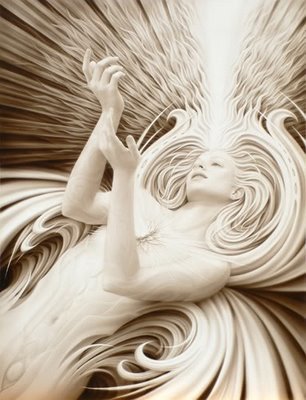
There are two reasons why “El Shaddai” is my most intimate of names for addressing God. One is that, with my proclivity toward eating God, it makes the most sense; one rendering of this name is “The God who feeds.” But there is a second reason. A deeper and more literal rendering of this name is “The God with breasts.” El Shaddai means provider precisely because she is the breast-feeding God. Also known as “The voluptuous God,” this is one of the many female depictions of God that has fallen by the wayside in popular use. (See my Appendix handout for Scriptural depictions of God-as-feminine.)
Why is this important to me? Well for one, becoming familiar once again with the many feminine faces of God in Scripture and history gives dignity and power to our sisters in Christ; it is an abandoned memory that needs to be recovered in our words, in our worship, and in our reflections on who God is in our midst.
But for me as a man this has an altogether more close-to-home meaning: recovering the eroticism of God in my devotional life. About a decade ago—first with certain songs coming out of the Vineyard movement and charismatic renewal, and then from the teachings of our itinerant church planters—I was introduced to a vigorous, full-on God-eroticism via bridal language.
Drawing from the Song of Songs and the many bridal images in both Old and New Testaments, I saw painted for me a love affair between the God of Israel/Christ and the people of God, both Israel and the Church. It was illustrated to me as a male suitor pursuing his beloved with fervor that can only be described as sexual, finally culimanating in the saucy, sensuous repertoire we see in both Song of Songs and the end of Revelation. I’ve seen how this understanding has revolutionized the devotional lives of our sisters in communities across the globe; I’ve also seen men in our churches try to get in the game, with varying results. Jesus-as-our-lover has a kind’ve mixed resonance for men because we’re men – it’s even parodied in our larger church culture by men who are uncomfortable with this level of intimacy in contemporary worship songs as Jesus-Is-My-Boyfriend Music. (I wonder: Have any of these critics ever read Bernard of Clairvaux? Hildegard of Bingen? Teresa of Avila?) We recognize that “In Christ there is no male or female,” so in a real sense we too can enter into the ‘bridal experience’ and feel what it’s like to be ravished by our bridegroom via imaginative prayer and resting in divine fellowship. But for those of us who happen to be heterosexual men happily inhabiting our bodies, this is never quite an intuitive experience, is it?
 So for me, seeing the sacred feminine as Sophia in Proverbs, or El Shaddai in the Old Testament, or Jesus-as-Mother in several New Testament depictions (not to mention in the writings of mystics like Julian of Norwich) gives me back something I’ve never had as a man: the Voluptuous God, the female creator and nurturer who is comfortable with the space she inhabits. El Shaddai is self-possessed with a powerful, seductive eroticism, one that can both initiate and follow. When I spend time with God, she can ignite my senses with insight and proposition; she can also receive everything I have to give. When our workers encourage us to “Make love to your Lord,” guys, it’s worth reframing this!
The early Genesis poem recounts that both male and female are needed to fully bear the Imago Dei, the image of God on earth as s/he is in heaven. I have taken this to heart, and have sought to incorporate both the male and female in my multi-faceted relating to a many-splendored God.
* * *
That’s what I shared in 2007. So. Many. Words. These days, words are failing me. I feel like Thomas Aquinas at the end of his life, when he fell into a profound silence that lasted weeks. When prompted by one of his assistants to continue writing the thousands of pages of analytical theology had was known for, he replied: “I cannot write anymore because all that I have written seems like straw to me, compared to what has been revealed to me…”
Recently, I’ve been through a dark and challenging time in my life. It isn’t over quite yet. And no, dear readers, I will not be disclosing. Some things are best not blogged. But it really doesn’t matter: If you’re breathing air, you know what I’m talking about: The dissolution of something you once held dear, or thought was solid – perhaps in an outside relationship or job; perhaps within yourself. Changes are taking place; sometimes it feels invigorating, sometimes it feels scary.
I was in just such a place while dog-sitting for my friend Jake – doing dishes, listening to music via my iPhone dock, wondering what was next. I was specifically listening to Krishna Das, an American Kirtan singer – his album Live on Earth. Das’s voice is deeply masculine and totally enchanting all at the same time, the depth of devotion he infuses in his songs is hauntingly beautiful. I’d bought his memoir Chants of a Lifetime: Searching for a Heart of Gold at one of the liquidation sales of the late, lamented Borders, and started reading it recently. As far as coming-of-age-in-the-1960s-and-now-being-an-enlightened-superstud stories go, I enjoyed the writing and pacing of Keith Martin Smith’s A Heart Blown Open: The Life & Practice of Zen Master Jun Po Denis Kelly Roshi better. But still – Krishna Das’s story of finding grounding and expansiveness through a life of chanting the Names of God is inspiring – and challenging, as stories like these from varying faith traditions threaten to make me a perennialist yet.
But here I go again with words, words, words – layers of interpretation. Let’s return to the heart of the story: A song came on, Das’s rendering of the Devi Puja, or Goddess Prayer.
From the first notes of his harmonium (an instrument I first heard with powerful effect by my friend, the street-smart yogi and Kalachakra monk Kir – aka Kirantana – at last year’s inaugural Wild Goose Festival), and the repetition of the words He Maa Durga, I stopped drying a glass and froze. Then, I dropped to my knees. I knew that I was in the presence of God, but in this familiar-but-still-culturally-foreign form of El Shaddi, Ruah, Sophia…and more particularly still, Shakti, Shiva, Kali – but more generally, The Goddess.
If you’re one of those people who needs to know what the words mean, here’s an approximate translation of the Devi Puja. But I didn’t know this at the time:
Oh Goddess, you are the one who conquers all
You are the One beyond time
The auspicious One beyond time
The bearer of skulls who destroys all difficulties
Loving forgiveness and supporter of the universe.You are the one who truly receives our sacrificial offerings
To you I bow.
I did not know, but I had the sense of this personified feminine Love, upholding the universe – and yet being difficult (or perhaps I was the one being difficult). And I was certainly bowing. I began crying – a little bit at first, and then weeping. Who was this One I was in the presence of? Somehow familiar, yet utterly foreign. Goddess. A complex swirl of thoughts, memories, and emotions began to swirl within me. Last May, I was initiated into the ManKind Project – a totally awesome secret society (we aren’t really, I just like to call us one); my initiation and subsequent, consistent time spent in a local circle of men has done wonders for digging deep into and integrating my experience of masculine energies – making peace with the idea of being both a real man and a good man. And now, it seems, that Femininity herself is knocking on the door of my heart. My integration continues.
After ten minutes or so of weeping and verbally asking questions of the Goddess, I decided to write them down. I picked up my journal. This is what I wrote:
May 22nd.
Goddess, I can’t be a man without you.
Who are You, who’s been refracted so imperfectly through the women of my life?
Abandoned
Smothered
Wounded
Unattainable
Complex
…why is Your energy so inaccessible, O cruel archetype?
I long to know You as Mother, Lover, Friend.
But You are aloof – You play games with me.
The absence of You divorces body from soul, heart from access and flow.
In my life, I’ve idolized You, and I’ve hated You.
I want neither.
Instead, I want to flow into You – to be lost in Your warmth, intoxicated in Your sensuality, recognizing and honoring Your essence in all things.
I also want to feel like a man in Your presence, to give you my essence and have it received, with gratefulness and joy.
In many ways, my journaling strikes me as being like a Psalm – structured in complaint and collapse into Love. Clearly, I have some issues with feminine energy – and clearly, I long for her. At times, I am misogynist and feminist: This is my confession. Both are true.
The Devi Puja ended, and so did the experience. But she has lingered.
In so many ways, I’m at a crossroads of life and experience. While composting the best of my past, I feel like the first-century church at Pentecost, watching and waiting for the Spirit to hover over the face of my waters. And sometimes, this Spirit comes to me in distinctly feminine form. My prayer – for healing, wholeness, integration, and fresh creation in the world – is summed up in many ways by this song from the band Live at the turn of this century:
Sitting on the beach
The island king of love
Deep in Fijian seas
Deep in some blissful dream
Where the Goddess finally sleeps
In the lap of her lover
Subdued in all her rage
And I am aglow with the taste
Of the demons driven out
And happily replaced
with the presence of real Love
The only one who saves
I wanna dance with you
I see a world where people live and die with grace
The karmic ocean dried up and leave no trace
I wanna dance with you
I see a sky full of the stars that change our minds
And lead us back to a world we would not face
The stillness in your eyes
Convinces me that I
I don’t know a thing
And I been around the world and I’ve
Tasted all the wines
A half a billion times
Came sickened to your shores
You show me what this life is for
I wanna dance with you
I see a world where people live and die with grace
the karmic ocean dried up and leave no trace
I wanna dance with you
I see a sky full of the stars that change our minds
And lead us back to a world we would not face
We would not face
We would not face
We would not face…
See also my “Biblical Proofs” for the Feminine Face of God in Scripture
Recommended Reading if you want to explore the feminine imagery of God more fully:
 In Memory of Her by Elisabeth Schussler Fiorenza (Feminist)
Is It Okay to Call God “Mother”?: Considering the Feminine Face of God by Paul R. Smith (Evangelical)
Embracing Jesus and the Goddess: A Radical Call for Spiritual Sanity by Carl McColman (Episcopagan)
Journeys by Heart: A Christology of Erotic Power by Rita Nakashima Brock (Womanist)
Revelation of Love by Julian of Norwich (Contemplative Catholic)
She Who Is: The Mystery of God in Feminist Theological Discourse by Elizabeth A. Johnson (Feminist)
The Alphabet Versus the Goddess: The Conflict Between Word and Image by Leonard Shlain (a general literary-historical investigation)
The Dance of the Dissident Daughter by Sue Monk Kidd (Post-evangelical, post-Mainline)
The Maternal Face of God by Leonardo Boff (Catholic-Liberationist)
The Unknown She: Eight Faces of an Emerging Consciousness by Hilary Hart (Perennial)


 There was a minister there too, from my past – though instead of having wiry white hair, he’d died it jet black and hat it nearly shaved. His mustache was dark too – made him look decades younger. After the awards were over, Jasmin & I were separated – I was in the car waiting for Jasmin, then I realized she wasn’t coming so I parked it and looked around. Adjacent to where the awards were was this huge coliseum-like structure, made of clay or grey concrete or something. I went inside looking for Jasmin, and it was some kind of coercive cult disguised as a radical labor movement. Most of the crowd – and there were tens of thousands – were working class people, blue-collar on “up.” From the center of the coliseum the speaker was talking about workers’ rights and organized labor and dignity, but there were blue-uniformed policemen at all the doors, preventing people from leaving. But then it got more bizarre; there were lots of kids in the crowd too, and they were encouraging the kids to make ‘scary’ sounds; I think training them for whatever they might be doing once let out of the structure. While most of the people there were ‘ordinary’ workers, there were Hollywood types in the crowd too (just being the Oscars and all). Jack Black was there, sitting in one of these stone-hewn rows, with lots of kids surrounding him – he seemed to be leading some of the scary-sound-making.


