
Personal God, Loving Evolution: My Conversation with Ilia Delio

As part of our prelude to the Cosmic Campfire Gathering this February 1-2 in Chapel Hill, North Carolina (co-hosted with Tripp Fuller of Homebrewed Christianity and ‘Science’ Mike McHargue of The Liturgists), I got to sit down with one of my favorite theologians, Ilia Delio:

We dive into her life and inspirations over the course our hour-long conversation. What I most wanted to know is this: how does one go from a New Jersey Catholic upbringing, to PhD studies in pharmacology, to a traditional Carmelite monastic life to a Franciscan community with a penchant for Medievalism, culminating in a ‘Second Axial Age’ renewed understanding of God and cosmos? How does all this fit together in one life??

Dr. Delio graciously indulged my curiosity, and in the process we also talked about:

  • If we robustly embrace an evolutionary understanding of the universe, what about Adam and Eve?
  • How can we embrace both a God of love and the process of evolution, which is ostensibly ‘red in tooth and claw’?
  • What do we do when ‘revelation’ and ‘science’ apparently conflict?
  • How can we encounter a personal God on the other side of deconstruction?
  • The idea of God as Trinity: Does it help or hold us back?
  • In a pantheistic world where God is all and all, is the Incarnation redundant?
  • If we’re entering a new understanding of cosmology, what are the gifts – and shortcomings – of specific religious traditions, including our own? Would we be better off giving them up to form some new universal spirituality? Why or why not?

It was an incredible conversation. Be sure to watch it above, and check out some of her books in her bio, here…

About My Dialogue Guest

Ilia Delio, PhD, OSF, currently holds the Josephine C. Connelly Endowed Chair in Theology at Villanova University and has authored or co-authored many books including Care for Creation: A Franciscan Spirituality of the Earth, which won two Catholic Press Book Awards in 2009. Her recent books include A Hunger for Wholeness: Soul, Space and Transcendence, Making All Things New, and The Unbearable Wholeness of Being: God, Evolution and the Power of Love, which received the 2014 Silver Nautilus Book Award. She lectures nationally and internationally in the areas of science, religion and culture and is the general editor for the series Catholicity in an Evolving Universe published by Orbis Books. Visit her website at OmegaCenter.info.

AND: While Dr. Delio won’t be able to join us in-person at the Cosmic Campfire Gathering, she will be sharing a Cosmic Query for us to ponder there, together!
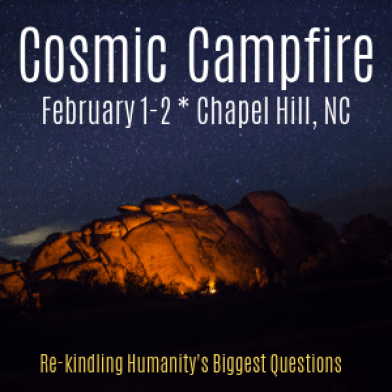
 

Speaking of: Early Bird Tickets are now on-sale for the Cosmic Campfire Gathering, this February 1-2 in Chapel Hill, North Carolina. (And stay for Sunday morning February 3 if you can, for extra Cosmic Campfire goodness at our host space, Holy Trinity Lutheran!). Early Bird tickets are $129 through January 15th, saving $70 on the at-the-door price, if they even last that long. Seats are limited, so if you’re looking for the perfect Christmas gift for loved ones, yourself, or best-yet all of you, please get yours now.

If this is your first time hearing about this one-of-a-kind gathering, Tripp, Mike McHargue and I are creating space to talk about the Big Questions:

  • Who are we as a species?
  • What does it mean to inhabit these bodies, on this planet, in this universe?
  • How are we so beautiful?
  • How do we find ourselves in such a multi-lateral mess ?
  • Does being a friend of God, aspiring follower of Jesus, and student of Scripture have anything meaningful to add to this conversation?
  • Do the inquiries of biology, physics, psychology, archaeology and anthropology have anything meaningful to add to this conversation?

We’ll be exploring these questions, specifically as framed in the emerging cosmological projects Big History and the New Universe Story, with some of our favorite scientists, philosophers, and theologians. Buying your Early Bird Ticket now helps us plan for the full breadth of contributors to your experience, so we really appreciate it.

Confirmed dialogue partners include: 

Barbara Holmes, PhD, is a theologian, writer and scholar who publishes books about the intersection of ethics, spirituality, mysticism, science, cosmology and African American religious culture.She is president emerita of United Theological Seminary of the Twin Cities and formerly professor of ethics and African American religious studies and vice president of Academic Affairs at Memphis Theological Seminary.In addition to her work with law firms, she has worked with homeless missions, HIV/AIDS ministries, and international ministries in Kenya (the Presbyterian Church of East Africa) and Japan. Her published work includes Liberation and the Cosmos: Conversations with the Elders, Race and the Cosmos: An Invitation to View the World Differently, Joy Unspeakable: Contemplative Practices of the Black Church, and other publications. Want to hear from Dr. Holmes? Listen to her on these episodes of Homebrewed Christianity and Contemplify!

Joan Roughgarden, PhD, is an evolutionary biologist, transgender, and described by the New York Times as “one of the world’s most influential theoretical ecologists.” She is well-known for her unique perspective on theistic evolution, and bold and pioneering work on sexuality in humans and the rest of the animal kingdom. She the author of numerous books and studies; for a popular readership, she has written Evolution’s Rainbow: Diversity, Gender, and Sexuality in Nature and People and Evolution and Christian Faith: Reflections of an Evolutionary Biologist. Dr. Roughgarden is no stranger to podcasts – check her out on Just Plain Sense, BBC Analysis (‘Why Are Even Women Biased Against Women?’), and her insights in the just-released Science Vs. episode The Science of Being Transgender.

Robyn Henderson-Espinoza, PhD, has been described in a myriad of ways: a scholar-activist, scholar-leader, thought-leader, teacher, public theologian, ethicist, poet of moral reason, and word artist. Among these ways of describing Dr. Robyn, they are also a visionary thinker who has spent two decades working in the hybrid space of church, academy, and movements seeking to not only disrupt but dismantle supremacy culture by focusing their PhD studies on new concepts of being and becoming, decolonizing knowledge production, and bridging with radical difference. Named one of ten Faith Leaders to watch by the Center for American Progress in 2018, Dr. Robyn is currently at work helping co-create Activist Theology. Dr. Robyn is a non-binary Transqueer Latinx who calls Nashville, TN home. (Dr. Robyn is one of Homebrewed Christianity’s favorite guests. Check them out in this interview archive!)

And while we’ll be having fascinating conversations with experts in their fields, the conversations continue with you…we’re building in plenty of space for all of us to explore the questions that drive us…together.

So…will you join us? You can find out even more info, and grab your early bird tickets, at CosmicCampfire.party.

The Seventh Story | Gareth Higgins and Brian McLaren

The following is an excerpt from The Seventh Story, a brand-new release from Gareth Higgins and Brian McLaren about the six stories that divide us and the Seventh Story that unites. It’s paired with a unique, beautifully-illustrated children’s book they’ve also written, both of which are available for order in time for Christmas at TheSeventhStory.com.

Violence doesn’t create anything.

That’s a radioactive statement. When I say it in certain circles, the negative reaction is swift and unambiguous. It’s ironic that conversation about reducing violence often results in a fight. But the outcome of even that fight proves the point: violence doesn’t create anything. Except suffering, of course.

People react to this suggestion with such intense opposition for a number of reasons. We have been taught from the earliest age the opposite: that violence works.

We have been inculcated through our national and community rituals that violent sacrifice is noble, and that our freedoms were not only secured by the deaths of our forebears (and the killing they carried out), but that such death and killing was the only way it could have happened.

And we have been nurtured into a catechism of fearing the world, so that we must always have violence as a recourse, because we never know when they are going to target us.

It’s perfectly reasonable, if such premises were true, to live fearful and ready to kill.

But the premises are false.

The suffering caused by violence, even in the most noble of causes, does not end when the shooting stops.

The current global crisis is a crisis of storytelling.
 
The threat of the world today is lied about every time you open your computer or switch on your phone. Terror lives in your pocket on a device that does not differentiate between wisdom, information, propaganda, and deceit. The good news is that you can learn more than ever before, connect quicker, and heal yourself (some of the world’s great healers and healing techniques are mobile apps). The challenge (and the invitation) is that you need to learn how to edit what you’re seeing. No one else will do that for you. It is in the interests of the military-industrial-entertainment-gossip-complex that you stay unconscious, and click on as many links as possible.

We have become possessed by the myth of redemptive violence, manifesting through six old stories that keep us apart, cause more suffering by attempting to avoid it, and simply do not work. Telling the story in those ways exaggerates fear, and violence will increase. The redemption of the myth of redemptive violence is not to destroy it by beating the “bad guys” at their own game. No.

The way to redeem the myth of redemptive violence is to de-story it: to refuse to play the game at all. 

To invent a new game. Tell the story in a new way that decreases fear, and violence will reduce.

To continue reading, and to order the children’s book edition in time for Christmas, visit TheSeventhStory.com.

Bonus: Hear Gareth and Brian talk about what inspired them to write a children’s book, with Tripp Fuller on Homebrewed Christianity! 

About the Authors

Brian D. McLaren is an author, speaker, activist, and public theologian. A former college English teacher and pastor, he is a passionate advocate for “a new kind of Christianity”—just, generous, and working with people of all faiths for the common good. He is an Auburn Senior Fellow and a leader in the Convergence Network, through which he is developing an innovative training/mentoring program for pastors, church planters, and lay leaders called Convergence Leadership Project. He works closely with the Center for Progressive Renewal/Convergence, the Wild Goose Festival and the Fair Food Program’s Faith Working Group. You can find him at brianmclaren.net

 Gareth Higgins was born just outside Belfast in 1975, grew up during the northern Ireland Troubles, and now lives in North Carolina. As a storyteller, retreat leader, and festival director, co-founder of the Wild Goose Festival, Movies & Meaning, and The Porch Magazine, and the New Story Festival, Gareth writes and speaks about the power of stories to shape our lives for better or worse, connection to the earth, cinema and the power of dreams, peace and making justice, and how to take life seriously without believing your own propaganda. He’s happy to be a work in progress, and you can find him at garethhiggins.net.

All Creation Radiant: My Conversation with Matthew Fox

As part of our ongoing Cosmic Campfire Book Club with Tripp Fuller of Homebrewed Christianity and ‘Science’ Mike McHargue of The Liturgists, I got to sit down with one of my all-time heroes, Matthew Fox:

In our conversation, Matthew and I discuss:

SO much! Please, tune in and let me know what you think in the comments below.

About My Dialogue Guest

Matthew Fox has been called a maverick, a rebel, and by some a heretic. In his quest for a viable spirituality he discovered the ancient (but often suppressed) creation spirituality tradition that honors the sacredness of all creation. He has worked closely with Native spiritual leaders, feminists, scientists, activists, and others, and got himself in trouble with his mother church and the pope. He has written nearly 40 books on spirituality and culture now translated in 67 languages and is a visiting scholar at the Academy for the Love of Learning and a professor at the new Fox Institute for Creation Spirituality. Among his books are Original Blessing, The Coming of the Cosmic Christ, The Lotus & The Rose, Naming the Unnameable: 89 Wonderful and Useful Names for God, A Way To God: Thomas Merton’s Creation Spirituality Journey, Meister Eckhart: A Mystic Warrior for Our Times, and The Hidden Spirituality of Men: Ten Metaphors to Awaken the Sacred Masculine.

Join Matthew for a free video event to revisit the groundbreaking teachings of St. Thomas Aquinas and Julian of Norwich to stay grounded in these uncertain times. Register here!

An Immanent God Meets Us in Our Pain: Science Mike & ‘Mystic’ Mike Mix it Up!

A few days ago, before the sold-out Evolving Faith Conference kicked off at Montreat, ‘Science’ Mike McHargue and I were able to grab an hour together to talk about some of our most vulnerable experiences with God, and how these encounters have impacted our approaches to life.

We discuss the potent idea of panentheism – God as all-in-all – and why I’m at home with the ‘en’ (transcendent) part of this conjunction, and why he’s more comfortable with the ‘pan’ of ubiquitous immanence. This video was created for members of our Cosmic Campfire pop-up book club, but the conversation was so good we decided to make it available for you, here. Check it out!

Books Mentioned in this Dialogue

Since that Mike and this Mike (me) are big nerds, we talk about several books in our conversation. They include:

Kindling New Questions 

This is all in preparation for The Cosmic Campfire Gathering this February 1-2 in Chapel Hill, North Carolina (co-hosted with Tripp Fuller of Homebrewed Christianity, ‘Science’ Mike McHargue of The Liturgists, and Yours Truly.)

And I’m happy to announce that Early Bird tickets are now available – $129 through January 15th, saving $70 on the at-the-door price, if they even last that long. Seats are limited, so if you’re looking for the perfect Christmas gift for loved ones, yourself, or best-yet all of you, please get yours now.

If this is your first time hearing about this one-of-a-kind gathering, Tripp, Mike McHargue and I are creating space to talk about the Big Questions:

  • Who are we as a species?
  • What does it mean to inhabit these bodies, on this planet, in this universe?
  • How are we so beautiful?
  • How do we find ourselves in such a multi-lateral mess ?
  • Does being a friend of God, aspiring follower of Jesus, and student of Scripture have anything meaningful to add to this conversation?
  • Do the inquiries of biology, physics, psychology, archaeology and anthropology have anything meaningful to add to this conversation?

We’ll be exploring these questions, specifically as framed in the emerging cosmological projects Big History and the New Universe Story, with some of our favorite scientists, philosophers, and theologians. Buying your Early Bird Ticket now helps us plan for the full breadth of contributors to your experience, so we really appreciate it.

Confirmed dialogue partners include: 

Barbara Holmes, PhD, is a theologian, writer and scholar who publishes books about the intersection of ethics, spirituality, mysticism, science, cosmology and African American religious culture.She is president emerita of United Theological Seminary of the Twin Cities and formerly professor of ethics and African American religious studies and vice president of Academic Affairs at Memphis Theological Seminary.In addition to her work with law firms, she has worked with homeless missions, HIV/AIDS ministries, and international ministries in Kenya (the Presbyterian Church of East Africa) and Japan. Her published work includes Liberation and the Cosmos: Conversations with the Elders, Race and the Cosmos: An Invitation to View the World Differently, Joy Unspeakable: Contemplative Practices of the Black Church, and other publications. Want to hear from Dr. Holmes? Listen to her on these episodes of Homebrewed Christianity and Contemplify!

Joan Roughgarden, PhD, is an evolutionary biologist, transgender, and described by the New York Times as “one of the world’s most influential theoretical ecologists.” She is well-known for her unique perspective on theistic evolution, and bold and pioneering work on sexuality in humans and the rest of the animal kingdom. She the author of numerous books and studies; for a popular readership, she has written Evolution’s Rainbow: Diversity, Gender, and Sexuality in Nature and People and Evolution and Christian Faith: Reflections of an Evolutionary Biologist. Dr. Roughgarden is no stranger to podcasts – check her out on Just Plain Sense, BBC Analysis (‘Why Are Even Women Biased Against Women?’), and her insights in the just-released Science Vs. episode The Science of Being Transgender.

Robyn Henderson-Espinoza, PhD, has been described in a myriad of ways: a scholar-activist, scholar-leader, thought-leader, teacher, public theologian, ethicist, poet of moral reason, and word artist. Among these ways of describing Dr. Robyn, they are also a visionary thinker who has spent two decades working in the hybrid space of church, academy, and movements seeking to not only disrupt but dismantle supremacy culture by focusing their PhD studies on new concepts of being and becoming, decolonizing knowledge production, and bridging with radical difference. Named one of ten Faith Leaders to watch by the Center for American Progress in 2018, Dr. Robyn is currently at work helping co-create Activist Theology. Dr. Robyn is a non-binary Transqueer Latinx who calls Nashville, TN home. (Dr. Robyn is one of Homebrewed Christianity’s favorite guests. Check them out in this interview archive!)

And while we’ll be having fascinating conversations with experts in their fields, the conversations continue with you…we’re building in plenty of space for all of us to explore the questions that drive us…together.

So…will you join us? You can find out even more info, and grab your early bird tickets, at CosmicCampfire.party.

What I’m giving up for Lent this year.


Lent falls on Valentine’s Day this year in the Western calendar, and Easter falls on April Fool’s. This feels about right for our current cultural moment, no?

I don’t always observe the liturgical calendar of “church seasons”: I didn’t grow up with it. But given this dual alignment of days traditionally associated with renunciation and pathos, respectively, an inner prompting came to me last night, concerning something fruitful I might “give up” beginning this Ash V-Day:

Suffering.

It’s been a challenging year for me, if I slow down enough to notice. (Can I get an ‘amen’? Anybody with me?) I noticed that I’ve been nurturing a special attachment to certain miseries this past year, almost as though me and The Blues were dating.

But is this relationship really working out?  What would it be like to let this melancholic romance go?

Lent- this season of sinking deep into the death, resurrection, ascension and indwelling of the Living Christ – offers us an opportunity, in grace, to let go of that which doesn’t serve.

“Remember that you are dust,” we say on Ash Wednesday, “and to dust you shall return.”

There’s a real freedom here.

Or, as Alexander John Shaia puts it:

We are marked because ash is one of the most fertile nutrients for growth that we have on the planet. To be touched with ash is a prayer for the grace and nutrients to grow ever more deeply into the image of the One in which we are already made.

But how do we grow? We Americans are often obsessed with the idea of ‘growth,’ by which we mean extractive consumption. We want more, more, more.

Thomas Merton offers us some contrasting wisdom:

The spiritual life moves forward by a process of subtraction not addition. I find my true nature as I am willing to let go of clinging to fruit and demanding consolations and rewards in this life.

What gifts am I seeking that keep me from opening to a genuine awareness of God’s presence in my life?

What might I need to let go of in order to open more fully to an awareness of God’s presence and action at work in all of life?

Sage input in an era of overconsumption and shallow materialism, echoes of the ancient Letter to the Hebrews:

Since we are surrounded by such a great cloud of witnesses, let us throw off everything that hinders and the sin that so easily entangles. And let us run with perseverance the race marked out for us…
(Hebrews 12:1)

And yet, some of us have become Olympic athletes of renunciation: making ‘sacrifice’ our calling card. Others of us, especially during Lent, excel at making token, notional ‘sacrifices’ that are perhaps more for our waistline or virtue-signaling than our actual growth.

This is why I’m not giving up chocolate or social media this Lent – deprivations along these lines feel arbitrary.

Instead, I’m giving up suffering – the kind I create. What would it be like to just let it go?

The enigmatic early 20th-century spiritual teacher George Ivanovich Gurdjieff drew a distinction between conscious suffering and mechanical suffering. Of the latter, he said:

Another thing that people must sacrifice is their suffering. It is very difficult also to sacrifice one’s suffering. A man will renounce any pleasures you like but he will not give up his suffering.

Man is made in such a way that he is never so much attached to anything as he is to his suffering.

And it is necessary to be free from suffering. No one who is not free from suffering, who has not sacrificed his suffering, can work [toward waking up]. Later on a great deal must be said about suffering. Nothing can be attained without [conscious] suffering, but at the same time one must begin by sacrificing [mechanical] suffering. Now, decipher what this means.

We have already spoken enough about the meaning of being ‘born.’ This relates to the beginning of a new growth of essence, the beginning of the formation of individuality, the beginning of the appearance of one indivisible I.

But in order to be able to attain this or at least begin to attain it, a man must die – that is, he must free himself from a thousand petty attachments and identifications which hold him in the position in which he is.

He is attached to everything in his life, attached to his imagination, attached to his stupidity, attached even to his sufferings, possibly to his sufferings more than to anything else.

He must free himself from this attachment. Attachment to things, identification with things, keep alive a thousand useless I’s in a man.

These I’s must die in order that the big I may be born.

Growth through letting go, a spirituality of subtraction: This is likely to offend our epicure I’s and please our masochist I’s.

But what if it’s suffering that’s first to be sacrificed on our altars? What if its oppressive comforts are denied? Might its golden chains be broken, giving me a whole new quality of experiencing my day-to-day? And might my inner epicure and inner masochist find their roles reversed?

This is what I aim to find out.

Recommended Reading for Keeping a Wholly Lent: 

Becoming Truly Human: Gurdjieff’s Obligolnian Strivings – a Lenten eCourse – Cynthia Bourgeault

City of God: Faith in the Streets – Sara Miles

Girardian Lectionary – Paul Nuechterlein + Various

Godspace: Lent – Christine Sine + Various

Heart and Mind: The Four-Gospel Journey for Radical Transformation – Alexander John Shaia

In Search of the Miraculous – P. D. Ouspensky

Resipiscence: A Lenten Devotional for Dismantling White Supremacy – Jasmin Pittman Morrell + Various

Seven Stories: How to Study and Teach the Nonviolent Bible – Anthony Bartlett

TextWeek – Jenee Woodard + Various

Thoughts in Solitude – Thomas Merton

Will You Join Me for A Prayerful ‘Experiment’ this Lent? – Carl McColman