The people
The virus took on many shapes
The bear, the elk, the antelope, the elephant, the deer
The mineral, the iron, the copper, the coltan, the rubber
The coffee, the cotton, the sugar
The people
The germ traveled faster than the bullet
They harvest the mountainside, protect the crops, herd the cattle
The people
The women and children were separated from the men
They’re divided as a foot into the regional filters of their minds
The violence of arrogance, crawls into the air, nestles into the geospatial cortex
We are not a conquered people
(Drum beats by region)
I was awakened by my elder brother
The compound was on fire
Awakened by my elder brother
The compound was on fire
The compound was on fire
The compound was on fire
The missionaries never hid their perspective
Perspectives of land, but rather see us disappear
Recyclable prayers
The people
This is my body, which is given for you
The people
This is my blood
We are not a conquered people
I was awakened by my elder brother
The compound was on fire
“Breaking Bread.” Even in an era of Atkins and Paleo, the phrase retains its strength. It suggests more than simple sustenance; it’s about who we eat with – the company we keep.
Meals can unite us, or divide us. Remember four years ago when news of Chick-Fil-A’s track record of anti-LGBT lobbying hit the mainstream? Progressives were aghast, and conservatives rallied the base. Former presidential candidate and FOX News host Mike Huckabee declared Chick-Fil-A Appreciation Day, which was attended by millions who blithely posted pics of their discriminatory dining on social media. Gay, lesbian, bisexual, and transgendered families, along with their friends and allies, grieved, while a nation seemed to gleefully say to them: “Let them eat chicken.”
Mealtimes in Jesus’ day were divisive, too. In the ancient Near East, observant Pharisees were careful to practice “safe sects,” eating only with their closest co-religionists, the ones that interpreted their purity codes just like they did. The less-than-pure were sure to be kept away from the immaculately prepared meals, socially-stratified tables, and carefully-washed utensils. The ‘pagan’ Romans were no better, with a firm pecking order of who got to eat where based on citizenship, social standing, and rank.
Jesus, by contrast, ate indiscriminately. Scholar Bruce Chilton suggests that Jesus, like many tradesmen of his day, was often paid in meals. At these meals, he could invite whomever he wished and his client had no choice but respect his table arrangements. It is here, Chilton believes, that Jesus honed his conviction that God was near when the table was full – of good food and “whosoever.”
So Jesus invited sex workers and religious leaders, government stooges and terrorists alike to share a common meal around a common table. In so doing, he enacted Isaiah and Ezekiel’s eschatological vision of a heavenly banquet come to earth, where God lays a spread of the finest foods and aged wines to all humanity. How inclusively does Jesus mirror this image of God’s all-encompassing shalom? Even at his final meal before execution, Jesus invites his betrayer to dine with him.
Do we eat like this today? I confess that every time I sat at a table with my social group in high school, every time I turn away from others at the mall food court, every time I refuse to meet a homeless street hustler’s gaze on the sidewalk downtown, I do not.
And in a worshiping context? So often, attendance communion or eucharist or Lord’s Supper follows society’s norms rather than reshaping them.
But it doesn’t have to be this way; another meal is possible. The meal that Jesus left us with can cause endless social and doctrinal divisions, or it can unite us against the larger societal forces that fragment us. Radical theologian William Cavanaugh frames our meal choice – between consumption or communion – in his ground-breaking essay The World in a Wafer:
Globalism is a masternarrative, the consumption of which ironically produces fragmented subjects incapable of telling a genuinely catholic story. [T]he Eucharist [by contrast] produces a catholicity which does not simply prescind from the local, but contains the universal Catholica within each local embodiment of the body of Christ. The body of Christ is only performed in a local Eucharistic community, and yet in the body of Christ spatial and temporal divisions are collapsed. In the complex space of the body of Christ, attachment to the local is not a fascist nostalgia for gemeinschaft in the face of globalization. Consumption of the Eucharist consumes one into the narrative of the pilgrim City of God, whose reach extends beyond the global to embrace all times and places.
To consume the Eucharist is an act of anticonsumption, for here to consume is to be consumed, to be taken up into participation in something larger than the self, yet in a way in which the identity of the self is paradoxically secured.” In sharing Eucharist we enter the suffering of one another – the literal meaning of compassion – and in so doing ” we see the distance between friend and enemy overcome.
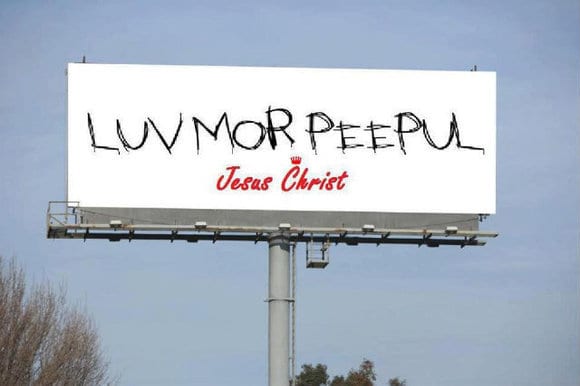
Several years ago, the Chick-Fil-A food fight was getting nasty. Much like “Trump! Trump! Trump!” is now beingshouted and scrawled as a racist epithet intended to intimidate, the misspelled ‘cow scrawl’ made famous in the chicken chain’s ads was used to vandalize Charis Books and More, a feminist bookstore not 20 minutes from Chick-Fil-A’s headquarters in Atlanta. The attack happened the night after a queer poetry reading I happened to be attending with friends. ‘Eat Mor D–k,’ the graffiti on the side of the iconic bookstore taunted.
Something had to change.
To this end, my Facebook friend Andy and I created People Appreciation Day – an attempt to stem the food fight that was, absurdly enough, gripping much of the nation. Its premise was simple: Invite someone out for a meal, someone you’d normally be uncomfortable dining with. Perhaps someone of another race, class, sexual orientation, or religion…or perhaps, an outright enemy.
For me, many of the above categories weren’t particularly challenging. I’m married to a woman of another race, and have a veritable ‘rainbow coalition’ of friends; while I don’t do it as often as I’d like, I joyfully breakbread with people who live outside; I get together with my Turkish Muslim friends monthly and enjoy baklava and other treats as we catch up on matters of family, nation, and faith. No, for me, my boogeyman wasn’t a black or homeless or gay or Muslim person…it was a ‘fundamentalist,’ the people I came from…the people I used to be.
I decided to invite my former Facebook friend Art Mealer. Art and I met a year or two ago, online and in-person. He’s a businessman and house church organizer. He has a ministry called Waging Love. We got together for dinner at Market in Raleigh. We really wanted to like each other…we found that, besides professing Jesus as Lord, we had little in common. It was awkward. Over the months, he’s invited me to house church barbecues (I’ve usually had other things to do, but honestly felt nervous around getting together in this setting); I’ve invited him to my church, Trinity’s Place (which made him nervous, he said to me plainly, on a number of theological and even moral levels.) Thus, Art and I’s primary interaction has been online, where tempers flare, partisanships are on display like proud peacocks, and the decorum that usually accompanies in-person interaction is all-but-absent.
A connection severed over our very real differences – different conceptions of ethics, the public square, governance, and even God. And yet…I knew that if I was going to follow my own mandate and break bread with someone who made me uncomfortable, I’d have to ask Art out to lunch. He accepted, and light-heartedly (?) proposed we meet at Chick-Fil-A. After some back-and-forth about politics and nutrition, he suggested Aladdin’s instead. I accepted.
Art and I had a great meal. Hundreds attended People Appreciation Day – not the million or so that defiantly ate chicken a few weeks before, but what is that line about not despising small beginnings? If the planet is a loaf, a little leaven is a good place to begin. The News & Observer did a great little write-up on PAD, in which they quote me saying:
If I can look in their eyes and share food, I won’t be able to callously dismiss their perspectives the next time I’m surrounded by like-minded people,” said Morrell, who often references the meals Jesus shared with people whom others avoided. “I’ll be able to see their perspectives in a more human and less sound-bitten way.
Part 2: Election Indigestion.
What have I learned since then? That I need to share even more such meals. I have been sound-bitten, and I have been the biter. In the run-up to election season, I have posted my fair share of opinionated pieces, news items, and videos – all advocating a particular vision of our nation’s future. Others have advocated their visions similarly. As you could imagine, these visions sometimes clash.
Be specific without being exclusivistic is my frequent refrain for myself. As I feast on God as the Tree of Life beyond judging good and evil, and sink ever deeper into unitive consciousness; as I see life through a renewed, Christ-like, and spacious lens, I recognize a paradox: I don’t un-become who I am. I don’t suddenly become formless. I’m still me, in all my partisan particularity. Though hopefully, as I keep breaking bread with enemies and eating God, I take myself and my particularities less seriously.
I needed this reminder after being de-friended by yet more people – including a relative I will likely see at Christmas, or her daughter’s wedding next Spring – over online political posts.
I needed this reminder after eating at Zaxby’s tonight with four of my MKP brothers, most of us laughing about a particular presidential candidate’s idiotic policies and presence – only to look over and notice that one of our brothers wasn’t laughing, because he’s voting for the candidate the rest of us were deriding.
I voted. It was an anguishing decision; I voted for my candidate after researching many angles. And this year in particular, I’m not feeling particularly charitable toward the other candidate, or their supports. I think this candidate is dangerous, irresponsible, uniquely corrupt. I fear for the future of our nation if they’re elected. And…I’m aware that supporters of the other candidates feel the same way about mine.
It’s been hard to keep nourishment down in such contentious times.
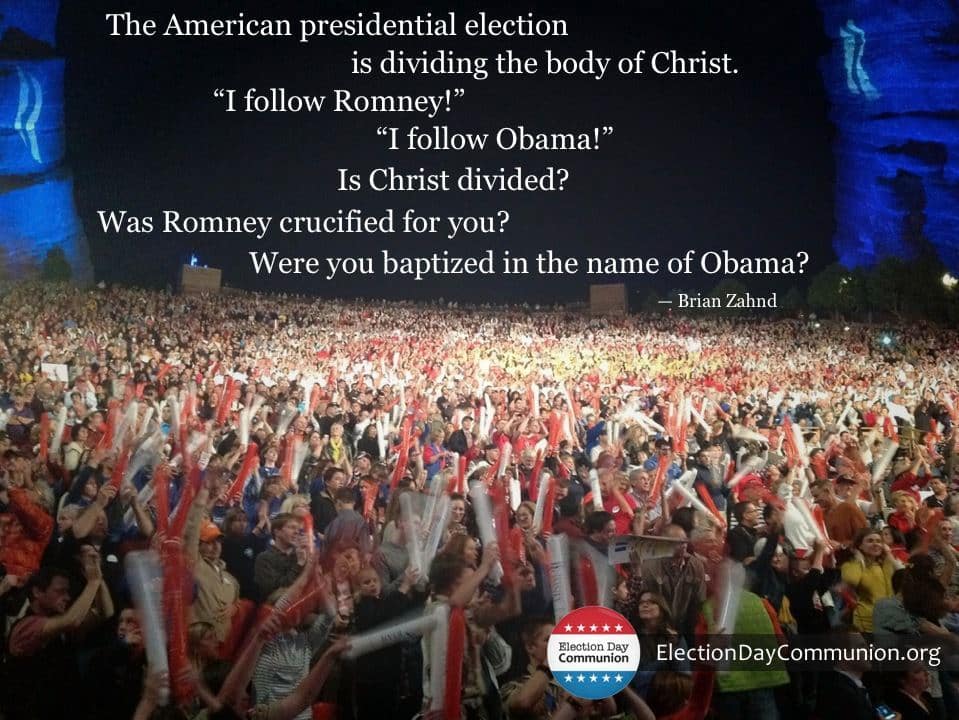
What’s this, you ask? Well, as their homepage reads in part:
On November 8, 2016, Election Day,
we will exercise our right to choose.
Some of us will choose to vote for Hillary Clinton.
Some of us will choose to vote for Donald Trump.
Some of us will choose to vote for another candidate.
Some of us will choose not to vote.
During the day of November 8, 2016, we will make different choices for different reasons, hoping for different results.
But that evening while our nation turns its attention to the outcome of the presidential election, let’s again choose differently. But this time, let’s do it together.
Let’s meet at the same table,
with the same host,
to remember the same things.
We’ll remember that real power in this world — the power to save, to transform, to change — ultimately rests not in political parties or presidents or protests but in the life, the death, and the resurrection of Jesus.
We’ll remember that, through the Holy Spirit, this power dwells within otherwise ordinary people who as one body continue the mission of Jesus: preaching good news to the poor, freeing the captives, giving sight to the blind, releasing the oppressed, and proclaiming the year of the Lord’s favor (Luke 4:16-21).
We’ll remember that freedom — true freedom — is given by God and is indeed not free. It comes with a cost and it looks like a cross.
We’ll remember that the only Christian nation in this world is the Church, a holy nation that crosses all human-made boundaries and borders.
We’ll remember that God’s strength is made perfect in weakness.
And we’ll re-member the body of Christ as the body of Christ, confessing the ways in which partisan politics has separated us from one another and from God.
On Tuesday evening, November 8,
make a choice to remember.
Let’s meet at the Lord’s Table.
Let’s remember together.
I wanted to remember, together. I wanted to counter the brokenness of my relationships with the brokenness of Christ’s body. I wanted to partake of a common cup to remind me of the transcendent meaning that we all share in a common humanity.
The only problem was, Raleigh Moravian had their Election Day Communion earlier that afternoon. Looking up an N&O article on my phone, I discovered that my friends at Raleigh Mennonite started their Election Day Communion Gathering…20 minutes before I read the article.
I zoomed over, just in time to hear pastor Duane Beck read from John 17…to speak of communion, common union, working its way through bread and wine and bodies – diverse bodies, political bodies, divergent bodies…common bodies. He invited everyone to come up and partake – black and white and Latinx, Republican and Democrat and anarchist, old people and young parents and students alike.
We ate, we drank, we lit candles if we wanted…and we lingered, reminding one another of our shared identity as God’s beloveds.
So I ate ate the bread, drank the cup, and passed the peace in embrace of friends and strangers.
Did I overcome division?
It’s a trickier question than I first supposed. It’s not only I’m divided from those who think and act and live differently than me; I’m divided from myself, sometimes. A stranger from myself. When it comes to politics, I am part-idealist, part-pragmatist, part-hypocrite, and part-cynic. Anarchism, intentional communities, partisan rancor, ambivalence, visionary hope, compromise, resignation, even nihilistic fantasies. All of these exist within me.
As I type, I hear a still, small voice:
This is My Body, broken for you.
Even me, Lord?
Even you. And every ragamuffin, ne’er-do-well, trickster, teamster, poseur, pollster, reality-upholsterer and gun-holsterer that walks this planet.
Even all of you…saints and scoundrels…broken apart like so much bread, in the fragments of your violence toward one another and Me;
Forgiven and re-gathered, reconstituted and re-mattered, as My Body is consumed and digested, I am consumed with love for you. You are bodies…broken and re-born.
You matter to Me.
It is in this consummation that I am consumed; it is in divine digestion that I rest. The election will be called soon – in the world of manifestation, ideological divisions still exist between us. As a nation, planet, and ecosystem, we have a lot of healing left to do. I pray that we can “taste and see” God’s sustaining goodness together. And with each other imagine a common future. Another world is possible – and in the scandalously-inclusive table of God, is already here.
My heart burned within me like a molotov cocktail Melting atrophied organs of sense and perception Third eyes blinking open from awakenings rude Iridescent night vision piercing sights long subdued.
Tricksters, gods and monsters find themselves drawn in To boys kicking off shrouds, emerging as men Without apology. Things hidden share secrets by flickering flames Word-spinning dervishes now turning a page
Grace ruptures – unmercied – lifting me high Charred nuclear shadow where dulled conscience once lay Shrugging off my hangover from that first awful drink ‘Good’ and ‘evil’ delusion – fruit’s draught soured sick. (Ferment)
“Rise up, Man,” Kali taunts me, blue angel of death Shrunk heads of men who died trying hanging mute ’round her breasts Her lips curled in kindness, a shared moment between us Daring me to do better, Mars rising from Venus
Archistrategos Sabaṓth ميخائيل, the template of me Stands silently, original, master of all that he sees Bedouin warrior of Thrones, desert Jinn جِنّ and bright devils, Has work to do once my apocalypse settles.
Alchemical heat sears marrow, my bones Leaden dreams long abandoned now blaze into gold Boy’s nightmares transmute through initiates’ door While Kairos and Chronos pirouette on time’s floor
Eden – alas – left me no forwarding address Shangri-La (from saved seeds) now blooms in her stead Could this garden-city be New Jerusalem’s nest? I’ve been saving ’till now; it’s time to invest.
The invitation is intuition A ceremony of recognition – my body and blood’s rhythmic repetition Mercury’s metal coats my tongue while sweat baptizes my brow Life’s transubstantiation – right here and just now.
Remembrance is re-cognition Re-membering this disposition That gives rise – then and always – to original face Holy Sun Absolute shining shelter and grace
Kindling the compost of what had begun Seraphim and Destroyer erect such a pyre Food for the moon from all left undone “Why not be utterly changed into fire?”
The sacred meal that Jesus-followers celebrate, variously called ‘Eucharist’ or ‘Communion’ or ‘Lord’s Supper’ – is both the centerpiece of most Christian worship worldwide, and is also one of the most divisive rites we practice. My friend and Catholic Celtic contemplative (how much more alliteration can I pack into his descriptor – oh I know, his first name!) Carl McColman blogs about feeling this ambivalence firsthand in Communion and the Broken Body. What follows is a response to Carl, and the others who have interacted in the comments. I recommend you read Carl’s post before proceeding.
I’m grateful to Carl for sharing this – I recall he and I discussing restrictions that Roman Catholics (among others) place around the Eucharist the first time I came to the Monastery of the Holy Spirit with him and participated in the morning prayers and mass. It was beautiful, getting up way earlier than I normally do, chanting Psalms with the monks and Carl as the sun gradually illuminated the stained glass windows with an all-pervasive, translucent purple.
Because of both their hospitality and their declining numbers, Carl and I were able to sit in the monastic choir loft right there with the Cistercians; I felt very included. This made the next portion of the morning gathering all the more jarring, as I was technically not allowed to take the wafer and wine, as per Roman Catholic restrictions on non-Catholic participation. Instead I stood, arms crossed, receiving a “blessing” from the priest. the Christian community’s celebration of unity with God and each other is fragmented, broken much like Christ’s body on the altar, and this does indeed call for sadness. I agree with Carl in his post about both the lamentability of this reality, and working for change from within.
But I also agree with Darrell and some of the other (you could call us ‘green meme’) commentators on this thread – that unlike other things the Church might mourn, such as the energy crisis or genocide in Darfur, this is a matter wholly of our own making and within our purview to change. In stages of grief, if grieving doesn’t lead to fresh beginnings and new action, the griever is stunted in her growth. So let’s move on and become the change we wish to see.
How might we do this? Well, if Catholics want to appeal to tradition and authority, and Protestants want to appeal to conscience and Scripture, maybe we can all agree to hold these in abeyance while taking a moment to appeal…to Jesus. (Ack – I realize upon typing this that it can sound awfully one-sidedly Protestant, even Pietist. Bear with me a moment…)
If I may be so presumptuous, I think Jesus agrees with Carl’s growing realization that there are legitimate boundaries to the community of faith – that there are mysteries to be stewarded, and hard roads to walk, and that while hospitality is a crucial part of our vocation as apprentices along the Christ-path, there are also places where the general public simply won’t go – and this is fine. Inclusive green meme progressives like me struggle with this a bit, but Jesus deliberately thinned out the crowds from time to time – speaking in enigmatic parables, ratcheting up Moses’ law a thousand-fold to show the uncompromising heart of God’s reign, and ultimately inviting followers to a challenging third way path between Roman hegemony and reactive Jewish intransigence. In this way Jesus brought a ‘sword,’ and families were divided over what to do about him and his message. So Jesus is exclusive, yes?
And I hardly need to argue in this esteemed audience that Jesus is inclusive, too. Maybe cranky and reluctant at times, but reaching out to Samaritan women and Roman centurions and – most significantly – to lowest-caste Jewish folks of his day that polite society and religious elites wouldn’t countenance. Jesus seems to genuinely enjoy the company of the outcast and ne’er-do-well.
And Jesus gave us a meal – sometimes somber, sometimes joyous, in re-membrance of him, embodying Christ for the sake of each other and the world. And the question we post-Christendom, postmodern friends of God in the way of Jesus are asking ourselves is,
How then shall we eat?
– andwith whom?
Recognizing that there are initiation rituals and boundary rituals in any religious group, we could then ask the question “What are our boundary rituals?” and “What are our initiation rituals?”
And is Eucharist the former or the latter? I know that official Roman Catholic polity – and that of many other communions – say that Eucharist is the former, it’s a boundary ritual reinforcing membership in Christ’s Body.
Images from http://smallfire.org
Byzantine/Anglo-Catholic liturgist Richard Fabian makes a brief-but-compelling case for reversing the well-tread order of Baptism and Eucharist in his essay First the Table, Then the Font. I’m not going to reiterate his arguments here, but it’s well worth the read. Summarizing him from my point of view, I have to ask the question “How did Jesus eat with others in his earthly life? Were they initiation meals, or boundary-maintenance?” I have to conclude that, overwhelmingly, in his eating Jesus is precisely at his most inclusive. This is when he dines with terrorists and sex workers and tax collectors, whilst the religious authorities of his day were disgusted.
“But oh,” contemporary religious authorities might object, “his final meal this side of the grave – the one where he told his followers to keep eating in remembrance of him – that was just with his inner circle.” Granted, but let me ask you this: If Jesus was asking his followers to eat in his manner, to celebrate his presence among them, would they be drawing solely on this one ‘final’ meal, or the collective memory of their years shared together? To put it another way: If the Church wants to insist on a closed, bounded-set meal based on one night of our Lord’s life, shouldn’t it work equally vigorously to celebrate the scandalously inclusive, no-strings-attached manner of eating our Redeemer practiced during the vast majority of his public ministry?
And – perhaps more provocatively – shouldn’t we consider that even in his “inner circle,” Jesus extended radical hospitality to a betrayer in their midst! Doesn’t sound like particularly good boundary-maintenance to me.
Religious thinking is so bass-ackward sometimes. We’re afraid of ourselves, and afraid of the ‘outside world.’ We think of boundaries as something that we need to institute and enforce, externally, while gratuitous inclusion is something that will result in our loss of distinction and identity. Jesus seemed to reverse this pattern, finding his identity in complete open-handed invitational inclusion at the site of the shared meal, with boundary naturally arising in his call to follow him. It’s good branding, really – being salt and light both attracts and repels different people, or even the same people at different times – even ourselves at different stages of life’s journey.
With this said, I realize that – both practically and intentionally speaking – Eucharistic celebration is primarily for the edification of committed apprentices of Jesus; it is not ‘evangelistic’ per se in its design. Even so, it is invitational when practiced in the way of Jesus. We needn’t be concerned that abject heathens are going to keep beating down our doors to participate in a ritual that they disrespect and that holds no meaning to them – it just ain’t happening, folks. On the other hand, atheists, agnostics, sinners and ne’er-do-wells might just be curious enough to participate alongside us – to see if they can belong before believing, to see if they can ‘taste and see that the Lord is good.’ I long to see creative, prophetic acts of public worship, like my friend Lucas Land proposes in Eucharist as Eat-In. If we unshackle Jesus from our exclusionary practices, the transforming love of God can spill into the streets and the ‘profane’ lives or ordinary people – through our supposed ‘means of grace’ that we keep shut up.
That’s what happened to another friend, Sara Miles, who stumbled into Fabian’s congregation over a decade ago. I loathe to think of where Sara, her city, and even her congregation would be had she not been allowed to encounter Jesus at a no-strings-attached Communion table in her neighborhood. I shudder to think of how Jesus is being shuttered up in buildings across this world – what we’re missing out on by not making liturgy the work of the people, for the people.
I guess I should apologize to Carl – I got into the very argument that he didn’t want to have. And I’m going to ratchet it up slightly here – I don’t think that Darrell was being overly unkind or by describing the closed-handed exclusivity of certain Eucharist practices as ‘demonic.’ This needn’t be seen in an overly polemic way, but rather in the spirit of the apostle Paul, when he wrote a church to say he was giving one of its members “over to the devil.” This wasn’t a curse, but a naming of things as they really are in hopes of full repentance and restoration. I can’t – and won’t – stand in judgment of denominations that fence the table from all who don’t have confessional unity with them. But I do sniff the smell of fear and sulphur around such behavior at an institutional level, at what Walter Wink would call “the Powers” (demonic again. 🙂 ) And I do pray that such power will be broken – for Christ’s sake, and the sake of the world.
If anyone wants to do some theological heavy-lifting on the matter, I’d recommend (in addition to Fabian’s essay above) Come to the Table by Anglican priest Jamie Howison – the full book is available here. Also Making A Meal of It: Rethinking the Lord’s Supper by United Methodist minister and theologian Ben Witherington III. And to be fair to another perspective (thanks Carl for pointing these resources out), Episcopal priest and Thomas W. Phillips Chair in Religious Studies professor at Bethany College in West Virginia Jim Farwell has staked a lot on a generous-but-boundary-keeping stance on limiting Communion to the baptized. His essay Baptism, Eucharist, and the Hospitality of Jesus: On the Practice of ‘Open Communion,’ as well as its rejoinder by Kathryn Tanner can be found on the Anglican Theological Review website here. (Interestingly, I took a class with Farwell over a decade ago on Eastern Religion with a focus on Zen and interreligious dialogue at Berry. It’s a small Body of Christ…)
It’s also worth noting that, in true house church fashion, I think that the Eucharist is best celebrated as a full meal – why redact God’s feast into a notional meal only? But that’s a subject for a whole ‘nother post…
An earlier version of this was originally posted September 21, 2009
Today’s reflection is sure to raise some ambivalence – but no one processing religion, faith, and spirituality in a post*(everything) world can afford to ignore Matthew Fox – tempestuous, flamboyant, inventive; priest, artist, liturgist and theologian. The defrocked Catholic-turned-Episcopal priest was (with the unlikely influence-pairing of Vineyard revitalizer John Wimber) responsible for inspiring what was arguably the first ever emerging/postmodern congregation in the mid-1980s – the brilliant, controversial, combustible Nine O’ Clock Service. Inspired by a Wimber prophecy at St. Thom‘s in Sheffield and nurtured by Fox’s Creation Spirituality amongst working-class rave culture, the NOS was a potpourri of influences and expression.
The message is as straightforward as it is apparently elusive to many “spiritual leaders” today: The person and message of Christ and the Christian mystery must be not only applied to, but interpreted by, the Janus-faced Crises/Opportunities we face today: political, economic, cultural, and ecological. When we mine our Scripture, tradition, poetry, and luminaries on the one hand, and nature, art, science, and global cosmologies on the other hand, real magic can happen.
“Eyes on a page are not really a way to open the heart up,” says Fox. To see footage from his Cosmic Mass in Oakland, see this video here. If you’re part of a worshiping community, join me in considering: How can we bring more beauty and awe into our worship, drawing from the deep wells of our tradition, from ecology, and from postmodern culture?








 The sacred meal that Jesus-followers celebrate, variously called ‘Eucharist’ or ‘Communion’ or ‘Lord’s Supper’ – is both the centerpiece of most Christian worship worldwide, and is also one of the most divisive rites we practice. My friend and Catholic Celtic contemplative (how much more alliteration can I pack into his descriptor – oh I know, his first name!) Carl McColman blogs about feeling this ambivalence firsthand in


