In America nothing reaches the media unless it’s commodification. This is all the media is interested in, something which can sell products.
—Hakim Bey, Millenium
The idea that spirit lives among us has been knocking on our door for some time now. Over the past twenty years there has been a surge of interest in all things spiritual, and in that time interest in traditional Western expressions has steadily grown. People have started reclaiming traditional practices associated with witchcraft, ancestral veneration, herbalism, and astrology, and the repurposing of Mary as the Divine Mediatrix Mother continues to inspire new devotees.
Up until a few years ago, there would have been very little room for the Holy Spirit in our very hip spiritual climate. While interest in the biblical tradition, especially in its magical and folk elements, seems to have grown at an increasingly rapid rate, among pagans, witches and occultists with an interest in Catholic magic there is still an understandable hesitancy to keep anything seeming “too Christian” at arm’s length. In cases where an interest in the Christian tradition has sprung up, it has almost always been in it’s hybrid and syncretic magical and folk expressions. For progressive young Americans interested in Western spirituality, the Bible, and the religion tethered to it, still presents as a significant problem.
Left-leaning antagonism toward a State increasingly enamored with far-right takes on “Christian mores,” has put many progressive-minded spiritual seekers in a tricky spot. Do you reject your culture’s religious expression, and orient yourself within a spirituality towing less baggage? Or, do you climb inside, and root out what speaks to you, reclaiming what is rightfully yours? Even though new books and blogs are being written all the time, it’s a question that increasingly gets answered on social media through the sharing of memes, photos of home altars, and pithy affirmations.
Social media has allowed people from different parts of the world to share their personal practices and reclimations of the faith. People with heterodox takes on traditional exegesis are finding it easier to connect with like-minded individuals and groups. There is a sense that a magical Catholic surge is manifesting just over the horizon.
And yet, social media has also turned expressions of spirituality into fodder for late-stage capitalist branding. People document their spiritual practice not only for networking purposes, but also in the hopes of legitimizing the monetization of their magical offerings, often at an inflated price point.
A platform like Instagram, which has been accepted by many self-styled spiritual radicals as a necessity, transforms posts into products. Images of candle magic double as advertisements for candle magic. A post about spiritism, becomes an ad for spirit consultations. If there’s an actual business tied to the account, the currency exchanged may be monetary. But, as is so often the case, the currency is merely egoic, a currency of “Likes” conveniently interpreted as “affirmations.” In an ironic twist, in the realm of social media those who posture as being the most anti-orthodox and, as is the flavor of the day, anti-capitalist, are sometimes the most spiritually materialistic of all, following in the footsteps of the antiauthoritarian hippies of the 1960s who, by the 1980s, had morphed into stock market yuppies, recontextualizing anti-government sentiment as anti-government oversight.
From a financial standpoint, it’s not surprising to see why. The yoga industry alone, which through the late 1990s and early 2000s paved the way for our current state of hyper-capitalist spirituality, is an $80 billion dollar industry, just shy of all the wealth in Europe. If something which was once the primary practice of hermits living in caves can be turned into a multibillion dollar industry, maybe something called “folk Catholicism” can be too! After all, ancestor veneration, spiritism, and witchcraft have already begun to merge with slogan-forward pop psychology, taking cues from the fandom success of Instagram self-help gurus parading as therapists.
But, does the value of the spiritual market, the number of memes being shared on social media, or the branding of expensive takes on inherently inexpensive spiritual practices have anything whatsoever to do with spirituality? Are we actually living in a spiritually woke time?
Old-Timey Holy Ghost Spirituality The biblical world was rife with spirit. The stuff was everywhere. Spirits began their lives inside humans, fawn, and fauna, and when their hosts passed away or dried up, they needed to find new places to hide. So, they spread out, seeping into every available nook and cranny. In an effort to establish some sense of sanity, idols, cemeteries, and shrines were set up as domiciles for these wayfaring entities. The hope was that they’d behave and stay put. But, this was rarely the case. Spirits would regularly escape, and latch on to unwitting people. Those who could handle it would go on to become inspired prophets and poets. Others would simply go mad.
But, spirits no longer cause people to go mad. These days, madness is seen as an unfortunate psychological glitch, an inability to distinguish between reality and fantasy due to chemical imbalances, drug use, or emotional trauma. Even “inspiration,” a word embodied with spirit, is less an expression of the ephemeral, and more the logical outcome of putting oneself in the right place at the right time, followed by a series of ah-ha moments.
Spirit and spirituality typically play little to no role in either. Inspiration and madness have become too messy for spirituality’s very tailored persona. Today’s spirituality is rational and “grounded.” It’s sensible and “engaged.” It’s there when you need it. Happy to sit quietly in the corner if you don’t. You can invite it over for dinner, and it’ll never overstay its welcome. Spirituality is respectful that way.
Two thousand years ago, however, the spirits were a downright nuisance. They caused people to get sick, have a run of bad luck, rant and rave in the middle of the street, go mute, blind, or worse.
So, while we may think of ourselves and our boutique apothecaries and nuanced appreciations of subtle energies as being spiritually evolved, one could argue that biblical times, rooted in direct experiences of the Spirit in everyday life, were even more spiritually-conscious, dare I say, more spiritual, than we are today.
Praise for Sitting with Spirits
“Doto draws from years of study and practice at the margins, to distill the beauty of spirit and spirit work into an easily digestible, exciting and inspiring read. He explores the history of the Christ tradition and its texts to unearth a fresh perspective on what it is to be ‘spiritual’ and engage the unseen world. It is a mind and heart opening book. Whether you’ve been burned by Christianity, if you’ve been a devout practitioner your whole life, if you’re looking to start a spiritual practice but don’t know where to begin or if you’ve ever wondered ‘What the Hell Am I’ (an actual subsection in chapter 5) you’ll find something meaningful, new and powerful in this book.”
—Amazon Reviewer
“I loved this book. It’s a wonderful and much-needed take on how spirits and spirit work function from the point a few different perspectives: biblical, psychological, and spiritist/spiritualist. I was particularly impressed with how deep the book gets in such a short time (only 136 pages). Peppered with personal stories, this book also contains a short manifesto at the end on ‘Reclaiming Your Root Religion,’ as well as a chaplet for the seven gifts of the Holy Spirit.”
—Amazon Reviewer
“What I love about Sitting with Spirits, and Bob Doto’s writing on Christianity in general, is the sincere depth of research, presented in an unpretentious yet educational format. Bob digs into the meaningful roots of Christianity, free from spiritual materialism, and presents a concise examination (both theoretical and experiential) on what it means to be ‘spiritual,’ or in communion with god/energy/spirits.”
—Amazon Reviewer
About the Author
Bob Doto is a writer and speaker on the intersection of spiritual margins and society. He is host of the Wild Christianity Salon, the creator of the anarcho-folk Catholic zine, Babylon Begone, and is a founding member of renegade yoga blog, The Babarazzi. Bob is a licensed massage therapist specializing in Chinese Tui Na massage, acupressure, and sports medicine. He is the founder of the Ditmas Park Yoga Society where he teaches yoga in the Mysore tradition, and also maintains his private massage practice. He is a faculty member at the Pacific College of Oriental Medicine in Manhattan teaching Chinese massage therapy with a focus on hand techniques, structural pathologies, and internal disharmonies.
In 2005 — back whenGodwasaboy — I was the coordinator of a monthly Meetup Group devoted to Christian Mysticism, that met at the Episcopal Cathedral in Atlanta. We were a small group, about 10-15 of us, and most of us frankly had silver or gray hair, even back then. So when at one meeting a carload of young people in their 20s showed up, we took notice. They were all from a house church that met out in the suburbs, but it was clear that they balanced a meaningful spirituality with a thoughtful and intelligent approach to life. After the meeting, I had a nice chat with the group’s apparent ringleader, an articulate young man named Mike Morrell. I learned that Mike was involved in a movement known, back then at least, as the Emerging Church. Soon Mike was introducing me to some of the most interesting voices in contemporary Christian literature, including Brian McLaren, Phyllis Tickle, Richard Rohr, and Peter Rollins. Many years have gone by, but I know I can still turn to Mike for insight into what’s happening at the cutting edges of theology, spirituality, interspirituality, and culture.
So begins Carl McColman‘s very kind introduction to our two-part interview together on Encountering Silence, in my opinion the best contemplative Christianity podcast today. Carl co-hosts with filmmaker and minister Cassidy Dale, and professor and priest Kevin Johnson:
Carl’s recollection is basically right, but — as I say in our first episode together — I actually encountered his work years before I met him, via his early Web repository The Website of Unknowing, a compendium of interspiritual wisdom I discovered in undergrad days. His insight and resources simultaneously frightened my somewhat-fundamentalist self, while filling me with wonder at what was possible in the mystical life, described by Carl’s and my favorite Evelyn Underhill as “the art of union with reality.”
The transforming power of poetry, experienced here in a selection by my friend, Simona Chitescu Weik
I found it to be a rousing conversation, among friends old and new. I hope there’s something here for you, too, in these catalytic times.
And hey — if you have time to listen, please don’t stop here. One of the reasons Encountering Silence is a real leader in spirituality podcasting is their unflinching commitment to examine systemic injustice today, showing how rootedness in the spacious silence of Christian mysticism helps us find our voice and speak up against racism, homophobia, and the forces of dehumanization everywhere. One of the ways they do this is by highlighting contemplative and theological visionaries of color.
To this end, theyrecently featured my friend and colleague Dr. Lerita Coleman Brown, whom you might be familiar with if you’ve had an opportunity to participate in our Wisdom Camp at the Wild Goose Festival. Please do yourself a favor and feast your ears on this:
Dive into how a contemplative witness translates to the academy and the streets with my friend and colleague Dr. Robyn Henderson-Espinoza and their work with Activist Theology here:
I recently sat down (virtually speaking) with my dear friend Rebekah Berndt. I’ve known Rebekah since our ’emerging church’ days, and I’m always inspired by what she’s up to. In this dialogue, we do a deep-dive on where her spiritual and life’s journey has taken her. I’m guessing that you’ll be both challenged and encouraged by what follows.
Shall we begin?
Like many of us, you grew up in a conservative evangelical home. What was this like for you? I grew up with a profound sense of being different. In the late 80’s and 90’s there was a push to create a totally separate evangelical culture to protect kids from the influence of mainstream culture. My parents weren’t the worst example when it came to “separating ourselves from the world”— I had friends who weren’t allowed to watch TV or play with the neighborhood kids, for example— but there was definitely a sense that we couldn’t really trust those who hadn’t “accepted Jesus Christ as their personal Lord and Savior.” They sent me and my brothers to a church-run school, and the idea that I didn’t belong in the outside world was hammered home there. There was a real sense of community, though, that was wonderful at times. I grew up in the suburbs of DC, where there’s a lot of transience due to the nature of government and military work. The church I was part of helped to create a feeling of rootedness, which was why it was really difficult to leave.
But you couldn’t stay in that flavor of faith, could you? What did you ultimately find untenable about the spiritual climate of your youth?
My father had a car accident and a head injury when I was 12. That turned everything upside down in my family. There was a lot of instability at home, and I became deeply depressed by the time I was in high school. People in the church didn’t know how to respond to this, other than to see it as a spiritual failing. By that time I was attending a public high school, I did have people reach out to me. But it was hard for me to trust because I had been taught to be suspicious of the “the world.” That was one of the worst things about Evangelicalism — the sense of superiority that fostered paranoia about people outside the fold. I did become involved in my church’s youth group, and had some friends there. We were charismatic, so they would take us to these week-long camps in the summer where we would have ecstatic experiences, dance around, and give ourselves to Jesus. I would get caught up in it; there would be a rush of excitement. But afterward when the high wore off, I felt so manipulated. Even amongst the adults, I would see people chasing a spiritual high in a way that felt really ungrounded, insisting God was going to perform miracles that never came to pass. Intellectually, this church environment was making less and less sense to me. The teachings of Jesus didn’t align with the conservative politics we were expected to support; the hostility to modern science was something I couldn’t really get behind. The cognitive dissonance required to maintain these contradictory beliefs became more than I could handle.
The final straw for me came in my mid-20’s. I had tried to leave and found myself pulled back in several times, usually because I was going through a rough time and needed comfort. I was feeling myself pulled in two different directions constantly, torn between what I had been taught to believe was right, and what my own reason, desire and consciousness were telling me. A woman in my church came up to me one day and said “I have a word from the Lord for you.” I performed a mental eyeroll, because in my experience, that usually meant I was going to hear some kind of moralistic admonishment.
But instead she quoted Jesus in John 10:10, “I have come that they might have life, and have it more abundantly,” and told me to meditate on it. I did. I decided that whatever I was experiencing was not abundant life. I was constantly obsessing over every little decision, questioning whether it was in alignment with God’s will or not, and I was sick of it. So I left. For a while after that, I would constantly ask myself the question, “Is this abundant life?” and if the answer was no, I said “F#^% it, I’m moving on.”
Your questions and seeking heart led you to what many of us called the ‘emerging church’ conversation – that’s when we first met! You were a mover and shaker in the emergent ‘scene’ – what did this path offer you that your earlier Christianity didn’t? And what were the drawbacks?
Yeah, I can’t believe that’s over ten years ago! It was so nice to find a group of people that were also questioning and deconstructing like I was, who had grown up with similar experiences. At the same time, it tended to be heavily male and heavily academic. While the intellectual conversation was welcome after what felt like the determined anti-intellectualism of the evangelical church, it started to feel increasingly disconnected from anything practical. On more than one occasion I would find myself in a pub with a bunch of dudes all trying to impress whatever emergent Christian celebrity happened to be in town on a speaking gig. Sometimes they would get in a heated back and forth and I wanted to pull out a ruler, slap it on the table and say “Let’s settle this now.” Eventually, after all the deconstruction, a lot of us were left asking – “What now?”
Because the postmodern analysis didn’t really provide us tools for actual re-construction. I missed the sense of meaning and purpose I had when I was evangelical, as well as the embodied mysticism and sense of enchantment. I don’t think I understood that at the time. I didn’t know how to articulate it, but something was missing. Another thing that I only see in retrospect, was how many people were really suffering from trauma in that space. Nowadays there are books about religious and spiritual trauma, but that wasn’t really something we were talking about just yet. There was a lot of unhealthy coping with alcohol— practically every event took place at a bar. I remember being at a party where a guy who was somewhat well known in that world got really drunk and started getting touchy and hitting on me….in front of his wife. Nowadays, the people who are going through this have so many more resources. There are a lot more female voices, there are more resources for addressing the psychological and emotional issues, and there’s more emphasis on spiritual practices like meditation as opposed to pure theologizing. I like to think that’s because we opened the way for it.
Your emergent disaffection eventually led you to the shores of contemplative spirituality – practices like centering prayer, the more mystical side of Christianity. What was this like? And, was this enough? There were a lot of people who were just giving up, and moving on to full-on atheism and agnosticism. But I knew that my life just worked better when I believed that something out there cared about me and had my back. Someone gave me The Meaning of Mary Magdalene by Cynthia Bourgeault, and it blew my mind. I didn’t understand everything she was talking about in that book, but I wanted to. I was very compelled by a more feminine and contemplative approach to Christianity. I started reading Richard Rohr and Thomas Keating, and practicing Centering Prayer. And that truly changed my life. It gave me a framework for belief that was beyond the rational without being anti-rational. And the practice was very grounding and healing for me. I really felt that I was finally coming into alignment with my soul in some way. Like I had a sense of who I was, and that I belonged in the world. I also began having more what I would call psychic experiences. I had experienced a few of these before, though I would have understood it as “just” the Holy Spirit. Which I still did, in some ways. But they started getting more intense and more frequent.
I ended up moving into an intentional community of activists that also practiced Centering Prayer. And I did a lot more meditation, including Buddhist. I got really into a scene of activist, Inter-spiritual contemplatives. And that was also wonderful in many ways. But again, it was dominated by men, and tended to have a heavily Buddhist and Christian influence. There’s so much patriarchy in both of these religions. There was a lot of focus on “dissolving” or “surrendering” the ego in a way that felt unhealthy. A lot of shaming of desire and agency and emotion. I was experiencing a lot of energetic body phenomena when I would meditate— what some people might call Kundalini awakening. I would ask instructors how to deal with it, and they would always tell me to just “let it go” or “be equanimous.” And when it came to the psychic phenomena, they tended to say, “just ignore it” and “don’t get engaged in it.” But I really felt like there was something I was supposed to do with it, with both of those things. Powerful energy was being released in my mind and body; I needed to learn how to channel it. But nobody could tell me how to do that. Unfortunately, Centering Prayer and mindfulness don’t know the first thing about how to do that. There are many yogic traditions, and some traditions in Buddhism that do, but they tend to be more esoteric. I should say there are a few in Christianity, but they are very esoteric.
So how did you deal with this? Well, I had a dream telling me to move to Puget Sound, on the coast of Washington State. And I knew that when I got there, I would find a teacher who would help me. So I did.
That began what I call my “going to Hogwarts” phase. Within a week of moving to Tacoma, WA, I was introduced to a psychic teacher. She had a year-long development program beginning the following week, and I had two days to decide whether to enroll. Moving forward was one of the best decisions I ever made.
Not only did I learn to develop my intuition, but I also learned a form of meditation that taught me how to channel the energy in my body. I started studying astrology, energy healing, magic, and other esoteric skills. And it was so fun! I no longer felt like spirituality was about trying to fix my hopelessly broken self; instead it was about discovering my gifts, developing skill and power and purpose. That’s not to say that it hasn’t been healing, or that I haven’t had to confront some of my issues. But when you’re putting the emphasis on positive and pleasurable development, it becomes easier to let go of old wounds
How would you describe your current path?
I still identify as Christian, although for me that’s a cultural and ancestral identity as much as a spiritual one. I feel a responsibility to help heal what’s broken within Christianity as well as the damage it’s caused to the world at large. One of the biggest pieces of this is the denial and subjugation of the feminine, the body, and the earth. I have zero interest in preserving any kind of doctrinal orthodoxy or the church as an institution. What I am interested in is how we look at our history to understand where we’ve come from, what has shaped us, asking what will serve us moving forward. For me, a lot of this means reclaiming feminine expressions of God— not just for women, but for all of us— and integrating more animist and pantheist practices that allow us to see the world around us as full of intelligent spirits capable of being in relationship. When we look at the history of how Christianity was practiced by common people and what got suppressed in “official” versions, there’s actually a wonderful diversity of beliefs and practices available to us. I really believe at this point that the fate of the planet rests on recovering these capacities. Western civilization is responsible for the destruction and degradation of the planet, and it largely rests on a Christian foundation. I believe that a radical-reimagining of spiritual understanding and praxis is necessary to shift the course we’re on. And because Christianity is my ancestral lineage, I feel I have a responsibility to show up for that. To quote RosemaryRadfordRuether in her book Gaia and God:
“Our kinship with all earth creatures is global, linking us to the whole living Gaia today. It also spans the ages, linking our material substance with all the beings that have gone before us on earth and even to the dust of exploding stars. We need new psalms and meditations to make this kinship vivid in our communal and personal devotions.” On a practical level, my personal practice is much more magical and pagan as well as Christian. I do have several altars I maintain at any time, depending on the spirits I’m working with. Right now, that’s a small altar for my ancestors, another for the goddess Hekate, who helped me break some of my toxic programming from Christianity, and one dedicated to Mary and the saints — Jesus is on that altar, but I give Mother Mary and Mary Magdalene more prominence. There’s a tremendous amount of assistance and guidance available to us through Mary. She has undoubtedly served as a survival of earlier goddess traditions throughout Christian history, and I had a profound experience with her several years ago. She has really been upping her appearances in recent years, to people all over the world, because she knows what’s coming. And the saints are really an ancestral veneration practice for Christians. It’s a shame Protestants threw all that out. I usually pray the rosary and meditate in the morning, and perform a ritual and mantra with Hekate at night. The spirit world — all these older forms of gods and goddesses, our ancestors, and especially Mary, are really wanting to assist us right now. They know we’re at a crucial point in our history.
What’s been the biggest breakthrough you’ve experienced on this path – something within your life that you couldn’t have imagined when you were embedded in restrictive Christianity? Learning to tap into and trust my essential desire, and to believe that it is inherently good. Desire is really the compass we are given to follow our own unfolding spiritual development. It’s how we discern and live into our purpose, and when we teach people to mistrust it or suppress it…it’s one of the worst things you can do, and frankly, it’s the reason we’re in this mess. The truth is, when we get past the surface level cravings and the things we’ve been taught to desire, what most everyone wants deep down is to live in authenticity to self, reciprocity with others and to have a sense of purpose and belonging. To know that they have a gift to offer that will be received. We really do want what’s best for ourselves and what’s best for the world. But it takes peeling off a lot of layers to get there.
What’s been the hardest thing to let go of from toxic religion, and/or a codependent relationship with ‘Jesus’? Letting go of “shoulds” and “oughts.” When I started working with Hekate, I would ask her questions like “should I do A or B?” And she would come back at me with, “well, what do you want? Tell me what you want and I’ll tell you the best way to get there.” That was so radical for me, and took a lot of getting used to. The idea that a deity might value my own will and desire and want to help me achieve it. So many of the people I work with are suffering under the burden of shoulds and oughts. They’ve been taught that they should strive to be as much like Jesus as possible or follow scripture in a literal way, because that’s the only way to fix what’s wrong with them. Or they’ve been taught to conform to capitalist notions of security, productivity and usefulness. So they want to explore shamanic healing, or magical practice, or their sexuality, but they can’t get past the fear and shame. Or they want to quit their jobs and find something more meaningful, but they’re afraid of losing their pension or getting pushback from family who won’t understand. Activists are another group I sometimes see — the levels of judgement and shame that are created in communities that are supposed to be liberatory is tragic.
What’s one thing you’ve kept from Jesus and/or Christianity that you regard as healthy?
Jesus was an OG DGAF badass magician. I love when he says “you have to lose your own life to find it.” People hear that and think it’s about becoming a martyr. It’s not. It’s about letting go of the things you think you need for safety and security so you can tap into a deeper level of power and authenticity. It’s about setting fire to everything that’s holding you back and becoming pure flame. And if they kill you for it, well, at least you’ve lived your life to the fullest and been true to your purpose.
What guidance would you offer others on this path — those who have begun doing the work of deconstructing harmful beliefs, but who are wondering how to rebuild with grace and power?
There’s so much I could say, but I would start with following your desire and your curiosity, and don’t be afraid to really mess up — that’s where all the real learning and growth comes from. Explore traditions and practices outside of your own — it’s hard to see what’s missing in Christianity and what’s really possible without this perspective. Focus less on what makes sense from a rational perspective, and ask instead what works? What actually helps you feel more grounded, more alive, and more purposeful? What helps you trust that you are inherently worthy, that you belong here? When developing a relationship with any spirit or deity, you should start with beings that show kindness, care, and want the best for you. If a spirit only ever tells you what you want to hear and never challenges you, you’re probably only talking to yourself. But they should challenge out of love. And they should respect your boundaries. The same goes for people — any teacher, guide, or mentor should do the same. It’s okay to be syncretic — i.e., mix and match — but you do have to show respect. If you are drawn to the goddess Kali, great, but I recommend finding out more about the actual tradition, learning from people in that lineage, or engaging specific practices of devotion to her.
First of all, this approach allows you to do it in a way that’s respectful and not appropriative. But also, tradition has real power. When millions of people across time have been chanting the same mantras or prayers and performing the same rituals, there is a tremendous reservoir of energy you can draw upon when you do the same. Not to mention, there are aspects of traditions that might not make sense until you experience them. Genuine spiritual practice will be challenging at times. Once you have a deeper understanding, you can start to jailbreak it.
And finally, even if you’ve left Christianity, consider re-engaging when you’re ready. If you have a long ancestral history with a religion, there is a lot of support and power available to you through it. And I believe healing the Christian imagination, theology, and praxis is a necessary part of healing the world. We need bold, grounded, courageous people to help do it. And not just seminary professors and ordained ministers. Institutional Christianity is dying, along with capitalism. Whatever comes next will have to be rooted in land and community. It will be less hierarchical, and less academic. There will always be a need for leaders, but we will all be growing into our own unique leadership, and supporting one another in that.
How can people learn more about you, and work with you?
I offer psychic aura readings, astrological readings, and spiritual coaching. But what I’m really excited about is my upcoming course, Initiation, the first offering in what I’m calling the School For Magical Purpose, starting May 4th.It’s my attempt to respond to the current moment we’re in — all the fear and uncertainty caused by the climate crisis and now COVID-19. When the things we’ve been relying on for security fall apart, it can be really terrifying. But it’s also the moment when a radically new world becomes possible. Death leads to rebirth. The tomb is also a womb. It’s not a guarantee that what comes next will be something better, but it’s possible, if we choose to commit to it. I’m teaching what I believe are essential skills for navigating this time. How to create a spirituality that works for you, how to open up intuitive capacities, how build collaborative relationships with other forms of intelligence (i.e., spirits), how to stare into your deepest fear, receive its wisdom, and emerge on the other side with a renewed sense of power and purpose, and how to start manifesting your deepest desires.
Just that, huh? : ) It’s like a real-life Hogwarts! Sounds awesome.
Thanks, I think so! People who can practice these things will become the leaders that carry us into the future. The School for Magical Purpose: Initiation will take place over 12 weeks, and the lessons will be live, but I’ve recorded a preliminary orientation lesson that is available for free. You can download the full lesson, with practices and guided mediation, here.
So there you have it.
If you find yourself de-constructing the religion you grew up with, how are you doing it?
And what are your initial perceptions of Rebekah’s spiritual path? Is there anything here that deeply resonates with you – or scares you?
Would you consider participating in something like a School for Magical Purpose, as you’re re-constructing a spirituality that actually works for you?
We dive into her life and inspirations over the course our hour-long conversation. What I most wanted to know is this: how does one go from a New Jersey Catholic upbringing, to PhD studies in pharmacology, to a traditional Carmelite monastic life to a Franciscan community with a penchant for Medievalism, culminating in a ‘Second Axial Age’ renewed understanding of God and cosmos? How does all this fit together in one life??
Dr. Delio graciously indulged my curiosity, and in the process we also talked about:
If we robustly embrace an evolutionary understanding of the universe, what about Adam and Eve?
How can we embrace both a God of love and the process of evolution, which is ostensibly ‘red in tooth and claw’?
What do we do when ‘revelation’ and ‘science’ apparently conflict?
How can we encounter a personal God on the other side of deconstruction?
The idea of God as Trinity: Does it help or hold us back?
In a pantheistic world where God is all and all, is the Incarnation redundant?
If we’re entering a new understanding of cosmology, what are the gifts – and shortcomings – of specific religious traditions, including our own? Would we be better off giving them up to form some new universal spirituality? Why or why not?
It was an incredible conversation. Be sure to watch it above, and check out some of her books in her bio, here…
AND: While Dr. Delio won’t be able to join us in-person at the Cosmic Campfire Gathering, she will be sharing a Cosmic Query for us to ponder there, together!
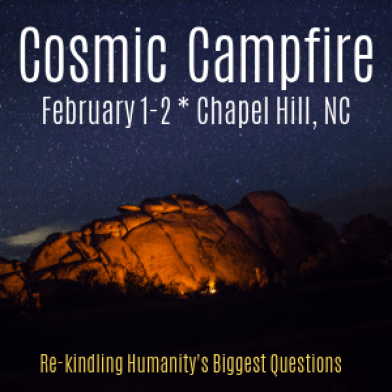
Speaking of: Early Bird Tickets are now on-sale for the Cosmic Campfire Gathering, this February 1-2 in Chapel Hill, North Carolina. (And stay for Sunday morning February 3 if you can, for extra Cosmic Campfire goodness at our host space, Holy Trinity Lutheran!). Early Bird tickets are $129 through January 15th, saving $70 on the at-the-door price, if they even last that long. Seats are limited, so if you’re looking for the perfect Christmas gift for loved ones, yourself, or best-yet all of you, please get yours now.
If this is your first time hearing about this one-of-a-kind gathering, Tripp, Mike McHargue and I are creating space to talk about the Big Questions:
Who are we as a species?
What does it mean to inhabit these bodies, on this planet, in this universe?
How are we so beautiful?
How do we find ourselves in such a multi-lateral mess ?
Does being a friend of God, aspiring follower of Jesus, and student of Scripture have anything meaningful to add to this conversation?
Do the inquiries of biology, physics, psychology, archaeology and anthropology have anything meaningful to add to this conversation?
We’ll be exploring these questions, specifically as framed in the emerging cosmological projects Big History and the New Universe Story, with some of our favorite scientists, philosophers, and theologians. Buying your Early Bird Ticket now helps us plan for the full breadth of contributors to your experience, so we really appreciate it.
Confirmed dialogue partners include:
Barbara Holmes, PhD, is a theologian, writer and scholar who publishes books about the intersection of ethics, spirituality, mysticism, science, cosmology and African American religious culture.She is president emerita of United Theological Seminary of the Twin Cities and formerly professor of ethics and African American religious studies and vice president of Academic Affairs at Memphis Theological Seminary.In addition to her work with law firms, she has worked with homeless missions, HIV/AIDS ministries, and international ministries in Kenya (the Presbyterian Church of East Africa) and Japan. Her published work includes Liberation and the Cosmos: Conversations with the Elders, Race and the Cosmos: An Invitation to View the World Differently, Joy Unspeakable: Contemplative Practices of the Black Church, and other publications. Want to hear from Dr. Holmes? Listen to her on theseepisodes of Homebrewed Christianity and Contemplify!
Robyn Henderson-Espinoza, PhD, has been described in a myriad of ways: a scholar-activist, scholar-leader, thought-leader, teacher, public theologian, ethicist, poet of moral reason, and word artist. Among these ways of describing Dr. Robyn, they are also a visionary thinker who has spent two decades working in the hybrid space of church, academy, and movements seeking to not only disrupt but dismantle supremacy culture by focusing their PhD studies on new concepts of being and becoming, decolonizing knowledge production, and bridging with radical difference. Named one of ten Faith Leaders to watch by the Center for American Progress in 2018, Dr. Robyn is currently at work helping co-create Activist Theology. Dr. Robyn is a non-binary Transqueer Latinx who calls Nashville, TN home. (Dr. Robyn is one of Homebrewed Christianity’s favorite guests. Check them out in this interview archive!)
And while we’ll be having fascinating conversations with experts in their fields, the conversations continue with you…we’re building in plenty of space for all of us to explore the questions that drive us…together.
So…will you join us? You can find out even more info, and grab your early bird tickets, at CosmicCampfire.party.
The ancient Vedas of India tell us that “The One Existence the wise call by many names.”
How many names for Divinity are there? Do the names for God change? Ought they change as humans evolve and as circumstances of life evolve around us? Are we among the “wise” that the Vedas speak of who are eager to call the One Existence by many names? Do we have permission—and maybe a serious responsibility—to change our understanding and naming of God as we mature as individuals and as we evolve as a species and as we face a critical time – a ‘turning time’ – in human and planetary history?
The great medieval mystic Meister Eckhart declared: “I pray God to rid me of God.”
Apparently he was so convinced in the need to allow God and our names for God to evolve that he actually prayed to God to move on from being “God.” He challenges us further when he declares: “The highest and loftiest thing that a person can let go of is to let go of God for the sake of God.”
How many names for God have humans come up with? And which ones might serve us besttoday and what new ones beckon us? One answer to that question is a simple one:There are as many names for “God” as there are languages in the world, for each language calls God by a different word. Examples: God (English); Gott (German); Dieu (French); Dios (Spanish); Allah (Arabic); Gut (Norwegian);Theos (Greek); Deus (Portuguese); Bog (Russian);Dia (Irish); Elohim (Hebrew); Marta(Polish); Kalou (Fijian), etc. etc.
But that is by no means the whole story. For one thing, each language may well have multiple words for “God.” For example in English we can talk of Divinity; Spirit; Creator; Deity; Godhead; Goddess; and much more. If this is true in English no doubt it is true in other languages as well.
Every Religion offers its name for the Divine: Brahmin; Krishna; Tao; Buddha; Tara; Allah; Yahweh; Adonai; Tagashala; Wankan Tanka; Oshun; Isis; Christ – to name but a few.
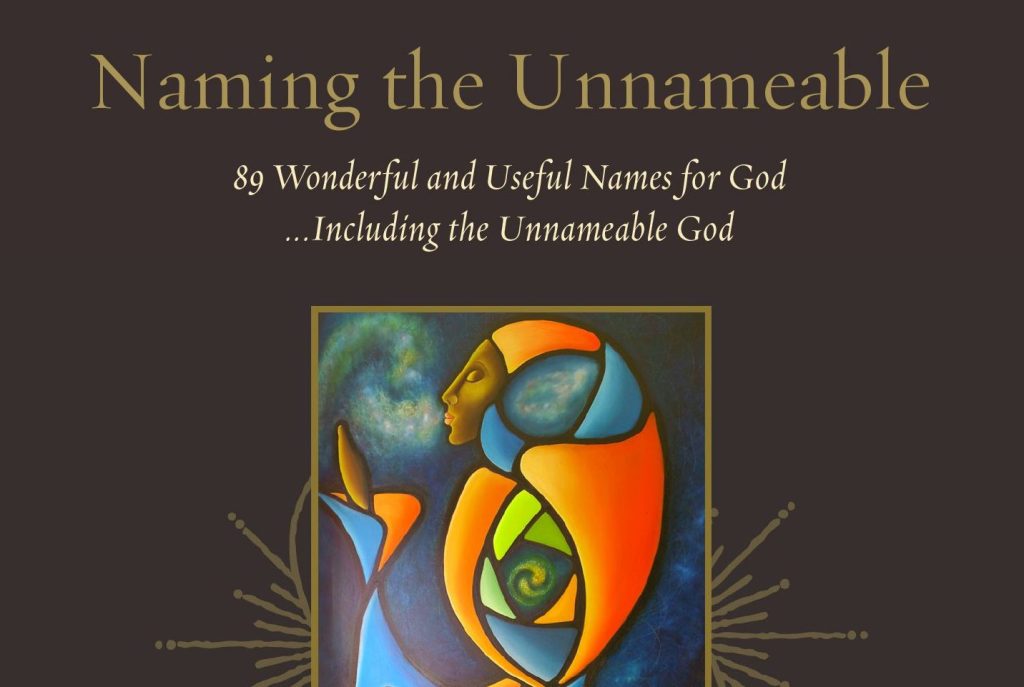
So where else do we come up with alternative names or images of God? The Sacred Scriptures of the world are one such place; and the mystics of the world are another; and science is another. The Muslim tradition boasts a powerful practice of reciting the “99 Most Beautiful Names” of God; in many ways, this practice has inspired my newest book, Naming the Unnamable, wherein I present 89 current names for Divinity that I think are most beautiful and wonderful and useful for our times. I am grateful for that Muslim practice to which I am indebted and which I have often prayed myself.
The ancient scriptures of Hinduism known as the Bhagavad Gita tell us this: “God has a million faces.”
St Thomas Aquinas, medieval theologian and mystic, goes even further. He says that every being is a name for God when he says: “Even the very ones who were experienced concerning Divinity, such as the apostles and prophets, praise God as the Cause of all things from the many things caused.” Aquinas, in this amazing passage,goes on to name 49 names for God that sixth century Syrian monk Dionysius the Areopagite found in Scripture alone and discussed in his foundational work, The Divine Names.
What follows from his statement is that there are literally multiple trillions upon trillions upon trillions of names for God. Countless creatures—therefore,countless faces, countless names. But at the end of his treatise he says nobeing is a name for God because “God surpasses all things.”
If there are trillions upon trillions of names for God, who am I – and who are you – to dare to choose only 89?
Well, first of all, my book is unfinished. It is open-ended, and the last pages of each section are left blank so that you may add your own most wonderful and useful names for God.
Secondly, while there may be trillions upon trillions of names for God, it is clear that we humans are limited. We can only take so much input, and reflect deeply on avery finite number of thoughts, concepts and names. So this book presents avery finite number, a working number, of possible names for God. Hopefully they might prove useful and inspire other useful names from the reader.
In this book I seek to offer a finite number of names for God that I sense might be useful for us in the difficult ‘in-between’ times in which we find ourselves at this dawning of the post-modern era. I include a modest meditation with each name to assist a kind of ‘unraveling’ and unpacking of each name. I invite the reader to deepen the experience by his/her own meditation and investigation. Some have called our times ‘apocalyptic’ and philosopher Theodore Richards points out that ‘apocalypse’ also means ‘revelation.’ Perhaps, in dire times, deeper mysteries are revealing themselves, unveiling themselves, to us. But we need to listen deeply. We need to develop our muscles of contemplation. We need to cease projecting and to learn anew to let go so that we can listen truthfully to the ‘hidden Word’ of silence. From this hidden place of silence, this “cave of the heart” as Father Bede Griffiths calls it, might emerge some new and fresh language for a spiritual awakening, for rich names for Divinity, for a global renaissance. Hopefully, Naming the Unnamable can assist that important task.
As humans undergo deep changes, so too does our understanding of God or Divinity. Both Meister Eckhart, a medieval mystic activist, and Alfred North Whitehead, a twentieth century scientific philosopher, agree that Divinity evolves. “God Becomes where all creatures express God,” notes Eckhart. Thus, our names for God increase in possibilities and evolve as evolution continues all around us. Deepak Chopra sees God’s evolution this way: “What actually evolved was human understanding….we think that God changes, because our own perception waxes and wanes. The messages keep coming though and God keeps showing different faces….as awareness evolves, so does God. This journey never ends.”
Which, among the trillions upon trillions of God-names might serve us the best today? And serve the planet the best? And therefore serve God the best? That is the question that this book is presenting. Hopefully, it will be useful, for as Aquinas insisted, a “little knowledge about important things is far more important than a lot of knowledge about unimportant things.”
A fresh understanding and language about Divinity may assist us to come up with fresh understandings of ourselves and thus the societies and institutions we feel called to give birth to as we struggle to assist other species to survive and to survive ourselves, to be sustainable, even to thrive and become beautiful and worthy of our holy existence.
Meister Eckhart warns us that when we talk about God we stutter and stumble. This is important information, that no word does God justice and no person or ideology holds a trademark on the word “God.” Humility and reverence are required evento enter into the conversation. A certain receptivity is required to enter into authentic God-talk. Hopefully that spirit of reverence, humility and receptivity imbues Naming the Unnamable and those who pick it up.
Here are but two of the 89 names and facets of God we explore…
God is the Newest and Youngest Thing in the Universe
In the ancient Vedas from India, God is called “most youthful.” Meister Eckhart says that “God is novissimus,” meaning the newest and youngest thing there is in the universe. He also says that “when we say God is eternal we mean God is eternally young.” There is something youthful and “in the beginning” about God—this is why both the Hebrew Bible and the Christian Bible (John 1.1) begin with the words “In the beginning….” To return to the beginning is to return to God therefore. And we do return to the beginning, to our “unborn selves,” as Eckhart puts it, and to the person you were before you were born. Buddhism tootalks of recovering our “original face” which we possessed before we were born.”
God is the Ancient One of Ancient Days, the ‘One Beyond Time’
Not only is Divinity young and youngest; it is also ancient and before time; and beyond time. Eckhart says: “God is eternity” who dwells in “the fullness of time. There everything is present and new.” But what is eternity? “Eternity is the peculiarity “that being and being young are one.” Because “both newness and life are proper to God,” our dwelling in the eternal now is dwelling in newness and life, vitality and the source of energy.
Hart says that “God is eternal, not in the sense of possessing limitless duration but in the sense of transcending time altogether. Time is the measure of finitude, of change, of the passage from potentiality to actuality. God, however, being infinite actual being, is necessarily…the One beyond time, comprehending all times within his eternal ‘now’.” We have glimpses of this “eternal now” when we undergo mystical experiences in moments of creativity or of great joy and ecstasy. At such times the past and future come together in the deep present and they are often accompanied by a deep Presence and a suspension of time—“Where did the time go?” we ask. This deep Presence can also communicate as a very ancient presence.
“Naming the Unnamable offers a smorgasbord of spiritual delights that will enrich the prayer life of both believers and nonbelievers. Fox’s radiant images and creative appellations transform the generic “God” into a vibrant, intimate Source for personal communion. Even those who have abandoned conventional religion will find wisdom and inspiration in these beautifully articulated reflections.” — Estelle Frankel, author of Sacred Therapy and The Wisdom of Not Knowing
“How refreshing! Fox shows how we can think about God in so many different ways, freeing our minds and liberating our imaginations. It is easy not to believe the narrow conception of God that atheists do not believe in, but it is hard not to be inspired by a God who is energy, breath, life, flow, love, joy and the cause of wonder. This book is timely, important and admirably brief, it is also open ended.” — Rupert Sheldrake, author of Science Set Freeand Science and Spiritual Practices: Transformative Experiences and Their Effects on Our Bodies, Brains, and Health
“These are not just names but 89 theories of God across the ages and the planet, each focusing on the characteristic it deems most divine. Matthew Fox leads us on a startling and beautiful journey through humanity’s capacity to envision God, showing every way of looking at God is legitimate if it raises the aspirations of its adherents and their ability to carry them out. Is there objectively a God? What ‘God’ even means explodes in this little book like fireworks in the mind.” — Nancy Abrams, author of A God That Could be Real: Spirituality, Science, and the Future of Our Planet
“This is a simple book written by a brilliant man who gives us a democratic vision of the names of God. It will be sure to appeal to readers of many faiths, scientists, and nature lovers as well.” — Steven Herrmann, author of Spiritual Democracy
“Matthew Fox leads us on an important yet easily absorbable exploration of the multiplicity of forms in which we perceive the Divine in our lives. While we so readily seek to differentiate, define or even dispel the sacred, we desperately need teachers like Fox who show us the unity in diversity. I suspect that anyone can find some names in this book that resonate for them, whether scientist or artist, believer or atheist, old or young, female or male. Fox’s depth of insight and abundant compassion is felt throughout the pages as he helps us embrace and share in the wholeness of who We are.” — Sky Nelson-Isaacs, M.Sc. Physics and author of Living in Flow
“I’ve always experienced the Divine as expressing through everything around me: the squirrel chattering up the oak tree, the waves crashing on the shore, my baby boy looking me in the eyes. Matthew Fox in Naming the Unnameable allows us to explore all of the many and dynamic ways that God speaks and breathes and plays in the world.” ―Jennifer Berit Listug, co-author with Matthew Fox and Skylar Wilson of Order of the Sacred Earth
“In Naming the Unnameable, Matthew Fox generously brings ‘God’ down to Earth and us into contact with the Great Mystery that dances all around and within us. He brings the arch of Western Religion back home …and with it, opens up a sense of the sacred for all to experience all-ways.” ―Skylar Wilson, co-author with Matthew Fox and Jennifer Berit Listug of Order of the Sacred Earth



 The biblical world was rife with spirit. The stuff was everywhere. Spirits began their lives inside humans, fawn, and fauna, and when their hosts passed away or dried up, they needed to find new places to hide. So, they spread out, seeping into every available nook and cranny. In an effort to establish some sense of sanity, idols, cemeteries, and shrines were set up as domiciles for these wayfaring entities. The hope was that they’d behave and stay put. But, this was rarely the case. Spirits would regularly escape, and latch on to unwitting people. Those who could handle it would go on to become inspired prophets and poets. Others would simply go mad.