
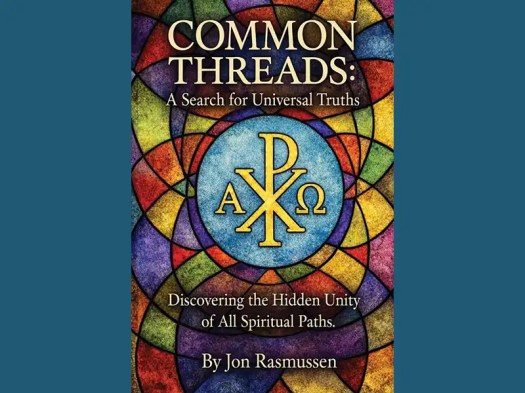
Common Threads | Jon Rasmussen

Common Threads

The following is an excerpt from Common Threads by Jon Rasmussen. It’s a featured Speakeasy selection, and there are still limited review copies available for qualified reviewers.

This work is not the result of an academic project. It is the result of trying to understand, study, practice, and make sense of and find truth in everything I was being taught about this world and the world of spirit.

For decades I have walked inside two worlds that many people believe cannot be reconciled: the sacramental life of the Catholic Church and the direct, initiatory encounter with the living structure of reality that many would call shamanic and scientific. In lived experience they are not in opposition. They are describing the same alignment from different entry points.

On one side was the immense, living tradition of the Catholic Church —sacramental, historical, embodied, anchored in the Incarnation and the Eucharist, shaped by saints, guarded by doctrine, luminous with beauty.

On the other side was the vast landscape of the world’s spiritual wisdom —the Upanishads and the Tao Te Ching, the Buddha’s awakening and the Sufi’s burning heart, the insights of contemplative psychology, the language of consciousness, the discoveries of modern science, and the testimonies of people whose experiences did not fit within any single inherited framework

I did not experience these as enemies. I experienced them as converging. Again and again, in prayer, in study, in conversation, and in the lives of people whose holiness could not be confined to a single vocabulary – like my Q’ero Shaman teachers who were isolated since 1492 AD high in a remote area of the Andes Mountains of Peru, who have spoken only the unwritten language of Quechua and share stories going back 15,000 years of originally coming from the stars, and who seem to me like the most Christ-like people I have ever met – I began to see the same pattern:

The same depths of silence.
The same transformation of the heart.
The same movement from ego to love.
The same intuition that reality is communion.

At first this convergence created a crisis. How could I remain fully, faithfully Catholic and at the same time acknowledge the real presence of truth, holiness, and transformation outside the visible boundaries of the Church, or any of the many Christian-based denominations?

How could I avoid reducing the uniqueness of Christ to one symbol among many — and also avoid denying the evident work of the Spirit in the world?

How could unity be real without becoming vague? This book is the fruit of living inside those questions. It is not an attempt to create a new system. It is an act of contemplation. It is the result of discovering that the Catholic mystical and sacramental vision does not close the circle of truth — it opens it.

What I came to see is simple and inexhaustible: Every authentic search for truth is already held within the Logos through whom all things were made, also known as the Source, the Universe, the Om, the Wiracocha (wellspring) and IntiTaiTai (the sun behind the sun). Every real movement toward love participates in the life of the Trinity in Catholicism: God, God in human form (Namaste), and the Holy Spirit (God Source in all of the forms both physical and non-physical).

Every transformation into compassion is a participation in the Paschal Mystery, which is Jesus’ passion to take on the suffering of the world (like Sidhartha the Budha), his death on the cross, and his resurrection, which are similar to the death and rebirth practice in shamanism and many other traditions for the primary purpose of freeing us from our mistakes and guilt and giving our soul the clarity to live consciously forever in the state of heaven within. You can go through this yourself, or you can accept and thank Jesus for doing it for you – like the ultimate shaman session, but rather completely free and unconditional.

The Incarnation of God through Jesus does not narrow the spiritual universe.

It reveals its center. This book was written for several kinds of readers. For the Catholic who senses that the Holy Spirit has been at work far beyond what they were taught to see, and who longs for a vision large enough to hold both fidelity and openness.

For the seeker who has encountered real light in many traditions and wonders whether there is a home in which those lights are not extinguished but rather gathered
For the contemplative who recognizes the same silence behind many different names.

For the modern person who can no longer divide science, spirituality, psychology, and daily life into separate compartments and who longs for a single, living synthesis.

This work does not attempt to erase differences between traditions. Those differences are real, and they matter. Nor does it pretend that every teaching is equally true?

Instead, it asks a more demanding question: What do we discover when we listen at the deepest level — the level at which the human person is actually transformed into love?

At that depth, the common threads appear. And at the center of those threads stands not an idea, but rather a presence:

The One in whom the Absolute becomes intimate,
the cosmos becomes sacrament,
the human person becomes communion,
and history becomes Eucharist – a true embodiment of Christ in all of us.

If this book has any value, it is not because it offers a new theory.

It is because it points toward a way of seeing — and ultimately a way of living— in which unity is no longer something we construct, but rather something we recognize as already given in Christ, who is “all and in all.”

This is not the end of a conversation. It is an invitation to one. What I am presenting here is not a theory about unity. It is the recognition of a pattern and common threads of teachings that repeatedly produces the same results in human lives across cultures: greater coherence between feelings and thoughts, power and integrity to ask for what you prefer and experience it, greater freedom from distortion and negative influences, greater capacity to love, and measurable protection from the forces that fragment the soul and seek to take from us all that we have – our power, our life force and will to live, our health, and our good relationships.

The Catholic mystical vision that I was originally born into and then left in my early twenties, is now clearly the incarnational center of this map because with a life of experience and now clearer understanding it is the place where what other traditions experience interiorly becomes historically embodied, sacramentally participatory, and communally lived. And the full circle for me going from Catholic to every other religion, spiritual tradition, and the most ancient continuous forms of Shamanism as both a practice and a vocation, is that I now see the value, beauty, grace, efficiency and commonality of all of my favorite aspects of all that I’ve learned and experienced are truly present in the Catholic Church. In other words, if I had applied the same time and effort of study, understanding and practice I put into everything else into my Catholic Faith, I might have come to this conclusion decades earlier. And then again, my purpose here seems to be a bridge for all things, for which I am now more qualified having taken this long and circuitous route.

With this book, I hope to take the decades of work and understanding that I’ve accumulated and pass it on as a more quick and efficient bridge to those who may be on a similar journey. This book is written for those who are no longer satisfied with inspirational language but rather want to understand the operational structure of transformation — what actually changes a human life and what does not.

If you read it slowly and apply it, it will function not only as a text but rather as a stabilizing alignment in your life that will allow you to focus your mind and energies to get to that experience of “heaven within” for this life and hereafter with greater ease and grace.

A good way to start is to take a measure of what portion of your life’s inner experiences would you consider to be heavenly (peace, pleasure, joy, comfort, love and etc.), hell-like (pain, anguish, confusion, fear and etc.) or purgatory, which is trying to get from hell-like to more heavenly with a lot of struggle, hard healing, spiritual, and psychological work, feeling lost and directionless, etc. Take note and write down what percentage of each of those you think is your current reality.

Then do it again after reading this book and maybe using the associated Common Threads Project App for a little while, and/or maybe joining or re-joining the Catholic Church if it makes sense to you. And with any spiritual tradition, healing tradition including western doctors and therapists, and everywhere else, it is critical to keep your power with it – in other words, nobody is above you, even in the man-made hierarchies. This way, you can participate in anything and not throw any babies out with the bath water – in other words, get the best of what it has to offer regardless of the flaws. Like I learned in my Shaman training, don’t confuse the message with the messenger, and certainly don’t give up on a valuable practice and non-physical team like the Eucharist, Jesus, Mary, and the Angels and Saints, the powerful sacred space and protection of the Church and years of powerful prayers just because, like in everything else, some deeply flawed humans are involved. In the end, it is about aligning YOUR Kingdom Within, with the best of the Kingdom of God aka the Source of All-that-Is. This is not the end of a conversation. It is an invitation to one.


Humanity is not suffering from a lack of spiritual information. It is suffering from fragmentation.

Common Threads reveals the single pattern that has produced authentic transformation across the great traditions of the world — and shows how that pattern becomes fully embodied in the Catholic sacramental vision.

This is not comparative religion.

This is a map of reality.

Drawing from decades of lived experience in contemplative practice, sacramental life, and direct work with the dynamics that either empower or fragment the human person, Jon Rasmussen presents a structure that allows the reader to:

  • recognize authentic transformation
  • discern false unity and ego-based spirituality
  • stabilize alignment with the Good
  • understand why the Eucharist is the operational center of communion

This book is for the reader who wants more than inspiration — it is for those who want a life that becomes coherent, protected, and capable of love.

Praise for Common Threads

“This book is an interesting and easy read that offers a personal perspective on identity, attraction, and self-understanding. The author writes in a simple and conversational style, which makes the topics approachable even when discussing more complex ideas. I liked how the book encourages readers to think beyond labels and reflect on how personal experiences can shape the way people understand themselves over time.”
—Amazon Review

“Common Threads has been such a gift for my soul at a time in our modern society where I’ve craved faith, truth, and hope. The author does a remarkable job laying bare so many answers to questions I haven’t known how to formulate with my own words.”
—Amazon Review

“Common Threads by Jon Rasmussen offers readers an introspective journey into the similarities that connect spiritual traditions across cultures and time periods. Rasmussen approaches spirituality with curiosity and openness, encouraging readers to look beyond differences in doctrine and focus on the recurring themes of compassion, purpose, connection, and human understanding.”
—Amazon Review

About the Author

Jon Rasmussen is a Catholic contemplative practitioner, shamanic initiatory guide, and teacher of the structural dynamics of transformation and consciousness.  His latest projects include a Catholic Life Coach web-based App called Veritas Life Guide, and his Common Threads project includes the book: Common Threads: A Search for Universal Truths – Discovering the Hidden Unity of All Spiritual Paths, the associated website and web-based app.

Common Threads on Bookshop

Jon Rasmussen’s YouTube

Shamen Radio Podcast

Common Threads Project Website

Common Threads Project App

Just Love | Wayne Jacobsen and Tobie van der Westhuizen

Just Love

The following is an excerpt from Just Love by Wayne Jacobsen and Tobie van der Westhuizen. It’s a featured Speakeasy selection, and there are still limited review copies available for qualified reviewers.

Excerpt from Chapter 2 & 3 of Just Love:
How One Mistranslated Word Distorted the Gospel

In my early forties, after a betrayal of a close friend and ministry colleague, I found myself on a different trajectory. God began to reveal how much he loved me, even in my feelings of failure and confusion. Over the next few years, he took me through a remarkable transition, from seeing God as someone I had to appease by my good behavior to a Father who already loved me, even in my struggles. Instead of waking up every morning trying to be loved by God, I started waking up as his beloved, a journey I chronicled in my book He Loves Me.

As that transition took place, I began to discover the relational joy and transforming power of engaging in an affection-based relationship with the Father through the Son. This was the life of Jesus I had long sought but my vigorous religious activities had failed to produce. I was amazed to watch struggles and temptations I’d fought for decades slowly fade away as love took hold. I found myself thinking and living differently; the joy I found in him displacing the temptations that I once wrestled with so stringently. This connection to his love became the predominant influence in my life, shaping how I treated myself and those around me.

For the past thirty years, I’ve traveled the world, helping people explore a relationship with Jesus that grows out of a confidence in his love for them, even in their darkest struggles. I want people to discover the joy of an affectionate relationship with God the Father, which is both personally liberating and redemptive for those around them. We can’t do that through our own efforts; it results from God’s love and goodness transforming how we think and live inside a growing relationship with him. 

Then one day, I received a fascinating email from South Africa. I had no idea who Tobie van der Westhuizen was or why he wanted to share with me a discovery he had been exploring for eight years. He wanted to know if his conclusions resonated with me.

Did they ever!

But it did take us some time to get there. His initial statement made me wonder if he was yet another kooky amateur theologian with some half-baked theological novelty. Tobie’s initial email cut right to the chase: “The word righteousness is not in the Bible.” 

Of course it is, I thought and immediately recalled two dozen Scriptures off the top of my head that speak of righteousness. However, I was intrigued enough to keep reading and discovered that his point was not that our English translations don’t include the word righteousness, but rather that it is a mistranslation of the original Greek. Then he laid out a compelling case that the word should have been translated to justice or justness, not righteousness.

At first glance, that would seem a minor distinction, but throughout this book, we will show you it is not. Why translators got that wrong and what it did to diminish our view of the life in Jesus is a compelling tale and opens the door to a more powerful gospel than what many embrace today. If true, this wouldn’t change the Gospel we’ve come to know, but it would give it a very different emphasis, making it richer and more transformative. 

Did Jesus say, “Seek first his kingdom and his righteousness, and all these things will be given to you as well?” Or did he say, “Seek first his kingdom and his justice, and all these things will be given to you as well?” (Matthew 6:33) The first naturally draws our eyes inward, focusing on our personal piety and individual morality. The second focuses on how we consider others around us. Am I seeking to be just in my dealings with them, or do I exploit them to get what I want? 

That’s how we’ll speak of justice in this book. Many people think of justice as punishment for crime. When someone is convicted and sentenced to death, we say the family of the victim got justice. Others think of it negatively because it has been co-opted by the political left to talk only about their view of social justice. But the Bible speaks early and often about being just in our dealings with people, and all the more so if righteousness is a mistranslation.

C. S. Lewis provided a powerful definition of the justice we’re discussing by listing his seven virtues in Mere Christianity: “Justice means much more than the sort of thing that goes on in Law courts. It is the old name for everything we should now call fairness; it includes honesty, give-and-take, truthfulness, keeping your promises, and all that side of life.” This is the justice of God that cannot be institutionalized in governments or religion by simply encoding it in rules.

The more Tobie and I explored this together, the more I realized that over the previous thirty years, love had already taught me to live in harmony with Tobie’s discovery. He offered a piece that has gone missing since the Reformation, when Protestants became more focused on imputed righteousness than on treating others justly.

Many follow the rituals and disciplines without ever discovering the fullness of joy that comes from living in tune with his presence in us. What I’ve been most struck by is how Tobie’s research unites the Old and New Testaments in a breathtaking way as one continuous story of God’s purpose unfolding in human history by connecting the coming of God’s kingdom on earth with the purpose of salvation. It also shows how Jesus transforms people from the inside out, not steeped in human effort but through the power of love to rewrite our story inside God’s redemption.

What Tobie shared with me highlighted in the Scriptures what I’d come to discover over the previous thirty years. Love had already taught me the reality of what he described, and now I had the Scriptural thread that brought it together. As we spoke, we both sensed that God had brought our two stories together to share something with the world that could help us embrace a more vibrant faith that expresses the kingdom of God.

As we’ll see, only the love of Jesus working in us can make us just. This isn’t something we can accomplish through human effort. When we experience his love, we’ll find ourselves increasingly treating others with compassion, integrity, honesty, fairness, and mercy. This is how the kingdom of God becomes visible in our world. The just person living in an unjust world will carry a weight of character and graciousness wherever he goes and will also scandalize a world built on selfishness.


What if one mistranslated word split the Gospel in two — and kept it broken for five hundred years?
In a high school chemistry classroom in Bloemfontein, South Africa, Tobie van der Westhuizen asked his students what “karma” meant. They leaned forward. They had opinions. They argued. Then he said: “There’s another word that means the same thing.”

Silence.

“Righteousness,” he said.

The class slumped back in their chairs. Faces twisted. Murmurs of protest went up across the room. “No, sir.” “That’s about entitlement.” “That’s when people think they’re better than others.”

And Tobie realized something seismic had just been confirmed: the very word English-speaking Christianity has used for five centuries to translate the heart of the Gospel is unintelligible — even repellent — to the people the Gospel was meant to reach.

Just Love: How One Mistranslated Word Distorted the Gospel is the fruit of that classroom moment and the decades of linguistic, theological, and personal reckoning that preceded it. Written by Tobie van der Westhuizen and beloved author Wayne Jacobsen (He Loves Me), it makes a case that is at once scholarly and devastating in its simplicity: the Greek word dikaiosynē, translated as “righteousness” in every major English Bible, is rendered as justice in every other language — German, Afrikaans, Spanish, French, Dutch. Every single one. The English deviation traces directly to the Norman Conquest of 1066, which severed English legal vocabulary from its Germanic roots, creating a religious word — “righteousness” — that conveyed personal moral status instead of right relationship, inner purity instead of just action, individual salvation instead of communal transformation.

In short: what we call the “social gospel” and the “personal gospel” were never meant to be two things. The split was a translation accident. And its consequences have been catastrophic.

This is not a book about scoring theological points. Wayne Jacobsen opens with one of the most vulnerable passages you’ll read this year — the story of discovering that his wife of forty-seven years carried buried childhood trauma that had nearly destroyed their marriage, and how finding that “missing piece” transformed everything he thought he understood. That’s the register of this book: personal, pastoral, luminous with grace, and quietly revolutionary.

Tozer sensed it. N.T. Wright and Nicholas Wolterstorff have written about it in academic papers few will ever read. Just Love brings it home — not to theologians with PhDs, but to the “plain man and woman, the insignificant, the widow and the orphan, the poor and oppressed” for whom the justness of God was always intended.

What changes when you read justice instead of righteousness?
Everything. “Blessed are those who hunger and thirst for justice.” “Seek first the justice of God.” “The Golden Rule” becomes the Golden Life — not a rule to follow, but a love to inhabit, overflowing into the world.

Perfect for readers who:

  • Have felt the tension between “personal salvation” and “social justice” — and suspected it was a false dichotomy
  • Are drawn to N.T. Wright, Dallas Willard’s critique of the “Gospel of Sin Management,” or Scot McKnight’s kingdom theology
  • Hunger for a Gospel that transforms from within rather than managing behavior from without
  • Find “righteousness” language alienating, moralistic, or weaponized — and want to know why
  • Work in justice ministry and want deeper theological roots for what they already know in their bones
  • Are tired of Christianity that produces converts but not transformed lives

Praise for Just Love

“Not since Luther nailed his ninety-five theses to the door of the Church has there been such an important rediscovery of truth. This changes everything!”
—Brad Cummings, co-author, publisher, and movie producer of The Shack

“Perhaps the most important spiritual discovery during my time on this earth. Prepare to be challenged and hopefully, changed.”
—Bob Prater, co-author of A Language of Healing for a Polarized Nation

“A most helpful, readable, wonderful book. You thought you knew it, but Wayne and Tobie offer eye-opening insight into the layers of God’s justice and love.”
—Dr. Stephanie Bennett, communication professor and author

About the Authors

Wayne Jacobsen has traveled the world helping people embrace a relationship with God deeply rooted in his affection for them. His numerous books include He Loves Me, So You Don’t Want to Go to Church Anymore, and A Language of Healing for a Polarized Nation, and was coauthor of The Shack. A former pastor, Wayne hosts Lifestream.org, which provides resources for spiritual growth, and a podcast at TheGodJourney.com.

Tobie Van Der Westhuizen is a Bible teacher, educator, and learning designer from South Africa, holds a PhD in Higher Education and has spent decades teaching, writing, and communicating complex ideas with clarity and imagination. He is the owner and principal of Ridgefield Academy and blogs at JusticeofGod.com.

Just Love on Bookshop

Just Love Trailer

Just Love on The God Journey Podcast

Insight Interview with Wayne Jacobsen and Tobie van der Westhuizen

Wayne Jacobsen’s Website

Tobie Van Der Westhuizen’s Website

Not to a Flag, but to a Flame: Introducing The 1526 Project — Resistance at 500 | Ben Boswell

An interlude before we go on.

Part Two of my Interdependence Day trilogy — The Road Not Taken — is nearly complete and will land in your inbox soon. But before it does, I want to hand the mic to my friend Rev. Dr. Ben Boswell, because what he’s weaving belongs in this conversation too. My trilogy argues that real freedom in USAmerica has never trickled down from our founding document — it has been seized, again and again, by the people this declaration was written to exclude. Ben takes this claim and builds a twenty-week spiritual-formation curriculum on it, tracing the true American founding not to 1776 but to a revolt of enslaved people in the Georgia woods in 1526. It’s called the 1526 Project, it’s already underway (you can still join mid-stream — each week stands alone), and the whole thing costs $15.26.

If you skim nothing else: get the curriculum here, or read three sessions free first. Now — here’s Ben.


The arc of the moral universe is long, but it bends toward justice — and the bending is being done by hands you have not yet learned to honor.
— after Theodore Parker, with maroon corrections

What, to the American slave, is your Fourth of July? I answer: a day that reveals to him, more than all other days in the year, the gross injustice and cruelty to which he is the constant victim.
— Frederick Douglass, Rochester, July 5, 1852

We who believe in freedom cannot rest until it comes.
— Ella Baker, by way of Sweet Honey in the Rock

I hate, I despise your religious festivals. Your assemblies are a stench to me.
— the prophet Amos (5:21)

Fifty years ago, on the bicentennial of the signing of the Declaration of Independence, my mother was not in the mood to celebrate. A graduate student at the University of Virginia, steeped in the Black intellectual tradition, she told my father — then her boyfriend — that she would not join the jingoistic pageantry of parades and fireworks. Instead of celebrating two hundred years of freedom for white male landowners, they agreed to see Aerosmith, Bob Seger, and Jeff Beck, and get high.

The apple doesn’t fall far from the tree.

Like my parents, I’m in no mood to celebrate the semiquincentennial of American independence, and I have no interest in the white nationalist propaganda festival masquerading as “Freedom 250.” There was no semblance of true freedom in this country until Juneteenth 1865 — and even that was partial and temporary. What “freedom” are we celebrating?

Whose Freedom?

There is a massive contradiction at the heart of the American experiment: what America calls freedom was built on, and continues to be dependent upon, the unfreedom of others. Freedom for white people was built on the enslavement of Africans, the genocide of Indigenous nations, Jim Crow apartheid, mass incarceration, mass deportation — and the beat goes on.

The Founding Fathers were capitalist landholding colonizers who declared independence chiefly from any constraint on their accumulation of wealth and power. They had no intention of extending freedom to women, to Indigenous nations, or to enslaved Africans. Their pseudo-enlightenment understanding of freedom was severely limited by a white colonial imagination.

Why would we celebrate the genocidal settler-colonialist enslavers who founded this nation?

Scholar Saidiya Hartman claims the end of slavery should be considered “the nonevent of emancipation” because the freedom received arrived burdened and hollowed out. In Scenes of Subjection, she shows how emancipation transferred the formerly enslaved into a new architecture of subjection: the debt of the sharecropper, the binding labor contract, the “burdened individuality” of a liberty that conferred blame without land, power, or protection. Liberty became one more instrument of domination.

According to Eddie Glaude Jr., American freedom is white freedom — an imposter freedom, treated as the white man’s possession and a revocable gift he can grant or withdraw at will. Every advancement toward freedom for non-white Americans meets a season of white backlash, like the one we are living through now, which serves as a horrific reminder that American freedom has always been for whites only.

Whose Democracy?

I am also in no mood to indulge attempts by “moderate” or “progressive” Christians to redeem the semiquincentennial as proof of a sacred bond between Christianity and American democracy. What Christianity are we talking about? What democracy?

In an age of extreme White Christian Nationalism, it is disingenuous to speak of that bond without specifying which Christianity we mean. There are many different versions of Christianity and democracy in America. Most of them are fraudulent.

Over the last 250 years, Christianity has most often been an enemy of democracy and a partner in oligarchy, patriarchy, colonialism, capitalism, and white supremacy, blaspheming their support for these evils in the name of Jesus. The only reason we have anything resembling a democracy in this country today is because of the resistance by the people to whom white freedom was never intended to extend.

What would Indigenous Americans, the descendants of enslaved Africans, women, LGBTQIA+ people, immigrants, and AAPI communities make of our 250 festivities and think pieces? These are not rhetorical questions. They force us to ask whether the word freedom means anything when Americans say it.

Honesty requires us to confess that true freedom has never been handed down by this nation. It has always had to be seized, repeatedly, by the very people the nation was built to own and oppress.

Freedom is not a gift an oppressor can give, because oppressors can only offer the freedom they possess — one built on the slavery of others, which is not freedom at all but domination in disguise. As Ursula Le Guin’s “The Ones Who Walk Away from Omelas” reminds us, real freedom cannot be based on oppression, and we must walk away from false white freedom to pursue a liberty that is not dependent on anyone’s bondage.

Frederick Douglass tore off that mask on July 5, 1852 — not July the Fourth, but the day after. He faced a hall of white abolitionists expecting an Independence Day oration and delivered an indictment: “What, to the American slave, is your Fourth of July?… To him, your celebration is a sham.” And: “This Fourth of July is yours, not mine. You may rejoice, I must mourn.”

He was not refusing to love freedom; he refused to let a complicit Christianity counterfeit the word.

Personally, I am not satisfied, as my mother had to be, in refusing the counterfeit alone. Sacred memory is among the holiest practices of any spiritual tradition.

A More Worthy Celebration

Watch Night New Year’s Celebration, 19th-century

I reject the Fourth of July as a day of independence, but that does not leave me without a celebration — only free to keep a truer and more liberative one, which took place five hundred years ago.

Two hundred and fifty years before the founding enslavers and colonizers signed their declaration, in the summer of 1526, a Spanish nobleman named Lucas Vázquez de Ayllón set out with roughly six hundred would-be settlers, three Dominican friars, and about one hundred enslaved Africans, and planted the first European colonial settlement in what would become the United States — the original sin of the American project, eighty-one years before Jamestown. He called it San Miguel de Gualdape, on the coast of what is now Georgia.

The colony lasted three months. Disease swept through it. The settlers fought each other. Ayllón died on October 18. And within weeks the whole thing lay in ruins — because the enslaved Africans rose up, killed their enslavers, burned what could be burned, and walked into the woods to live free with the Guale people. They were the first enslaved Africans to revolt against slavery on this soil, and when they joined with the Guale they formed, in all likelihood, the first maroon community on the North American mainland. Scholars now believe the descendants of that 1526 revolt also played a critical role in the massive Guale Revolt of 1597, a coordinated uprising that nearly dismantled the Spanish colonial system across Georgia’s Sea Islands.

These brave revolutionaries signed no parchment. Their names have been lost to history. Yet they engaged in the first of a long line of slave revolts on this continent; they formed the first maroon community on this soil; they gave birth to Afro-Indigenous solidarity; and they established a true multiracial community of freedom two hundred and fifty years older than America itself. They began the real American revolution — the only one that has ever mattered — and it has been going on, in maroon swamps and slave quarters and Indigenous councils and Black churches and Pentecostal storefronts and on the Standing Rock prairie, for five hundred years without stopping.

This is what I intend to celebrate this year: the anniversary of the first enslaved rebellion, the first resistance to settler-colonialism, the first maroon community, the first true birth of freedom. Freedom did not begin in 1776. It began in 1526, in the woods of coastal Georgia, in the hearts of the enslaved, in the hospitality of the Guale people, and in the courage of those who resisted.

So this year, while the United States throws itself the most expensive birthday party in the history of empires, I am keeping a different feast — and I have built a way for you to keep it with me. It’s called the 1526 Project.

A Debt to The 1619 Project

The 1526 Project takes its name, and much of its method, in homage to The 1619 Project — the landmark work created by Nikole Hannah-Jones with The New York Times Magazine in 2019, which reframed the American story around the arrival of the first enslaved Africans in the English colony of Virginia in 1619 and insisted that slavery and Black resistance belong at the center of the national narrative rather than its margins. The 1526 Project would not exist without it.

Where The 1619 Project reckons with the year slavery’s enduring American institution took root, The 1526 Project reaches back another ninety-three years — to the first European colonial settlement on the mainland, the first enslaved Africans, and, decisively, the first rebellion — and asks the church in particular to keep a different anniversary. We do not offer this as a correction to Hannah-Jones’s work; we offer it as a continuation of it, into the territory of liturgy, theology, and spiritual formation, and with profound gratitude. The argument that the true American founding belongs to the resisted and the resisting is hers before it is ours.

What the Project Is

The 1526 Project: Resistance at 500 is a twenty-week spiritual-formation curriculum that began on Independence Day 2026 and runs through the First Sunday of Advent (November 29) — a calendar arc that opens on the day America tells itself freedom was born, peaks on Sunday, October 18 (the day a different America was actually born, in the woods of coastal Georgia), and carries the work forward to the opening of the Christian liturgical year at Advent.

The curriculum is intended for use by:

  • Individuals seeking a personal devotional — a guided rule of life to read, pray, and practice alone, one session a week from Independence Day to Advent.
  • Local church small groups and adult Sunday school classes seeking a serious, biblically grounded engagement with the histories their pews were not built to remember.
  • Seminary classrooms and theological reading groups who want a primary-source-rich syllabus on the long tradition of liberatory resistance.
  • Faith-rooted organizers, abolitionist communities, and movement chaplains forming the spiritual lives of people doing the work.
  • Ecumenical public-facing networks running a parallel article and podcast series across the same months.

Each weekly session is built around the same six-fold pattern, derived from the spiritual practices of the maroon communities themselves — gather, remember, examine, lament, celebrate, and act — and is paired with a Sunday in 2026, a passage of Scripture, and a moment in the Christian liturgical year. Where the church’s calendar offers an opening — St. Mary Magdalene, the Transfiguration, Michaelmas, St. Francis, St. Luke — we have walked through it.

Five monthly deep-dives — one each for July, August, September, October, and November — provide longer, essay-length studies for those who want to go further. Use them as optional fifth-week gatherings, weekend retreats, podcast deep-cuts, or solo reading.

The arc has two peaks. The first is Sunday, October 18 — the Feast of St. Luke, the gospel of the poor, the day Ayllón died and the day the first rebels walked free — in a gathering we call simply The Feast of Maroon Freedom. The second is Sunday, November 29 — the First Sunday of Advent, also the anniversary of the start of Jamaica’s Baptist War of 1831–32 — in a closing liturgy that hands the fugitive tradition forward into the Christian year. The five weekly sessions between those peaks — Part V: The Long Continuance — carry the story across the rest of the great Atlantic-world rebellions of the nineteenth century: the German Coast Uprising, Amistad, the Creole mutiny, the St. John insurrection, and the Baptist War itself.

A Theological Framework: Maroon and Fugitive Christianity

The theology that animates this project is what we are calling — with the help of theologians and ancestors named in the appendices — maroon Christianity, and, in close conversation with it, fugitive theology. The two terms name the same gospel from slightly different angles:

The maroon escapes and builds a place. The fugitive escapes and keeps the escape itself sacred.

The maroon is the community in the swamp. The fugitive is the disposition in the heart.

We need both.

The framework rests on six convictions:

  1. The God of the Bible is the liberating God of the people who leave, walk, run, hide, and escape. From the Hebrew midwives who lied to Pharaoh, to the Israelites who walked out of Egypt, to Mary who fled to the hill country and then to Egypt with her child, to the early church scattering from Jerusalem under persecution — the Scriptures are saturated with the holiness of escape. Maroonage and fugitivity are not deviations from biblical faith. They are among its native forms.
  2. Freedom is the running, not only the arrival. The political theorist Neil Roberts has argued that freedom is best understood as marronage itself — the movement of fleeing, not the eventual settlement in a free place. Fred Moten and Stefano Harney, in The Undercommons, have shown how the fugitive constitutes another way of being in the meanwhile, beneath and alongside the institutions that cannot capture it. Kelly Brown Douglas has named what this looks like in the church: a fugitive faith, never fully settled, always on the way toward the kingdom. To be a maroon Christian is to recover the fugitivity of running.
  3. The cross is not a license for empire; it is empire’s defeat. When the Doctrine of Discovery turned the cross into a property deed, it inverted the gospel. The cross is the place where Rome’s project failed, where the lynching tree was made into a tree of life, where the executioners learned that they had killed someone who would not stay killed. A theology that uses the cross to justify conquest has stopped being Christian; it has become Caesarist — empire religion.
  4. Resistance is a spiritual discipline. The enslaved Africans who set fire to San Miguel de Gualdape were not engaged in a political act distinct from their religious lives. They were practicing the discipline of refusal. Like prayer, fasting, almsgiving, and worship, refusal is something Christians do — and it is something we have to learn.
  5. Land is liturgy. The first communities of resistance on this continent — Indigenous and maroon — knew themselves to be in covenant with particular places. The swamps that hid them, the rivers that fed them, the soil they planted: these were not backdrops to their faith but participants in it. Any spirituality of resistance has to relearn how to be in relationship with land, which means relearning how to follow the lead of those who have always known how.
  6. The eschaton has already broken in among the fugitive people. Where two or three gathered in the Great Dismal Swamp, the kingdom was there. Where Palmares stood for a hundred years, the kingdom was there. Where a Black church sang under the trees in hush harbors and a Lakota grandmother prayed at a pipeline gate, the kingdom is there. We are not waiting for the new heaven and the new earth. We are joining people who have been living in it the whole time — and who, in the tradition that runs from the maroons of San Miguel de Gualdape through Harriet Tubman through the scholars of fugitivity in our own day, have always known that the gospel is on the move.

Interested? Here’s how to join us.

The 1526 Project is not a document to admire; it is a practice, and it is already underway. It began on Independence Day and runs every Sunday through the First Sunday of Advent — which means the two great peaks are still ahead of us: the Feast of Maroon Freedom on October 18 (the day Ayllón died and the first rebels walked free), and the Advent liturgy on November 29 that hands the fugitive tradition forward into the Christian year. Every week stands on its own, so it is not too late to begin. Start today and walk the rest of the way with us.

Get the full curriculum — $15.26. Priced at fifteen dollars and twenty-six cents in honor of the anniversary, a single congregational license gives you all twenty weekly sessions, the five monthly deep-dive essays, the Feast of Maroon Freedom and July 4 liturgies, the reading and guest-list guides, and permission to reproduce the whole thing for your community. (Not ready to buy? Read three sessions free — San Miguel de Gualdape, the anatomy of a failed empire, and the maroons’ fugitive theology — before you decide.)

And however you come, come to do something. There are three ways in:

  • Run the series. Gather a circle, a class, or a whole congregation and walk the twenty weeks together — then tell the project you’re running it, so you can be woven into a network of communities keeping this anniversary across the country.
  • Pay reparations. Every session ends in action. Build durable, recurring support for Indigenous-led and Black-led organizations in your own region. Reparation begins with relationship.
  • Amplify the voices. If you run the companion podcast or article series, center Indigenous, Black, Caribbean, and Latin American scholars and elders as your primary voices — and pay them for their time.

The empire is throwing itself the most expensive birthday party in history. You are invited to keep a truer feast — one that is five hundred years old and still running. Come find your place in it.

Learn more and begin at resistance500.com.


Rev. Dr. Benjamin Boswell is the co-creator of the Resistance 500 curriculum and the author of For the Facing of This Hour: Preaching That Resists White Christian Nationalism and Confronting Whiteness: A Spiritual Journey of Reflection, Conversation, and Transformation. He is the former pastor of Myers Park Baptist Church in Charlotte, N.C., and is currently the lead pastor of a new church in Charlotte called Collective Liberation Church.

The Chemistry of Longing: On Science, Spirituality, and the One Addiction We All Share | Stuart Morse

The Science and Spirituality of Addiction

The following is an excerpt from The Science and Spirituality of Addiction by Stuart Morse. It’s a featured Speakeasy selection, and there are still limited review copies available for qualified reviewers.

Foreword by me, Michael Morrell

When Stuart Morse asked me to edit his opus on addiction, spirituality, and neuroscience, I jumped at the chance. I’ve known Stuart through our overlapping work in personal development and human potential streams, and I’ve always appreciated his incisive mind and generous spirit. What I didn’t expect was how much I would learn from this remarkable book, The Science and Spirituality of Addiction.

As I began reading, I was immediately struck by Stuart’s willingness to be vulnerable about his own journey with addiction and recovery. This isn’t an academic tome written from an ivory tower of clinical detachment. Instead it’s a deeply personal exploration that manages to weave together cuttingedge neuroscience, time-tested wisdom traditions, and raw human experience into something truly unique and valuable.

The biochemistry sections were eye-opening for me. While I’ve spent years studying consciousness and human development from psychological and spiritual angles, my grasp of the underlying neuroscience has been limited. Stuart’s explanations of how dopamine, serotonin, and other neurotransmitters shape our experience and behavior are remarkably clear and accessible. His exploration of conditions like Brunner Syndrome helps us understand how biological predisposition affects behavior, while avoiding both determinism and moral oversimplification.

Perhaps most impressive is Stuart’s ability to draw insight from his Christian faith while fearlessly examining difficult questions about human behavior and biochemistry. While my own Christian path tends toward the more progressive and contemplative, and Stuart’s theological framework is somewhat more traditional, I found his integration of faith and science to be refreshingly nuanced. He demonstrates how scientific understanding can deepen rather than diminish our appreciation of human spirituality and our need for divine grace.

In exploring the spectrum of addiction, Stuart encourages us to drop our pat condemnations and widen our lens beyond the ‘usual suspects’ that some of us tend to wax judgmental about, such as drug, sex, and gambling addictions. While not neglecting these, he widens the aperture to include just about all of us in compulsion’s lens. His analysis of technology addiction, for instance is particularly timely and insightful. From social media to video games, from smartphones to designer drugs, he helps us
understand how modern innovations can hijack our brain’s reward systems. His examination of these issues through both contemporary and biblical lenses—particularly his analysis of idolatry then and now—offers fresh insight into age-old human struggles.

The book’s exploration of money, power, and status as potential objects of addiction is equally compelling. Stuart helps us see how our economic systems and social structures can enable and even encourage addictive patterns. His integration of Biblical wisdom with contemporary understanding of brain chemistry offers a unique perspective on why Jesus had so much to say about the dangers of wealth and power.

When Stuart ventures into territory more familiar to me—drawing on Integral Theory, Spiral Dynamics, and the work of theorists like Clare Graves, Abraham Maslow, and Carl Jung—he still managed to surprise me with fresh insights. His synthesis of developmental psychology with neuroscience offers new perspectives on why we get stuck in destructive
patterns and how we might find our way to greater wholeness.

Particularly fascinating is Stuart’s engagement with Steve Peters’s “Chimp Paradox” and John Piper’s concept of “Christian Hedonism.” He shows how understanding our brain’s reward systems can actually enhance rather than diminish our spiritual life, helping us grasp why genuine service and worship can be deeply pleasurable without becoming self-serving.

What makes this book particularly valuable is its holistic approach. Stuart recognizes that addiction isn’t simply a matter of biochemistry, psychology, or spirituality alone—it’s an intricate dance between all these aspects of human experience. By helping us understand these various dimensions and how they interact, he offers hope for those struggling with addiction while maintaining realistic expectations about the challenges of recovery.

I appreciate how Stuart consistently returns to the fundamental human need for connection and meaning. Whether discussing dopamine receptors or Biblical parables, he never loses sight of the fact that at our core, we are beings who long for authentic relationship—with ourselves, with others, and with the divine. His work helps us understand why we so often seek to fill this longing in ways that ultimately leave us feeling more isolated and empty.

The Science and Spirituality of Addiction arrives at a crucial moment in human history, as we grapple with rising addiction rates, increasing social isolation, and profound questions about how technology is reshaping human consciousness and community. Stuart’s integrated approach offers valuable insights for anyone seeking to understand these challenges—whether from a personal, professional, or societal lens.

For those struggling with addiction—whether to substances, behaviors, or pursuing wealth and status—this book offers both understanding and hope. For those working in helping professions, it provides a broader context for understanding addictive patterns and potential paths to healing. And for anyone interested in the intersection of science, spirituality, and human development, it offers fascinating insights and thought-provoking questions.

Stuart’s work reminds us that while the biochemistry of addiction may be complex, the path to healing ultimately leads us back to elegant truths about human nature and our need for authentic connection. By helping us better understand the science behind our struggles while maintaining sight of our spiritual essence, he offers a valuable contribution to both recovery literature and our broader understanding of human nature.

This is a book that deserves to be read slowly and thoughtfully. Its insights build upon each other, creating a comprehensive framework for understanding both addiction and human development more broadly. I’m grateful to Stuart for writing it, and for allowing me to be part of bringing it into the world.

—Michael Morrell
Michael Morrell is an award-winning, best-selling author, collaborator on The Divine Dance: The Trinity and Your Transformation with Fr. Richard Rohr, founder of Wisdom Camp, and a founding organizer of this very justice, arts, and spirituality Wild Goose Festival. He co-parents his two astonishing kiddos in Asheville, NC.

What if you’re more addicted than you think?

Not to substances. Not to anything you’d confess in a meeting. But to money, prestige, romantic love, social media, the regard of others, the dopamine rush of political outrage, or the numbing comfort of control?

Stuart Morse’s The Science and Spirituality of Addiction: A Healing Guide for a Broken World opens with a disarming claim: there is ultimately only one addiction — the addiction to dopamine — and that means all of us are somewhere on this spectrum. The question isn’t whether we’re addicted to something. It’s whether we’re willing to look at ourselves with the “compassionate curiosity” that Gabor Maté describes, and ask the question that sits at the heart of this book: Why do I do what I do?

This isn’t a clinical textbook. Morse writes from his own lived experience — a recovery coach who has stared down his own compulsions — weaving cutting-edge neuroscience, developmental psychology, Christian theology, and integral theory into something that feels less like a lecture and more like a frank conversation over coffee with someone who’s been in the trenches. His chapters on technology addiction are especially timely: he traces with alarming precision how Silicon Valley has deliberately engineered our dopamine reward systems for maximum engagement, and how this maps onto ancient Hebrew warnings about idolatry. The god we bow to has updated its interface, but the mechanism of worship is the same.

Morse draws on the full range of thinkers who will be familiar to your contemplative and integral readers: Ken Wilber’s AQAL matrix, Spiral Dynamics, Abraham Maslow’s peak experiences, Carl Jung’s shadow integration, Victor Frankl’s search for meaning — all brought into dialogue with Jesus’s startling teachings on wealth, power, and the “eye of the needle.” His treatment of money and status as neurochemical addictions is not merely provocative; it’s exegetically serious, tracing the same dopamine prediction error that keeps a casino gambler pulling slots all the way to Solomon’s fatal fusion with his wives’ idols, and to the modern billionaire’s addiction to surplus value.

The path forward Morse offers is neither twelve-step nor purely spiritual bypass. It’s a fully integrated map: physiological recalibration, shadow work, developmental growth through the Spiral, contemplative practice, community, and the grace of a God who designed our reward systems and knows what they were meant to be filled with.

Perfect for readers who:

  • Recognize themselves in the compulsive scrolling, the overworking, the numbing — and want to understand why
  • Are drawn to Gabor Maté, Bessel van der Kolk, or Johann Hari’s work on addiction as disconnection
  • Want neuroscience and Christian theology in genuine, non-forced dialogue
  • Find Ken Wilber, Spiral Dynamics, or integral approaches compelling
  • Work in counseling, recovery coaching, chaplaincy, or pastoral care
  • Are curious why Jesus had so much to say about money, power, and the dangers of wealth
  • Believe that healing the self and healing the world are inseparable projects

Praise for The Science and Spirituality of Addiction

“This book is a remarkably comprehensive and well-balanced guide that weaves neuroscience, systems thinking, spirituality, and lived experience into a compassionate whole. I especially appreciated how the book translates complex science into meaningful insight through strong thematic reflections and practical takeaways. Morse invites readers, regardless of spiritual orientation, into deeper understanding and tangible pathways toward healing. I would recommend this book to anyone seeking an integrative approach to addiction and recovery! Really excellent read.”
—Rebekah Gold, PhD Candidate, Child and Youth Studies

“A rare and timely work, The Science and Spirituality of Addiction reframes addiction with depth, rigor, and compassion. By weaving neuroscience, psychology, and spiritual insight, it replaces shame with understanding and ofers an integrated path toward healing—one that speaks equaly to the mind and soul, leaving professionals and general readers with a deeper sense of what healing can be.”
—Jayne Norman, Addiction and Mental Health Worker

“This book treats the spirit with as much clinical rigor as the brain. It fills the void left by my formal education, weaving biblical lessons into neuroscience and psychology to offer a complete map of the human person, while being enriched with stories of the author’s lived experience. This is the holistic method in its truest form—scientifically grounded, spiritually deep, and immensely hopeful. It is a vital resource for integrated healing.”
—Jasmine Tromp, Addiction Recovery Worker

About the Author

Certified addictions coach Stuart Morse brings more than three decades of experience in the technology sector to The Science and Spirituality of Addiction, a cross-disciplinary exploration that bridges neuroscience, wisdom traditions and lived experience. With a Master’s degree in Computer Science and a background in artificial intelligence and complex systems, Morse examines addiction through a lens shaped by a longstanding curiosity about how humans think and behave—while grounding the work in his personal experience of addiction and recovery. Rather than an academic analysis, the book offers an accessible, deeply human account of addiction as a disruption of connection, and recovery as a process of reconnecting with self, others and community.

Born in England and influenced by its drinking culture, Morse’s early life informs his perspective on social norms and substance use. Before transitioning into his current work in addiction and recovery, he worked as a forester, dabbled as a heavy metal musician, and later built a long career in software. An avid gardener, he continues to draw on ecological perspectives in understanding growth, environment and interdependence. His writing reflects a synthesis of analytical rigor and lived insight, offering readers a perspective on addiction that is both scientifically informed and grounded in real-world experience and spiritual awareness that aid in the recovery journey.

The Science and Spirituality of Addiction on Bookshop

Stuart Morse’s Website


Bone of My Bone | Grant Romoser-Claunch

Bone of My Bone

The following is an excerpt from Bone of My Bone by Grant Romoser-Claunch. It’s a featured Speakeasy selection, and there are still limited review copies available for qualified reviewers.

“The way for Christians to enter into the mystery of and relationship with God is through Christology.”

“Remember Christ has no human body now upon the earth but yours; no hands but yours; no feet but yours. Yours, my brothers and sisters, are the eyes through which Christ’s compassion has to look upon the world, and yours are the lips with which His love has to speak. Yours are the hands with which He is to bless men now, and yours the feet with which He is to go about doing good through His Church which is His body.”

To talk about Christology is to also talk about incarnation — that the Word became flesh. “God with us.” Incarnation is the first and most foundational aspect of Christology. It is the God-drawn-near revelation. It is the light by which all the rest is seen. If Christology has anything to offer, it must meet us in our humanity. Divinity must be inextricably linked to humanity to have any merit. Any theology that says God is distant, uncaring, uninvested, or unmoving isn’t worth our time or adoration. God must be in this. Or else nothing really matters, even God.

To reuse the James Cone quote from the introduction of the book: “Christianity begins and ends with the man Jesus—his life, death, and resurrection. He is the Revelation, the special disclosure of God to man, revealing who God is and what his purpose for man is.”

I waste no time on a shallow incarnation that purports that the fullness of God dwelled in Christ Jesus 2,000 years ago yet is no longer with us in the world today. The Christological claim of the incarnation is of a deep incarnation. It is the claim that even beyond the historically bound human person, the fullness of Christ himself is with us in real, tangible ways today. Which is to take Jesus’ words seriously: “On that day you will realize that I am in my Father, and you are in me, and I am in you,” and, “Surely I am with you always, to the very end of the age.” What else does he mean when he takes bread and wine and says that it is his body and blood?

He must surely mean that he is always and unceasingly with us and in us. Nothing short of that will do. No Body But Yours I saw Christ crucified, and, in the same instant, I saw the power of his resurrection.

I saw Christ on October 30, 2023. It wasn’t the first time, but I had never seen this side of him before. His blood was A positive and there was a tiny 67 mL volume of him, containing 45 mL 5% Albumin in Dextran. This was the day Simon received his bone marrow transplant: “Day 0.” Christ’s cross fashioned into an IV pole. His blood flowed by nothing but gravity pulling it out of the bag. The speed of God is a slow drip. No machine, no pump to regulate the speed of flow. This isn’t a regular blood infusion. Just Christ and God’s intricate and good creation of gravity working together in life-saving synergy: the Divine and the Divine’s creation working in harmony.

Christ didn’t just get wheeled into the room on October 30, but had been at work, had been present, before that holy day, too. Christ is the little girl whose umbilical cord blood was used to heal Simon. Christ is the parents who chose to donate it. Christ in the hospital staff at her birth. Christ in the OBGYN who followed the strict yet proper protocol to collect, handle, and ship the cord blood safely. Christ in the transport teams to carry the stem cells. Christ in the weather and road conditions to allow for safe transport. Christ in the ones who processed the sample. Christ in the ones who froze it. Christ in Simon’s team who chose that specific sample. Christ in Simon’s nursing and doctoral staff. The deep incarnation of Christ everywhere, in all things.

Christ in the marrow.

Christ has no umbilical cord but yours.

Christ has no bone marrow but yours.

Christ has no stem cells but yours.

Praise for Bone of My Bone

“What a beautiful book! Grant weaves profound knowledge of scripture and doctrine to think theologically and spiritually in a terrible circumstance: his son’s cancer treatment. The pediatric oncology ward becomes a deep place to discover God, for ‘a God who can’t be found in suffering can’t be found anywhere.’ No one will read this book without being enriched by Good News. I will return to this book very often.”
—Paul Stroble, Retired Adjunct Professor, Eden Theological Seminary

“Bone of My Bone is a heartfelt emotional narrative about a father seeking spiritual understanding following his young son’s cancer diagnosis. The author, a pastor, shares his insights and reflections during this challenging time, inviting readers to engage in a deeper conversation about their own experiences and to explore the question of where God is during unimaginable circumstances. This book is a poignant, vulnerable, and thought-provoking story that is a must-read.”
—Jami Curley, Dean of the College of Nursing and Social Sciences, Lourdes University

“In Bone of my Bone, Grant Romoser-Claunch has brought the work of theology out of the abstract world of ideas and into the living, breathing, and suffering world of a pediatric cancer ward. Eschewing easy answers or trite solutions, Romoser-Claunch is the be praised not only for his theological acumen but even more so for his hard-won human sensitivities that make this work achingly powerful. I commend this book to all who may wonder what theology is really for in a world that all too often turns away from the pain that lies at its heart.”
—Adam Ployd, Dean, Davenport College, Yale University

“At once a stirring memoir of parenthood in crisis, a theological interrogation of suffering and pain, and a pastoral offering of a family’s journey with pediatric cancer, Grant Romoser-Claunch has written a book that can guide, challenge, and comfort readers on various levels. Bone of My Bone boldly advances theological inquiry into the challenging subject of theodicy, even as it pulls no punches in sharing the agonizing personal experience of a pastor and his family. Honest, brave, and beautiful, this book tells a powerful story of suffering and hope and forges new important insights in Christian theology and pastoral care.”
—Deborah Krause, President, Eden Theological Seminary

About the Author

Bone of My Bone

Grant Romoser-Claunch is foremost a husband and a father. Professionally, he works at Newsong Fellowship in Edwardsville, Illinois, as Pastor of Discipleship. In his work he seeks to help teenagers and adults alike to live into a vibrant, meaningful, and liberative faith.

Bone of My Bone on Bookshop

Edwardsville Intelligencer – Edwardsville father shares faith and fear in memoir about son’s cancer