Nonviolent Power | Bayard Rustin, Gareth Higgins


Today I’m sharing a powerful reflection from the late Bayard Rustin, notable change-maker for civil rights, nonviolence and a reconciled world. I have to state up-front that I share this reflection with some trepidation. If you’re white and reading this, I invite you to resist with me the temptation to idealize Rustin’s courageous nonviolent approach as the ‘ideal behavior’ for people of color and other oppressed peoples, while leaving the violent normalcy of our own structures of white supremacy intact. In my experience this weaponizes the ideal of nonviolence itself, against black and brown movements for justice that don’t pass the muster of our armchair criticism.

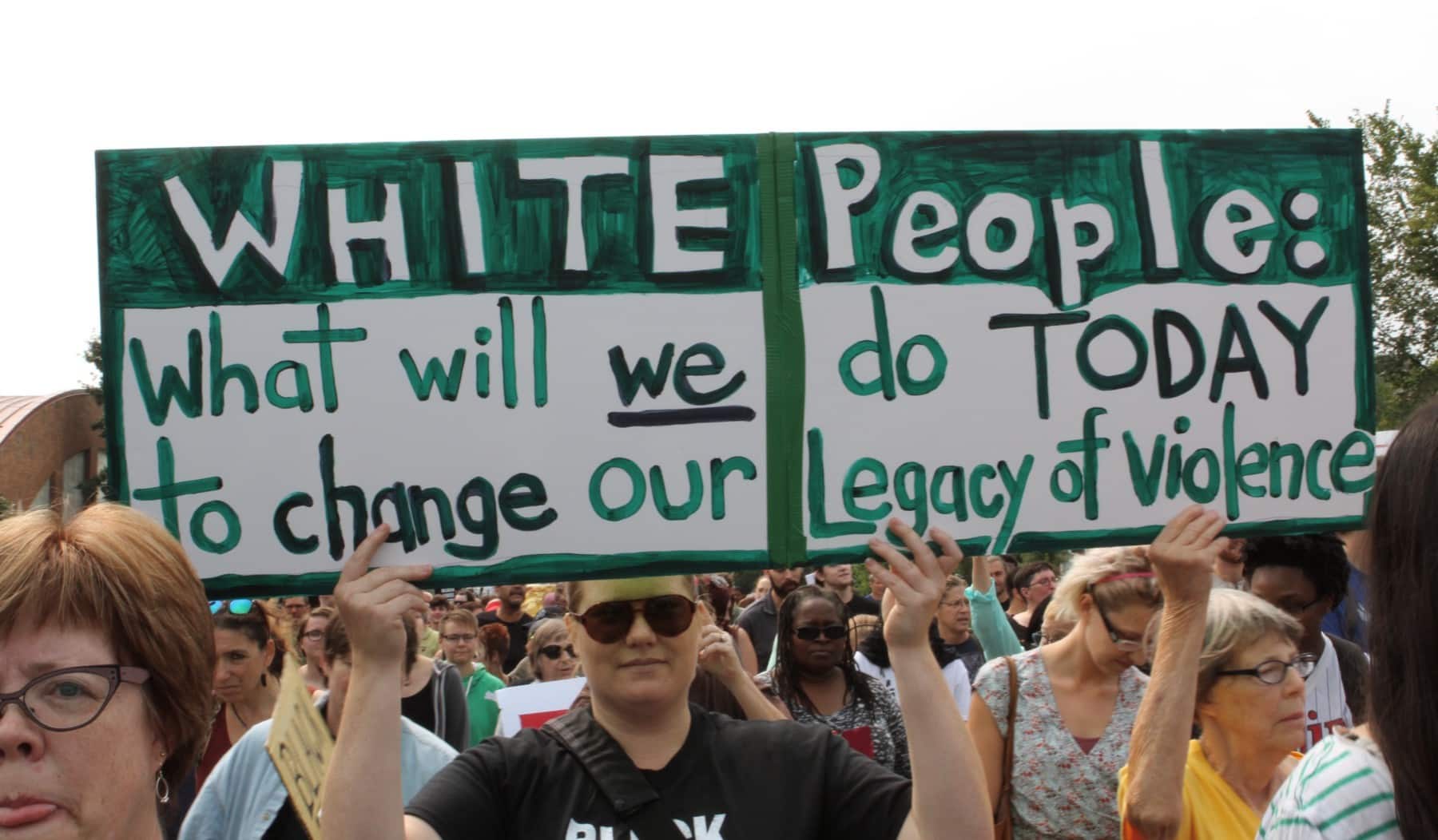
Instead, I invite you to see yourself in the various white folks in Rustin’s account: the belligerent bus driver, the sadistic ‘law enforcement,’ and – yes – the people who intervened and stayed on as witnesses to ensure that justice would be served. If you’re most tempted – as am I – to identify with the latter interveners and witnesses, then I encourage you to pay greater attention in your life, actively putting yourself in the harm’s way that our black, brown, immigrant, and non-Christian sisters, brothers, and non-binary siblings face on a routine and involuntary basis. If you see something, say something. And if you’re not seeing anything, consider making a change of venue part of your routine. This post by Chris Crass is an excellent starting point for aspiring allies like you and me.

Now: Please read Brother Bayard’s painful, dignified, and transformational account with your whole heart. 

RECENTLY I WAS PLANNING to go from Louisville to Nashville by bus. I bought my ticket, boarded the bus, and, instead of going to the back, sat down in the second seat. The driver saw me, got up, and came toward me.

“Hey, you. You’re supposed to sit in the back seat.”

“Why?”

“Because that’s the law. N****** ride in back.”

I said, “My friend, I believe that is an unjust law. If I were to sit in back I would be condoning injustice.”

Angry , but not knowing what to do, he got out and went into the station. He soon came out again, got into his seat, and started off. This routine was gone through at each stop, but each time nothing came of it. Finally the driver, in desperation, must have phoned ahead, for about thirteen miles north of Nashville I heard sirens approaching. The bus came to an abrupt stop, and a police car and two motorcycles drew up beside us with a flourish . Four policemen got into the bus, consulted shortly with the driver, and came to my seat.

“Get up, you n*****!”

“Why?” I asked.

“Get up, you black -”

“I believe that I have a right to sit here,” I said quietly. “If I sit in the back of the bus I am depriving that child” – I pointed to a little white child of five or six – “of the knowledge that there is injustice here, which I believe is his right to know. It is my sincere conviction that the power of love in the world is the greatest power existing. If you have a greater power, my friend, you may move me.”

How much they understood of what I was trying to tell them I do not know. By this time they were impatient and angry. As I would not move, they began to beat me about the head and shoulders, and I shortly found myself knocked to the floor. Then they dragged me out of the bus and continued to kick and beat me.

Knowing that if I tried to get up or protect myself in the first heat of their anger they would construe it as an attempt to resist and beat me down again, I forced myself to be still and wait for their kicks, one after another. Then I stood up, spreading out my arms parallel to the ground, and said,

“There is no need to beat me. I am not resisting you.”

At this three white men, obviously Southerners by their speech, got out of the bus and remonstrated with the police. Indeed, as one of the policemen raised his club to strike me, one of them, a little fellow, caught hold of it and said, “Don’t you do that!”

A second policeman raised his club to strike the little man, and I stepped between them, facing the man, and said, “Thank you, but there is no need to do that. I do not wish to fight. I am protected well.”

An elderly gentleman, well-dressed and also a Southerner, asked the police where they were taking me.

They said, “Nashville.”

“Don’t worry, son,” he said to me. “I’ll be there to see that you get justice.”

I was put into the back seat of the police car, between two policemen. Two others sat in front. During the thirteen-mile ride to town they called me every conceivable name and said anything they could think of to incite me to violence. I found that I was shaking with nervous strain, and to give myself something to do, I took out a piece of paper and a pencil, and began to write from memory a chapter from one of Paul’s letters.

When I had written a few sentences, the man on my right said, “What’re you writing?” and snatched the paper from my hand. He read it. then crumpled it into a ball and pushed it in my face. The man on the other side gave me a kick.

A moment later I happened to catch the eye of the young policeman in the front seat. He looked away quickly, and I took renewed courage from the realization that he could not meet my eyes because he was aware of the injustice being done. I began to write again, and after a moment I leaned forward and touched him on the shoulder. “My friend,” I said, “how do you spell ‘difference’?”

He spelled it for me – incorrectly – and I wrote it correctly and went on.

When we reached Nashville, a number of policemen were lined up on both sides of the hallway down which I had to pass on my way to the captain’s office. They tossed me from one to another like a volleyball. By the time I reached the office, the lining of my best coat was torn, and I was considerably rumpled. I straightened myself as best I could and went in. They had my bag, and went through it and my papers, finding much of interest, especially in The Christian Century and Fellowship.

Finally the captain said, “Come here, n*****.”

I walked directly to him.

“What can I do for you?” I asked.

“N*****,” he said menacingly, “you’re supposed to be scared when you come in here!”

“I am fortified by truth, justice, and Christ,” I said. “There’s no need for me to fear.”

He was flabbergasted and, for a time, completely at a loss for words. Finally he said to another officer, “I believe the n*****’s crazy!”

They sent me into another room and went into consultation. The wait was long, but after an hour and a half they came for me and I was taken for another ride, across town. At the courthouse, I was taken down the hall to the office of the assistant district attorney, Mr. Ben West. As I got to the door I heard a voice, “Say, you colored fellow, hey! ” I looked around and saw the elderly gentleman who had been on the bus.

“I’m here to see that you get justice,” he said.

The assistant district attorney questioned me about my life, the Christian Century, pacifism, and the war for half an hour. Then he asked the police to tell their side of what had happened. They did, stretching the truth a good deal in spots and including several lies for seasoning. Mr. West then asked me to tell my side.

“Gladly,” I said, “and I want you” – turning to the young policeman who had sat in the front seat – “to follow what I say and stop me if I deviate from the truth in the least.”

Holding his eyes with mine, I told the story exactly as it had happened, stopping often to say, “Is that right?” or “Isn’t that what happened ?” to the young policeman. During the whole time he never once interrupted me, and when I was through I said, “Did I tell the truth just as it
happened?”

And he said, “Well … ”

Then Mr. West dismissed me, and I was sent to wait alone in a dark room. After an hour, Mr. West came in and said, very kindly, “You may go, Mister Rustin.”

I left the courthouse, believing all the more strongly in the nonviolent approach. I am certain that I was addressed as “Mister” (as no Negro is ever addressed in the South ), that I was assisted by those three men, and that the elderly gentleman interested himself in my predicament because I had, without fear, faced the four policemen and said, “There is no need to beat me. I offer you no resistance.”


My dear friend and occasional collaborator, queer Northern Irish writer and activist Gareth Higgins, first introduced me to Bayard Rustin. He offers us this reflection: 

Bayard Rustin was born on March 17th, St. Patrick’s Day, which is a happy coincidence, for he did something in his life that warrants if not sainthood, st least a parade in his honor. But given that probably his greatest achievement was managing the 1963 Civil Rights March on Washington, I’m not sure he really needs another parade. Some would say that Rustin was the person who taught Gandhian nonviolence and to Martin Luther King; if you watch the footage of the rally at the Lincoln Memorial, you might spot Rustin in the background, not taking an upfront role.

He didn’t get the public profile that his wisdom, experience and courage deserved, partly because of one other fact of his life. He was gay, and his sexuality was seen by some as a reason to keep his profile low. St. Patrick has become an excuse for kitsch parties, dyeing rivers green, and drinking to oblivion. That’s sad, because what St. Patrick really did was to champion the dignity of Irish people. At a time when most others considered us to be primitive, sub-human, or otherwise less-than, Patrick taught that we were worthy of the human dignity inherent in the teachings of Jesus. Whether or not you’re religious, such a teaching could be life-giving.

Bayard Rustin embodied just such a teaching: that at a time when his people were oppressed, he helped lead a movement centered on the dignity of all people. The humanity he called for was surely not unconnected to his experience as a gay man, whom others sought to marginalize not just for the color of his skin, but for whom he loved. On March 17th – coming up next week – I celebrate St Patrick, and Bayard Rustin: men who saw the healing of our most oppressed people as bound up with the healing of us all.

And next month, from April 27-30, I’ll be co-creating the third annual Movies & Meaning Festival for a long weekend of art, storytelling, and tooling up for social justice work and community healing. Over one weekend, participants will be inspired and challenged by artists, activists, and spiritual leaders who work at the intersection of creativity, peace, spirituality, and social change.

We’ll hear from Alice Walker, Pulitzer Prize-winning author of The Color Purple; Brian McLaren, author, activist, and theologian; Malidoma Somé, West African Elder and international teacher; Mona Haydar, poet and Muslim interfaith activist; and myself. My hope is that we’ll be reenergized by the brilliant diversity of human stories and experiences, and renewed in our work to undo suffering and oppression in all its forms—both inside and out.

Alice Walker says of the festival, “This is exactly what we should be doing. Unless we really start to fortify ourselves spiritually, and affirm who we are and what it is we really value, a lot of our energy is going to seep away in the froth of resistance, and we won’t be able to move very far. I have no doubt whatsoever that this is the right thing to do. We are actually creating something that will have some strength.”

Want to spend time with us? Find out more here.

Diving Deeper:

Time on Two Crosses: The Collected Writings of Bayard Rustin

I Must Resist: Bayard Rustin’s Life in Letters

Bayard Rustin: The Invisible Activist

Lost Prophet: The Life and Times of Bayard Rustin

Brother Outsider: The Life of Bayard Rustin
 (documentary) 

A master strategist and tireless activist, Bayard Rustin is best remembered as the organizer of the 1963 March on Washington, one of the largest nonviolent protests ever held in the United States. He brought Gandhi’s protest techniques to the American civil rights movement, and helped mold Martin Luther King, Jr. into an international symbol of peace and nonviolence.

In the pacifist Fellowship of Reconciliation (FOR), Rustin practiced nonviolence. He was a leading activist of the early 1947–1955 Civil Rights movement, helping to initiate a 1947 Freedom Ride to challenge with civil disobedience racial segregation on interstate busing. He recognized Martin Luther King, Jr.’s leadership, and helped to organize the Southern Christian Leadership Conference to strengthen King’s leadership; Rustin promoted the philosophy of nonviolence and the practices of nonviolent resistance, which he had observed while working with Gandhi’s movement in India. Rustin became a leading strategist of the civil rights movement from 1955–1968. He was the chief organizer of the 1963 March on Washington for Jobs and Freedom, which was headed by A. Philip Randolph, the leading African-American labor-union president. Rustin also influenced young activists, such as Tom Kahn and Stokely Carmichael, in organizations like the Congress on Racial Equality (CORE) and the Student Nonviolent Coordinating Committee (SNCC).

Despite these achievements, Rustin was silenced, threatened, arrested, beaten, imprisoned and fired from important leadership positions, largely because he was an openly gay man in a fiercely homophobic era.


When Things Close In | Rainer Maria Rilke

It feels as though I make my way
through massive rock
like a vein of ore
alone, encased.

I am so deep inside it
I can’t see the path or any distance:
everything is close
and everything closing in on me
has turned to stone.

Since I still don’t know enough about pain,
this terrible darkness makes me small.
If it’s you, though—

press down hard on me, break in
that I may know the weight of your hand,
and you, the fullness of my cry.

— Rainer Maria Rilke, “III, 1,” Book of Hours: Love Poems to God
(translated by Anita Barrows and Joanna Macy)

Find yours at:

IndieBound

Amazon

Barnes & Noble

For White People Who Want the Racist Nightmare to End, We Must Reclaim Our Lives from Anti-Black Racism | Chris Crass

In honor of Black History Month, I’ve asked a number of friends and colleagues to contribute guests posts sharing their wisdom about how to live in a world where so much is shifting, and so much stays exactly the same. I encourage you to let these words sink in. – Mike

We who are the descendants of indentured European servants and of European working-class immigrants who fought back against bosses and their police to form unions and fight for better pay, better working conditions, the weekend, benefits, that few my age and younger have,

We who are the descendants of peoples who became white as a ruling class strategy to divest us of our shared humanity and solidarity with all working and oppressed people, and gave us entitlements, rights, the social and cultural wages of whiteness, as W.E.B DuBois wrote, that ultimately kept many of us economically down, politically weak, and spiritually impoverished,

We who are the descendants of people who became white through our collective consumption of hundreds of years of toxic anti-Black racist culture from the minstrel show to COPS that reinforces anti-Black laws, policies, and de facto rules that allow every form of brutality and insult to be unleashed against those who became Black in the process of extracting the wealth and power that built the United States,

We who are raised to be white in a white supremacist capitalist society must remember that white privilege was both a granting of access to resources and rights, while also a strategy to warp our worldview in anti-Black racism. This strategy channeled our our anger and resentment about working everyday to make someone else rich, deflecting it from the bosses and the ruling elite who imposed these conditions onto us, redirecting it onto other working people who are Black and of color. A strategy of maintaining structural inequality by granting non-ruling class white people the opportunity to regain a sense of our own power through our socially-encouraged, protected and often-rewarded ability to desecrate the dignity, humanity and life of Black people.

We who are raised white must realize that this society that devours the lives of Black people, everyday, is also a society that systematically raises us to be either butchers of Black life or the defenders and supporters of those doing the butchering. We are raised in a culture where white parents brought their “becoming” white children to watch the lynching and participate in the private rioting of socially acceptable white violence against Black bodies. We who are raised to be white, are raised in a death culture to be soldiers inflicting daily dehumanization against Black people in a capitalist society that profits from the slow (and sometimes quick) taking of Black life that maintains the monstrosity of the status quo.

While the most devastating and brutal consequences of anti-Black racism take place against Black communities, anti-Black racism is also core to what it means to be white in this society — to be emotionally and spiritually malnourished, fed hate, fear, envy, and resentment that deliberately replaced the sustenance of solidarity, love, friendship, community and mutually-affirming authentic human interactions across what became the color lines of a white supremacist society.

Every murder of a Black person by the police, every justification of how ‘scary’ and ‘threatening’ that person was to armed, trained, law enforcement, every media account that assumes innocence on the part of the police and guilt on the part of the murdered, every justification for endless anti-Black racist war, is also a continuation of the campaign to turn descendants of European servants, descendants of insurgent European immigrants, into patriotic white people who fight for the agenda of the rulers and denounce all who strike out for a world that affirms the inherent worth and dignity of all people, that embraces our shared humanity, that centers economic, racial, disability, gender, and environmental justice for all.

Anti-Black racism is war against Black communities. It is a cancerous, solidarity-poisoning, justice-denying process of straightjacketing the hearts, souls, and liberatory imaginations of those of us who have been raised white, so that we will be butchers, soldiers, and ‘good white people’ who call for ‘calm’ over ending violence when it’s Black lives being taken.

Anti-Black racism is a structural nightmare that white people must wake up from. We must wake up and fight back against it. The fight for white people against anti-Black racism is one of solidarity with Black communities and Black people in our lives and in our hearts, but it is also a fight to break free from the death culture suffocating and malnourishing us – and everyone raised white – whom we love.

When indentured Europeans joined with enslaved Africans to overthrow the tyranny of the slave master, the goal was to all get free. When the descendants of indentured servants, of exploited working-class immigrants, descendants of those who became white, join with the Black-led multiracial Black Lives Matter movement today, we must remember that in our confrontation with anti-Black racism, in our efforts to dismantle white supremacy, in our work for racial justice, we are also working to all get free and reclaim our shared humanity and the power of our solidarity, to build a world where liberation rather then supremacy guides all of our lives.

Free Downloadable Resources on Taking Next Steps:

Towards the ‘Other America’: Anti-Racist Resources for White People Taking Action for Black Lives Matter by Chris Crass

Practice Showing Up: A Practice Guide for White People Working for Racial Justice by Jardana Peacock

Support the Movement for Black Lives Now:

Right here.

For White People Who Want to Get Involved:

Showing Up for Racial Justice

More Posts on MikeMorrell.org in this series:

Resistance, Resiliency & Revival | Ashon Crawley & Rev. Dr. William J. Barber, II

Dear White Evangelicals – I Need You To Do Better | Maurice Broaddus

The Rise of the New White Church | Billy Michael Honor

Chris Crass is the author of the new book Towards the ‘Other America’: Anti-Racist Resources for White People Taking Action for Black Lives Matter. He writes and speaks widely on anti-racist organizing, feminism for men, strategies to build visionary movements, and creating healthy culture and leadership for progressive activism. He was a founder of the anti-racist movement building center, the Catalyst Project, and helped launch the national white anti-racist network, SURJ (Showing Up For Racial Justice).  Rooted in his Unitarian Universalist faith, he works with congregations, seminaries, and religious and spiritual leaders to build up the Spiritual Left.  He is also the author of Towards Collective Liberation: Anti-Racist Organizing, Feminist Praxis, and Movement Building Strategy. He lives in Louisville, KY with his partner and their two sons.  You can learn more about his work at ChrisCrass.org.

The Rise of the New White Church | Billy Michael Honor

In honor of Black History Month, I’ve asked a number of friends and colleagues to contribute guests posts sharing their wisdom about how to live in a world where so much is shifting, and so much stays exactly the same. I encourage you to let these words sink in. – Mike

I recently viewed Raoul Peck’s new film I Am Not Your Negro, which is essentially a radical narration about race in America, featuring the social commentary of James Baldwin.  I came away from this film with many thoughts and emotions, not least of which was the profound realization: if white supremacy is ever going to be curtailed and derailed, those who created it will have to do it.

As Baldwin classically asserts “If I’m a nigga, you invented me.”  This point cannot be under-emphasized.  Though many white Americans constantly bemoan the divisive state of race relations in the United States of America and feel that race is constantly placed in conversations where it doesn’t belong, they forget that this is a conundrum of their creation. Whiteness created ‘race.’ Thus giving birth to racism and creating the context for centuries of conflict between so-called whites, blacks and others.

Given this reality, one wonders why more whites don’t see it as their responsibility to tear down the racial tower of terror they created.

Moreover, it is really sad and shameful that more White Christians have not stood up in the name of their loving God to oppose the evil that is white supremacy.

The Rise of White Christian Resistance

The fight to combat white supremacy in the US has, by and large, been led by Black Churches that came into existence in response to Christian-based racial discrimination. But the time has come for White Christians to step up and take the lead in terminating the nagging racial pest that their heritage of privilege has unleashed in our shared social home.

For years, blacks have led in this cause for the sake of our own humanity and equality. And though, we, Black Christians, are happy to share from the wisdom of our many years in the struggle against racial injustice, we cannot continue to be responsible for this fight.

To be sure, there have always been White Christian abolitionist and freedom fighters who have courageously supported the cause of equality.  However, there has never been a major coordinated Christian-based movement for racial justice led and sustained by whites in this country.  This reality must change, and I dare say that it is changing.

With the rise of the Trump presidential administration with its neo-fascist, white nationalist and draconian sensibilities, it seems like a new diverse coalition of justice-seekers is finally forming.

Learning from the Black Christian Freedom Struggle

If I’m correct that a new coalition of White Christian justice-seekers are rising up, they would do well to learn from the church that white supremacy created – the Black Church.  Without a doubt, Black Christians have a long and productive legacy of engaging in communal combat against white supremacy.

Here are a few things that I think White Christians can learn from the black Christian freedom struggle.

Here are a few places to start:

The liberation struggle requires theological imagination.

Historically, most white scholars and theologians have not made the pursuit of justice and/or combating racism central or even marginal to their work.  Instead they have chosen to put forward so-called Christian ways of being that either ignore white supremacy or cutely divert by talking about the more palatable topic of racial ‘reconciliation.’

[Mike’s note: As my friend Melvin Bray asks, “Re-conciliation? When have we ever been conciled to begin with?”]

In order to rise above this un-artful dodge, justice-seeking white Christians will have to use their theological imagination to construct their own theologies of resistance and liberation.

They will have to write books, construct sermons and give talks that tell the ugly truth about the rages of white supremacy and why it’s a divine necessity to deconstruct whiteness.  This is what some the enslaved Africans did when they constructed the spirituals and what Benjamin Mays, James Cone, Jacqueline Grant and others did when they wrote about black liberation theology.  In similar fashion, we need white liberation theology focused on liberating whites from the bondage of their conscious and unconscious white supremacy.

[Mike’s note: I resonate with everything that Reverend Billy is saying here, especially the need for a white theological imagination digging in deep for beauty and justice. An early popular example of this is Rob Bell and Don Golden’s book Jesus Wants to Save Christians, which Don once described to me – at a Wild Goose Festival planning retreat – as “liberation theology of white people.” But if you’re white and reading this, don’t read Don and Rob’s book unless you pair it with at least one of the books linked in the paragraph above! Let’s educate ourselves.]

The liberation struggle requires institutions animated by freedom.

No real movement can be sustained long-term without forming institutions that extend the liberation moment into a lasting cause.  Black Christians demonstrated this by building schools, churches and civic organizations rooted in the pursuit of freedom, justice and equality for all. White justice-seeking Christians need to do the same.  They need to build new educational institutions devoted to unlearning white supremacy and colonial mentality.  They need new churches rooted in the radical gospel of subversive love and Holy Ghost-filled truth telling. They need to form civic organizations invested in the liberation of modern society from the perils of racial injustice and systemic inequality.  In short, they need to turn the historic trend of pro-white institution building into pro-human institution building.

The liberation struggle requires moral resilience.

Because the work of justice-seeking and equality is often difficult and full of setbacks and disappointments, moral resilience is necessary for this journey. If the Black Christian church knows anything it’s that the freedom march is a marathon, not a sprint.  It took 400-plus years to get equal protection under the law for African Americans in the US, and the fight still continues today.  In like manner, I’m quite sure white supremacy and systemic inequality will not die tomorrow or the day after.  White Christians seeking justice must pack their bags with resilience and prepare for a long ride down the road of freedom.

Billy Michael Honor is a minister, public theologian, and cultural critic whose progressive and compelling insights have made him a sought after preacher, lecturer, and social commentator.

He is an ordained Presbyterian (PCUSA) minister and the founding pastor of Pulse Church in downtown Atlanta. Billy travels domestically and internationally speaking about issues relating to faith and culture.

His writings and sermons have been featured on the Huffington Post, On Scripture, Day1, Sojourners, Yahoo Voices and the Grio.  He is also a graduate of the Candler School of Theology, the Interdenominational Theological Center and Beulah Heights University. Billy resides in Atlanta with his wife, Kaldeen. You can follow his work online here.


More in this series:

Resistance, Resiliency & Revival | Ashon Crawley & Rev. Dr. William J. Barber, II

Dear White Evangelicals – I Need You To Do Better | Maurice Broaddus

Dear White Evangelicals – I Need You To Do Better | Maurice Broaddus

In honor of Black History Month, I’ve asked a number of friends and colleagues to contribute guests posts sharing their wisdom about how to live in a world where so much is shifting, and so much stays exactly the same. I encourage you to let these words sink in. – Mike

The dealers in the bodies of men erect their stand in the presence of the pulpit, and they mutually help each other. The dealer gives his blood-stained gold to support the pulpit, and the pulpit, in return, covers his infernal business with the garb of Christianity.
-Frederick Douglass,* Narrative of the Life of Frederick Douglass, an American Slave

White Evangelicals, I need you to do better.

Watching so many of my fellow Christians so fervently support the rise of President Trump gave me pause and served to broaden the disconnect I feel with Evangelicals. I’ve historically identified as one. But somewhere along the way, “Evangelicals” became a byword, synonymous with “American white Republican Christian,” leaving a whole lot of us behind. You should be leading the charge against injustice, intolerance, hate, and destruction of the environment – yet your silence has become your message.

The Church promises a better way for the world, but we can’t seem to get it right ourselves. The Reverend Dr. Martin Luther King, Jr. once famously said “it is appalling that the most segregated hour of Christian America is eleven o’clock on Sunday morning.” President Trump’s rhetoric has created a hostile climate and emboldened people’s racism. It has stripped away the polite veneer, reminding us that we aren’t as “post-racial” as we dared to dream.

The promise of healing under President Obama remains unfulfilled. With the anger, fear, and frustration behind this electoral whitelash, we have a lot of work ahead of us.

When I have heard Evangelicals finally speak up, it’s to denounce how the rest of us protest injustice. Acts of protest, acts of civil disobedience, by their nature and intent, disrupt the natural order of things. That’s the point. The natural order needs to be questioned; the fact that not everyone experiences this natural order equally needs to be highlighted.

For example: if “All Lives Matter” was the case in practice, there would never be a need for Black Lives Matter. To go one step further, if All Lives Matter was the way things really are, when a black life was cut down unjustly, all people of all races would rally in objection. Instead, we have your silence and inaction.

Please stay with me, my white Evangelical friends: Before you get lost in reflex-like “terrorist organization” rhetoric, to say “Black Lives Matter” is a reminder. There is an unspoken “too” (as in “Black lives matter, too”) because it’s obvious that to many people they don’t. Black Lives Matter is not a difficult concept to grasp unless a person willfully doesn’t want to. Hiding behind #alllivesmatter is a distraction, an act of erasure, where people retreat to in order to cover their indifference with platitudes.

The simple fact is that Jesus often emphasized specific groups of people. The poor. Those whom others—the majority, the system—would tend to discount or condemn. The marginalized. Those denied a voice. The persecuted. His was a ministry of empathizing with ‘the other.’ He stood in opposition to oppression and systematic racism.

Pro-life activists retort “but the Supreme Court…”, summarizing their logic of electing a super-villain by appealing to Trump’s overtures of outlawing abortion. but by not denouncing racist and sexist and xenophobic rhetoric, you single issue-voters basically sent the signal that African-Americans, Latinos, women, the LBGTQ community, Muslims, and poor lives don’t matter. Being pro-life doesn’t mean that you stop caring about us once we’re born. Being pro-life means – and here’s where you get to say it – that all life is valuable: the unborn, the under-served, the abandoned, the forgotten.

With verses like “I tell you the truth, whatever you did for one of the least of these brothers of mine, you did for me” (Matthew 25:40) and “If anyone has material possessions and sees his brother in need but has no pity on him, how can the love of God be in him?” (I John 3:17), the Church is charged to take care of the poor. How you welcome the outsider, how you treat “the least of these”—be they immigrants, refugees, the voiceless, the disenfranchised—defines you as a culture and as a country. Yours should be the first voice in a chorus of welcome and compassion, not so scared that you forget what the gospel message should look like.

People notice when you have no problem calling out sin…unless racism is involved. Then suddenly you “don’t see color.”

People notice that racially charged language—playing to white fears—is not a deal-breaker for you.

You are called to do God’s work of reconciliation and redemption. This means you have to confront injustice whenever you see it, defend the disenfranchised (even at a sacrifice of your self-interests), and love one another.

Yet as long as it doesn’t affect your neighborhood, gentrification doesn’t matter.

Pipelines and clean waterways don’t matter.

In not rallying alongside those of NoDAPL and the people of Flint, Michigan, your silence is deafening.

You’re not in a position to demand that others build bridges to you when you rally around building walls. Which brings to mind another quote from Reverend Dr. Martin Luther King, Jr.:

Whites, it must frankly be said, are not putting in a similar mass effort to reeducate themselves out of their racial ignorance. It is an aspect of their sense of superiority that the white people of America believe they have so little to learn.

Evangelicals, you’ve lost whatever prophetic voice you had. You have to earn the right to speak into people’s lives; if they don’t feel loved or cared about, then you’ve missed the point of your faith. There’s no problem with your spirituality informing your politics, but there’s a huge problem with your politics informing your spirituality.

It looks like you’ve sold your soul to Republican politics, speaking more to an American Gospel than the message of Christ. Christians need to bear witness to the biblical story within a cultural context; this is unavoidable.  However, we are to do so without being co-opted by our culture. In other words, don’t confuse a civil religion with Jesus-flavored rhetoric (American Christianity) with a Jesus-shaped Gospel. Jesus didn’t die for lower taxes, smaller government, pro-business policies, and an individualistic worldview!

Keep the faith. Please, live out your mission to love the world. Love your neighbor. Love your enemies. Love the least of these. Such discipleship may very well cost everything, but it isn’t rocket science, either.

Dear Evangelicals, I’m going to need you to do better, to stand up, to show me that you care … or else take the name Jesus out of your mouth.

*Frederick Douglass, now President Trump–approved.

With nearly one hundred stories published, Maurice Broaddus’ work has appeared in Lightspeed Magazine, Weird Tales, Apex Magazine, Asimov’s, Cemetery Dance, Black Static, and many more. Some of his stories have been collected in The Voices of Martyrs. He is the author of the urban fantasy trilogy, The Knights of Breton Court trilogy. He co-authored the play Finding Home: Indiana at 200. His novellas include Buffalo Soldier, I Can Transform You, Orgy of Souls, Bleed with Me, and Devil’s Marionette. He is the co-editor of Dark Faith, Dark Faith: Invocations, Streets of Shadows, and People of Colo(u)r Destroy Horror. Learn more about him at MauriceBroaddus.com.

Learn about the work Maurice does as an Asset-Based Community Development consultant at The Learning Tree.