Today I sit down – virtually speaking – with my friend Dan Maurer – a writer of books and graphicnovels and, now, curator of plays!
So Dan – you have this creative outfit, Arches -n- Bells. How would you describe it?
We got bells! We got arches! Well, really now . . . Arches ‘n Bells is a skit, play, dialogue, monologue, reader’s theater, and litany provider for churches and faith communities. Our writers focus on producing high-quality resources from a progressive, grace-centered angle. All the stuff is downloadable for you to print and use. Oh . . . and we’re about fun too. Anybody going to the site should be able to see that. What’s more is that these works are intergenerational—they work with kids, teens, adults, and various subsections of a faith community’s demographics.
Diving into your plays, A-n-B is a bit…different than most church theatrical outfits out there. How would you describe this difference?
Well, for one we’re committed to writing high-quality works. I pay our writers handsomely because I know they’re pros in their field. The other difference I think goes into our commitment to writing plays that won’t just be engaging, fun, or thought-provoking, but also centering around themes like LGBT justice, racism, and also our commitment to use inclusive language. So far, FunChurchPlays[dot]com is the only show in town with these aspects. Did I mention we’re fun and a bit irreverent?
Some of your skits and plays are pretty straightforward riffs on Scripture – like your Samaritan Woman piece, drawn from John 4. But others, like ‘I Am You,’ are fairly stunningly original pieces. How would you express the need for both kinds of drama in the life of the church?
Great question, Mike. I think if people get the impression that we’re only about dealing with justice-based or theologically-progressive themes then they haven’t seen all we have to offer. Look, scripture is diverse in how it delivers the message. What I encourage our playwrights to ultimately convey, though, is that grace wins out in the end.
I think it’s pretty easy to write little moralistic tales that somehow make us feel good about humanity’s capacity to create a loving society. It’s much harder to realize that we’ve tried this on our own—again and again—and we don’t do a very good job at loving our neighbor, much less our enemy. Arches ‘n Bells resources are simply like no other, because we want to cover the gamut of scripture and dig deeply into both the more conventional, and also the alternative themes . . . like I Am You, where playwright and award-winning author Jonathan Bing wrote Jesus as a woman.
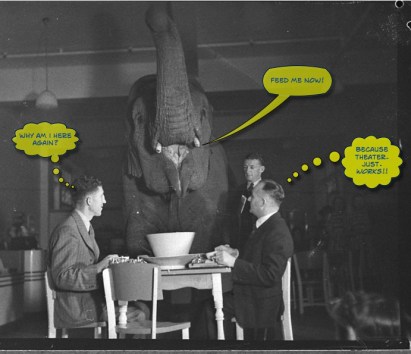
Let’s take a step back from that previous question: Why drama in the life of the church, period? Can’t we just be content with hymns and sermons and such?
Ha! You’re really rollin’ out the good questions! Why drama? Simple. Because human beings are story-creatures. We understand the complex and sometimes difficult themes from scripture best when we can see, hear, and feel it as a story. I’ve written about this topic frequently on the site’s blog, but I also understand as a writer (like you!) that stories engage people from every generation and every walk of life better than any other medium. What’s great is I encourage the folks who use our work to use it in any format they like. If you want your players to memorize, fine, but it’s not necessary. You’d be amazed at how effective drama is at relating the story, even when people just hold their scripts and read it off!
So, yup. We’re story creatures. No other species on the planet functions this way. I suppose anthropologists could aptly name us homo narrates: the creature that cannot help but tell stories. Just so I’m clear: hymns and sermons have their places. I’m suggesting that drama, litanies, and actively “playing the faith” should as well.
What do you hope communities of faith will come away with if they begin to work with progressive, grace-imbued drama in this way? How does this inform the players, and those who witness such plays?
Because I’ve experienced the power of drama firsthand, I know communities will not only enjoy the diversion drama naturally offers, but also I hope that “playing the faith” will essentially train people to act out their faith in real life. Arches ‘n Bells continues to build its repertoire (it takes time to write this stuff!) and I know that not every play will strike a chord with everyone. But regularly using drama helps both the players and those watching that all this Bible stuff really is relevant to speak to the human condition . . . and how God fits into the whole scheme of things. Plus, have I mentioned it’s fun yet? It’s okay to have fun in church!!
Thank you for you time today, Dan! Stay tuned next week for a sample play from Arches-n-Bells. In the meantime, you can go to FunChurchPlays.com to check these out for yourself.
I know, I know
If you could go back you
would walk with Jesus
You would march with King
Maybe assassinate Hitler
At least hide Jews in your basement
It would all be clear to you
But people then, just like you
were baffled, had bills
to pay and children they didn’t
understand and they too
were so desperate for normalcy
they made anything normal
Even turning everything inside out
Even killing, and killing, and it’s easy
for turning the other cheek
to be looking the other way, for walking
to be talking, and they hid
in their houses
and watched it on television, when they had television,
and wrung their hands
or didn’t, and your hands
are just like theirs. Lined, permeable,
small, and you
would follow Caesar, and quote McCarthy, and Hoover, and you would want
to make Germany great again
Because you are afraid, and your
parents are sick, and your
job pays shit and where’s your
dignity? Just a little dignity and those kids sitting down in the highway,
and chaining themselves to
buildings, what’s their fucking problem? And that kid
That’s King. And this is Selma. And Berlin. And Jerusalem. And now
is when they need you to be brave.
Now
is when we need you to go back
and forget everything you know
and give up the things you’re chained to
and make it look so easy in your
grandkids’ history books (they should still have them, kinehora)
Now
is when it will all be clear to them.
—Danny Bryck
It’s Black History month in the United States. Our new President has rolled out some truly terrifying Executive Orders his first dozen days in office. If you have a pulse you’re doubtless aware, so I won’t take up pixels enumerating them here – ’cause this post isn’t about him. These orders – with their policy and cultural ramifications – have led to some beautiful acts of resistance across the country and around the world.
They’ve also led to some dire predictions of what it all means, as well as alternative framings that basically say ‘calm down, it can’t
be this bad.’ I’ll admit, I’ve found myself caught up in all this back-and-forth, but I got a wake-up call when scholar, educator, and theologian Ashon Crawley shared this on Facebook:
Reading some of these doomsday think pieces, I suspect some self-branded leftists get pleasure from elaborating worst-case scenarios. There’s this sorta muffled glee from talking about how they were right – about everything – from the beginning. No no no, 45’s admin isn’t full of novices but really serious and sinister and smart people and y’all aren’t ready for fascism, they imply.
I think the more grotesque and absurd 45’s actions, the more pleasure they get from telling us how bad things will be. The stuff I’m reading isn’t about knowledge with the purpose of confronting and alleviating harm, but about spreading discomfort. And it’s almost like a shaming:
“Why didn’t you think it’d be bad?! how could you not know?!” sorta moralizing happening. because they wanna style themselves as the ones with the real knowledge of what’s ‘actually happening.’
It’s quite vulgar.
And this is where Ashon got me:
This is why minoritarian knowledge is so important. Not (only) because we emerge from traditions of resisting this shit since before 1492, but also because we have had to imagine – and thus materially implement – alternatives to normative order as a way of life. Doomsday narratives emerge as pleasurable when you don’t pay attention to indigenous and black and latinx and queer and women knowledges.
As a white male, I will resist the temptation to presume a place of command in this insurgency, as this is precisely the pattern of being that’s gotten us into this mess: the last gasp of Colonial nostalgia and Boomer entitlement. I will become a grateful student of those far wiser and more experienced than I – the Mujerista, the Zapatista – Standing Rock Water Protectors and Black Lives Matter white supremacy conscientious objectors.
Teach me, if you’re willing. For I stand with you.
I meant this. I mean this. But sometimes I forget.
So this month – this Black History ‘month’ that our nation has deigned to dedicate to a people and a culture that’s contributed so much to everything that’s best about these ideally-United States – I’m going to listen extra hard.
I’m starting with re-engaging a talk that Reverend Dr. William Barber is sharing across the nation right now like a modern-day circuit rider. This is part of a nationwide Moral Revival initiative being lead by Repairers of the Breach and the North Carolina NAACP. I heard Dr. Barber share a version of this message at the closing of the annual AAR gathering in San Antonio this past November; it was powerful. Having heard him many times at the Wild Goose Festival and on the steps of the NC Capitol building while participating in Moral Monday marches in my home state, I expected to be inspired. What I didn’t expect was to be educated. He gave us all vital, perspective-giving lesson on empire and white supremacy, and the hope of liberation that Jesus brings in his invitation to join the Beloved Community.
Please take an hour to watch this video with minimal distraction – especially if you’re white like me:
One compelling quote among many:
America must not waste time asking ourselves how this could have happened. It happened because it is a habit written deep in our public memory. If we are willing to see ourselves as we are and have been, we will also see another habit – and that is our potential for prophetic resistance. Our potential for revival and resiliency and redemption after rejection – even in times like these.
Happy Black History Month. May we come to realize, ever-more, that our liberation is bound up in each other’s freedom.
Recommended Reading to Catalyze Conversation & Collaboration:
To celebrate the release of The Divine Dance: The Trinity and Your Transformation with Richard Rohr and me, I’ve asked some of the most radiant and gifted thinkers, teachers, and practitioners I know to share their reflections on why Trinity matters. This week I share a powerful reflection by friend, musician, dancer, mother and scribe, Brie Stoner! If you don’t already have access to her contemplative chant videos, I recommend you subscribe to her blog at Becoming Ultrahuman and soak in ’em – they’re the perfect soundtrack to this post!
Suffering holds hidden within it, in extreme intensity, the ascensional force of the world.
– Teilhard de Chardin
It’s all about carrying to term and giving birth. To let every impression and every seed of a feeling realize itself on its own, in the dark…beyond the reach of your understanding, and to await with deep humility and patience the hour when a new clarity is born…
– Rilke
The ‘Trinity’…what in the world? Is there anything to this particular vision of Divinity? And could it possibly speak to the post-election tumult the United States is facing?
Traditionally, the Trinity is taught and understood as a self-enclosed community of God the Father, God the Son, and the Holy Spirit. Most understand it as a somewhat-speculative foray into the inner life of God, an abstraction created to make sense of Christ’s divinity and humanity. It’s no wonder that Karl Rahner made the statement that if the Trinity were to drop out of our religious lexicon, no one would even notice.
I’m actually pretty fond of this particular Christian doctrine, however, and many of the mystical writers that I’m a fan of (ancient and contemporary) are too: Bonaventure, Teilhard, Panikkar, Beatrice Bruteau and current wisdom teacher Cynthia Bourgeault all have interesting things to say about the Trinity. Rather than viewing the Trinity only as three persons, they view the Trinity as dynamic functions of a relational God-in-the-midst-of-the-cosmos.
When seen through the light of evolution and colored by the insights of some of the aforementioned theologians and scholars, the Trinity is no longer simply a theological speculation on the inner life of God; it becomes a dynamic mandala of God’s ongoing creativity in an evolving universe. It becomes, in fact the evolutionary principle.
Threeness, creativity, and evolution are joined at the hip.
How?
If the physical structure of the universe is love, then attraction, frustration, and creativity are all a natural cycle of a universe in motion both at a meta-scale, and in moment-to-moment occurrences.
You could think of it this way: In every circumstance there is a triadic structure at play: a yearning force, an opposing force, and a reconciling force, and these three forces work together to create something new.
What I am describing is a universal principle of change and transformation first articulated George Ivanovitch Gurdjieff’s “Law of Three.”
Gurdjieff (1866-1949), although still not widely known in theological conversation, was an Armenian-born Wisdom teacher who developed a system of spiritual transformation (commonly known as “The Work”) in which the Law of Three was a centerpiece. The Law of Three, or “The Law of World Creation” as he called it, stipulates that
Every phenomenon, on whatever scale (from subatomic to cosmic) and in whatever world, springs from the interaction of three forces: the first active, the second passive, and the third neutralizing.
The new arising from this interaction will in turn form a new triad by which the process continues in its course of creativity.
In other words: resistance, frustration, and opposition are the essential path by which new creation happens.
Like the collision of flint that makes a spark, it seems that creativity rests on this principle of friction, and perhaps instead of running to immediately diffuse all tension in our lives, we’re invited to learn how to hold it long enough to allow more being to emerge.
But tension isn’t easy to bear…and anything that entails suffering isn’t something we tend to get excited about as humans.
Sixteenth century German mystic Jacob Boehme wrote a reflection in which he describes the “compression from nothing into something” of God as being mediated through the reconciling point of anguish. You can feel the meaning of the word in saying it, can’t you?
Anguish.
It conjures up memories for me of being in Ballet with my Russian-born ballet teacher, Olga. She used make us sit with our backs to the wall, and our arms stretched above us hanging on to the bars, while she would push her heels against our ankles until our legs were painfully stretched open into a perfect 180 degree split. It was Anguish. She kept us pinned, one after the other, for what felt like an eternity. If we dared to utter a single complaint to our torturer she’d keep us there longer, smiling all the while and saying with her thick accent, “You will do nothing in ballet if you cannot endure this.”
She was right, of course. All the hours on the floor stretching and at the bar perfecting form are all the unseen moments of anguish that result in the graceful beauty that takes your breath away as you watch seasoned dancers pirouette and leap through the air, seemingly impervious to gravity.
Teilhard described suffering as “the ascentional force of the world”. In other words: friction, frustration, and suffering can be thought of as an energetic compression, an occurrence that happens in the process of a converging evolution.
I mean, really….what do we know about how much it hurts to bloom? Or what it costs to grow a pine needle?
We certainly know that the birth of a human being entails some pretty excruciating anguish, so why would the evolution of our consciousness be any different?
Smack-dab in the center of the pressure you’re under at work, the unresolved issue in your relationship, or even in the daily grind of menial tasks is a progression that begins with anguish: the yearning for something, the energy that seems to push against it…and if we’re patient enough to bear the tension, a third force will arise that will set the seeming impasse into motion.
Hang in there, dancer-in-training. Don’t run from the next experience of constriction. Something new is being formed in you through every compression, and if you can patiently ground yourself in the midst of the friction, allowing that threefold tension to do its work, you might just give birth to something you never could have anticipated or imagined.
Mike’s note: What follows is an excerpt from Godlings, a whimsical retelling of the Biblical creation story. Author Cy Chase charts an alternative history for the human race. Atom and Erg have traveled through time and space to reach earth, their new home. Atom comes from another planet, and Erg from a ball of light. His skill and her insight clash. Erg is new to all things physical, and thus challenges gravity, darkness, and her new mate. Interested in a review copy of Godlings? Copies are available for qualified bloggers via Speakeasy. Find out more here!
Atom was pleased to predict the whales would be there on the morrow. He and Erg walked hand in hand on the beach at high tide, enjoying the soft sand and the sound of the shorebirds calling to one another.
A wolf, a dog and three puppies gamboled about. None of them liked salt water, but with the seal pounding in and out of the water around them, Pyro finally got brave and tried the surf. He came up for air just as a wave curled over him, and he tumbled over and over to the shore.
Shaking his canine body vehemently, his tongue kept erupting from his mouth with, “Pthaagh – Pthaagh” sounds.
“Tastes weird, doesn’t it Pyro?”
“Pthaagh.” The big dog shook until spikes of fur stuck straight out. But when the sleek and cocky seal slipped up beside him, he was not to be outdone, and he dived back into the breakers. Atom and Erg joined seal and dog, and soon they were all body surfing.
The puppies were more cautious. About three months old, they bumbled at the edge of the water. As a wave receded they followed it down. As another one crashed on the wet beach, they blundered up the beach, usually staying ahead of the water, and sometimes tumbling. Wolfine stayed on the dry sand with the cat. Salt was not her thing.
Patience was wrung out of Atom at the sounds of tumultuous shouts and laughs and cries. Here came the natives.
Atom had not expected natives. Though they had worked with Atom in the mountains – hunting, mining, blacksmithing, even partying with him – he had his valley, they had theirs.
It wasn’t the whole colony running down to the beach. But dozens had come. They brought lots of children and enough gear to overflow four wagons. It looked like they had come to stay.
Brown bodies of all shades ran around happily. Shore to bushes to river to rocks to shore again. The display of colors awed Erg, as she watched so many cotton frocks of every color tumble and splash and shout.
“What is it?” Atom asked, struggling to hide his annoyance.
Everyone talked at once until Erg singled out a few women and came to Atom. “Marriage.”
“What?” Atom asked testily. “You like it? You don’t like it? What can I do about it?”
After eruptions, one wrinkled woman with white eyebrows splaying in all directions hushed the others, and spoke clearly. “It is not clear who qualifies for marriage.”
Children were playing in the sand, and amid the romp – puppies. Yips and shouts and laughter followed their play. A puppy got caught in a tug of war between two boys, and Erg pounced. “Look kids, these animals are puppies. They are the babies of Atom’s wolf and that big yellow dog over there.” She took one boy’s hand and stroked the puppy gently.
Loudly, she said, “These animals are new to you.” She summoned Pyro who came to her call. She fluffed up his wet fur and asked him to sit. “This is a ‘dog’.” Pyro raised a paw into her hand and licked her fingers. “This one’s name is Pyro. He came from the stars because I asked him to.”
Kids were crawling under grownups’ legs to pet the puppies. Erg caught the chamois that Atom threw to her. While people milled around nearby, she toweled her dog until he was fluffy.
“Funny looking wolf,” one man said.
“It’s not a wolf,” she explained, and raised her voice to carry. “This is a dog, a domestic animal whose puppies will become dogs. These sweet and smart animals will hang out with humans, warn you of danger, guard your children. They’ll need you to include them in your meals because they are not wild and will not develop hunting skills. Also, because each dog chooses to include a family in his or her pack.”
By now the whole crowd was watching. Erg found a fat log of driftwood and stood taller. Her hands beckoned the rest of the kids and their parents. “These animals are sent from the heavens to be our friends. Each dog will eventually choose the person it wants to spend its life with, but you must honor that trust. To keep a dog you have to earn it. They are to be treated with sacred respect.”
People circled around, and Erg gathered the other puppies. Pyro and Wolfine stood over them. “These dogs are mortal angels.” People pointed and petted, and shushed each other. “Each dog will show you unconditional love that is hard for a human to emulate. Like they will greet you with joy, even if you have left them behind for a hunting pursuit. They will forgive you, even if you keep tripping over them in the camp circles. They will yip with joy at your triumphs and grieve with you over your losses. A better friend you will never find.”
People rearranged themselves so everybody got to pet Pyro and cuddle a pup. Even Wolfine was sociable.
“It is no coincidence that their title, ‘dog’ is actually ‘god,’ backwards.” The public tried out both sounds and elbowed each other, nodding at the paradox. It was a quick intro, but Erg hoped they got it. “Dog” was ordained.
The folks out of earshot came into the gathering. “What are they?” asked one. “It’s a Dog!” announced another. And then, “Isn’t that Atom’s wolf?” and “Oh, look at that yellow one!” and “Not a wolf.” And one kid hollered, “He’s god, backwards.”
Moms and dads reached down to fondle puppies, and Pyro waved his tail as he checked each puppy, nosing them, licking them, claiming ownership.
A very pregnant mom approached the gallant sire. Pyro sat and held up one wrist, paw dangling. She laughed, and took it. He licked her hand. She scruffled his ears. He stood and pushed his head up against her swollen belly. “Oh, he’s sweet! I think he knows I have a baby in here.”
With instructions shouted to children to stay close and wait for a grownup before going in the water, folks pursued their marriage cause. They surrounded Erg with shouts and arguments.
Erg spread her arms and invited people to sit down in groups of agreement. “Choose one spokesperson each to tell us how marriage is stirring up such a muddle.” Content that their kids were safe nearby, folks separated into three groups, and were busily conferring.
Despite passionate outbursts, there was an effort to be civil. Erg’s eyes surveyed the clusters of earthfolk looking to herself and her mate with hope. It was as she feared – these people assumed starfolk knew more than they did.
She looked to Atom, who was looking out to sea. His mind was on his marine entourage. Erg was on her own.
Erg moved from group to group, listening to them argue. Her voice rose above them. “Will everybody sit, and then you will take turns speaking your views.” Even this caused altercation, but Erg kept circulating until most of them sat.
Erg searched faces for Zyra and Vizak. Must still be doing weddings back in the jungle, she thought. She stood before the crowd, her brows raised, her hands beckoning for input. Two people rose, but Erg gestured no, and insisted on one speaker.
“It’s because they think marriage is only for making children. Only to increase family and create a ruling clan,” said this one.
Someone else jumped up, but Erg’s hands reached out, palms down. They took the hint and sat. “One speaker from a group who thinks mating is only to make children,” she called.
Three stood from one side, and Erg beckoned to a calmer woman.
“Well what’s the point of mating for life if there are no kids to hold the bond together?” she said.
Half a dozen stood, and shouting prevailed. Atom rolled his eyes to the sky and stepped closer to the water’s edge. Erg spoke clearly, but softly enough that people couldn’t hear if murmurings continued. “One at a time! This first time, only, I will lead the discussion and enforce the one-at-a-time rule. Watch how I do it so you can lead the next one.”
Pyro loped up to her with a long bleached and gnarled stick of driftwood in his mouth. “Oh, thank you, Pyro!” She petted him and stood the stick, as tall as she was, on end beside her.
“First, I must formally introduce my dog. His name is Pyro. He is named after fire because he sort of looks like fire. Also because he was a ball of fire before he came to earth.”
The crowd looked on, enchanted. “More tame than Atom’s wolf, Pyro will get to know all of you. He will visit your camps, lick your children, and eat whatever scraps you care to give him. But please don’t ever give him bird bones. They are hollow and will splinter as he chews. They could poke holes in his guts. Agreed?”
People nodded and Pyro sat and licked Erg’s hand. He licked a nearby child’s cheek and grinned ear to ear, his tongue lolling out to the side.
“Don’t mind his licking. Dogs do that with their puppies and litter mates… a form of affection. Their mouths are clean, carrying no germs that are communicable to humans.”
Erg leaned down and picked up one ear. She spoke above the dog’s head so the crowd could hear. “Pyro, will you mill around among all those who are sitting and let them get to know you?”
The dog wagged and scuffed through the sand, stopping only to greet the folks who were sitting. They all sat, and he continued to schmooze among fifty-some people. The ire in the air abated.
“Good boy.” She raised the crooked stick. “This is the Speaker Staff. Only the one with the staff may speak. Do you agree?”
Nodding, muttering, shuffling brought rearrangement into a messy, multi-row semi-circle so each could see the others. Erg’s eyes sailed across the three groups, her heart swelling.
Someone from the middle pushed one girl up, and she said, “We’re the group that doesn’t agree with these other two groups.” Erg planted the speaker staff beside her.
The girl was young and bubbly, and hugged the staff to her face as she rose up and down on her toes. “We…” she pointed to a lad sitting at her feet, “We want to be married but our parents want us to wait to see if they can find others they like better.”
“How old are you?”
“Seventeen years,” the couple said together.
“Can you both put together enough tools and trade to live without your parents’ support?”
They eyed each other, dismayed, and then nodded.
“You must be sure. Marriage is long, often hard, but should be stable and secure. Can you?”
The lad stood up beside his lass and said boldly, “Definitely.”
Erg chuckled. Her eyes swept around the circle. “Is it uncommon for youth to choose their own mates?”
A young, squat woman, nursing a baby, stayed down but spoke up. “If parents get a chance to choose, they do. If the kids make a baby, parents butt out.”
Erg smiled at the eager couple. “But making a baby isn’t a promise to stay together. The baby needs that.”
The girl was jumping up and down. “We promise!”
“Then I don’t see why you can’t marry.” She looked over the mumbling crowd. “Do you all agree that seventeen-year-olds can marry?”
There was a riot of positives and negatives, so Erg walked before them to settle the mood. A shout, “Kids do it anyhow.” was answered with, “Set a limit!”
Erg whispered to Pyro, and he walked into the noisiest group. As they quieted, Erg looked over other clusters. “Will all those who agree that seventeen is the age limit to marry please raise one hand?”
She hurried to one end to ask a woman to count hands. Then she scurried to the other end for the same. The two counters concurred, and the number was announced.
“Now, all those who favor no age limit on marriage.” The two lovebirds in front raised their hands, plus a noisy cluster of youth off to one side. They were a minority.
Erg took the speaking stick and declared: “Age seventeen, marriage limit. That was a vote, folks. Your first act of democracy.”
About the Author: Cy Chase is a biologist with a passion for nature, animals, and laughter. She sees science as a relevant truth in all our doings and weaves it into gutsy orbits of activity. Chase’s flow of fiction is influenced by Robert Heinlein, Madelynne L’Engle, and J. K. Rowling. Her stories are uplifting and funny, carrying her readers into higher levels of consciousness. Chase lives with her husband and Goldendoodle amid volcanic mountains tucked into the red rocks of Utah.


 Today I sit down – virtually speaking – with my friend Dan Maurer – a writer of books and graphic novels and, now, curator of plays!
 Let’s take a step back from that previous question: Why drama in the life of the church, period? Can’t we just be content with hymns and sermons and such?
 What do you hope communities of faith will come away with if they begin to work with progressive, grace-imbued drama in this way? How does this inform the players, and those who witness such plays?