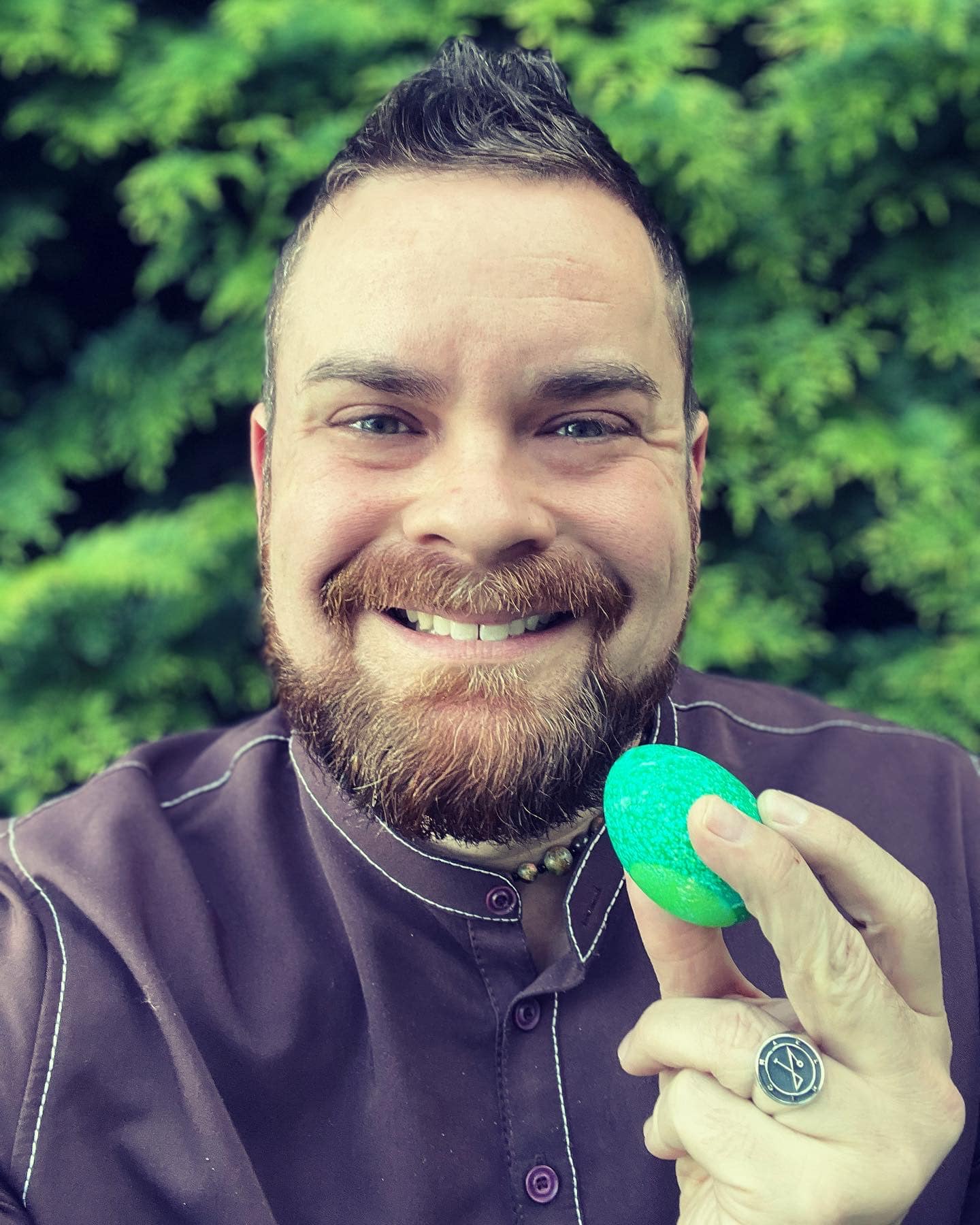
Welcome, dear friends. In this dialogue we are blessed with the presence of Roger Wolsey — a minister, spiritual director, author and speaker whose journey mirrors mine in many profound ways. As children of the church, we’ve each treasured the gifts Christ brings to our lineage while venturing beyond conventional religious boundaries, exploring the rich tapestry of global spirituality, American pragmatism, counterculture, and the human potential movement. We’ve each found unique ways to synthesize these experiences, creating something deeply resonant and transformative for ourselves and many others.
In Roger’s book Discovering Fire, he doesn’t advocate for thoughtless religious syncretism, but he does recognize that our lived experiences often transcend the neat boxes of religious or spiritual categories. He draws inspiration from Methodist pioneer John Wesley and his holistic pastoral care, which led Wesley into diverse areas of advocacy—from economic aid to herbalism to early forms of electroshock therapy.
Our shared background allows us to delve deeply into conversations, often finding a rhythm that is both spontaneous and enlightening. In our interview, we cover ground like:
Why is religion in crisis today?
What are the benefits and drawbacks of ‘spirituality’ as a standalone pursuit? (We respond to this one from our paradoxical experiences living in the ‘spiritual’ hubs of Boulder and Asheville.)
Why being both spiritual and religious is arguably the most countercultural way-of-being today.
The interplay between revelation and pragmatism in religious belonging and spiritual practice
Adaptive spiritual technologies as God’s way of helping us reconnect and thrive in a world of fresh challenges
What are three emerging practices from the wider culture we wish Christians would embrace?
What are three practices from the Christian tradition that we believe our spiritual-but-not-religious friends should explore?
How can Methodist pioneer John Wesley’s approach guide us in following Jesus and embracing the full spectrum of ‘fiery grace’ available to us today?
Our discussion touches on practices including:
Centering Prayer
Lectio Divina
Choir singing
Acts of service
Authentic Relating and its intersection with spiritual growth
Shadow Work
and yes, plant medicine.
Roger’s chapter on plant medicine is one of the best introductions to the topic I’ve encountered. He highlights the surprising continuities between Scripture, Christian tradition (thank you Hildegard of Bingen!), and indigenous wisdom. He presents a balanced view, considering both the promises and the perils of working with our plant siblings. He also addresses the complexities of cultural adaptation, potential pitfalls of cultural appropriation, and the consumerism of ‘Big Shamanism.’ I highly recommend you pick up Discovering Firefor this chapter alone.
Thank you for joining us. I invite you to dive into this rich conversation with open heart and mind:
Roger Wayne Wolsey is a free spirit who thinks and feels a lot about God and Jesus. He’s a progressive Christian who identifies with people who consider themselves “spiritual, but not religious.” A trumpeter, Roger grew up during the “Minneapolis Sound” era of the 1980s and ‘90s. These experiences contribute to a musical approach to his theology. Roger studied philosophy and political science, graduated magna cum laude and Phi Beta Kappa, from Macalester College in St. Paul, MN, and earned a Master of Divinity degree at the Iliff School of Theology in Denver, CO. Roger is an ordained pastor in the United Methodist Church. He has taught classes as an adjunct instructor at Graceland University in Lamoni, IA, and at the Iliff School of Theology in Denver, CO. He has served as a pastor for churches in Minnesota, Iowa and Colorado. Roger was president of the board of directors of the Boulder International Fringe Festival. He currently serves on the Board of Directors of Progressive Christianity.Org. Roger blogs for Patheos (as The Holy Kiss), Sojourners, Elephant Journal, and Huffington Post. Roger is a speaker for numerous festivals and conferences. Roger is available for speaking, retreat facilitation, and spiritual direction — check out his offerings here.
Advent — this season of longing for the arrival of the Emmanuel, God-with-us — begins in just a few weeks. For those of us in the Northern Hemisphere, this time of descent into winter — a time of literal and metaphorical hunger — can make our yearning for sacred connection restless, even desperate.
The spiritual craving we feel for the Divine in this moment of the year seems to be universal. It’s echoed in storied rituals created to invoke the return of the sun, to be bathed in the gifts of her resplendent being. We see in Neolithic sites like Newgrange in Ireland and Maeshowe in Scotland how peoples built passage tombs that specifically received the light of the winter solstice through stone-framed transoms, perhaps with an understanding that the sun’s return could bring life back to or create communication with the ancestral dead. Countless other European traditions make use of candles and Yule Logs to sympathetically mimic the sun’s light in anticipation of her return. God is correlated with the sun outright (Psalm 84:11) and the feeling of the “sunrise from on high” is described as a visitation “of the tender mercy of our God” (Luke 1:78-79). Jesus himself is likened to the sun (Matthew 17:2, Revelation 1:16), and the season leading up to the Winter Solstice is awaiting his arrival.
In keeping with these traditions of connection and invocation, the song Come Crimson Mother is a supplication for the return of the Divine light. The term “solstice” is taken from Latin for the sun stands still, likely because at both midwinter and midsummer, the sun appears to rise and set in the same place for a few days. This song envisions peoples asking the sun — the golden, Crimson Mother — to begin to “move” again: that is, for her to start shifting her position on the horizon and begin to lengthen the days.
Here are the words to this simple but powerful chant:
Won’t you move, won’t you move, won’t you move, Mother? Won’t you move, won’t you move, won’t you move/ Again, again, again? Golden Crimson Mother/ Won’t you come, Dawn Bringer? Sitting still, sitting still
I refer to the sun here as “Mother” not only because of the rich biblical references to God as mother, but because she appears many times across Indo-European cosmology in feminine form, too — often emerging from the sea, dancing and garbed in clothes of red and gold.
Reflecting on this wondrous season, my friend and colleague Saro Lynch Thomason says “I imagine the immense sense of relief and blessing ancient peoples would have felt when the sun did indeed fulfill her yearly promise of coming back, of not abandoning the world. No matter the face of the Divine, this moment in the year pulls us into that cathartic, sacred pulse — that yearning for union with the forces that complete us, and the ecstasy and ease when that union predictably — yet still astonishingly, miraculously — arrives.”
As I mentioned recently, Saro is offering a groundbreaking course called Singing the Wheel of the Year. This year-long, song-based exploration of eight earth-based holidays can be a wonderful complement to the Christian liturgical year, helping you learn traditional and modern songs for each holiday and sharing these songs in ritual.
Singing the Wheel of the Year is happening onlineand in Asheville, if you happen to live near western North Carolina. Anyone who registers before December 1st will receive Saro’s course Witches, Mermaids, and Fairy Queens. This is a package of songs and folklore on the magic-wielding women of British Isles balladry and American folksong, complete with four recordings, two audio essays, and a curated playlist with commentary all about the enigmatic and powerful magical women whose powers and wisdom have been praised (and warned against!) in the old songs passed through oral tradition.
Singing the Wheel of the Year starts this week! (Yes, I’m taking the course. It’s quite in-depth, and a lot of fun.) And while it’s a robust year-long immersion and worth every penny, Saro is making a few discounts available for folks with financial need; if this is you and you feel this experience calling, you can can reach out to her directly at sarosingssongs@gmail.com. Otherwise, please register at full price here and support this wonderful creator.
My dear friend and colleague Saro Lynch-Thomason is offering an unprecedented learning experience called Singing the Wheel of the Year. Which got me thinking about our braided spiritual paths…
As I’ve shared before, I grew up in the spiritually-enchanted, Christ-haunted Bible-belt of the American South, where we took our faith very seriously. At age four I had a full-on ‘born again’ experience in a Baptist Sunday school, turning from my life of nascent nefariousness and casting my lot with Jesus. I’ve since let go of many attitudes, beliefs and practices that don’t actually serve the kind of spiritual and social vitality promised by this unlikely Messiah, but I’ve always stuck with Jesus.
Turns out, I’d follow him to unexpected places!
Like a decade + ago, when I got the weirdest Facebook friend request of my life. The note accompanying it said “Hello Mike. I think I might be your birth mother. Please disregard if I’m mistaken!” This was the penultimate moment in my years-long quest to discover my biological origins as an adoptee, beginning a relationship with my birth mom, Renee, that thankfully flourishes to this day.
But it wasn’t always easy.
You see, her dad was a Juilliard-trained, Candler/Emory-educated, United Methodist minister who was active in the Civil Rights movement and penned hundreds of hymns. Like many fathers, ministers, and human beings, David Robb was at-turns wonderful and complex, gifting Renee a Christian faith that sometimes seemed more complex than wonderful.
She ultimately opted for a gift-exchange, paving her own path which included finding her place in the contemporary Neo-Pagan revival. In Asheville, the Appalachian mountain city I’d eventually call home too, Renee was one of the founders of the Mother Grove Goddess Temple (and later, Elder Moon).
And boy, that was initially uncomfortable for me, even as a “composting” and open-minded Christian.
Many of us are, of course, only too aware of the suspicion, strife, and outright bloodshed that’s possible when we react from the most fearful and reactionary potentials of our social, cultural and religious conditioning instead living from their unique zone of genius. Pagans and Christians have taken turns persecuting each other throughout history, leaving wounds that persist in our cultural memory — from feeding Christians to lions in ancient Rome to witch hangings in not-so-ancient Salem. Sacred writings and secular histories alike can be sampled in ways that dig the gulfs between us ever-wider.
But people build “tension bridges” when they love each other. And when we actually walk across, we often find them to be surprisingly sturdy!
When it comes to deepening my understanding of ‘pagan’ (literally meaning ‘of the land’) folkways, understandings, and rites, I know few more reliable guides than Saro Lynch-Thomason. As an award-winning singer, song leader, folklorist, documentarian, and illustrator, Saro has been studying and teaching traditional song and balladry from Appalachia, the American South, the British Isles and Ireland for over a decade, as well as leading in heart-centered activism including the international ecological anthem, More Waters Rising.
As I mentioned, Saro is launching Singing the Wheel of the Year very soon. When I asked her how this embodied learning journey through the sacred cycle of the pagan year might relate to friends and followers of Jesus, she reminded me of the unique dual identity of the enigmatic Celtic figure, Brigid, and her role as a bridge between these sacred worlds. Saro says it better than me — and teaches us a chant, to boot! So without further ado, I leave you with her wisdom:
Burning, Yearning, Blessing: Bríg, Brigid, and Divine Abundance by Saro Lynch-Thomason
The goddess Bríg (pronounced Breej), known by many in her modern manifestation as the Irish Saint Brigid enjoys a special relationship…with herself. They are distinct beings in the annals of Irish literature and cosmology, and yet it’s almost certain they are, for all intents and purposes, the same holy woman. The deity known as Bríg was a triple goddess of smithcraft, poetry and healing. “Bríg” probably originally meant “Exalted One” or “High One.” The medieval Irish text known as Cormac’s Glossary states that she was the patron goddess of poets and afforded great honor and affection.
Then we have St. Brigid, a woman who in medieval sources is credited with founding an abbey at Kildare in the 5th century, as well as performing a great number of miracles in her lifetime. Today she is Ireland’s only female patron saint. There is much debate about the origins of St. Brigid: Was she a real historical figure? Was she generated through folklore as a way to continue veneration of the goddess Bríg? The truth may likely lie in the middle: This 5th century abbess perhaps did exist, and qualities of the goddess Bríg became attached to her over time.
There are an astounding number of attributes and stories associated with both the goddess Bríg and her later counterpart Brigid, but for me, the core of this divine woman’s gifts have to do with her abilities as a bringer of hope, a tender of flames, and a nurturer of mothers and children. We can trace these qualities through this invocation for St. Brigid, which is meant especially to be recited on her feast day of February 1st:
February 1st is also the traditional date given for Imbolc, the opening of spring in Celtic tradition. The overlap of the saint’s feast day with this ancient holiday leads many to believe that this day may have first had special associations with the goddess Bríg, with St. Brigid taking her place sometime in the middle ages.
Our lines begin:
Oh to hear the newborn lambs
Bleating, bleating
Many of the miracles attributed to St. Brigid have to do with abundance: In some accounts she produces amazing supplies of milk and butter from cows, and in others she’s said to have had a limitless larder of food. These qualities would have had a special relevance at Imbolc, when the sheep were giving birth and beginning to produce milk that their hungry human caretakers would have also deeply needed in the starvation-prone period of late winter.
Oh to see the sun so early
Greeting, greeting
May your fires burn away
Sin and sorrow, oh we pray
Saint Brigid has strong associations with fire: Hundreds of years after her death, a 12th-century traveler described that an eternal flame was still being tended in her honor by 19 attendant nuns at her religious house in Kildare. Her associations with fire are also reinforced by her feast day at Imbolc, a time when the strength of the sun is slowly returning. Her counterpart Bríg, with her associations of the forge, also hearkens to the comforts of hearth and home during the winter months.
This night as you make your way
Bless us as we’re sleeping
From Cornwall to Ireland to the Hebrides of Scotland, St. Brigid is said to visit and bless local homes on the eve of her feast day, and one can tell if she has passed through the house by looking for disturbed ashes in the fireplace. The tradition of this annual domestic blessing is also a reminder of her close guardianship of mothers and children. In Scottish folk tradition, St. Brigid is said to have been a midwife to Mary and the foster mother of Jesus. In those same traditions, she’s credited as providing easy and healthy births for mothers whom she favors. And in one account of her from Ireland, she also uses her divine powers to make the fetus of a pregnant nun disappear, furthering, in some ways, Brigid’s qualities as a midwife, since such women historically also often aided in birth control.
Bríg/Brigid’s many qualities of flame and hearth, returning abundance, and nurturer create a powerfully soothing image for us at a time when we descend into winter. Though her feast day- and the returning spring- are many months away, this invocation can serve as a balm as we enter into what is often a frightening and desolate period of the year. This flame keeper, this bringer of fresh milk, this potent master of fertility, invites us to nestle in by the fire and accept her hospitality and protection. Saint or goddess — she may not mind what form she takes — as long as the gifts she so eagerly and easily dispenses are accepted with gratitude.
If you’d like to explore deeper natural-world attunements and devotional practices for every season of life on our planet, Saro’s offering Singing the Wheel of the Year is likely for you.
Starting next week, this year-long, song-based exploration of the eight neo-pagan holidays helps you learn traditional and modern songs for each holiday, sharing these songs in ritual.
Saro will teach a mix of ballads, rounds, chants and layered songs ranging from proto-Celtic to middle English to new compositions by Saro and other amazing song leaders. You can sample ritual songs by Sarohere (this is a song for the casting of circles) and here (a song for Beltaine).
This course is for anyone who’s interested in bringing consistent, powerful seasonal ritual into their lives, learning new songs that go beyond pagan classics, and getting a grounding in many of the traditions associated with the old holidays. You can take the course as part of an online cohort, or in-person if you live in Western North Carolina. Students will receive practice tracks, liner notes and bonus materials throughout the year. You can learn more and register right here.
In any case I hope you continue bridging the differences in your circles, with courage and verve.
The people
The virus took on many shapes
The bear, the elk, the antelope, the elephant, the deer
The mineral, the iron, the copper, the coltan, the rubber
The coffee, the cotton, the sugar
The people
The germ traveled faster than the bullet
They harvest the mountainside, protect the crops, herd the cattle
The people
The women and children were separated from the men
They’re divided as a foot into the regional filters of their minds
The violence of arrogance, crawls into the air, nestles into the geospatial cortex
We are not a conquered people
(Drum beats by region)
I was awakened by my elder brother
The compound was on fire
Awakened by my elder brother
The compound was on fire
The compound was on fire
The compound was on fire
The missionaries never hid their perspective
Perspectives of land, but rather see us disappear
Recyclable prayers
The people
This is my body, which is given for you
The people
This is my blood
We are not a conquered people
I was awakened by my elder brother
The compound was on fire
Unless a grain of wheat falls into the earth and dies, it abides alone; but if it dies, it yields a grand harvest.
― Jesus of Nazareth, Gospel According to John, 12:24.
What didn’t you do to bury me
But you forgot that I was a seed.
― Dinos Christianopoulos, ‘The Body and the Wormwood.’
The journey to our next Octave feels arduous right now for so many of us.
But when the principalities and powers bellow their death-dealing “No!”, I’m grateful that a different Note can be heard ― in the distance, in our innermost hearts ― singing us into a resounding “YES!”
Your new-life-from-the-dead might feel delayed in its arrival.
Or “contents may have shifted during delivery.”
If so, I resonate. Perhaps you’re exhausted, like I feel some days. If this is you, I invite you to hear these words from St. Leonard of Toronto:
Avoid the flourish.
Do not be afraid to be weak.
Do not be ashamed to be tired.
You look good when you’re tired.
You look like you could go on forever.
Now come into my arms.
You are the image of my beauty.
These are some of my favorite songs, celebrating the unexpected splendor of new life out of anticipated death. I hope they give you a few moments to reconnect to that quickening within yourself, and those you love.
Happy Easter, all you resurrection artists.
God is alive, magic is afoot
God is alive, magic is afoot
God is afoot, magic is alive
Alive is afoot, magic never died
God never sickened
Many poor men lied
Many sick men lied
Magic never weakened
Magic never hid
Magic always ruled
God is afoot
God never died
God was ruler
Though his funeral lengthened
Though his mourners thickened
Magic never fled
Though his shrouds were hoisted
The naked God did live
Though his words were twisted
The naked magic thrived
Though his death was published
Round and round the world
The heart did not believe
Many hurt men wondered
Many struck men bled
Magic never faltered
Magic always led
Many stones were rolled
But God would not lie down
Many wild men lied
Many fat men listened
Though they offered stones
Magic still was fed
Though they locked their coffers
God was always served
Magic is afoot, God rules
Alive is afoot, alive is in command
Many weak men hungered
Many strong men thrived
Though they boasted solitude
God was at their side
Nor the dreamer in his cell
Nor the captain on the hill
Magic is alive
Though his death was pardoned
Round and round the world
The heart did not believe
Though laws were carved in marble
They could not shelter men
Though altars built in parliaments
They could not order men
Police arrested magic
And magic went with them
For magic loves the hungry
But magic would not tarry
It moves from arm to arm
It would not stay with them
Magic is afoot
It cannot come to harm
It rests in an empty palm
It spawns in an empty mind
But magic is no instrument
Magic is the end
Many men drove magic
But Magic stayed behind
Many strong men lied
They only passed through magic
And out the other side
Many weak men lied
They came to God in secret
And though they left him nourished
They would not say who healed
Though mountains danced before them
They said that God was dead
Though his shrouds were hoisted
The naked God did live
This I mean to whisper to my mind
This I mean to laugh with in my mind
This I mean my mind to serve ’til
Service is but magic
Moving through the world
And mind itself is magic
Coursing through the flesh
And flesh itself is magic
Dancing on a clock
And time itself
The magic length of God
My friend Alana Levandoski recorded three mini concerts over this Easter Weekend for her Patreon patrons, and was moved to share them more widely. Her songwriting and craft are a real treat! To listen to the reflections and the songs, go here.
And finally, here are a couple perennial favorites for this season:
Roll away your stone I will roll away mine
Together we can see what we will find
Don’t leave me alone at this time
For I am afraid of what I will discover inside…
The angels, they all surround us
And they are ministering Jesus’ power
Quickly now, reach out and receive it
For this could be your glorious hour
Joy to the world, he has risen — hallelujah!
Note: This was originally written on April 12, 2020. Updates were added on April 9, 2023.



 Roger Wayne Wolsey is a free spirit who thinks and feels a lot about God and Jesus. He’s a progressive Christian who identifies with people who consider themselves “spiritual, but not religious.” A trumpeter, Roger grew up during the “Minneapolis Sound” era of the 1980s and ‘90s. These experiences contribute to a musical approach to his theology. Roger studied philosophy and political science, graduated magna cum laude and Phi Beta Kappa, from Macalester College in St. Paul, MN, and earned a Master of Divinity degree at the Iliff School of Theology in Denver, CO. Roger is an ordained pastor in the United Methodist Church. He has taught classes as an adjunct instructor at Graceland University in Lamoni, IA, and at the Iliff School of Theology in Denver, CO. He has served as a pastor for churches in Minnesota, Iowa and Colorado. Roger was president of the board of directors of the Boulder International Fringe Festival. He currently serves on the Board of Directors of Progressive Christianity.Org. Roger blogs for Patheos (as The Holy Kiss), Sojourners, Elephant Journal, and Huffington Post. Roger is a speaker for numerous festivals and conferences. Roger is available for speaking, retreat facilitation, and spiritual direction — check out his offerings here.