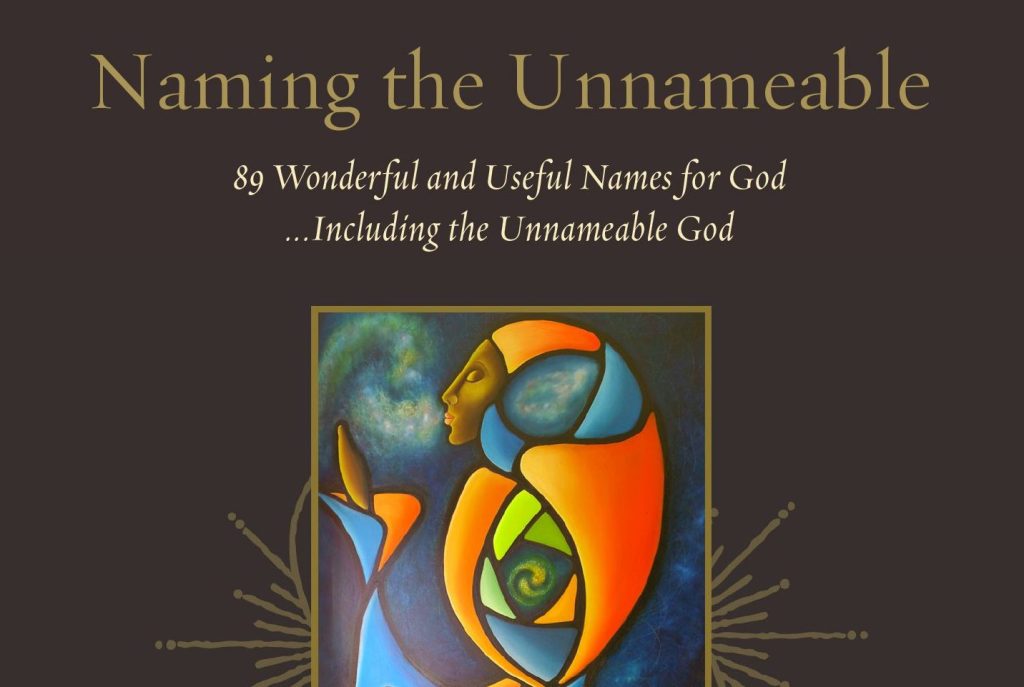
The following is based on a portion of Naming the Unnamable: 89 Wonderful and Useful Names for God, a brand-new release from esteemed Creation Spirituality theologian Matthew Fox.
God Has a Trillion Faces
The ancient Vedas of India tell us that “The One Existence the wise call by many names.”
How many names for Divinity are there? Do the names for God change? Ought they change as humans evolve and as circumstances of life evolve around us? Are we among the “wise” that the Vedas speak of who are eager to call the One Existence by many names? Do we have permission—and maybe a serious responsibility—to change our understanding and naming of God as we mature as individuals and as we evolve as a species and as we face a critical time – a ‘turning time’ – in human and planetary history?
The great medieval mystic Meister Eckhart declared: “I pray God to rid me of God.”
Apparently he was so convinced in the need to allow God and our names for God to evolve that he actually prayed to God to move on from being “God.” He challenges us further when he declares: “The highest and loftiest thing that a person can let go of is to let go of God for the sake of God.”
How many names for God have humans come up with? And which ones might serve us besttoday and what new ones beckon us? One answer to that question is a simple one:There are as many names for “God” as there are languages in the world, for each language calls God by a different word. Examples: God (English); Gott (German); Dieu (French); Dios (Spanish); Allah (Arabic); Gut (Norwegian);Theos (Greek); Deus (Portuguese); Bog (Russian);Dia (Irish); Elohim (Hebrew); Marta(Polish); Kalou (Fijian), etc. etc.
But that is by no means the whole story. For one thing, each language may well have multiple words for “God.” For example in English we can talk of Divinity; Spirit; Creator; Deity; Godhead; Goddess; and much more. If this is true in English no doubt it is true in other languages as well.
Every Religion offers its name for the Divine: Brahmin; Krishna; Tao; Buddha; Tara; Allah; Yahweh; Adonai; Tagashala; Wankan Tanka; Oshun; Isis; Christ – to name but a few.
So where else do we come up with alternative names or images of God? The Sacred Scriptures of the world are one such place; and the mystics of the world are another; and science is another. The Muslim tradition boasts a powerful practice of reciting the “99 Most Beautiful Names” of God; in many ways, this practice has inspired my newest book, Naming the Unnamable, wherein I present 89 current names for Divinity that I think are most beautiful and wonderful and useful for our times. I am grateful for that Muslim practice to which I am indebted and which I have often prayed myself.
The ancient scriptures of Hinduism known as the Bhagavad Gita tell us this: “God has a million faces.”
St Thomas Aquinas, medieval theologian and mystic, goes even further. He says that every being is a name for God when he says: “Even the very ones who were experienced concerning Divinity, such as the apostles and prophets, praise God as the Cause of all things from the many things caused.” Aquinas, in this amazing passage,goes on to name 49 names for God that sixth century Syrian monk Dionysius the Areopagite found in Scripture alone and discussed in his foundational work, The Divine Names.
What follows from his statement is that there are literally multiple trillions upon trillions upon trillions of names for God. Countless creatures—therefore,countless faces, countless names. But at the end of his treatise he says nobeing is a name for God because “God surpasses all things.”
If there are trillions upon trillions of names for God, who am I – and who are you – to dare to choose only 89?
Well, first of all, my book is unfinished. It is open-ended, and the last pages of each section are left blank so that you may add your own most wonderful and useful names for God.
Secondly, while there may be trillions upon trillions of names for God, it is clear that we humans are limited. We can only take so much input, and reflect deeply on avery finite number of thoughts, concepts and names. So this book presents avery finite number, a working number, of possible names for God. Hopefully they might prove useful and inspire other useful names from the reader.
In this book I seek to offer a finite number of names for God that I sense might be useful for us in the difficult ‘in-between’ times in which we find ourselves at this dawning of the post-modern era. I include a modest meditation with each name to assist a kind of ‘unraveling’ and unpacking of each name. I invite the reader to deepen the experience by his/her own meditation and investigation. Some have called our times ‘apocalyptic’ and philosopher Theodore Richards points out that ‘apocalypse’ also means ‘revelation.’ Perhaps, in dire times, deeper mysteries are revealing themselves, unveiling themselves, to us. But we need to listen deeply. We need to develop our muscles of contemplation. We need to cease projecting and to learn anew to let go so that we can listen truthfully to the ‘hidden Word’ of silence. From this hidden place of silence, this “cave of the heart” as Father Bede Griffiths calls it, might emerge some new and fresh language for a spiritual awakening, for rich names for Divinity, for a global renaissance. Hopefully, Naming the Unnamable can assist that important task.
As humans undergo deep changes, so too does our understanding of God or Divinity. Both Meister Eckhart, a medieval mystic activist, and Alfred North Whitehead, a twentieth century scientific philosopher, agree that Divinity evolves. “God Becomes where all creatures express God,” notes Eckhart. Thus, our names for God increase in possibilities and evolve as evolution continues all around us. Deepak Chopra sees God’s evolution this way: “What actually evolved was human understanding….we think that God changes, because our own perception waxes and wanes. The messages keep coming though and God keeps showing different faces….as awareness evolves, so does God. This journey never ends.”
Which, among the trillions upon trillions of God-names might serve us the best today? And serve the planet the best? And therefore serve God the best? That is the question that this book is presenting. Hopefully, it will be useful, for as Aquinas insisted, a “little knowledge about important things is far more important than a lot of knowledge about unimportant things.”
A fresh understanding and language about Divinity may assist us to come up with fresh understandings of ourselves and thus the societies and institutions we feel called to give birth to as we struggle to assist other species to survive and to survive ourselves, to be sustainable, even to thrive and become beautiful and worthy of our holy existence.
Meister Eckhart warns us that when we talk about God we stutter and stumble. This is important information, that no word does God justice and no person or ideology holds a trademark on the word “God.” Humility and reverence are required evento enter into the conversation. A certain receptivity is required to enter into authentic God-talk. Hopefully that spirit of reverence, humility and receptivity imbues Naming the Unnamable and those who pick it up.
Here are but two of the 89 names and facets of God we explore…
God is the Newest and Youngest Thing in the Universe
In the ancient Vedas from India, God is called “most youthful.” Meister Eckhart says that “God is novissimus,” meaning the newest and youngest thing there is in the universe. He also says that “when we say God is eternal we mean God is eternally young.” There is something youthful and “in the beginning” about God—this is why both the Hebrew Bible and the Christian Bible (John 1.1) begin with the words “In the beginning….” To return to the beginning is to return to God therefore. And we do return to the beginning, to our “unborn selves,” as Eckhart puts it, and to the person you were before you were born. Buddhism tootalks of recovering our “original face” which we possessed before we were born.”
God is the Ancient One of Ancient Days, the ‘One Beyond Time’
Not only is Divinity young and youngest; it is also ancient and before time; and beyond time. Eckhart says: “God is eternity” who dwells in “the fullness of time. There everything is present and new.” But what is eternity? “Eternity is the peculiarity “that being and being young are one.” Because “both newness and life are proper to God,” our dwelling in the eternal now is dwelling in newness and life, vitality and the source of energy.
Hart says that “God is eternal, not in the sense of possessing limitless duration but in the sense of transcending time altogether. Time is the measure of finitude, of change, of the passage from potentiality to actuality. God, however, being infinite actual being, is necessarily…the One beyond time, comprehending all times within his eternal ‘now’.” We have glimpses of this “eternal now” when we undergo mystical experiences in moments of creativity or of great joy and ecstasy. At such times the past and future come together in the deep present and they are often accompanied by a deep Presence and a suspension of time—“Where did the time go?” we ask. This deep Presence can also communicate as a very ancient presence.
Praise for Naming the Unnameable
“Matthew Fox elegantly offers a contemplative practice that transforms the names of God to the experience of God.”
— Deepak Chopra, MD, author of Reinventing the Body, Resurrecting the Soul and Why Is God Laughing?
“Naming the Unnamable offers a smorgasbord of spiritual delights that will enrich the prayer life of both believers and nonbelievers. Fox’s radiant images and creative appellations transform the generic “God” into a vibrant, intimate Source for personal communion. Even those who have abandoned conventional religion will find wisdom and inspiration in these beautifully articulated reflections.”
— Estelle Frankel, author of Sacred Therapy and The Wisdom of Not Knowing
“How refreshing! Fox shows how we can think about God in so many different ways, freeing our minds and liberating our imaginations. It is easy not to believe the narrow conception of God that atheists do not believe in, but it is hard not to be inspired by a God who is energy, breath, life, flow, love, joy and the cause of wonder. This book is timely, important and admirably brief, it is also open ended.”
— Rupert Sheldrake, author of Science Set Free and Science and Spiritual Practices: Transformative Experiences and Their Effects on Our Bodies, Brains, and Health
“These are not just names but 89 theories of God across the ages and the planet, each focusing on the characteristic it deems most divine. Matthew Fox leads us on a startling and beautiful journey through humanity’s capacity to envision God, showing every way of looking at God is legitimate if it raises the aspirations of its adherents and their ability to carry them out. Is there objectively a God? What ‘God’ even means explodes in this little book like fireworks in the mind.”
— Nancy Abrams, author of A God That Could be Real: Spirituality, Science, and the Future of Our Planet
“This is a simple book written by a brilliant man who gives us a democratic vision of the names of God. It will be sure to appeal to readers of many faiths, scientists, and nature lovers as well.”
— Steven Herrmann, author of Spiritual Democracy
“Matthew Fox leads us on an important yet easily absorbable exploration of the multiplicity of forms in which we perceive the Divine in our lives. While we so readily seek to differentiate, define or even dispel the sacred, we desperately need teachers like Fox who show us the unity in diversity. I suspect that anyone can find some names in this book that resonate for them, whether scientist or artist, believer or atheist, old or young, female or male. Fox’s depth of insight and abundant compassion is felt throughout the pages as he helps us embrace and share in the wholeness of who We are.”
— Sky Nelson-Isaacs, M.Sc. Physics and author of Living in Flow
“I’ve always experienced the Divine as expressing through everything around me: the squirrel chattering up the oak tree, the waves crashing on the shore, my baby boy looking me in the eyes. Matthew Fox in Naming the Unnameable allows us to explore all of the many and dynamic ways that God speaks and breathes and plays in the world.”
―Jennifer Berit Listug, co-author with Matthew Fox and Skylar Wilson of Order of the Sacred Earth
“In Naming the Unnameable, Matthew Fox generously brings ‘God’ down to Earth and us into contact with the Great Mystery that dances all around and within us. He brings the arch of Western Religion back home …and with it, opens up a sense of the sacred for all to experience all-ways.”
―Skylar Wilson, co-author with Matthew Fox and Jennifer Berit Listug of Order of the Sacred Earth
 Matthew Fox has been called a maverick, a rebel, and by some a heretic. In his quest for a viable spirituality he discovered the ancient (but often suppressed) creation spirituality tradition that honors the sacredness of all creation. He has worked closely with Native spiritual leaders, feminists, scientists, activists, and others, and got himself in trouble with his mother church and the pope. He has written nearly 40 books on spirituality and culture now translated in 67 languages and is a visiting scholar at the Academy for the Love of Learning and a professor at the new Fox Institute for Creation Spirituality. Among his books are Original Blessing, The Coming of the Cosmic Christ, The Lotus & The Rose, Naming the Unnameable: 89 Wonderful and Useful Names for God, A Way To God: Thomas Merton’s Creation Spirituality Journey, Meister Eckhart: A Mystic Warrior for Our Times, and The Hidden Spirituality of Men: Ten Metaphors to Awaken the Sacred Masculine.