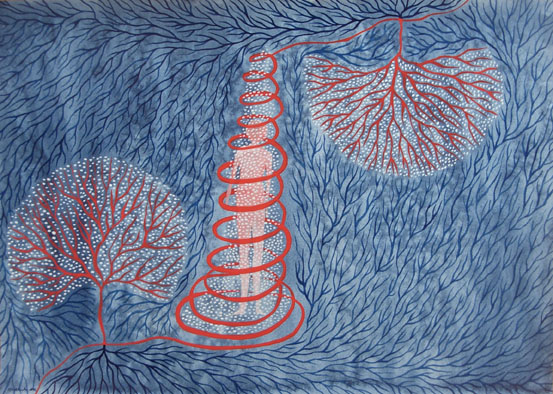
A Mosaic of Voices & Feast of Visuals

What if there was a Bible that combined a readable-yet-accurate text with breath-taking art from every continent and era, combined with meditative reflections both ancient and contemporary? What if they ancient voices were similarly from a myriad of ethnicities and theological persuasions, carefully chosen to sing a chorus of praise to the One who eternally Was, Is, and Is to Come? And what if these reflections and art were paired together – much like fine wine and good food – and synced to the ancient rhythms of the liturgical calendar?

Well then, you’d have the Holy Bible: Mosaic, one of the most ambitious Bible undertakings in years. Publisher Tyndale House and editorial director David Sanford wanted to create a truly ecumenical, multi-cultural work of art that is as beautiful to behold as it is to read. It achieves its goals, I think. But then again, I might be biased…I’m one of the contemporary contributors!

Below are excerpts of my unedited contribution*:

God as Nourishment

Exodus 24:9-11 * Leviticus 6:18b * Psalm 34:8a, 10 * Isaiah 25:6 * John 6:22-58 * Revelation 19:1-9

Food and God, God and food. God is food—taste and see. Jesus and fish, fish and bread; bread and wine, wine of New Covenant. Come to the banqueting table—set and served by the God of plenty, our El-Shaddai, God who nurses us at the breasts of divinity. The Spirit and Bride sing out—the wedding supper of the Lamb arrives! Father, Son, and Spirit, setting a table before us—even before our enemies. Fear dissipates; our Abba gives us fish and not stones. When we rest in our true center, we play hide and seek—we are lost in God, and found in the way things really are: God is immediately present to us, and us to the Triune God. Here God nourishes our spirits—Jesus is real food and real drink. At the table of our souls we are consumed by the all-consuming God.

* * * *

When the Church eats and drinks in Eucharistic feast, in Lord’s Table and Lord’s Supper, we celebrate Christ’s subversive presence in our midst. We consume God and are consumed, eating and drinking once again in God’s upside-down reign. This holy meal that Jesus gives us disorients us in God’s nourishing presence and re-orients us to our real surroundings, God’s Kingdom on earth as it is in heaven. When we take the recipes of heaven into our bodies, the Church re-members once more that we are reconstituted, new creation, real bodies becoming one flesh and blood by Jesus’ flesh and blood. We become God’s life incarnate, free to act in the world with startling freedom, astonishing grace and truth, no strings attached.

Let us taste God, and let us become. What if we became gardeners, cooks, party-throwers; cultivating God’s organic life and sharing this nourishment with all? Communal meals, agape feasts, subversive lunches and dinners shared in the Way of Jesus. What if we followed Jesus, inviting everyone to the table: sex workers and terrorists, homeless and high-powered business leaders, blacks and Asians and whites and Latinos, televangelists and gay activists? Around the table of God, we are reduced to the grandeur our common humanity, the spark of divinity that by God’s grace sparks us, perchance to dream, together. To dream of another world, one filled with choice food and fine aged wines, and new wine—the wine of New Covenant, containing the inebriating dreams of God’s new world.

God is food and drink. We can taste and see the Lord’s goodness with our whole lives, along interior and outward paths alike. We can imbibe divinity in the still, small moments of restful inner repose; we can eat and drink the will of our Father at the raucous tables where stranger, neighbor, enemy and friend meet…

…to be continued on page 320, in Pentecost week 27!

Mosaic: Holy Bible Hardcover

Mosaic: Holy Bible Simulated Leatherbound

Check out the Slideshow

Browse inside the Advent Meditations!

*They cut back some portions of this, with my blessing. I wrote like a bit of a mad chef, experimenting with ingredients. The editors needed to be mindful of the appropriateness of its use for a large and diverse readership, and I completely understand their editorial revisions. I’ll write more like a whirling dervish channeling John of Ruusbroec and Sara Miles when my book on God-as-nourishment comes out !

FREE Coffeehouse Theology Study Guide!

I’m a huge fan of all things free. It’s not just because I’m a cheapskate; I think that offering substantial items of real value online is a good way for artists, musicians, and authors to connect with people who might be inspired by their work. I think that ultimately it’s economically viable, and I applaud publishing houses (like the newly-formed HarperStudio) who are taking ‘risks’ in this area to test out freemiums in our growing freeconomy.

This is why I’m so glad my friend Ed Cyzewski and the folks at NavPress are giving away the study guide to his uber-cool Coffeehouse Theology! I’ll leave you to Ed to learn the details from here…

Ed Cyzewski: Freelance Writer

Download a Free Bible Study PDF Today!During December and January my book Coffeehouse Theology: Reflecting on God in Everyday Life (about),will be available from NavPress.com at 35% off (coupon K82E1D8E6).

In light of this offer, starting today and ending at 7 pm EST on December 31st, the Coffeehouse Theology: Bible Study Guide (about) will be available as a free PDF for download. This guide, which complements Coffeehouse Theology, provides group/personal Bible studies under the guidance of a series of theologians, commentaries, and discussion questions.

There is a limit of one print out per person. Need more copies for your group? Then forward this message to your friends or place an order with NavPress. If you mention this offer on your web site or social media, please refer your readers to this page.

This offer ends December 31st at 7 PM EST.

Newsletter Subscribers Click Here Not a Subscriber? Click Here to Download


Act Today for Another Free Book Download!

If you forward this e-mail to your friends by December 17th, you can visit this page and enter the caps locked password “FORWARD EMAIL” in order to download a free PDF of the Coffeehouse Theology Contemporary Issues Guide. This guide applies Coffeehouse Theology to a biblical examination of a number of today’s most pressing issues (about).

This offer ends December 17th at 7 PM EST, so act fast!

About the Bible Study Guide
A personal or group study guide that will help readers learn to study scripture with an awareness to their contexts and to the Christian voices from history and around the world.

For those who don’t know where to start with theology, The Bible Study Guide will provide a series of first steps that will assist individual and group study of scripture.

Order Physical Copies of the Study Guides
Both study guides are available for purchase at NavPress at 25% off and at bulk discounts.


Keep in Touch!

Bible Study GuideContemporary Issues Guide

You can find my writing blog at www.edcyz.com and my theology blog at www.inamirrordimly.com. I’m also on Twitter and Facebook.

Coming Out of the “Pagan Christianity” Closet

pagan1.jpg

Update: Brother Maynard at Subversive Influence has completed a good three-part interview with Frank; check it out here, here and here.

Also: P.C. has been breaking into Amazon best-seller territory.

So: My buddy Frank Viola‘s book Pagan Christianity? has been causing quite the stir. Many responses have been positive, but some clearly have taken issue with matters both of tone or content. I’ve sort of just realized that I’ve largely been sitting on the sidelines of the debate raging through the blogosphere, even though many of the participants are my friends and I care deeply about what’s being discussed. Why?

Because I suck at time management. It’s tough being a new daddy, husband, have 2.5 businesses, and take graduate-level courses. I’m seeing a life coach friend. I’m getting better–slowly but surely. So here’s my belated entry into the fray.

I feel deeply ambivalent about the talk going ’round, like the kid with a lot of friends whose friends are really really different from each other. One day the kid has a birthday party, and the friends are all under the same roof for the first time…and they ain’t getting along so well. My journey of knowing Jesus led me into house church waters in 1998, and into the pre-emergent discussion in 2001 (back when it was just PoMo Christianity, baby! Who remembers Stranger Things?). I have since felt like the bastard child of both, a hopeful amphibian breathing the air and water of two similar yet distinct movements/phenomena. Of course emerging saints are waaaay more media saavy (new media, old media, all of it) and so have made far more headway into the popular religious imagination and discourse. But now that me pal Frank has graduated from guerilla publishing to real, live publishers, our subterranean wares are being offered in the marketplace of ideas for the first time and eeesh! We’re like that odd gypsy family offering homemade trinkets to snobby European connoisseurs. What to do?

Sigh…I have dear blogger friends on all “sides” of this…I hate that it’s become so divisive. Over the past decade in housechurchland, Frank’s books on a different kind of ecclesial life were always (believe it or not) among the kinder, gentler offerings available. Like the Radical Reformation of old (which gave us Levellers, Diggers, Anabaptists, Quakers, etc…), much early North American house church literature was produced by embattled Christians who felt very disempowered by mainstream ecclesiastical authorities. These extended “tracts” (and that’s often what they were) seethed angst, all the while making many valid points about contemporary church practices and whether or not they resonate with Jesus’ original intent.

I don’t think that the revised “Pagan Christianity” is one such tract. You could, perhaps, argue that the earlier edition was. But Frank has grown since then, and changed. He embraces a more generous orthodoxy. Frank appreciates past and contemporary Roman Catholic mystics; he is a genuine conversation partner with this wild and crazy ride we call “emergent/ing.” Sure he might be passionate and use rather absolutist language at times, but you can’t fit him in a fundamentalist box…not really.

While not everything in Pagan Christianity is as I would have written it (and let’s face it–it’s easy to be armchair critics…have you ever written a full-length book? I’m finishing up my first one, and even co-authored it’s a bear!), I think that Frank is doing an important work that even Jack would appreciate–he’s deconstructing one of the most powerful institutions the world has ever known, and asking if there’s an alternative path.

Bob H, Michael S., Robby–I have nothing but respect for you, I hope you know that. You’re living out your life and calling in faithfulness and as best you know how–as am I, in a clergy-less, open and participatory house church. I would only ask that everyone–friend and foe of this book alike–will pause for a moment and consider: In my Foresight Program, I am learning a ‘systems thinking’ approach to seeing the world. One thing about systems—they’re everywhere, and we each simultaneously are in one, are one, and have sub-systems within our very bodies. When looking at dysfunctional reality from a Systems perspective, we’re encouraged to do something which at first seems counter-intuitive: focus on the system itself, rather than blaming the character of those within the system, or chalking up the systems’ failure to some vague, nebulous forces outside it. Similarly, we should own up to the possibility that our present church system might be the (or at least a) problem in our present breakdown of faith. It’s not that we have bad pastors, or bad ‘laypeople.’ And it’s not that the new atheism or Islam or Buddhism is picking off our best and our brightest. It could be that the system itself is sick, and needs thorough metanoia and rebirth.

When a Peter Rollins or a Doug Pagitt comes along and heavily critiques some aspect of traditionalist Christian dogma or theology—a thought system–most of us applaud. (I know I do.) We consider it spiritually courageous and intellectually brave and want to rethink epistemology, atonement, or what have you, accordingly. So why do we then react so viscerally when someone aims similar deconstructive queries to church-as-institution—a praxis system?

It could be that many of you reject the puritan impulse, the glassy-eyed nostalgia which longs for some ecclesial golden age. Understandable. I do too. And in my early days of house churching (not to mention my early days of being Pentecostal nearly 20 years ago, and my flirtations with Messianic Judaism…), this was precisely a main motivation–to get back to the way it ‘really oughta be.’ But my reasons for practicing church as I do have evolved, I think–and I’d venture to say Frank’s have too. Before you assume he’s advocating a rigid, absolutist, proof-texted New Testament dictatorship as an alternative to culturally compromised Christianity, read again. If he does, it’s absent from Pagan itself. As to what Frank practices and positively articulates, I’m looking forward to seeing his growing/changing thoughts in the summer release Reimagining Church. I hope that we can leave primitivist romanticism behind, while retaining a real and healthy respect for the peculiar genius (even organizational genius) of Jesus and his earliest apprentices.

From what I’ve gathered, a great many Christians not involved in our ’emerging conversation’ have found Pagan Christianity to be quite helpful as a historical sketch looking at the origins of various (mostly Protestant) church practices. They’ve been able to see where steeples or dressing up for church has come from, and have then been able to evaluate whether these practices are helpful and edifying for their spiritual journey, or not. Interestingly, emerging church readers seem to be more sensitive to the discussion than the yeoman “guy in the pew” not in our enlightened masses. And so–without disrespect to any who have genuinely struggled with (or even felt hurt by) the book, I’d propose that maybe we can re-examine our unwritten ‘script’ of who we allow in our ‘conversation’–do they really have to talk and write a certain way, to quack and waddle just like we do? I hope not. The North American house church movement is emerging from its fundamentalist roots, and they desperately want some open-minded conversation partners. But they might get loud and passionate, use terms like “Praise The Lord” and “Amen” without irony, and talk like they walked of the pages of the New American Standard Bible. (Maybe one day they’ll forgive us emergers for sounding like art students dropping acid.) But like emerging church folk, they have been reexamining their faith for 5, 10, or even 40 years. The house church movement needs you, emerging church brethren and sistren. Please keep the possibility of dialogue open.

My View of the Future Now

…is considerably more complex. While not dogmatic about eschatology, I tend to resonate with a perspective known as Transmillennialism, which tries to frame the Old and New Testament apocalyptic discourses in the prophetic, symbolic framework that would have been comprehensible to their original hearers. Doing this has the effect of seeing most (if not all) apocalyptic warnings and promises as being fulfilled, no later than 70 CE. This is, of course, quite different than the “Left Behind” perspective that tends to dominate our novels and video games these days…I still don’t know if my parents are aware that I’m no longer waiting for Jesus to pull an invasion of the body snatchers move!

My thoughts in eschatology tend to flow with my more general conviction regarding the future: It is an open book, and humanity has a vital role to play in it. Our decisions matter. Spiritually speaking, God does not want us to remain children forever; we are intended to grow and mature, becoming co-creators with God in every area of creation. This goes against a certain fatalism in American Christendom’s dominant guiding story, as well as our throw-away American psyche, that lives for momentary gains and little else. This is why I’m in the degree program I’m in: to meaningfully initiate change, and show others how appealing and beneficial this is.

Tree of Life

When I allow myself the luxury of silence
In naked stillness and love within God
Refusing to know anything
Apophatic hunger grips me
And I am eating from the Tree of Life

When I emerge from this place of unknowing
And re-enter the sounds of daily living
Free of judgment toward friends and strangers
Then I know that Life’s Fruit has planted a seed in me
And I am joining other awakening ones in the healing of nations