Opti-mystic meditations on Spirit, Culture, & Permaculture
Author: Mike Morrell
Michael Morrell is the collaborating author, with Fr. Richard Rohr, on The Divine Dance: The Trinity and Your Transformation. He's also the founder of Wisdom Camp, a day-retreat for mystical misfits, and a founding organizer of the justice, arts, and spirituality Wild Goose Festival.
Michael curates contemplative and community experiences, taking joy in holding space for the extraordinary transformation that can
take place at the intersection of anticipation, imagination, and radical
acceptance.
Michael is also an avid writer, publishing consultant, author coach, futurist, and curator of the book-reviewing community, Speakeasy. His two children are growing up entirely too fast and he lives in Asheville, North Carolina.
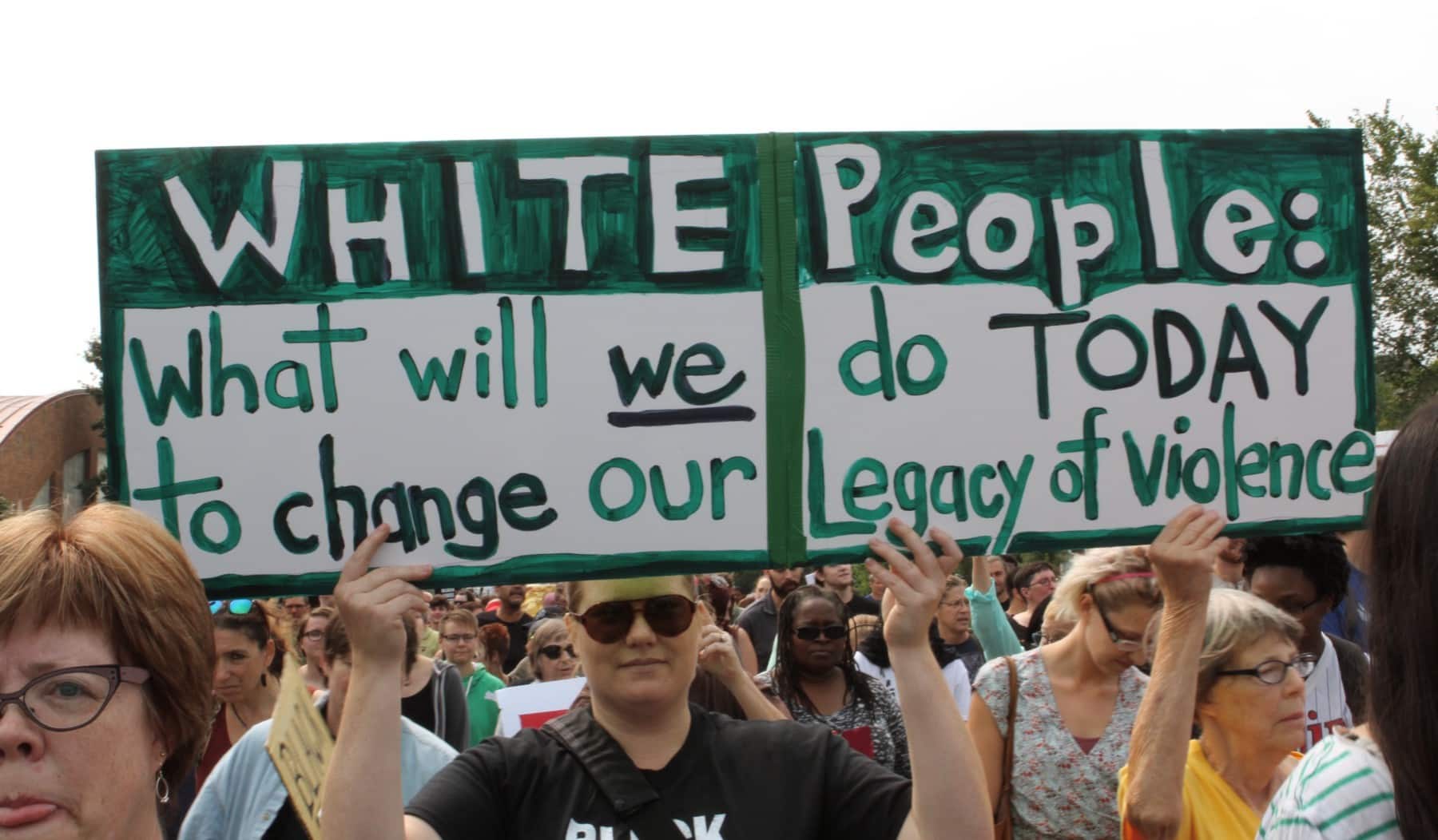
We who are the descendants of indentured European servants and of European working-class immigrants who fought back against bosses and their police to form unions and fight for better pay, better working conditions, the weekend, benefits, that few my age and younger have,
We who are the descendants of peoples who became white as a ruling class strategy to divest us of our shared humanity and solidarity with all working and oppressed people, and gave us entitlements, rights, the social and cultural wages of whiteness, as W.E.B DuBois wrote, that ultimately kept many of us economically down, politically weak, and spiritually impoverished,
We who are the descendants of people who became white through our collective consumption of hundreds of years of toxic anti-Black racist culture from the minstrel show to COPS that reinforces anti-Black laws, policies, and de facto rules that allow every form of brutality and insult to be unleashed against those who became Black in the process of extracting the wealth and power that built the United States,
We who are raised to be white in a white supremacist capitalist society must remember that white privilege was both a granting of access to resources and rights, while also a strategy to warp our worldview in anti-Black racism. This strategy channeled our our anger and resentment about working everyday to make someone else rich, deflecting it from the bosses and the ruling elite who imposed these conditions onto us, redirecting it onto other working people who are Black and of color. A strategy of maintaining structural inequality by granting non-ruling class white people the opportunity to regain a sense of our own power through our socially-encouraged, protected and often-rewarded ability to desecrate the dignity, humanity and life of Black people.
We who are raised white must realize that this society that devours the lives of Black people, everyday, is also a society that systematically raises us to be either butchers of Black life or the defenders and supporters of those doing the butchering. We are raised in a culture where white parents brought their “becoming” white children to watch the lynching and participate in the private rioting of socially acceptable white violence against Black bodies. We who are raised to be white, are raised in a death culture to be soldiers inflicting daily dehumanization against Black people in a capitalist society that profits from the slow (and sometimes quick) taking of Black life that maintains the monstrosity of the status quo.
While the most devastating and brutal consequences of anti-Black racism take place against Black communities, anti-Black racism is also core to what it means to be white in this society — to be emotionally and spiritually malnourished, fed hate, fear, envy, and resentment that deliberately replaced the sustenance of solidarity, love, friendship, community and mutually-affirming authentic human interactions across what became the color lines of a white supremacist society.
Every murder of a Black person by the police, every justification of how ‘scary’ and ‘threatening’ that person was to armed, trained, law enforcement, every media account that assumes innocence on the part of the police and guilt on the part of the murdered, every justification for endless anti-Black racist war, is also a continuation of the campaign to turn descendants of European servants, descendants of insurgent European immigrants, into patriotic white people who fight for the agenda of the rulers and denounce all who strike out for a world that affirms the inherent worth and dignity of all people, that embraces our shared humanity, that centers economic, racial, disability, gender, and environmental justice for all.
Anti-Black racism is war against Black communities. It is a cancerous, solidarity-poisoning, justice-denying process of straightjacketing the hearts, souls, and liberatory imaginations of those of us who have been raised white, so that we will be butchers, soldiers, and ‘good white people’ who call for ‘calm’ over ending violence when it’s Black lives being taken.
Anti-Black racism is a structural nightmare that white people must wake up from. We must wake up and fight back against it. The fight for white people against anti-Black racism is one of solidarity with Black communities and Black people in our lives and in our hearts, but it is also a fight to break free from the death culture suffocating and malnourishing us – and everyone raised white – whom we love.
When indentured Europeans joined with enslaved Africans to overthrow the tyranny of the slave master, the goal was to all get free. When the descendants of indentured servants, of exploited working-class immigrants, descendants of those who became white, join with the Black-led multiracial Black Lives Matter movement today, we must remember that in our confrontation with anti-Black racism, in our efforts to dismantle white supremacy, in our work for racial justice, we are also working to all get free and reclaim our shared humanity and the power of our solidarity, to build a world where liberation rather then supremacy guides all of our lives.
Chris Crass is the author of the new book Towards the ‘Other America’: Anti-Racist Resources for White People Taking Action for Black Lives Matter. He writes and speaks widely on anti-racist organizing, feminism for men, strategies to build visionary movements, and creating healthy culture and leadership for progressive activism. He was a founder of the anti-racist movement building center, the Catalyst Project, and helped launch the national white anti-racist network, SURJ (Showing Up For Racial Justice). Rooted in his Unitarian Universalist faith, he works with congregations, seminaries, and religious and spiritual leaders to build up the Spiritual Left. He is also the author of Towards Collective Liberation: Anti-Racist Organizing, Feminist Praxis, and Movement Building Strategy. He lives in Louisville, KY with his partner and their two sons. You can learn more about his work at ChrisCrass.org.
I recently viewed Raoul Peck’s new film I Am Not Your Negro, which is essentially a radical narration about race in America, featuring the social commentary of James Baldwin. I came away from this film with many thoughts and emotions, not least of which was the profound realization: if white supremacy is ever going to be curtailed and derailed, those who created it will have to do it.
As Baldwin classically asserts “If I’m a nigga, you invented me.” This point cannot be under-emphasized. Though many white Americans constantly bemoan the divisive state of race relations in the United States of America and feel that race is constantly placed in conversations where it doesn’t belong, they forget that this is a conundrum of their creation. Whiteness created ‘race.’ Thus giving birth to racism and creating the context for centuries of conflict between so-called whites, blacks and others.
Given this reality, one wonders why more whites don’t see it as their responsibility to tear down the racial tower of terror they created.
Moreover, it is really sad and shameful that more White Christians have not stood up in the name of their loving God to oppose the evil that is white supremacy.
The Rise of White Christian Resistance
The fight to combat white supremacy in the US has, by and large, been led by Black Churches that came into existence in response to Christian-based racial discrimination. But the time has come for White Christians to step up and take the lead in terminating the nagging racial pest that their heritage of privilege has unleashed in our shared social home.
For years, blacks have led in this cause for the sake of our own humanity and equality. And though, we, Black Christians, are happy to share from the wisdom of our many years in the struggle against racial injustice, we cannot continue to be responsible for this fight.
To be sure, there have always been White Christian abolitionist and freedom fighters who have courageously supported the cause of equality. However, there has never been a major coordinated Christian-based movement for racial justice led and sustained by whites in this country. This reality must change, and I dare say that it is changing.
With the rise of the Trump presidential administration with its neo-fascist, white nationalist and draconian sensibilities, it seems like a new diverse coalition of justice-seekers is finally forming.
Learning from the Black Christian Freedom Struggle
If I’m correct that a new coalition of White Christian justice-seekers are rising up, they would do well to learn from the church that white supremacy created – the Black Church. Without a doubt, Black Christians have a long and productive legacy of engaging in communal combat against white supremacy.
Here are a few things that I think White Christians can learn from the black Christian freedom struggle.
Here are a few places to start:
The liberation struggle requires theological imagination.
Historically, most white scholars and theologians have not made the pursuit of justice and/or combating racism central or even marginal to their work. Instead they have chosen to put forward so-called Christian ways of being that either ignore white supremacy or cutely divert by talking about the more palatable topic of racial ‘reconciliation.’
[Mike’s note: As my friend Melvin Bray asks, “Re-conciliation? When have we ever been conciled to begin with?”]
In order to rise above this un-artful dodge, justice-seeking white Christians will have to use their theological imagination to construct their own theologies of resistance and liberation.
They will have to write books, construct sermons and give talks that tell the ugly truth about the rages of white supremacy and why it’s a divine necessity to deconstruct whiteness. This is what some the enslaved Africans did when they constructed the spirituals and what Benjamin Mays, James Cone, Jacqueline Grant and others did when they wrote about black liberation theology. In similar fashion, we need white liberation theology focused on liberating whites from the bondage of their conscious and unconscious white supremacy.
[Mike’s note: I resonate with everything that Reverend Billy is saying here, especially the need for a white theological imagination digging in deep for beauty and justice. An early popular example of this is Rob Bell and Don Golden’s book Jesus Wants to Save Christians, which Don once described to me – at a Wild Goose Festival planning retreat – as “liberation theology of white people.” But if you’re white and reading this, don’t read Don and Rob’s book unless you pair it with at least one of the books linked in the paragraph above! Let’s educate ourselves.]
The liberation struggle requires institutions animated by freedom.
No real movement can be sustained long-term without forming institutions that extend the liberation moment into a lasting cause. Black Christians demonstrated this by building schools, churches and civic organizations rooted in the pursuit of freedom, justice and equality for all. White justice-seeking Christians need to do the same. They need to build new educational institutions devoted to unlearning white supremacy and colonial mentality. They need new churches rooted in the radical gospel of subversive love and Holy Ghost-filled truth telling. They need to form civic organizations invested in the liberation of modern society from the perils of racial injustice and systemic inequality. In short, they need to turn the historic trend of pro-white institution building into pro-human institution building.
The liberation struggle requires moral resilience.
Because the work of justice-seeking and equality is often difficult and full of setbacks and disappointments, moral resilience is necessary for this journey. If the Black Christian church knows anything it’s that the freedom march is a marathon, not a sprint. It took 400-plus years to get equal protection under the law for African Americans in the US, and the fight still continues today. In like manner, I’m quite sure white supremacy and systemic inequality will not die tomorrow or the day after. White Christians seeking justice must pack their bags with resilience and prepare for a long ride down the road of freedom.
Billy Michael Honor is a minister, public theologian, and cultural critic whose progressive and compelling insights have made him a sought after preacher, lecturer, and social commentator.
He is an ordained Presbyterian (PCUSA) minister and the founding pastor of Pulse Church in downtown Atlanta. Billy travels domestically and internationally speaking about issues relating to faith and culture.
His writings and sermons have been featured on the Huffington Post, On Scripture, Day1, Sojourners, Yahoo Voices and the Grio. He is also a graduate of the Candler School of Theology, the Interdenominational Theological Center and Beulah Heights University. Billy resides in Atlanta with his wife, Kaldeen. You can follow his work online here.
Spending substantial time in three different denominations growing up, I had to become a practical pluralist at a very young age when I came to realize that the exclusivity claims that each group made couldn’t all be true. I wasn’t willing to say that one of them was true and the others untrue – I didn’t want to condemn any of them as 100% ‘false.’ It was more a question asking ‘What is true about each of these streams?’ What is the gift they have to offer? What is the beauty they have to bring to the table of faith and being human in the world? Am I able to receive what’s beautiful while leaving painful exclusivity behind?
Part of me will always be homesick for a person I came to know, also in Manchester… When the Baptist church, of which she was a member, was without a minister one winter, I took the services every Sunday for a few months, and that was how we met. She was a woman well on into her seventies, very thin, very stooped. She had been married a number of times, and for years, as a widow, had been living alone, on welfare, in the one small apartment left inhabitable in a house that had been gutted by fire a few years earlier. Shaking hands at the church door after the service one Sunday morning, I had said to her—neither expecting nor much caring about an answer—”How are you?” and she looked up at me out of her wry, beleaguered old lace and said, “As well as can be expected.” Just that and no more, then made her way down the steps and out into the cold.
I am as deaf as the next one and usually deafer when it comes to calls for help, but I was all she had by way of a minister just then, alter all, and I was not so literary and detached and specialized as not to know that every once in a while, if only to keep their hands in, Christians are supposed to be Christs to each other for Christ’s sweet sake, so I steeled myself and went to call on her one winter afternoon. I expected the worst, of course, because that is my nature. I expected a long, dreary monologue. I expected plenty of complaints with some tears to go with them. I expected to feel awkward and inadequate. I expected to be bored and hoped to get away as soon as I decently could. And I couldn’t possibly have been more wrong on every count. None of the things I expected to happen happened, and none of the things I expected to feel did I feel, neither on that first day I went to see her nor on all the other days I went to see her from that time on until finally, around Saint Valentine’s day some seven or eight years later, she died, and I conducted her burial service before a little knot of family and friends under a gray Vermont sky with the wind flapping my black robe around my ankles.
– From Listening to your life: Daily Meditations with Frederick Buechner