


Well. Trump has been elected President of the United States, and the Klan is celebrating in Mebane, not 45 minutes from where we live.* Today I’m contemplating the very real impacts a Trump Administration – and the accompanying cultural shifts – are going to have:
- On my interracial family.
- My Muslim friends, who fear deportation.
- My queer friends, who fear their marriages annulled.
- My friends and family who are people of color, who don’t even want to walk outside today.
- I also think of the women in my life who fear their health care choices will be subjected to even more intrusion than they already are.

Even if Trump doesn’t/can’t carry through all the terrible things he repeatedly vowed to do to Muslims, immigrants, POC, women, and LGBTQ folks – and its unconscionable that so many Americans voted for him, thinking/hoping he could – the cultural validation he gives those who take his words and translates them into action is chilling.
I will speak words of love and comfort to my daughters, and my wife, but we’ll by no means rush to a false sense of equilibrium – crying ‘peace, peace,’ where there is no peace. I do not wish to be one who “leads the people from peak to peak, giving them no true rest.”
We can’t pretend that this moment will simply beget “business as usual.”
It isn’t.
It won’t be.
Because half of America affirmed their approval of a declaration of war on some of the people who matter most to me.
I won’t take up arms against flesh and blood, but – grounded in solidarity, contemplation, community, and place – I will participate in an insurgency of Spirit, summoning the full force of millennia of protest movements, beloved communities, liberation theologies, organizing strategies, and resistance from below.

As a white male, I will resist the temptation to presume a place of command in this insurgency, as this is precisely the pattern of being that’s gotten us into this mess: the last gasp of Colonial nostalgia and Boomer entitlement. I will become a grateful student of those far wiser and more experienced than I – the Mujerista, the Zapatista – Standing Rock Water Protectors and Black Lives Matter white supremacy conscientious objectors.
Teach me, if you’re willing. For I stand with you.
I not only stand, but I kneel: Considering, with as tender a heart as I can allow, the sheer immensity of this moment. Were I hearing God as a Hebrew prophet of old, I might prophecy that this is an apocalypse in the purest sense – a revelation of America as we’d rather not see her:
Afraid, opportunistic,
The sobering reality is that this describes the life of America under virtually every past administration, Democrat and Republican alike. In each generation, this unseemly collateral damage is cloaked under more, or less, respectability, but these are our original sins. Donald Trump is for man of us a cartoon super-villain of a Presidential candidate – now, a President-Elect. A caricature of our worst traits, writ large. We could pretend before, but now our hubris is unavoidable.
The invitation, as with the prophets of old, is that of repentance. Thorough-going and creative acts of changing our course, and imagining a wholly different future.
All empires crumble. And it could be that civilization itself is revealed as the extended human trauma-response I (and a growing number of others) believe it is. But this isn’t cause for despair. I think another world – something better than civilization – is possible.
Election Day Communion in an Age of Food Fights

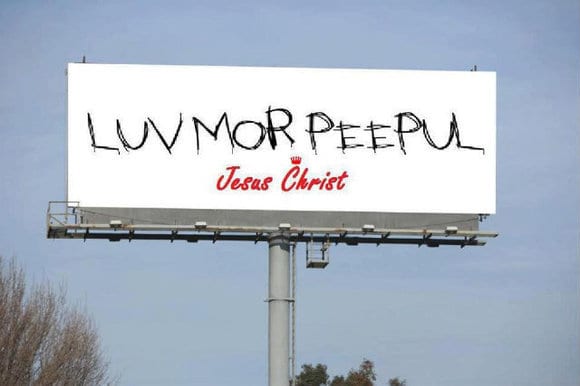
“Breaking Bread.” Even in an era of Atkins and Paleo, the phrase retains its strength. It suggests more than simple sustenance; it’s about who we eat with – the company we keep.
Meals can unite us, or divide us. Remember four years ago when news of Chick-Fil-A’s track record of anti-LGBT lobbying hit the mainstream? Progressives were aghast, and conservatives rallied the base. Former presidential candidate and FOX News host Mike Huckabee declared Chick-Fil-A Appreciation Day, which was attended by millions who blithely posted pics of their discriminatory dining on social media. Gay, lesbian, bisexual, and transgendered families, along with their friends and allies, grieved, while a nation seemed to gleefully say to them: “Let them eat chicken.”
Mealtimes in Jesus’ day were divisive, too. In the ancient Near East, observant Pharisees were careful to practice “safe sects,” eating only with their closest co-religionists, the ones that interpreted their purity codes just like they did. The less-than-pure were sure to be kept away from the immaculately prepared meals, socially-stratified tables, and carefully-washed utensils. The ‘pagan’ Romans were no better, with a firm pecking order of who got to eat where based on citizenship, social standing, and rank.
 Jesus, by contrast, ate indiscriminately. Scholar Bruce Chilton suggests that Jesus, like many tradesmen of his day, was often paid in meals. At these meals, he could invite whomever he wished and his client had no choice but respect his table arrangements. It is here, Chilton believes, that Jesus honed his conviction that God was near when the table was full – of good food and “whosoever.”
So Jesus invited sex workers and religious leaders, government stooges and terrorists alike to share a common meal around a common table. In so doing, he enacted Isaiah and Ezekiel’s eschatological vision of a heavenly banquet come to earth, where God lays a spread of the finest foods and aged wines to all humanity. How inclusively does Jesus mirror this image of God’s all-encompassing shalom? Even at his final meal before execution, Jesus invites his betrayer to dine with him.
Do we eat like this today? I confess that every time I sat at a table with my social group in high school, every time I turn away from others at the mall food court, every time I refuse to meet a homeless street hustler’s gaze on the sidewalk downtown, I do not.
And in a worshiping context? So often, attendance communion or eucharist or Lord’s Supper follows society’s norms rather than reshaping them.
But it doesn’t have to be this way; another meal is possible. The meal that Jesus left us with can cause endless social and doctrinal divisions, or it can unite us against the larger societal forces that fragment us. Radical theologian William Cavanaugh frames our meal choice – between consumption or communion – in his ground-breaking essay The World in a Wafer:
Globalism is a masternarrative, the consumption of which ironically produces fragmented subjects incapable of telling a genuinely catholic story. [T]he Eucharist [by contrast] produces a catholicity which does not simply prescind from the local, but contains the universal Catholica within each local embodiment of the body of Christ. The body of Christ is only performed in a local Eucharistic community, and yet in the body of Christ spatial and temporal divisions are collapsed. In the complex space of the body of Christ, attachment to the local is not a fascist nostalgia for gemeinschaft in the face of globalization. Consumption of the Eucharist consumes one into the narrative of the pilgrim City of God, whose reach extends beyond the global to embrace all times and places.
As Cavanaugh states elsewhere:
To consume the Eucharist is an act of anticonsumption, for here to consume is to be consumed, to be taken up into participation in something larger than the self, yet in a way in which the identity of the self is paradoxically secured.” In sharing Eucharist we enter the suffering of one another – the literal meaning of compassion – and in so doing ” we see the distance between friend and enemy overcome.
Several years ago, the Chick-Fil-A food fight was getting nasty. Much like “Trump! Trump! Trump!” is now being shouted and scrawled as a racist epithet intended to intimidate, the misspelled ‘cow scrawl’ made famous in the chicken chain’s ads was used to vandalize Charis Books and More, a feminist bookstore not 20 minutes from Chick-Fil-A’s headquarters in Atlanta. The attack happened the night after a queer poetry reading I happened to be attending with friends. ‘Eat Mor D–k,’ the graffiti on the side of the iconic bookstore taunted.
Something had to change.
To this end, my Facebook friend Andy and I created People Appreciation Day – an attempt to stem the food fight that was, absurdly enough, gripping much of the nation. Its premise was simple: Invite someone out for a meal, someone you’d normally be uncomfortable dining with. Perhaps someone of another race, class, sexual orientation, or religion…or perhaps, an outright enemy.
For me, many of the above categories weren’t particularly challenging. I’m married to a woman of another race, and have a veritable ‘rainbow coalition’ of friends; while I don’t do it as often as I’d like, I joyfully break bread with people who live outside; I get together with my Turkish Muslim friends monthly and enjoy baklava and other treats as we catch up on matters of family, nation, and faith. No, for me, my boogeyman wasn’t a black or homeless or gay or Muslim person…it was a ‘fundamentalist,’ the people I came from…the people I used to be.
I decided to invite my former Facebook friend Art Mealer. Art and I met a year or two ago, online and in-person. He’s a businessman and house church organizer. He has a ministry called Waging Love. We got together for dinner at Market in Raleigh. We really wanted to like each other…we found that, besides professing Jesus as Lord, we had little in common. It was awkward. Over the months, he’s invited me to house church barbecues (I’ve usually had other things to do, but honestly felt nervous around getting together in this setting); I’ve invited him to my church, Trinity’s Place (which made him nervous, he said to me plainly, on a number of theological and even moral levels.) Thus, Art and I’s primary interaction has been online, where tempers flare, partisanships are on display like proud peacocks, and the decorum that usually accompanies in-person interaction is all-but-absent.
I forget which online post it was from one of my friends that triggered it: Was it the one from Kimberly Knight? Or Matthew Paul Turner? Or Rachel Held Evans? Or Jonathan Wilson-Hartgrove? Whichever it was, after reading one post too many, Art de-friended me on Facebook.
As online connections, we were “over.”
 A connection severed over our very real differences – different conceptions of ethics, the public square, governance, and even God. And yet…I knew that if I was going to follow my own mandate and break bread with someone who made me uncomfortable, I’d have to ask Art out to lunch. He accepted, and light-heartedly (?) proposed we meet at Chick-Fil-A. After some back-and-forth about politics and nutrition, he suggested Aladdin’s instead. I accepted.
Art and I had a great meal. Hundreds attended People Appreciation Day – not the million or so that defiantly ate chicken a few weeks before, but what is that line about not despising small beginnings? If the planet is a loaf, a little leaven is a good place to begin. The News & Observer did a great little write-up on PAD, in which they quote me saying:
If I can look in their eyes and share food, I won’t be able to callously dismiss their perspectives the next time I’m surrounded by like-minded people,” said Morrell, who often references the meals Jesus shared with people whom others avoided. “I’ll be able to see their perspectives in a more human and less sound-bitten way.
Part 2: Election Indigestion.
 What have I learned since then? That I need to share even more such meals. I have been sound-bitten, and I have been the biter. In the run-up to election season, I have posted my fair share of opinionated pieces, news items, and videos – all advocating a particular vision of our nation’s future. Others have advocated their visions similarly. As you could imagine, these visions sometimes clash.
Be specific without being exclusivistic is my frequent refrain for myself. As I feast on God as the Tree of Life beyond judging good and evil, and sink ever deeper into unitive consciousness; as I see life through a renewed, Christ-like, and spacious lens, I recognize a paradox: I don’t un-become who I am. I don’t suddenly become formless. I’m still me, in all my partisan particularity. Though hopefully, as I keep breaking bread with enemies and eating God, I take myself and my particularities less seriously.
I needed this reminder after being de-friended by yet more people – including a relative I will likely see at Christmas, or her daughter’s wedding next Spring – over online political posts.
I needed this reminder after eating at Zaxby’s tonight with four of my MKP brothers, most of us laughing about a particular presidential candidate’s idiotic policies and presence – only to look over and notice that one of our brothers wasn’t laughing, because he’s voting for the candidate the rest of us were deriding.
I voted. It was an anguishing decision; I voted for my candidate after researching many angles. And this year in particular, I’m not feeling particularly charitable toward the other candidate, or their supports. I think this candidate is dangerous, irresponsible, uniquely corrupt. I fear for the future of our nation if they’re elected. And…I’m aware that supporters of the other candidates feel the same way about mine.
It’s been hard to keep nourishment down in such contentious times.
And so, after voting, I drove around the corner to Raleigh Moravian Church, where I knew Election Day Communion was taking place.
What’s this, you ask? Well, as their homepage reads in part:
On November 8, 2016, Election Day,
we will exercise our right to choose.
Some of us will choose to vote for Hillary Clinton.
Some of us will choose to vote for Donald Trump.
Some of us will choose to vote for another candidate.
Some of us will choose not to vote.
During the day of November 8, 2016, we will make different choices for different reasons, hoping for different results.
But that evening while our nation turns its attention to the outcome of the presidential election, let’s again choose differently. But this time, let’s do it together.
Let’s meet at the same table,
with the same host,
to remember the same things.
We’ll remember that real power in this world — the power to save, to transform, to change — ultimately rests not in political parties or presidents or protests but in the life, the death, and the resurrection of Jesus.
We’ll remember that, through the Holy Spirit, this power dwells within otherwise ordinary people who as one body continue the mission of Jesus: preaching good news to the poor, freeing the captives, giving sight to the blind, releasing the oppressed, and proclaiming the year of the Lord’s favor (Luke 4:16-21).
We’ll remember that freedom — true freedom — is given by God and is indeed not free. It comes with a cost and it looks like a cross.
We’ll remember that the only Christian nation in this world is the Church, a holy nation that crosses all human-made boundaries and borders.
We’ll remember that God’s strength is made perfect in weakness.
And we’ll re-member the body of Christ as the body of Christ, confessing the ways in which partisan politics has separated us from one another and from God.
On Tuesday evening, November 8,
make a choice to remember.
Let’s meet at the Lord’s Table.
Let’s remember together.
I wanted to remember, together. I wanted to counter the brokenness of my relationships with the brokenness of Christ’s body. I wanted to partake of a common cup to remind me of the transcendent meaning that we all share in a common humanity.
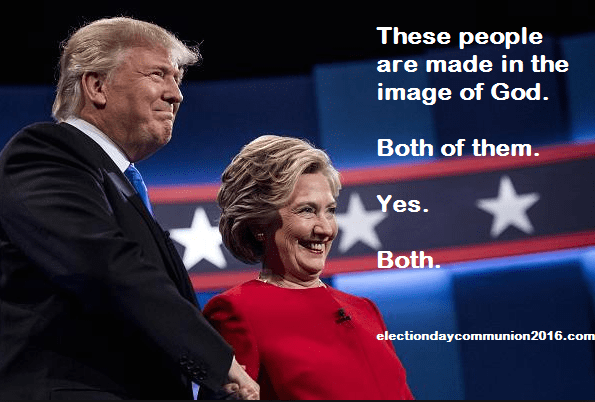 The only problem was, Raleigh Moravian had their Election Day Communion earlier that afternoon. Looking up an N&O article on my phone, I discovered that my friends at Raleigh Mennonite started their Election Day Communion Gathering…20 minutes before I read the article.
I zoomed over, just in time to hear pastor Duane Beck read from John 17…to speak of communion, common union, working its way through bread and wine and bodies – diverse bodies, political bodies, divergent bodies…common bodies. He invited everyone to come up and partake – black and white and Latinx, Republican and Democrat and anarchist, old people and young parents and students alike.
We ate, we drank, we lit candles if we wanted…and we lingered, reminding one another of our shared identity as God’s beloveds.
So I ate ate the bread, drank the cup, and passed the peace in embrace of friends and strangers.
Did I overcome division?
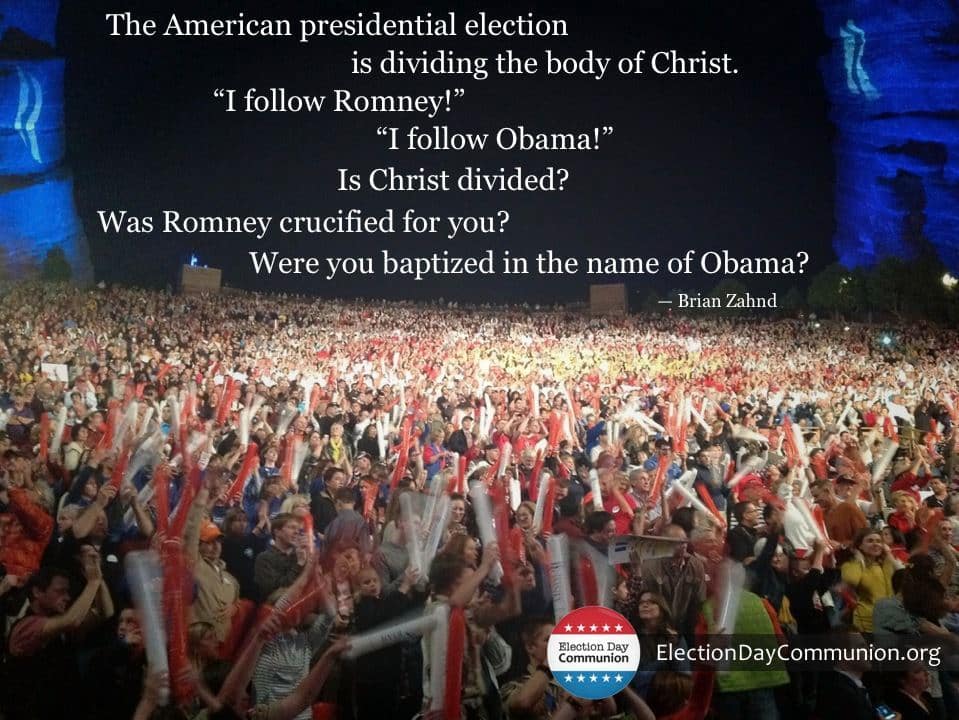 It’s a trickier question than I first supposed. It’s not only I’m divided from those who think and act and live differently than me; I’m divided from myself, sometimes. A stranger from myself. When it comes to politics, I am part-idealist, part-pragmatist, part-hypocrite, and part-cynic. Anarchism, intentional communities, partisan rancor, ambivalence, visionary hope, compromise, resignation, even nihilistic fantasies. All of these exist within me.
As I type, I hear a still, small voice:
This is My Body, broken for you.
Even me, Lord?
Even you. And every ragamuffin, ne’er-do-well, trickster, teamster, poseur, pollster, reality-upholsterer and gun-holsterer that walks this planet.
Even all of you…saints and scoundrels…broken apart like so much bread, in the fragments of your violence toward one another and Me;
Forgiven and re-gathered, reconstituted and re-mattered, as My Body is consumed and digested, I am consumed with love for you. You are bodies…broken and re-born.
You matter to Me.
It is in this consummation that I am consumed; it is in divine digestion that I rest. The election will be called soon – in the world of manifestation, ideological divisions still exist between us. As a nation, planet, and ecosystem, we have a lot of healing left to do. I pray that we can “taste and see” God’s sustaining goodness together. And with each other imagine a common future. Another world is possible – and in the scandalously-inclusive table of God, is already here.
I leave you with two songs as a benediction balm on this contentious day: The Cupboard’s Full by my friend Tim Coons, who wrote the Divine Dance-inspired ‘Trinity’ song:
And my friend Chris Slaten‘s awesome anthem, Voting Day, from his upcoming album, No Story Is Over (free single download here):
Please…tell me your story of Election Day Communion, or other boundary-breaking meal-sharing, in the comments below. I’d love to hear.
Note: This is an updated edition of a post I originally wrote for Election Day 2012…but it feels even more vital this year. Check out the Election Day Communion site and Facebook page to see participating faith communities this year, or host your own election day communion.
See also:
- Morgan Guyton on Election Day Communion
- Post-election church services aim to reconcile Christian voters by Lauren Markoe – Religion News Service
- Richard Beck on Torture and Eucharist
- Chris Smith on The Hope-Full Politics of the Table
- and, for another take, Fred Clark on Why I’m Worried about Election Day Communion
- Rachel Held Evans, Let Us Put Away our Swords and our Sound Bites
- And welcome, Brian McLaren readers!
Standing Rock from the Other Side of the World – by Katie Jo Suddaby


My friend Katie Jo, currently on an artistic and humanitarian trip in Nepal, hand-wrote the following post and sent it to me across spotty wifi, asking if I could share her perspective on the Dakota Access Pipeline intrusion on Standing Rock Sioux Tribe sacred grounds. I happily agreed.
From a little café in Pokhara, Nepal I’m reading about the conflict at Standing Rock on Facebook.
“Water is life” has a significant meaning for me since I’ve been suffering from serious traveler’s diarrhea for three days, due to bacterially-infected water in Kathmandu. If I were home in the U.S., I think “water is life” would have the ruing of a nice of saying – an apt metaphor. But in a majority-world country, with my insides exiting me at break-neck speeds, I can only clutch my stomach and agree more than I have ever agreed with anything else. 80% of Nepali people are at risk from contaminated water. And most cannot afford the antibiotics I have the luxury of taking.
In the first world, we think of dirty water as a bad smell, or dingy laundry – an inconvenience. But most of the world – now including Flint, Michigan – understands that water is life also means that contaminated water is death.
Not a metaphor.
The actual death of real people – usually the people with the most burdens already.
 The last few days have been a festival of lights in Nepal. The Newar people – the natives of the Kathmandu valley – dress in traditional clothes, sing in the streets, and make beautiful, colorful paintings with colored powder in the streets. I spoke with a young Newari shop owner about his culture. He shares the pride of over one million Newari natives in their food, art, and faith.
“Your American natives have similar art?” he asked me.
I told him that yes, some tribes in the Southwest make art with sand. But my ancestors killed most of them and the few that are left live on small reservations, so their culture is not well-known to most Americans.
We both shook our heads.
As Newari women with candles and young men with drums paraded past us, I fet the weight of shame that this majority-world country honors its native peoples, and clean water projects are popping up everywhere in the Kathmandu valley. But at home, in the supposed “first” world, the “white man” still chokes native water supplies and chooses profit over endangered culture.
It took being poisoned for me to better understand Standing Rock. I fear most Americans won’t understand until their water is poisoned too.
See also:
In Solidarity with Standing Rock: by Jeff Clark for the Wild Goose Festival
NoDAPL Archive
 Katie Jo Suddaby is the founder of The Clover Center for Arts and Spirituality, an ordained pastor in the American Baptist Churches, USA, a sought-after speaker, consultant, and artist. Working in a number of mediums, when she found sand painting, she came home. A Tibetan lama at an interfaith festival mesmerized her with this art form and its message of letting go. She taught herself the technique using tools she made from oil funnels and cake-decorating tips. After several years of only YouTube videos as her guide, she got the opportunity to study briefly with several lamas visiting Rochester, NY. Since then, her craft has blossomed. For Katie Jo, sand painting has become a way to meditate and teach. She’s now in Nepal to deepen her learning and expression. You can connect with Katie Jo on her website.
Divine Dance – The Creative Process of God – Micah Redding

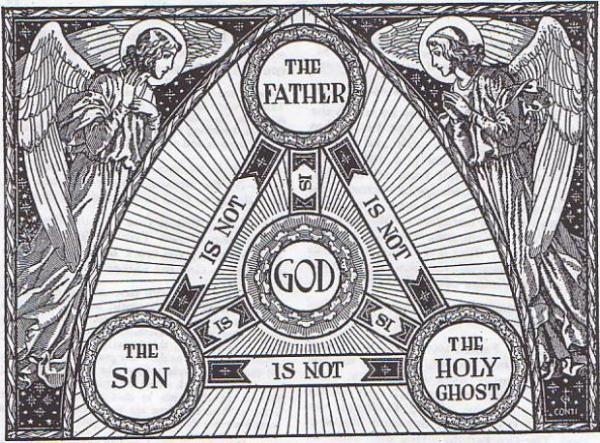
To celebrate the release of The Divine Dance: The Trinity and Your Transformation with Richard Rohr and me, I’ve asked some of the most radiant and gifted thinkers, teachers, and practitioners I know to share their reflections on why Trinity matters. This week I share a think-piece by friend, musician, Mensa, and founder of the Christian Transhumanist Association, Micah Redding!
For quite a while now, I’ve been suffering through something I might call abstraction angst. It’s hard to describe to those who haven’t experienced it, but you might get a little of the flavor if you imagine working at a bank, handling thousands and thousands of dollars per day, then finding a dollar on the ground on your walk home. It’s not that you don’t appreciate the dollar—it’s just that it’s hard to think of it as mattering much. In fact, you might even be in a kind of Pursuit of Happyness situation, where that dollar actually makes a whole lot of difference—and still have trouble caring much about it.
If you really want to understand what I’m feeling, this article by Bret Victor might get you significantly closer.
Essentially, Bret Victor ascends the ladder of abstraction, so that he can program video games in a way that’s both interesting and challenging to human beings. In doing so, he moves farther and farther away from what it feels like to play a game, or even to think about a game, and moves into a territory where the game itself is just one of many points in possibility space. But once you’ve reached that level, creating the game is just a few choices on a grid of possibilities—it’s not much like the creative process. And then, when you play the game, you’re aware that you’re just exploring one of a number of different paths someone else laid out for you to experience. You’re not really bringing anything new into existence—you’re not doing something the game creators didn’t foresee. Your gameplay is just one of the many different possibilities explored by the creators of the game beforehand.
Now what if this is what some people feel when contemplating a photo of earth from far away? How can life be significant, when it’s so incredibly small in the cosmic order of things?
For a while now, that’s what life has felt like to me. Of course, I recognized it as a fallacy—I should still be able to enjoy life even if it’s possible to think about it from a great height, or from very far away. Or in my case, at a very high level of abstraction.
But recognizing something as a fallacy, and feeling it as a fallacy are two very different things. In part, the feeling is just from overwork, from focusing my mind too intently on intellectual challenges, and not spending enough time in the practical enjoyment of life. But getting out of that overwork rut is hard: I make a living by writing code, which is an incredibly abstract process, and I’m on a mission to work through a vast amount of philosophy, which is an incredibly abstract discipline, and my main form of self-expression is typing words onto a black screen, which is an abstract hobby if ever there was one.
How to integrate my feelings with what I know to be true, especially when relatively feeling-less knowledge is my forte? That’s the question.
All this has led me to thinking about the Trinity. I’ve been meaning to do an in-depth dive into this mystery, and I’m sure I’ll get around to that eventually. The short version, though, is that although the Trinity itself isn’t spelled out anywhere in the scriptures, from the earliest moments of Christian history it was one of the most important and distinctive ideas in the faith. Understanding why it became so important is itself quite an interesting story.
My take on it is that the Trinity emerges from early Christian experience. As good monotheists, Christians experienced God as transcendent, mysterious, and unknowable. This is the position of much of philosophical theism: there must be a God, but its true nature must be forever beyond us. Christians affirmed this thought and this experience.
At the same time, Christians had experienced God in Jesus of Nazareth. In him, “the fullness of God dwelt bodily,” as they put it. They also affirmed this thought and this experience.
And they had also experienced God among themselves. When they were inspired, when they seemed to reach beyond their place and situation, and experience true brilliance of thought and word and action, when their community seemed to exhibit a creativity and order far beyond the norm—they could say that God was among them. They affirmed this thought and this experience.
The Trinity is simply the affirmation and description of these experiences. The experiences could not be simply conflated—experiencing the Spirit among you was not the same as knowing the absolutely transcendent mind of the Creator. But neither could they be completely separated—as a matter of faith, Jesus had revealed that the core identity of the transcendent Creator was love. And so the doctrine of the Trinity was formulated to affirm that these things were distinct, but not separate.
I bring this up because it seems to tell us something about the creative process.
In the Trinitarian doctrine of creation, God the Father creates the world, God the Son is embodied within it, and God the Spirit brings new life out of it.
We can think of God the Father as creating the world in an analytical and abstract way. It is a work of construction or programming or design. It is done from the outside. But once created, the world is not complete until the Son can be incarnated within it. Then it can be experienced from the inside. Then, according to Christian doctrine, God can truly understand us and relate to us as we are.
I find it interesting that humans are so obsessed with creating virtual worlds. We’ve been doing this from the moment we started telling stories, but now we do it across all kinds of media, from books to radio to movies to virtual reality. And one thing that seems to be universal, is that when we tell a story, we have the impulse to place ourselves within it.
In fan-fiction, this is called the Mary Sue—the character whose sole reason for existence is so that we (the authors or viewers) can see ourselves interacting with our heroes and favorite characters. But that’s a little dismissive—at some level, all stories are built so that we have a way of experiencing ourselves within them. With virtual reality, we now have the ability to do it almost literally.
Why do we have such a strong desire to inhabit our created worlds?
I don’t think it’s because of the quality of experience. Many critics of virtual reality think we’re on a mission to escape real life for an experience that’s much more enjoyable. And yet virtual reality to date does not get anywhere close to the quality of real life.
I think it’s something deeper. I think, as creators, we have an impulse to incarnate within our creations. We are not drawn to virtual realities because they are better than our current experience, but because we have created them, and we are instinctively drawn to commune with our creation.
It would seem that as creators of art, of words, of worlds, we find ourselves drawn into a trinitarian relationship with our creations. We create from a position of analytic and architectural abstraction, and then seek to experience our creations from the inside.
You’ll notice that I left out the third member of the Trinity. In western Christian thought, the Spirit proceeds “from the Father and the Son”. In the biblical account, once God has incarnated in the world, once both the Father and the Son are involved in the universe, then the Spirit is set loose in creation.
Where the Father creates analytically and architecturally, and the Son experiences that creation from within, the Spirit acts to bring forth new things from the life contained in creation.
The Spirit is not analytical, but emergent. The Spirit is in a sense the feedback loop of the Father and the Son, transforming and bringing forth the creative potential of existence, surprising and delighting all with new things that were completely unforeseen.
In my own creative experience, this feedback loop is absolutely necessary. When you create from a position of analysis and abstraction, you may create something that makes sense, but has no life. When you lose yourself in the experience, you may create something amateurish and unwieldy, like a Mary Sue character, or a tearjerking song that simply recites bad things that have happened to you. But when you can maintain both—when you can analyze and create and experience all at the same time—then you experience something like inspiration. Then you’re shocked to find things emerging that you never anticipated or planned or foreknew, things which are your own creations, and yet are the surprising and spontaneous creations of new life.
When I got there with my songwriting, when I was analyzing and crying and surprising myself all at the same time—that’s when I felt that the creative process was truly at work. That’s when I created the things I’m most proud of to this day.
A few years ago, I lost my songwriting ability. Where it had come naturally to me for years, it stopped coming. And I could tell that what I had done was to stray too far, and lose myself in analysis and abstraction.
But analysis is not something you can undo, exactly. You can’t unsee the things that you’ve trained yourself to see. Trying to get myself to stop analyzing seemed even more hopeless and quixotic than anything else I had done. So eventually I gave up and moved on to other forms of self-expression.
In a sense, I may now be at a similar place with life itself. Striving to analyze too much, and losing my ability to create.
But thinking about the Trinity has changed my perspective on this. My problem is not that I have done too much analysis—it’s that I have done too little incarnation. I don’t need to try to stop analyzing, I need to learn to do more inhabiting. I need to analyze, create, and experience all at the same time. I need to create what I can simultaneously experience and enjoy. Only in doing so can I move out of abstraction angst, and move back towards understanding what things feel like. Only in doing so can I generate the feedback loop that enables true creation to come into the world. Only in doing so can I rediscover and re-embrace life.
I’m not absolutely sure what that looks like yet. But it gives me hope that the creative process isn’t doomed to self-destruction, that new things really are possible, and that abstraction doesn’t have to lead to nihilism—but when placed in its proper context, can lead to ever more beautiful art, music, stories, and worlds.
 Micah Redding is a software developer and the Executive Director of the Christian Transhumanist Association. He’s an international TEDx speaker and educator, and a contributor to Vice Motherboard, the Huffington Post, IEET, and Humanity+. His extensive travels have taken him to Tahrir Square during the Arab Spring, and Afghanistan during the war. Micah is a member of Mensa, a teaching fellow at Exosphere Academy in South America, and the host of the Christian Transhumanist Podcast.
Love is Love


Calling All Lovers:
Augustine (or was it John Caputo?) once famously probed:
What do I love when I love my God?
Tom Oord in his Nature of Love: A Theology takes seriously, like few others in contemporary theology, ‘GOD IS LOVE’ as a starting point for theology, spirituality, and practice. I think his project is exciting (you should really check out the book if you haven’t already), and if it resonates, it begs the question: Who do I love? What is love? And how can we explore/express these questions together trans-rationally, devotionally, ecstatically, in song?
Well, if these are questions that matter to you, I’ve got your mystical poetry for the dance between the One and the Many, today.
This is Love is Love, coming from post-hardcore band Lungfish‘s visionary, wheel-within-a-wheel frontman, Daniel Higgs. The version that so resonates with me – and with Trinity’s Place, my late, lamented faith community in Raleigh – is actually a cover by Tortoise, when they collaborated with Bonnie “Prince” Billy.
I use this song frequently as a prelude to prayer or contemplation. Here it is:
The lyrics are anybody’s guess. Here’s mine:
Love is love in the shape things take
Love is love in the womb of wombs (wound of wounds?)
Love is love at the highest height
Love is love at the deepest depth all right
Love is love as the risen rise
Love is love in the sight of creation
Love is love in patterns of light
Love is love at the root of the grave
Love is love in the life of all life
Love is love in echoes through space
Love is love a vigil for this world (a vision for this world?)
Love is love in the marrow of new bones
Love is love as above so below
Love is love in the record of events
Love must be love to let time begin
Love is love always reconciled
Love is love in the wind and shade
Love is love – alien and strange
Love is love in truth and falsehood
And, for your added enjoyment, here’s the original Lungfish version. Sink in!