Opti-mystic meditations on Spirit, Culture, & Permaculture
Author: Mike Morrell
Michael Morrell is the collaborating author, with Fr. Richard Rohr, on The Divine Dance: The Trinity and Your Transformation. He's also the founder of Wisdom Camp, a day-retreat for mystical misfits, and a founding organizer of the justice, arts, and spirituality Wild Goose Festival.
Michael curates contemplative and community experiences, taking joy in holding space for the extraordinary transformation that can
take place at the intersection of anticipation, imagination, and radical
acceptance.
Michael is also an avid writer, publishing consultant, author coach, futurist, and curator of the book-reviewing community, Speakeasy. His two children are growing up entirely too fast and he lives in Asheville, North Carolina.
The book I collaborated on received a scathing review from an influential website of professed siblings in Spirit.
Don’t get me wrong: It’s been a good month, too. Beautiful connections with family, friends, and loved ones. A great time at AAR/SBL in San Antonio – a gathering of over 10,000 religion and spirituality scholars who really care about the difference faith and scholarship makes in the world.
But there were times when I felt like I was losing my grip – on reality.
Times when challenges turned to grief turned to outright disorientation.
I mean, we lost Leonard Cohen, for goodness sakes. C’mon, 2016!
Like a good song, a good poem, a good movie or a good grief, I don’t want to rush to resolution. It would be an insult to my friends most effected by the tumult. It would be an insult to my own soul.
And…in the midst of all this challenge and disorientation and grief, I am open to encountering the One Whom I witness as being unconditionally here.
Fully in the pain, and yet also Deep Springs of Joy.
I’m open to this encounter in my day-to-day – walking in my neighborhood, logging onto social media, showing up at rallies for peace and justice in our time.
Be kind to yourself, friend. Consider hugging or kissing someone close to you right now, and telling them how much you love them. If you don’t have such a one at-hand, ask the One in Whom you have breath, being, and a beating heart how you might be more available to Love – even today.
I wondered if the Reformed blogosphere was going to issue a ‘strong warning’ against The Divine Dance. Mark Driscoll told his then-congregation “Have you read The Shack? Don’t,” and John Piper infamously tweeted “Farewell, Rob Bell” when Rob dared question the eternal-conscious torment party line in Love Wins, so I was curious if my former tribe of more conservative-leaning Calvinists (along with their conservative Evangelical fellow-travelers) was going to circle the wagons and warn their perceived flock against Fr. Richard’s and my ode to love.
Then last night, I saw it:
I have a review coming out tomorrow @TGC on Richard Rohr's book The Divine Dance: The Trinity & Your Transformation.
Fred and I then had a brief, relatively-pleasant email exchange. He let me know that, as an art-student-turned-theologian, he created a series of underground-comix–styledgraphicnovels illuminating his favorite dogmatics. So, y’know, he can’t be that bad. (I hope he sends these to me, to show me the error of my ways.)
(And, update, I’ve been told by several today that the Good Doctor is not himself Reformed, but is in fact Wesleyan Arminian. So let his name be cleared of the TULIP-strewn path, but let the alliterative record stand on The Gospel Coalition.)
You can read it if you want.
John Calvin burning Michael Servetus at the stake over Trinitarian disagreement – artist’s depiction.
In it, Dr. Sanders says things like “The Divine Dance is not about the Trinity,” and “Rohr aggressively misappropriates Trinitarian language in order to commend his own eclectic spiritual teaching,” and “[Morrell’s] transition of this material from speech to print is not, stylistically, a happy one.” (Ouch!)
By and large, I find this ‘review’ to be a bit of a hit piece, full of theological caricature, character assassination, under-appreciation for metaphor, and disdain for divergent perspectives. There’s also some substantial critique.
I’ve left a comment on the post, which is currently under moderation. Since so many of my friends have been banned from commenting on TGC’s site (did I mention their disdain for divergent views?), I’m not holding my breath that my comment will be approved, so I’m sharing it here with you, dear reader. It’s a kind of open letter to The Gospel Coalition, Dr. Fred, and their readers. Here you go…
Hi all. Fr. Richard’s thoroughly-Protestant collaborator on The Divine Dance here.
Well, Fred, you told me on Twitter last night that you’d be posting a “very negative” review, and you did not disappoint! I feel like it would read better without what occurs to me as a level of personal invective, but I’m still able to see the substance of your critique beneath this.
What’s obvious to me is how much you really care about the Trinity – it shows up here loud and clear. I resonate with your care and concern. I won’t spend time on a point-by-point rebuttal – I’ll only name that it’s equally obvious to me that it makes total sense that a kataphatic, hierarchical, substance-oriented Calvinist approach to Trinity would be at odds with an apophatic, social, process-oriented Franciscan approach. While we both believe in revelation, we see God not only as God is, right, but as we are!
Life is such an ongoing process of discernment being held in love, isn’t it?
And so, I appreciate how much you care about this, Fred. You want to get God right. Oddly, I’m right here with you. It’s why I watched with interest this summer when some friends from the Reformed camp seemed to be engaging in heterodox Trinitarian redefinition, which one of my Missional friends wrote about so eloquently here.
You care. I care. And so here we are, having this conversation.
I will say that we saw what little conversation was taking place about the life of God expressed in Trinity focused on the individual persons traditionally named Father, Son, and Spirit, and precious little on their relationship. We get why this is the case, but there are already so many engaging treatises on Theology, Christology, and Pneumatology, that we – like our friend Paul Young, whose novel The Shack I helped launch nearly a decade ago – wanted to say something about the divine relations, the process of divinity-in-friendship, the Space Between.
Writing about one does not negate the other.
And when so many of our best teachers, poets, and sages have put heart to paper about their experience of being caught up in this divine fellowship – not to mention Jesus’ own high priestly prayer in John 17 – it seems like such a neglect not to give contemporary voice to this rich, neglected stream of Christian spirituality.
The life of the Trinity is characterized not by self-centeredness but by mutually self-giving love. When we delight and serve someone else, we enter into a dynamic orbit around him or her, we center on the interests and desires of the other. That creates a dance, particularly if there are three persons, each of whom moves around the other two. So it is, the Bible tells us. Each of the divine persons centers upon the others. None demands that the others revolve around him. Each voluntarily circles the other two, pouring love, delight, and adoration into them. Each person of the Trinity loves, adores, defers to, and rejoices in the others. That creates a dynamic pulsating dance of joy and love. The early leaders of the Greek church had a word for this—perichoresis. Notice the root of our word ‘choreography’ is within it. It means literally to “dance or flow around.
I’ll close with something that surely a Calvinist and a mystic can appreciate: Being pursued by God. There was a time in my life, about four years ago, that I was at a major life crossroads. Facing an agonizing decision; feeling desperately lonely. Truly, it felt like no one got me. No one was for me. In this space, I approached God in prayer. The opening words from Come Thou Fount of Every Blessing began to sing their way through me:
Tune My Heart to Sing Thy Grace.
And suddenly, my heart was opened: To the Father, Son, and Spirit.To the divine dance, weaving its indelible grace through my life. Trinity showed up for me in such an undeniable way, revealing just how love and pursued and (yes) chosen I was. Life goes on with its ups and downs, but this Trinitarian encounter was a game-changer. I write about this holy moment more in-depth in a special Divine Dance bonus chapter that I give away on my blog.
At the end of the day, what I’m left with is that we’re all in this together. Being formed in the Imago Dei means that we’re wired for ‘Imago Tres’ – we thrive living into our vital connection with God, self, others, and world. When we forget that we’re all connected, we wither. While we might see ‘the curse’ and ‘the cure’ differently, I appreciate that you’re asking these questions and are on this path.
Grace and peace to you.
Other Divine Dance Reviews
I want to name here that I’m not upset that The Gospel Coalition has posted their ‘very negative’ review of The Divine Dance. Because I really do believe that everything belongs, I think that such jolting exclamations – unfair though they may be – serve a real purpose: to continue the conversation in all its messiness, and help even more people discover this beautiful Mystery (not unknowable, but endlessly knowable) that Fr. Richard and I are so passionate about.
Thankfully, all of the other reviews I’ve seen thus far are far more generous – even critical ones like my friend Byron Borger’s from Hearts & Minds Books. If you’re curious to see what others are saying about The Divine Dance, what follows (in no particular order) are other reviews that have crossed my desk:
Indeed, Cynthia. For me, I’m processing the grief and disorientation of 2016 through the lenses of Gurdjieff, Bonaventure, and – yes, certainly therecently–ascendedCohen, a priest indeed for how to live well with ‘defeat.’ “This is not a biography,” Liel begins, and then proceeds to open us to Leonard’s soul – a Canadian soul, and a Jewish soul, which, for all its blessed particularities, speaks across cultures, faiths, and generations. I didn’t want Liel to stop reading to me – I think you’ll feel the same.
To celebrate the release of The Divine Dance: The Trinity and Your Transformation by Richard Rohr and me, I’ve asked some of the most radiant and gifted thinkers, teachers, and practitioners I know to share their reflections on why Trinity matters. In the light of over 800 hate crimes taking place in the U.S. in the aftermath of the election, it feels only appropriate to share reflections from Fr. Richard himself, on the oppression of racism and liberation of Trinity.
This year, as has been true for the past few years, racism has made headline news. Deep divisions have been put in the spotlight, and it can sometimes feel as if that spotlight has served to dig them even deeper.
But we can’t confront racial strife if we don’t acknowledge that it exists. The challenge is that racism does not just have a deep root, but has many deep roots in our lives, communities, and country.
Like much of our nation, I’ve been doing substantial soul-searching to seek understanding about my own actions, beliefs, and behaviors, as well as the systemic patterns that write collective actions, beliefs, and behaviors in quite large letters across our society.
What I’m coming to understand through this reflection is startling, and might surely seem like a non-sequitur. But here it is:
The widespread Christian failure to understand and experience God as Trinity has provided a breeding ground for both implicit and explicit racism.
To understand a sin that is as old as history, it is helpful to go back to one of the oldest questions of human inquiry.
When I studied the history of philosophy in the early 1960s, I was told that the first and foundational philosophical problem that keeps recurring in every age and in different forms is “the problem of the one and the many”: How can there be any primal unity to reality when what we see is so much obvious and seemingly conflicting diversity? Is there any unifying pattern to “the ten thousand things” that overwhelm our horizon?
This remains our issue today, at least for those of us who look for “big-picture narratives” that speak to the confusion that still confronts us. Theology always made the claim that it had the power to offer us the biggest picture of all (the “Reign of God” in Jesus’ language), even though it all too often offered us rather small, self-serving, and tribal images of God. Without knowing it, and contrary to its own unique revelation, I think much of Christian history did the same thing.
Let’s look at one of the very destructive effects of a diminished, anti-transformative image of God on the perennial and ubiquitous issue of racism. Today, most Christian notions of the Divine are much more formed by pagan and Greek conceptions than by the central Christian doctrine of the Trinity. Even the Latin word for God, Deus, is a direct reformulation of the Greek word for the head of the gods, Zeus. I believe racism is often rooted in this distorted view of divinity; rather than reflecting the One who created all things in God’s own “image and likeness” (Genesis 1:26-27), we instead make God into a mascot who, as Anne Lamott brilliantly quips, hates all the same people we do.
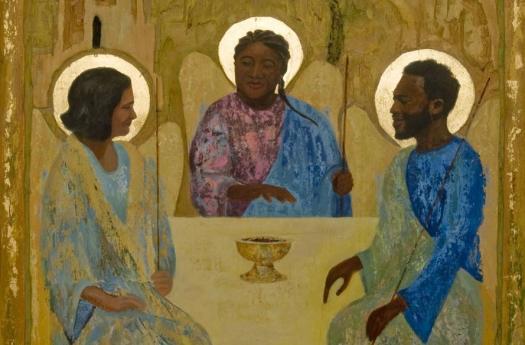
When you start with a conception of God as an old white man sitting in the clouds, it is of little surprise that white men, preferably empowered white men, are considered the closest to God and the most worthy of respect and value. It becomes a top-down universe, a pyramid much more than the circular dance (perichoresis).
Perichoresis, the Trinity as dance, is indeed the precise and daring image that ignited some of our early church fathers’ finest intuitions, prompting consensus around this utterly new revelation of God. It took them three centuries to make full sense out of Jesus’ often-confusing language about what he named “Father,” how he understood himself, and what he named the “Holy Spirit.” Our common form of dualistic thinking just could not process such three-fold and one-ness evocations at the same time.
It was frankly, illogical — and even silly.
Yet if we do not discern and celebrate difference on the level of what visible humanness means, what hope is there on issues where “difference” is often much more striking (gender, power, class, education, etc.)? Every one of these issues is searching for its own locus of authority today, and as naïve as it might sound to some, I believe Trinity does provide such an appropriate locus of authority for those who are willing to trust and allow it. God is precisely one by holding together very real difference.
Richard Rohr, OFM, a globally recognized ecumenical teacher bearing witness to the universal awakening within Christian mysticism and the Perennial Tradition. He is a Franciscan priest of the New Mexico Province and founder of the Center for Action and Contemplation and Living School in Albuquerque, New Mexico. Father Richard’s teaching is grounded in the Franciscan alternative orthodoxy — practices of contemplation and lived kenosis (self-emptying), expressing itself in radical compassion, particularly for the socially marginalized. His spirituality of creativity, vulnerability, and interdependence is the inspiration behind The Divine Dance: The Trinity and Your Transformation.