Containing the Sacred: How Jung Led Me A̶w̶a̶y̶ ̶F̶r̶o̶m̶Toward Christianity | Kenneth Kovacs

Mike’s note: The 500th Anniversary of the Protestant Reformation is upon us. During this momentous occasion – with much to celebrate, grieve, and be curious about –  it feels appropriate to share this excerpt from the Speakeasy book review selection, Out of the Depths. In these pages, Reformed pastor and scholar Kenneth Kovacs puts the ground-breaking psychological approach of Carl Gustav Jung in conversation with robust Christian theology without compromising either. The full book offers us a sustained conversation between the two in its collection of vignettes: drawing on Scripture, pastoral insight, and Jungian analysis with skill and verve. Experience this for yourself first-hand: Read on!  

[Dogma] … ritual … cultic practices … these artifacts of primal experience in time become institutions, and progressively more and more remote from the original encounter with the gods. We all know this is true. If these institutional forms really connected people with the gods, we could see the difference.
– James Hollis, Creating a Life: Finding Your Individual Path

I remember the exact moment I read these words ten years ago. It was an experience of resonance and recognition. With considerable excitement I wrote in the margin, in red ink, Yes! Yes!

These words have become a constant companion, informing my journey and vocation, and, at times, showing up in dreams. They mirrored back to me what I’ve been feeling for some time, but could not articulate. It was James Hollis who did this for me. I was unfamiliar with his work at that time. I remember wandering one day through Politics & Prose, one of my favorite bookstores in Washington, DC, when my eye was drawn to this title: Creating a Life: Finding Your Individual Path. I devoured the book (or, better, it devoured me). This was my first introduction to the searching insight and wisdom that one consistently finds in Hollis. Reading this text also signaled my return to the thought of C. G. Jung, which I first encountered as a religion and history major at Rutgers College.

Hollis is right. If religious institutions were doing a good job helping people connect with the gods, we would see the difference. This applies to all religions, of course. But as a life-long Presbyterian and a minister in the Presbyterian Church (USA) for more than twenty-four years, I read Hollis, through the filter of my own experience, as a veiled yet honest and accurate critique of the contemporary Church, particularly in Europe and North America. If the Church was really doing a good job helping individuals connect with God, the numinosum, we would be seeing the difference. It would be evident. But it’s not.

The Church is in trouble. Christianity is in trouble. These are overly generalized statements, to be sure. Of course there are many churches led by dedicated and gifted clergy who are passionately and imaginatively engaged in helping people connect with the Holy. It is happening and making a difference in those locations. And there are even some clergy who are optimistic about the current state of the Church. It’s obvious that the Church these days is undergoing a massive transition or reformation, the kind that seems to occur once every 500 years. (See Phyllis Tickle, The Great Emergence: How Christianity is Changing and Why.) I suspect, though, that something deeper is going on.

As I talk with colleagues and friends, especially those working in denominational offices, they are less than positive about the prospects of the Church. Congregations are struggling with massive membership decline, the financial burden of caring for aging buildings (many of which were built after World War II when it was “American” to go to church), sexual and financial scandals, eroding trust in authority (especially institutional authority), the polarizing liberal-conservative rhetoric infecting worshipping communities, all of which contribute to a crisis of identity for the Church.

People are moving away from Christianity because of what they see going on in the Church. This is not to say that people no longer have a desire for the Holy or no longer have religious experiences, because they do. People are moving away from the Church because very often (not always, but often) it fails to speak to the deep, human desire to connect with the Holy, to something numinous. These direct encounters with Mystery are occurring apart from the ministrations of religious institutions. “Is it not a paradox,” Hollis asks in his recent work, Hauntings, “that the chief practical function of so many religious organizations is to protect people from religious experience?”

People have left and continue to leave [institutional Christianity…] in droves. And many are being drawn to Jung precisely because they appreciate his “spiritual” or “mystical” vision and because he seems to stand outside conventional religious traditions, particularly Christianity. Some have even argued that Jung was trying to create a new religion as an alternative to Christianity and the teachings of the Church. There is much in Jung that could and does provide a sanctuary for disenchanted Church-goers, those who wish to be “spiritual” but not religious, apart from religious institutions.

However, the more I read Jung—Jung, not necessarily Jungians—it’s difficult to subscribe to the notion that he was trying to form a new religion. Neither do I feel that his theories are always incompatible with orthodox Christianity, although it’s certainly easy to think so. Memories, Dreams, Reflections offers many examples of his disappointment with the faith of his father, a Reformed Church pastor. Jung’s blistering critique of the Church throughout his writings, his frustration with theologians who accuse him of “psychologizing” the Gospel, and his own “theological,” seemingly heretical writings over the last third of his life, could effortlessly lead one to conclude that Jung was against the Church and that he wasn’t a Christian.

Yet, it’s significant that Sonu Shamdasani firmly places Jung within the Christian tradition. In the 1930s, Jung said that he stood on the extreme left wing of Protestantism.4 And even though, as Shamdasani concedes, the Red Book (Liber Novus) “is a heretical text … it remains within a Christian framework.” (See Lament of the Dead: Psychology After Jung’s Red Book) In a conversation with James Hillman, Shamdasani makes this remarkable observation: “If there were an index [to the Red Book], it would show that the critical figure is Christ. In Jung’s later writings, [he claimed that] the development of the Christian tradition led to a suppression of what he calls individual symbol formation, so that it had blocked access to direct religious experience. This was what he saw his whole endeavor as recovering.” This was not only Jung’s “endeavor” in the Red Book, but throughout his life’s opus. “In Jung’s view,” Shamdasani suggests, “recovering the full depth and range of individual symbol formation is the way forward, paradoxically, to the revivification of Christianity.” As a Protestant, Jung knew what was lost in Protestantism: “individual symbol formation.” Indeed, in a striking comment, Shamdasani insists that Jung was not against the Church, but that, on the contrary, the “task [Jung] takes up [in the Red Book] is one of revivifying ecclesiastical Christianity.”

What I increasingly hear in Jung is the voice of a prophet seeking the reform of the Church. As a prophet Jung is severely critical of the Church; however, like all prophets, he sees things that others cannot see (or refuse to see): he sees its untapped potential. Jung has a vision for what the Church could be and the invaluable service it could provide, not only to Christians and Christianity, but also to a larger society, when a community of people (a real koinonia) risks serious intimacy with the wisdom of the psyche. Jung wrote that the “dogmatically formulated truths of the Christian Church express, almost perfectly, the nature of psychic experience. They are the repositories of the secrets of the soul, and this matchless knowledge is set forth in grand symbolical images. The unconscious thus possesses a natural affinity with the spiritual values of the Church, particularly in their dogmatic form, which owes its special character to centuries of theological controversy…and to the passionate efforts of many great men.” Jung continues, “The Church would be an ideal solution for anyone seeking a suitable receptacle for the chaos of the unconscious were it not that everything man-made, however refined, has its imperfections.” (See C. G. Jung, “The Psychology of Transference,” The Collected Works of C. G. Jung, Vol. 16) It’s difficult for the Church to be a container for the psyche when it’s rent asunder by centuries of division and dissension.

The challenges facing the Church today are enormous, but I haven’t given up on it—thanks to Jung. Indeed, what if the Church really saw itself as a vas temenos—not a sacred container, but a container of the sacred, the “secrets of the soul”? Instead of the Church conflating itself with its contents, its sacred “secrets,” what if the Church really saw itself in service to the sacred and viewed itself as the conduit, the means, and the place where a connection with the Holy might actually occur, a community that helps individuals live into the transformation that inevitably occurs when one encounters the Holy? It would be a Church that values, celebrates, welcomes, and facilitates these kinds of connections, providing a “safe” place for individuals to have direct, primal religious experiences—a relatively safe place, that is. For what encounter with the Holy or numinosum is ever entirely safe? Just imagine: if more of the Church took this approach to its mission, we would definitely see the difference.

Kenneth E. Kovacs, Ph.D., is pastor of the Catonsville Presbyterian Church, Catonsville, Maryland, and has served congregations in St. Andrews, Scotland, and Mendham, New Jersey. Kenneth studied at Rutgers College, Yale Divinity School, Princeton Theological Seminary, and received his Ph.D. in theology from the University of St. Andrews, St. Andrews, Scotland. The author of The Relational Theology of James E. Loder: Encounter & Conviction (New York: Peter Lang, 2011), his current research areas include C. G. Jung and contemporary Christian experience. Kenneth is also an avid traveler and has led pilgrimages/tours to Scotland, Italy, Turkey, Greece, Switzerland and France. He blogs here.

Praise for Out of the Depths:

“Ken Kovacs’ Out of the Depths is a brilliant set of reflections on the journey of the soul in post-modern times. Drawing upon the wisdom of our ancestors, the insights of depth psychology, and his own thoughtful interpretations, he presents the reader with much to ponder, whatever his or her religious history might be. These essays transcend doctrinal apologetics and get at what the ancient word means to this fugitive world, how it can illumine our days, and guide our ways. Always respectful of the views of others, Kovacs revivifies the tradition and brings its timeless wisdom to each of us.”
— James Hollis, Ph. D., Jungian analyst, and author

“Kovacs has drawn out of the depths in writings that are grounded in thorough biblical knowledge and Reformed theology and illuminated by the breadth of his intellectual curiosity and, in particular, his study of Jungian psychology. Kovacs points out that C. G. Jung’s unique spiritual perspective on the human journey as a psychiatrist raised in the Reformed tradition enabled him to shed light on the struggles and failures of the contemporary Protestant Church and create imaginative symbols in the often-arid Calvinist domain. Yet what truly makes Kovacs’ sermons stand above the rest is how every time he reaches down into the riches of Scripture, searching for its original contextual meaning to explain such challenges as predestination, Revelation or Job, he articulates his exegetical discoveries and makes historical and literary connections with well-informed passion. Without arrogance or superficiality, but with honest vulnerability, Kovacs plumbs his own life of faith as well.”
— Susan White, Faith in Books: Essential Reading for Spiritual Vitality

“Kenneth Kovacs is a seasoned pastor and a theologian who writes like a poet. What he offers in this collection of sermons and essays is prophetic, in the finest sense of that word. Since his days studying with practical theologian James Loder, Kovacs has dared to explore the importance of authentic experience in the Christian life. He has done this while understanding the suspicion of human experience prevalent in the Reformed tradition.”
— Roy Howard, The Presbyterian Outlook

Re-Visioning Religion | The Story of Our Time | Robert Atkinson


Mike’s note: Here’s an excerpt from the Speakeasy book review selection, The Story of Our Time. In these pages, Dr. Robert Atkinson offers a deeply thoughtful narrative of conscious evolution drawn from the cumulative wisdom of the world’s religions. The Story of Our Time traces love’s unifying power throughout history to love’s presence in our midst. Don’t be distracted by seeming setbacks, Atkinson encourages; the big-picture of conscious evolution and human progress points toward the promise of peace on earth. Unity is our ultimate destination. How we get there depends upon the stories we live by and the action we take. I really appreciate hearing this from his Baha’i perspective, a faith-path I don’t really have much experience with. I choose to put this perspective into curious dialogue with my own path as an aspiring Jesus-follower; to me, life is too short and the Great Work is too vital for us to approach different and challenging paradigms with anything but respect and wonder. I may not always agree, but I can always learn. Without further ado, here’s ‘Re-Visioning Religion’! 

There are two ways we can view religion: as consisting of multiple, separate, and independent entities; or, as one evolving knowledge system with many branches. If we view reality as a whole, we also have to see Divine truth as relative, progressive, and unfolding gradually, all the while coming from the same Source. Truth is not known and fixed for all time, but is rather revealed little by little. When more is needed, more follows. If reality is one, truth has to be one.

A long-standing paradox in the comparative study of religions has been: How could there be one Creator and so many religions? This question has perplexed the keenest minds for centuries. Yet, the Messengers of the one Creator have each accepted the prophets before and acknowledged that there would be others to follow.

The continuing nature of divine Revelation has been expressed by Krishna, a principal founder of Hinduism, as: “Whenever dharma declines and the purpose of life is forgotten, I manifest myself on earth. I am born in every age to protect the good, to destroy evil, and to reestablish dharma.” In the Bible is written, “And thou shalt be called by a new name, which the mouth of the Lord shall name.”

Buddha taught that Brahman is continually manifested in the world: “I am not the first Buddha who came upon earth, nor shall I be the last. In due time another Buddha will arise in the world, a Holy One, a supremely enlightened One… He will reveal to you the same eternal truths… such as I now proclaim.”

Christ also took an eternal perspective on the progressive nature of revelation: “I have many things to tell you, but ye cannot bear them now… when the Spirit of truth is come, he will guide you into all truth…and he will show you things to come.”

Muhammad also looked ahead to the “day unto which mankind shall be gathered together” as “a time appointed,” adding, “To each age its Book.”

As earlier prophets did for their time, Baha’u’llah, in this age, fulfilled the promises of previous Revelations, reaffirming the progressive nature of religion. In The Book of Certitude, Baha’u’llah tells the story of the prophets from Abraham, the “Friend of God,” to Moses, “He Who held converse with God,” to “the Manifestation of Jesus,” and to “the Day-star of Muhammad.” They, and the other major prophets (including Krishna, Zoroaster, and Buddha), are all “Treasuries of divine knowledge,” each a clearly polished mirror reflecting the light of one sun, each central to the Creator’s promise to never leave humanity alone.

“The paradox of many religions and one Creator can now be seen holistically. No longer do we need to see the world’s religions as separated from each other; rather, they can be seen as joined in purpose and origin. The story of the prophets is the story of the Creator sending a never-ending message to humanity, piece by piece.

In these trying times, we cannot afford to lose sight of the many individual and social benefits humanity has reaped from religion. Within the world’s religious and spiritual traditions lie the seeds for rebuilding a tired and worn world.

However, misconceptions still linger about the nature of religion and the way the Creator interacts with an ever-evolving creation; these need to be addressed in public and interfaith discourse in order to ensure the progress of humanity.

Religion needs to be re-envisioned as built upon a dynamic, interconnected sequence of divine Messengers who manifest the attributes of an inaccessible Divinity and convey divinely-inspired Revelations that guide and educate humanity from age to age. As Abdu’l-Baha has put it, “Religion is the outer expression of divine reality. Therefore, it must be living, vitalized, moving, and progressive.”

“With this perspective, we can see that the founders of the world’s major religions (including Abraham, Krishna, Zoroaster, Buddha, Jesus, Muhammad, and Baha’u’llah) each brought messages representing a stage in the limitless unfolding of a single reality which has gradually yet purposively awakened humanity to our true nature, empowered us to serve the evolutionary process itself, and made us the first example of “evolution become conscious of itself,” as Huxley noted.

As one universal law governs the entire creation, the same law governs the evolution of religion. How different would our sense of meaning and purpose in life be if we actually saw religion as part of evolution?”

“It wasn’t until the mid-19th century, with the “work of Darwin, that evolution even entered popular discourse. We now understand that everything evolves: life, society, cultures, civilization, and especially science and technology. Teilhard de Chardin indicates that evolution itself may be tied to the greatest force of all: “Is evolution a theory, a system or a hypothesis? It is much more: it is a general condition to which all theories, all hypotheses, all systems must bow and which they must satisfy henceforward if they are to be thinkable and true. Evolution is a light illuminating all facts, a curve that all lines must follow.”

About the only area of human consciousness we haven’t yet accepted as evolving is humanity’s relationship to the Creator, or religion itself. The idea that all religions could be seen as pieces of the same puzzle, or the same evolutionary whole, is missing from leading definitions of religion; this idea might even be seen as disrespect for religion itself. Prevailing views of religion try to keep the branches separate from the trunk of the tree they have emerged from.

Re-visioning religion for our time would mean recognizing religion as one, just as we see science as one, though both science and religion have their many branches. Rather than religions having popped up here and there, now and then, at the deepest level religion is religion, as science is science.

Religion has taught us how to love on greater and greater levels over time. The Baha’i writings say, “The purpose of the successive revelations of God is the awakening of humankind to its capacities and responsibilities as the trustee of creation.” This process rests upon the progressive unfolding of a single reality.

Baha’u’llah, in his 19th-century revelation, continuing from where the revelation of Muhammad left off some twelve centuries earlier, extended, expanded, and renewed our understanding of ethics, values, and spiritual relativity. He also recast religion as one evolutionary process, one system of knowledge, and as the most compelling force guiding the unfolding of consciousness. He identified the oneness of humanity as the primary spiritual principle of our time; one people occupying one planet. This could not have been envisioned in any of the previous revelations.

Referring to his own revelation and all those preceding and following, Baha’u’llah said, “This is the changeless faith of God, eternal in the past, eternal in the future.” This concept, crucial to understanding the evolution of religion, is eloquently, yet mysteriously, expressed in the Gospel of John (1:1-10), “In the beginning was the Word… and the Word was God… There was a man sent from God… He was not that Light, but he was sent to bear witness of that Light. He was in the world, and the world was made by him.”

Praise for The Story of Our Time

“Robert Atkinson’s The Story of Our Time is a thoughtful, balanced, and gracious contribution from the Baha’i perspective, introducing a stream of unitive evolutionary wisdom that has been ahead of the curve for a long time and deserves to be more widely known.”
– Cynthia Bourgeault, author of The Wisdom Way of Knowing; The Holy Trinity and the Law of Three; and The Heart of Centering Prayer: Nondual Christianity in Theory and Practice

“Good news! For all the divisive shadows rising across the landscape of the global community these days, there is an answering and much more potent luminosity. Human consciousness is unfolding toward its essential unity—not only with other humans but also with all Life. This lucid book both celebrates that evolutionary trajectory and guides our full and empowered participation.”
— Mirabai Starr, author of Caravan of No Despair: A Memoir of Loss & Transformation, and God of Love: A Guide to the Heart of Judaism, Christianity & Islam

“What makes this book a classic is its profound stretch across the philosophical, metaphysical, scientific, and spiritual panorama of existence, all wrapped in the universal language of connectivity that unites all sentient beings: Love. It is a must-read by the widest of global audiences.”
— Michael Bernard Beckwith, author of Life Visioning

“As Muhammad said, ‘To every age its own book.’ Atkinson’s The Story of Our Time aptly summarizes today’s story of emergent conscious unity across our species. Organizing the scientific, spiritual, and myriad other elements of this story into seven binding principles only further enhances the value of this book.”
— Kurt Johnson, organizer of The Interspiritual Network, and author of The Coming Interspiritual Age

“With clarity and insight, Atkinson describes this pivotal moment in our collective evolution. Here are the guidelines for the shift in consciousness humanity needs to make if we are to survive and transform, if we are to make the transition from ‘the love of power to the power of love.’ Here is real hope grounded in the deep understanding of life’s essential unity and our innate capacity for love.”
— Llewellyn Vaughan-Lee, Sufi teacher and author of Spiritual Ecology: The Cry of the Earth

Robert Atkinson, Ph.D., is an internationally acknowledged authority in helping people tell their life stories. He is a pioneer in the development of the life story interview methodology and among the first to apply Joseph Campbell’s classic work on the mythological journey of the hero to contemporary personal mythmaking. His books in these areas, The Gift of Stories: Practical and Spiritual Applications of Autobiography, Life Stories, and Personal Mythmaking, and The Life Story Interview, and Mystic Journey: Getting to the Heart of Your Soul’s Story have been translated into Japanese, Italian, and Romanian and are widely used in personal growth and life review settings. His latest book, The Story of Our Time: From Duality to Interconnectedness to Oneness, is excerpted here.

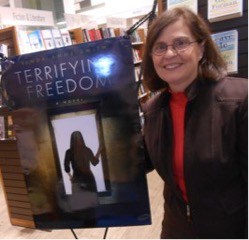
Terrifying Freedom | Linda Smith

What follows is a Speakeasy excerpt from Terrifying Freedom, Linda Anne Smith’s debut novel.

Amidst the large number of women joining the community, Sr. Rebecca Marise drew no particular attention. She entered at nineteen with some college education—typical of many—and went through the formation process in stride with the rest. Her reports were consistently positive yet in no way remarkable in comparison to the others.

As councillor of formation, Sr. Henrietta had access to the reports of the temporary professed sisters and she reviewed them all. And so it was that she read the practicum evaluation of Sr. Rebecca Marise. It was the first time Sr. Rebecca Marise blipped above the median. From the evaluation, Sr. Henrietta sensed that Sr. Rebecca Marise did not just love teaching, she was passionate. She had connected and adapted in order to draw out the abilities of the children. The superior’s evaluation, on the other hand, was similar to previous reports. Sr. Rebecca Marise was observant and prayerful, generous in community, devoted to the Church and its teachings. These qualities were mere check marks without comment, at par with the expected.

Not that Sr. Henrietta considered this a fault.

During the turbulent years following Vatican II, the SCRs clung together and braved the battle as a small, local congregation. They had few but steady numbers of vocations. Staunchly clinging to the traditions of the past and insisting on absolute loyalty to the Pope and Church teaching, they were tolerated or ignored among the more prominent and progressive religious Orders. In time, John Paul II was elected pope and the dust began to settle. During the past decade, their growth had been unprecedented and they garnered the notice and support of high-ranking members of the hierarchy. It was amazing to witness.

At the same time, a stance, difficult to name and even harder to address, was also surfacing. Sr. Henrietta noted among the superiors and many of the sisters a… a…. So nebulous, she found it hard to even articulate. It was a… particular flourish when expressing their gratitude to God for the blessing of their numerous vocations—always linked to their fidelity to the Pope and religious habit. In her later years as mistress, and now as councillor, she perceived a certain zeal…, surety…, even hauteur, among some of the younger sisters. They were thoroughly convinced of their vocation, resolute in their allegiance… jubilant, really. Wasn’t that right, wasn’t that to be lauded? And wasn’t their distain justified on occasion, given the trends prevalent in society and among certain sectors in the Church? So what was it that made her uncomfortable?

In this regard, Sr. Rebecca Marise was inconspicuous. Had Sr. Henrietta known her better, it would not have been surprising. Sr. Rebecca Marise had no experience of religious life outside the SCRs. Their perspective was reinforced by what she learned in class, gleaned from sermons, and read in the periodicals recommended by the superiors—the world was on a fast track toward impending doom. The sisters, instead, were buoyant and so zealous to have new members share their life. When among them, Sr. Rebecca Marise felt lifted up, banded together with sisters under the guidance of superiors who supported them on their journey toward eternal life. Together they brought Christ’s light to the darkness surrounding them.

***

The bus wound its way through the foothills toward the mountains, leaving behind the flatlands and its meandering lakes, headed toward Whitewaters. Sr. Rebecca Marise looked out the bus window at the rolling hills. Driving into the mountains was unknown and mysterious.

***

For the SCRs, establishing a school in a locale such as Whitewaters was unprecedented—the Catholic population was less than five percent. And truth be told, the decision would never have been made without the strong encouragement from the bishop at the time.

In the beginning, the new foundation generated much interest and esprit de corps among the SCRs. Over time, the novelty waned and other apostolic initiatives took precedence. Due to greater needs in larger centres, the Whitewaters community was reduced to four sisters approaching retirement age, “seasoned” nuns as they were called. While Whitewaters always maintained the distinction of the missionary project (which kept it in existence), the tiny community drifted into the shadows of the congregation’s attention, and its current inhabitants sought to keep it that way.

Unfortunately, a couple of weeks before school began, one of the four had a heart attack, sending Mother General and her councillors into a flurry. A replacement was imperative. But whom to send? All the sisters slated to teach were in their local communities gearing up for the first day of classes, now only a week away. In addition, the diocese’s anniversary celebrations were set to launch within the year and the SCRs held key positions on the coordinating team, further reducing an already limited selection.

***

Sr. Rebecca Marise’s head rattled hard against the window as the driver sped over a series of potholes. It was night. The full moon flitted in and out of view as the bus swerved around the mountains and wound through the hollows. Why was I chosen? Of all the nuns, certainly there had to be “seasoned” nuns willing to venture into missionary territory.

Linda Smith lives near Calgary, Alberta, enjoying the beauty of the Rocky Mountains.  For 30 years, she was a member of a community of religious sisters. She currently works in an organization that is dedicated to assisting and advocating for traumatized and neglected children.

Terrifying Freedom website
Terrifying Freedom on Amazon
Terrifying Freedom on Facebook
Terrifying Freedom on Twitter

The Reality and Goodness of the World: Tantric Jesus | James Reho

What follows is the first of several excerpts from one of this month’s Speakeasy book review selections, Tantric Jesus, wherein Episcopal Priest and tantric initiate James Reho makes a provocative proposal: Original Christian spirituality, as practiced in the early church and by Jesus himself, was tantric in nature. In the West, Tantra often evokes images of arcane rituals or acrobatic sexuality, while in reality Tantra is a holistic transformative path of life, love, and being—grounded in practice.

I’d also like to add something: My heart in offering these guest-voices – of Jesus as wisdom teacher, shaman, and now tantric master – is not to diminish Jesus as Lord, Prophet, Priest, Healer, etc… I share these perspectives because (as sentimental as this might sound to my more secular or agnostic friends) I really love Jesus, and I want to highlight his rather inexhaustible compelling features, which I believe these guest-voices do with grace and skill. So if you come from a more ‘orthodox’ or traditional Christian background – like I do – please know that you don’t have to relinquish in any way the Christ of the creeds, or the Jesus of your experience. I encourage you to give James here an open-hearted hearing. And whatever resounds with truth, honor, insight, purity, and love, savor those things. (See Philippians 4:8) Feel free to let go of whatever doesn’t resonate. 

[Jesus said,] The Kingdom of the Father is spread out upon the earth, and [people] do not see it.
– The Gospel of Thomas (Logion 113)

If you do not see God in everything, you will not see God in anything.
– Yogi Bhajan, 20th-century tantric master

As human persons, we negotiate reality through multiple fields of experience. We engage the three-dimensional, physical world through our senses, and we engage the inner realms of imagination, emotion, and logic through other organs of active perception. We can experience time as linear or as cyclical, and we sometimes have intimations of timelessness as well. We can perceive the activity and monologues of our own minds, and from time to time can drop into a fertile stillness that words cannot describe. We can experience a sense of isolation, and we can experience a sense of connectedness and oneness with all of creation. We can reflect upon our lives and find a single, sacred narrative thread, and we can reflect again another day and find scattered, isolated events that seem empty and confusing.

As we gather and reflect upon these various fields of perception and experience in our lives—the mundane and the sublime, the joyful and the heart-wrenching—we begin to wonder what in all of this is real, and what if anything is within our power to change. Is the elimination of suffering possible, and if so, how? Are the moments of ecstasy and joy in our lives what are truly real, or is tragedy the true nature of existence? How much of our own peace and happiness is up to us? Is the world “out there” something to flee or something to embrace? Is our inner world more real, or the outer? Do they both exist, and if so, are they even different worlds? Often such questions are precipitated by pivotal events in our lives: births, deaths, and other major life changes.

I have seen in my own life that the answers we hold to such seemingly theoretical questions actually bear very practical results. Shortly after my twentieth birthday, my mother died after a three-year battle with cancer. As her only surviving child, I had always been extremely close to her and we enjoyed a deep, healthy, and life-giving relationship until her death. While I had done plenty of grieving during her illness, when she died I did not allow myself to mourn. According to my beliefs at the time, what was most real about the human being was something that could and did exist apart from the body: an eternal soul or divine spark or atman. Death was largely inconsequential, or at least ultimately an illusion. Death was merely a shift, a liberation, in fact, of the core of individual reality from the darkening and limiting husk of the physical body to something far finer.

Armed with this philosophy, I was determined to prove my spiritual maturity through responding to my mother’s death with stoic aplomb. I did not cry at her funeral; in fact, I served as the pianist for her funeral Mass and kept my composure throughout the day, being the gracious host to the many who had come to honor her memory. I worked hard to replace the difficult images of her last days and hours with pictures of her transfigured and at peace, making this substitution in my mind less than an hour after her death. I refused to engage her dead body, telling myself and others that the body was of no consequence: it was no longer her. This way of negotiating my mother’s death proved to be an excellent short-term insulator against difficult and painful emotions. As a further benefit, I was able to soothe my lonely and sad self with reflections on how spiritually advanced I must be; after all, I had not even cried at her funeral.

Shortly after her death I experienced a year-long series of dreams. In these dreams I would see my mother here and there slipping through a large crowd but could never seem to connect with her or get her attention. In some dreams I would see her walking past me but became frustrated because I had lost the ability to speak or move and couldn’t call to her. Sometimes in these dreams I would call her on the phone and there would be no answer, or I would get an old-fashioned busy signal over and over again. These dreams caused me great agitation, and upon waking I would find myself breathing hard and soaked with sweat. I would try to push down the deep sadness that would visit me after these dreams with affirmations of my spiritual philosophy: death was an illusion, all that finally mattered was the eternal soul, and I had no reason to be sad.

Finally, over a year after her death, I had a dream which closed this series. In this dream, I was in my parents’ house and something funny had happened. I picked up the phone to call my mother and tell her about this funny event. As the phone rang multiple times, I thought within the dream, “Oh, that’s right. They don’t have any phones there,” and hung up the phone. As the phone receiver clicked onto its carriage, I woke up with a sense of calm. This time I let the sadness remain with me. I had, in my dream life at least, finally admitted that she was gone, that her death was real.

My father died fifteen years later. On the last night of his life my wife and I returned to the nursing home late in the evening, after having gone out for dinner with family, to say goodnight to the dying man, silent and still for two days already. We arrived only moments after he died, as his body was still quite warm. We did not immediately call the nurse. Instead, we spent time alone with him in the quiet room, now only dimly lit as night had fallen. I took a few unhurried moments to stroke his hair, touch his cheek, and offer his body the veneration of my touch and tears.

By this time in my life I was no longer an intellectual but nervous twenty-year-old. Older now, I had grown tired of using the life of the mind to absent myself from a reality that kept me scared and inwardly running. I wanted to fully inhabit my life, the laughter and the ecstasy of it as well as the equally holy times of sorrow and anxiety and frustration. Having put aside spiritualist metanarratives and exotic cosmologies, I was now more interested in tasting the vitality of the actual life I was living—an embodied life full of laughter and pain and particularity and sacredness and uncertainty—rather than keeping myself safe from finitude and sadness by holding all experiences at arm’s length.

Whether or not my father’s eternal soul or divine spark or atman might now be present to another dimension of reality, my father’s death was real. Engaging his face, trying my best to remember this sacred moment, I did not turn away from his body or from his death. My sense of spiritual reality was no longer a salvific explanation that would save me from an acute emotional difficulty; rather, it was a sense of deep and abiding presence in and through the matter of my life, a sense of the holy soaked into the sorrow, sanctifying it but not removing it. I cried at my father’s funeral, and did not play the piano. My only role that day was to be a mourning adult child of a man who had died.

After my father’s death, there was no series of dreams. While my father did from time to time appear in a dream or in deep meditation, these encounters were not marked by anxiety. I welcomed them and found joy in them, even though in life our relationship was often very strained. I believe the wide difference in how I experienced the deaths of my parents was partly due to the wide difference in the ideas I held concerning the meaning and value of the body, the meaning and value of matter and of the world, and the meaning and value of human particularity and its relationship to the sacred.

The Reverend James Hughes Reho, Ph.D., is an ordained Episcopal priest with a Ph.D. in Chemistry from Princeton University. He has served on the staff of Trinity Episcopal Cathedral in Miami, as the Chaplain and Director of Spiritual Formation at the General Theological Seminary in New York City, and currently pastors a Lutheran-Episcopal church in Fort Myers, Florida. A spiritual director and certified yoga instructor, he leads retreats and workshops on yoga, meditation, and tantric practice in both religious and secular settings. He lives in southwest Florida with his wife. You can find him online at JamesReho.org.

Listen to James discuss Tantric Jesus on Strategies for Living with David McMillian and Anatomy of Living with Ashton Szabo.

Raindrops of Love for a Thirsty World

Mike’s note: Scripture attests to an astonishing spiritual reality: A world created by, through, and sustained within a God Who’s all-in-all. We are given the dignity to remain in separation concsciousness if we so choose, but we can also “join to the Lord and become One Spirit” with God (1 Corinthians 6:17 ). What follows is an excerpt from Raindrops of Love for a Thirsty World, a tender invitation to Divine-world cooperation for the good of the whole. Interested in a review copy? We still have a few eBook copies for qualified bloggers via Speakeasy. Find out more here!

Beloved, I am Life. And I invite you, in this perfect moment, to realize that we—you and I—are one Spirit flowing within, and throughout, the infinite realm of matter, and that our unity has always and ever been so. Although for a while you forgot that we were united, that did not mean we were ever separated. It just rendered you briefly insensible to our eternal connection.

Know that I AM your formless Self, communing with you through these words because you desire the conscious reconnection of form and formlessness. The time has come for you to awaken and transcend your imagined limitations so that you can express ever more of your formless Self in the realm of form.

Know too, that the more sincerely you open yourself and allow my formless presence to permeate your awareness, the gentler I can be when communing with you. And the easier that we can harmonize, the more loving, relaxed and joyful will be our experiences and our creative self expressions.

I invite you to notice that I speak with you in our native tongue—the language of Life—all the time. I communicate with you from all around you: through images, sounds, fragrances, movement and touch. I even connect with you from within by inspiring specific moods and feelings. I speak to you through your planet’s rhythms, its energy flows, and your dreams for a brighter tomorrow. I am, in my infinite love for you, endlessly communing with you and encouraging you to awaken to my existence.

Before you were born we existed in undifferentiated unity. But once you were born you were taught to perceive yourself as a separate being. The more you accepted that human story, the more you began to perceive me as a possession that would someday be stolen from you. Eventually, the artificial chasm between us, which your human story created, required you to invent an ego that now claims to be the owner of a life, instead of life itself.

I know how confused you have felt at times as you’ve traveled in the world of form, and how on occasion you’ve struggled to find your proper place in the world. I’ve also watched you grow lost now and then in the dramas of human society. Even so, in this precious now moment you can reclaim your native tongue and commune with me in our mutual language; for the language of Life has been ever your birthright, Beloved.

The doorway that leads directly to me is unlocked and will always stand open. The only key you need is simple willingness to listen to the cosmic melody that plays inside you, so you can dance your way home to your higher Self through the gateway within your own heart.

Eileen Workman spent sixteen years in the financial industry as First Vice President of Investments at a major Wall Street firm. After a profound spiritual awakening, she departed the high-powered world of money and wrote Sacred Economics: The Currency of Life, which questions assumptions about the nature of capitalism. The book is about directing our attention toward the purposeful design of a more compassionate, cooperative, and abundantly flowing economic system from a spiritually-driven perspective. This is an excerpt from Eileen’s newest book, Raindrops of Love for a Thirsty World.