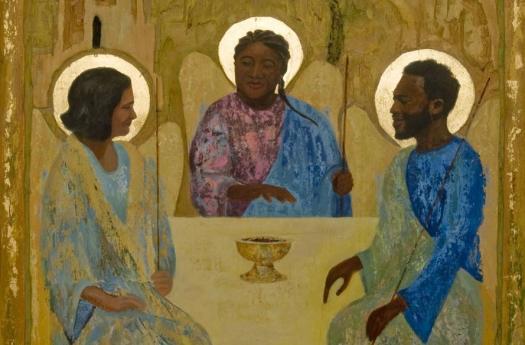
Divine Dance, Divine In-Dwelling: Invitation to a Trinitarian Theology of Religions by Bruce Alderman


To celebrate the release of The Divine Dance: The Trinity and Your Transformation with Richard Rohr and me, I’ve asked some of the most radiant and gifted thinkers, teachers, and practitioners I know to share their reflections on why Trinity matters. This week I share an Integral Post-Metaphysical deep-dive by John F. Kennedy University Professor Bruce Alderman! 

Richard Rohr and Mike Morrell have written a very accessible and engaging book on a topic typically confined to abstruse theological treatises: the perichoretic relations of the 3 Persons of the Trinity (and, by extension, of all creatures participating in the divine being of God).  I have not yet finished The Divine Dance: The Trinity and Your Transformation, but I am more than halfway through it, and they have thus far successfully avoided ever mentioning theology wonkish terms like perichoresis or circumincession.  But these concepts – of the “dancing around,” dynamic interpenetration, and mutual in-dwelling of the divine Persons of the godhead – are central to the gently subversive and radically relational psychocosmology they unfold.  So I hope you will forgive my indulgence in them here.

Although no longer a practicing Christian myself, I have remained interested for many years in Trinitarian thinking as a distinctly Christian expression of nondual spiritual insight – and have wished for just the sort of unpacking and broad metaphysical application as it receives in The Divine Dance.  (See Raimon Panikkar‘s The Silence of God: The Answer of the Buddha for a more specialized and rigorous philosophical analysis of Trinitarian perichoresis in light of the core Buddhist concepts of emptiness and dependent co-origination).  Readers of my 2015 paper, Integral In-Dwelling: A Prepositional Theology of Religions, will know that my own recent theological and (post-)metaphysical reflections have been animated by the potential of Trinitarian insights to inform an integral-pluralist model of interreligious relationship.  As I argue in the paper, a generalized concept of Trinitarian “circumincession” – the entanglement or in-dwelling of each being by all beings – opens the door, I believe, to a deeply participatory and relational (or post-pluralist) understanding of religious diversity, particularly when applied not only to persons but to religious communities as well.

Rohr and Morrell acknowledge this potential early on in the book:

Once you look out at reality from inside the Trinity, you can and will know, love, and serve God in all that you do.  The metaphors, rituals, and doctrines of other religions are no longer threatening to you, but often very helpful.  God as Trinity makes competitive religious thinking largely a waste of time.

There have been several recent attempts to build models of religious diversity on a Trinitarian foundation – with perhaps the most well-known examples being S. Mark Heim‘s books, The Depth of the Riches: A Trinitarian Theology of Religious Ends and Salvations: Truth and Difference in Religion. But Heim’s approach still treats the Trinity in the “substance-oriented” vein of traditional Christian metaphysics that Rohr and Morrell (rightly) critique: it conceives of each person of the Trinity rather statically as representing a particular ontological and phenomenological domain that may be accessed by different religious traditions for distinct soteriological ends (with only the Christian tradition providing access to all three Persons or Domains of the Godhead, and thus to the fullest soteriological possibilities).

The Divine Dance, however, locates the liberative power of Trinitarian thinking not in the individual substances of the Persons themselves, each concretely defined, but rather in the dance between them – shifting from a nounal object-orientation to a more verb-al one which emphasizes flow and inter-being. Rohr and Morrell suggest that substance metaphysics traditionally has inclined Christian metaphysics toward a pyramidal model of being, with God at the top as the supreme substance. I would suggest this has contributed to the pyramidal inclusivism common to Christian interreligious relations as well (where other traditions are recognized and included – if they are at all – as partial revelations of the greater Christian truth).  Heim’s approach still operates under this model.  A truly Trinitarian (perichoretic) orientation, on the other hand, would promote a more circular, entangled, multiplistic metaphysics – a participatory metaphysics of kenotic love and entangled co-becoming.

In Integral In-Dwelling, I explored the concepts of perichoresis (divine “dancing around”) and circumincession (the mutual in-dwelling of each being by all beings) in prepositional rather than verbal terms – highlighting the creative, pre-positioning power of with and in, around and through, for instance: to set the vectors, the clearing, for the unfolding dance of being.  A prepositional theology is a theology of relations.  And prepositions, I suggest, function somewhat like light:  in the very act of presenting the various objects and elements of experience (in what-ever configuration), they tend to absent themselves.

Rohr and Morrell also comment on this light-like play of God:

Light is not really what you see; it is that by which you see everything else. God is the Great Empowerer, taking the forms of inherent grace and constant evolution. Trinity is so humble that it does not seem to care who gets the credit. Like light, you do not see God; but God allows you to see everything else through really good eyes.

And Rohr and Morrell invoke the divine dance in prepositional terms as well when they speak of the persons of the Trinity in the sacred roles of for (Father), alongside (Son), and within/between (Holy Spirit):

God for us, we call you Father.
God alongside us, we call you Jesus.
God within us, we call you Holy Spirit.
You are the eternal mystery that enables, enfolds, and enlivens all things.
Even us and even me.

This is the kenotic, gifting agency of the divine community.  Like salt and light, working in and for. This is the direction, I believe, in which a circumincessional theology of religions would lead us: a theology of in-dwelling is a theology of co-presence, a vision in which each being, each religious practitioner or tradition, can be seen to enfold the totality, or the potential for the realization of any aspect of the totality.  Prepositionally, we exist with/in and through, for and against, and as one another, with our light and life between and beyond.

Does a Trinitarian theology of the mutual in-dwelling of traditions vitiate interreligious relationships? Does it undermine the need for dialogue across traditions – rendering each tradition a self-sufficient whole, with no need to interact with or learn from others? The possibility for such an interpretation is present, of course; but in my opinion, in light of the prepositional orientation I’ve hinted at above, the principle of co-presence or universal circumincession has great potential to effect the opposite result: that is, to enrich and reinforce the entire field of interreligious relationship. For, while each being or form is in-dwelt by the totality of all forms (or at least the alethic truth of those forms), and therefore has the potential to realize some aspect of each, in reality we only ever actualize a limited amount of that potential – developing richly along certain evolutionary pathways, perhaps, while leaving many others relatively untrod.  In interfacing closely with other traditions, we are afforded the opportunity to learn something about our own implicit capacities and potential forms of being, which we may then unfold in our own unique ways. As Richard Kearney (2010) argues in Anatheism, his wonderful book on religious hospitality after the death of God, “Only through the shock of affinity through alterity does something new emerge.”

Interreligiously, such a model might inspire modes of encounter similar to Deleuze’s becoming-animal: Not a process of imitation, not a conscious choice to adopt a costume or to mimic another being’s ways, but the invitation to draw close to the other until, imperceptibly, in that zone of maximal proximity and indeterminacy, becoming eventuates. We awaken what is always already, but in so doing, it becomes what it never (yet) was.

Put differently, a practice founded on the recognition of perichoretic and circumincessional co-presence, of being inseparably with and in, is a practice which invites us also to put ourselves in-between, in the thick midst of our co-becoming.  For in any of our projects of becoming, as William Desmond (1995) reminds us, we are always delimited and sustained by an overdetermined excess – the ontological excess which is our milieu, an overflowing betweenness which always escapes final dialectical synthesis in our individual projects of self-determination (or systematic theology). This excess of the in-between, I would argue, is inseparable from our being-with/in-one-another.  The “/” of with/in is never finally erased. And as Desmond (1995) observes, this excess has the capacity to startle us into agapeic astonishment – into the primal innocence of appreciative wonder at and for the other as other. In practice, this is a call to gelassenheit, to a hermeneutics of care (Levin, 1989) and the exercise of the imperative method (Panikkar, 2015): a knowing which doesn’t take co-presence to mean that our interpretive categories fully exhaust or capture the being of another, or that our light leaves no shadows, and yet which trusts its assurance that mutual illumination – mutual incandescence – is always possible.

In my view, The Divine Dance issues a strong Yes to such possibilities, and represents for our time the welcome flowering of seeds long dormant – or at least frequently suppressed and crowded out – in the Christian tradition.  As a non-Christian, I’ve remained theologically and philosophically connected to some of the richness of the tradition through folks such as Raimon Panikkar, Catherine Keller, and William Desmond, and I’ve explored several different trinitarian visions over the years in my own personal reflections, but often a lot of the re-translation of Christianity for modern contemplative tastes strikes me as a “stretch” – trying to get more mileage out of a failing car.  But Rohr and Morrell’s trinitarian contemplative theology strikes me as fresh and “indigenous” (enough) to the tradition to be compelling. So I will close with a small confession: This is the first book in very many years to make me consider Christianity again as an attractive and compelling path for myself.

Richard and Mike, thank you:  may this vision flourish.

This Post, the Bibliography: 

Alderman, B. (2016). Integral In-Dwelling: A Prepositional Theology of Religions.  Retrieved from Consciousness: Ideas and Research for the Twenty First Century | Fall 2016 | Vol 1 | Issue 4.

Desmond, W. (1995). Being and the Between. New York: SUNY Press.

Heim, S.M. (1995). Salvations: Truth and Difference in Religion. Maryknoll, NY:  Orbis

Books.

Heim, S.M. (2001). The Depth of the Riches: A Trinitarian Theology of Religious Ends. Grand Rapids, MI:  Wm. B. Eerdmans

Publishing Co.

Kearney, R. (2010). Anatheism: Returning to God After God. New York: Columbia University

Press.

Levin, D.M. (1989). The Listening Self: Personal Growth, Social Change and the Closure of Metaphysics. New York: Routledge.

Panikkar, R. (1989). The Silence of God: The Answer of the Buddha. Maryknoll, NY: Orbis

Books.

Panikkar, R. (2015). Religions and Religions: Opera Omnia Volume II. Maryknoll, NY: Orbis Books.

Rohr, R. and Morrell, M. (2016). The Divine Dance: The Trinity and Your Transformation. New Kensington, PA: Whitaker House.

Bruce Alderman is adjunct faculty in the College of Graduate and Professional Studies at John F. Kennedy University (JFKU). He received his master’s degree in Integral Psychology, with an emphasis on Transpersonal Counseling Psychology, from JFKU in 2005. He teaches Paradigms of Consciousness, Fundamentals of Transpersonal Psychology, Fundamentals of Psychology, World Spirituality, Living Systems Theory, Integral Life Spiritual Practice, Psycho-spiritual Development, and Integral Meditation. Bruce has served as a thesis and final integrative project advisor, and has published several articles on Integral spirituality in the Journal of Integral Theory and Practice, has two chapters appearing in forthcoming anthologies on Integral meta-theory and philosophy, and has recently won Best Paper Awards at the 2013 and 2015 Integral Theory Conferences. Prior to working at JFKU, he worked and studied abroad for several years, including teaching courses on creative writing and inquiry at the Rajghat Besant School, a Krishnamurti school in Varanasi, India. His current areas of interest include Integral Theory and practice, transpersonal psychology, integral postmetaphysical spirituality, the time-space-knowledge vision, transformative arts, dream yoga, and interfaith dialogue.

Cruci-fixation: Religion’s Deadly Habits – and Jesus’ Antidotes by Morgan Guyton

Note: This guest post is by Morgan Guyton, a dear friend who’s both a prophetic and pastoral voice to college students in New Orleans. You can read more about him in the bio below, but for now know that his campus ministry NOLA Wesley Foundation, is the only LGBT-affirming campus ministry in the state of Louisiana and they’re facing a budget shortfall. Please consider helping keep their doors open by supporting their year-end fundraising campaign right here!

Have Christians become the very thing that Jesus came to liberate us from?

It’s a question that haunts me as an American evangelical Christian who lives in a time when our culture wars have alienated so many good people from ever giving Jesus a chance. Why do the loudest Christian voices today sound so much like the religious authorities who crucified Jesus? Did Jesus really win after he was raised from the dead? Or was his movement co-opted over the centuries by the spiritual heirs of the very people who had him killed?

Some people blame Constantine, the first Roman emperor to convert to Christianity, for turning an outsider movement into an imperial conquest. Other people point the finger at Augustine, the brilliant fourth-century theologian whose misgivings about his sex life may have helped to shape the unhealthy relationship we Christians have with our bodies. Others say it was the medieval nominalists, who taught that words mean only whatever God says they mean, which means that God could hate and call it love.

Of course, there has always been a beautiful Christianity sharing the same church with the loudmouths who get all the headlines. There were the Egyptian desert mystics, who, whenever they got robbed, would chase after the thieves to tell them they forgot something. There was Francis of Assisi, who never met a leper whom he didn’t kiss. There was Julian of Norwich, the first Christian woman to write a book in English, who claimed that her visions revealed a God who was purely benevolent and mostly motherly, without an ounce of hate, despite the bubonic plague that was devastating her people.

Still, it seems as if the loud, mean Christians are the ones who always win. But perhaps this makes sense in a strange way. If Jesus’ cross is the heart of Christianity, then maybe Jesus has never stopped being crucified by his own people, and the ones who really get Jesus are crucified along with him. John 1:11 says, “He came to what was his own, and his own people did not accept him.” How do we know this is talking only about Jesus’ original life on earth? What if Jesus keeps coming back to “his own” and we keep on rejecting him?

When Jesus was on the cross, he said something that applies to Christians who crucify him today as much as it did to the religious leaders who first crucified him. He said, “Father, forgive them, for they do not know what they are doing” (Luke 23:34). Jesus knew that the religious leaders who crucified him thought they were doing so out of genuine allegiance to God. They thought he was ruining everything about their religious system—and indeed he was. They didn’t realize that he was actually God incarnate, come down to fix what they had screwed up.

The religious authorities had good reason to think that they were supposed to put Jesus to death. In the ancient Bible stories they had read, God commended those who killed out of zeal for his holiness. When the Israelites built a golden calf to worship instead of God, their leader, Moses, told the sons of Levi, “Go back and forth from gate to gate throughout the camp, and each of you kill your brother, your friend, and your neighbor” (Exodus 32:27b). When the sons of Levi obeyed Moses and slaughtered three thousand random people, Moses told them, “Today you have ordained yourselves for the service of the Lord” (Exod. 32:29). Thus, the Levites, one of the most important Israelite religious orders, was established by an act of terrorism almost as massive as 9/11.

Likewise, when the Israelite men started sleeping with Moabite women and worshiping their gods, Moses’ great-nephew Phinehas saw an Israelite take a Moabite woman into a tent. He followed them, took a spear, and thrust it through both of them while they were making love. As a reward for this double murder, Phinehas and his descendants were given “a covenant of perpetual priesthood, because he was zealous for his God, and made atonement for the Israelites” (Numbers 25:13).

If holy priesthoods are rewarded to those who kill for God’s honor, then crucifying a man who claimed to be God is the ultimate expression of righteous zeal. Likewise, it was perfectly righteous for a religious zealot named Saul of Tarsus to persecute the followers of this Jesus. In Acts 7, Saul oversaw the stoning of the first Christian martyr, Stephen. Then he went on a tear, dragging Christians from their homes and throwing them in prison (Acts 8:1–3).

Saul was every bit as passionate about standing up for God as many Christians are today. But one day, on his way to persecute Christians in Damascus, Saul was blinded by a light and fell to the ground. A voice came out of the bright light saying, “Saul, Saul, why do you persecute me?” Saul said, “Who are you, Lord?” And the voice replied, “I am Jesus, whom you are persecuting” (Acts 9:4–5).

As a result of this dramatic encounter, Saul stopped persecuting Christians and became the apostle Paul, the greatest Christian missionary of all time. Christians often see Paul’s Damascus Road encounter as a biblical paradigm for how salvation happens. But Jesus didn’t save Saul from anything so much as he saved the world from Saul. I wonder if this recognition would be helpful to how Christians understand salvation today. How would Christians live differently if we believed that Jesus needs to save the world from us?

I really do mean us. All of us. Not just the Christians I define myself against, but Christians who posture exactly the same way I do. I really believe that being authentically Christian amounts to believing that the world needs to be saved from me, instead of thinking I have to save the world from them (whoever “them” is). British writer G. K. Chesterton gave a famous two-word response when a newspaper asked its readers to share what they thought was wrong with the world. “I am,” he wrote back.

I’ve identified twelve toxic Christian attitudes from which Jesus needs to save us and twelve antidotes that Jesus uses to save us. He’s saving the world from our disingenuous posturing, our exhibitionist martyrdom, our isolationism, our disembodiment, our moral cowardice, our ideological certitude, our divisiveness, our anxious overprogramming, our moralistic meritocracy, our prejudice, our pursuit of celebrity, and our quest for uniformity. He’s saving us by filling our hearts with genuine worship, wounding us with his mercy, emptying our spiritual clutter, breathing vitality into our bodies, awakening our sense of honor, captivating us with his poetry, letting us taste true glory, showing us the beauty of his temple, sticking up for people who screw up, liberating us from social conventions, modeling his way of servanthood, and calling us deeper into his kingdom.

The discomfort that you feel at what you’ve seen around you is the Holy Spirit awakening the church. We have so many problems in our day: police brutality against people of color, a generation of severely indebted college graduates, the greatest wealth inequity our society has known in generations, unjust trade and immigration laws, a climate that has been heavily damaged by our waste. I feel pretty helpless in the face of these serious problems, but I do have one piece of good news: Jesus is saving the world from us, one Christian at a time.

Morgan Guyton and his wife Cheryl are co-directors of the NOLA Wesley Foundation, the United Methodist campus ministry at Tulane and Loyola University in New Orleans, LA, part of the affirming, inclusive, gospel-centered Reconciling Ministries Network. In addition to his blog at Mercy Not Sacrifice, Morgan has contributed to Huffington Post, Red Letter Christians, Ministry Matters, Think Christian, and the United Methodist Reporter. Morgan is also known to DJ in an ecstatic, perichoretic rave style! This post is based on an excerpt of his debut book, How Jesus Saves the World from Us: 12 Antidotes to Toxic Christianity from WJK.

Please help keep the doors open at NOLA Wesley Foundation – the only LGBT-affirming campus ministry in Louisiana – by supporting their year-end fundraising campaign right here!

Come Healing by Leonard Cohen

kintsukori

O gather up the brokenness
And bring it to me now
The fragrance of those promises
You never dared to vow

The splinters that you carry
The cross you left behind
Come healing of the body
Come healing of the mind

And let the heavens hear it
The penitential hymn
Come healing of the spirit
Come healing of the limb

Behold the gates of mercy
In arbitrary space
And none of us deserving
The cruelty or the grace

O solitude of longing
Where love has been confined
Come healing of the body
Come healing of the mind

O see the darkness yielding
That tore the light apart
Come healing of the reason
Come healing of the heart

O troubled dust concealing
An undivided love
The heart beneath is teaching
To the broken heart above

Let the heavens falter
Let the earth proclaim
Come healing of the altar
Come healing of the Name

O longing of the branches
To lift the little bud
O longing of the arteries
To purify the blood

And let the heavens hear it
The penitential hymn
Come healing of the spirit
Come healing of the limb

O let the heavens hear it
The penitential hymn
Come healing of the spirit
Come healing of the limb
– Come Healing, penned by Leonard Cohen, recorded on Old Ideas (2012).

a-broken-hallelujahI just finished listening to A Broken Hallelujah: Rock and Roll, Redemption, and the Life of Leonard Cohen by journalist and esotericist Liel Leibovitz. I recommend you read this book, or better yet listen to it on CD or via Audible (where you can get it for free for trying it). As my Living School teacher Cynthia Bourgeault recently posted, “Pondering the state of the world through the eyes of Gurdjieff, Jacques Lusseyran, Karl Jenkins, and Leonard Cohen.”

Indeed, Cynthia. For me, I’m processing the grief and disorientation of 2016 through the lenses of Gurdjieff, Bonaventure, and – yes, certainly the recently–ascended Cohen, a priest indeed for how to live well with ‘defeat.’ “This is not a biography,” Liel begins, and then proceeds to open us to Leonard’s soul – a Canadian soul, and a Jewish soul, which, for all its blessed particularities, speaks across cultures, faiths, and generations. I didn’t want Liel to stop reading to me – I think you’ll feel the same.

Divine Dance: How the Trinity Confronts Racism | Richard Rohr

trinity-after-rublev-ii

To celebrate the release of The Divine Dance: The Trinity and Your Transformation by Richard Rohr and me, I’ve asked some of the most radiant and gifted thinkers, teachers, and practitioners I know to share their reflections on why Trinity matters. In the light of over 800 hate crimes taking place in the U.S. in the aftermath of the election, it feels only appropriate to share reflections from Fr. Richard himself, on the oppression of racism and liberation of Trinity.

This year, as has been true for the past few years, racism has made headline news. Deep divisions have been put in the spotlight, and it can sometimes feel as if that spotlight has served to dig them even deeper.

But we can’t confront racial strife if we don’t acknowledge that it exists. The challenge is that racism does not just have a deep root, but has many deep roots in our lives, communities, and country.

Like much of our nation, I’ve been doing substantial soul-searching to seek understanding about my own actions, beliefs, and behaviors, as well as the systemic patterns that write collective actions, beliefs, and behaviors in quite large letters across our society.

What I’m coming to understand through this reflection is startling, and might surely seem like a non-sequitur. But here it is:

The widespread Christian failure to understand and experience God as Trinity has provided a breeding ground for both implicit and explicit racism.

To understand a sin that is as old as history, it is helpful to go back to one of the oldest questions of human inquiry.

When I studied the history of philosophy in the early 1960s, I was told that the first and foundational philosophical problem that keeps recurring in every age and in different forms is “the problem of the one and the many”: How can there be any primal unity to reality when what we see is so much obvious and seemingly conflicting diversity? Is there any unifying pattern to “the ten thousand things” that overwhelm our horizon?

This remains our issue today, at least for those of us who look for “big-picture narratives” that speak to the confusion that still confronts us. Theology always made the claim that it had the power to offer us the biggest picture of all (the “Reign of God” in Jesus’ language), even though it all too often offered us rather small, self-serving, and tribal images of God. Without knowing it, and contrary to its own unique revelation, I think much of Christian history did the same thing.

Let’s look at one of the very destructive effects of a diminished, anti-transformative image of God on the perennial and ubiquitous issue of racism. Today, most Christian notions of the Divine are much more formed by pagan and Greek conceptions than by the central Christian doctrine of the Trinity. Even the Latin word for God, Deus, is a direct reformulation of the Greek word for the head of the gods, Zeus. I believe racism is often rooted in this distorted view of divinity; rather than reflecting the One who created all things in God’s own “image and likeness” (Genesis 1:26-27), we instead make God into a mascot who, as Anne Lamott brilliantly quips, hates all the same people we do.

When you start with a conception of God as an old white man sitting in the clouds, it is of little surprise that white men, preferably empowered white men, are considered the closest to God and the most worthy of respect and value. It becomes a top-down universe, a pyramid much more than the circular dance (perichoresis).

Perichoresis, the Trinity as dance, is indeed the precise and daring image that ignited some of our early church fathers’ finest intuitions, prompting consensus around this utterly new revelation of God. It took them three centuries to make full sense out of Jesus’ often-confusing language about what he named “Father,” how he understood himself, and what he named the “Holy Spirit.” Our common form of dualistic thinking just could not process such three­-fold and one-ness evocations at the same time.

It was frankly, illogical — and even silly.

Yet if we do not discern and celebrate difference on the level of what visible humanness means, what hope is there on issues where “difference” is often much more striking (gender, power, class, education, etc.)? Every one of these issues is searching for its own locus of authority today, and as naïve as it might sound to some, I believe Trinity does provide such an appropriate locus of authority for those who are willing to trust and allow it. God is precisely one by holding together very real difference.

Continue reading this reflection on Sojourners – and for a deeper-dive into how God as Trinity changes everything, check out our book, The Divine Dance: The Trinity and Your Transformation!

richard-rohr-bioRichard Rohr, OFM, a globally recognized ecumenical teacher bearing witness to the universal awakening within Christian mysticism and the Perennial Tradition. He is a Franciscan priest of the New Mexico Province and founder of the Center for Action and Contemplation and Living School in Albuquerque, New Mexico. Father Richard’s teaching is grounded in the Franciscan alternative orthodoxy — practices of contemplation and lived kenosis (self-emptying), expressing itself in radical compassion, particularly for the socially marginalized. His spirituality of creativity, vulnerability, and interdependence is the inspiration behind The Divine Dance: The Trinity and Your Transformation.

Standing Rock from the Other Side of the World – by Katie Jo Suddaby

festival-of-lights-ii

My friend Katie Jo, currently on an artistic and humanitarian trip in Nepal, hand-wrote the following post and sent it to me across spotty wifi, asking if I could share her perspective on the Dakota Access Pipeline intrusion on Standing Rock Sioux Tribe sacred grounds. I happily agreed.   

From a little café in Pokhara, Nepal I’m reading about the conflict at Standing Rock on Facebook.

“Water is life” has a significant meaning for me since I’ve been suffering from serious traveler’s diarrhea for three days, due to bacterially-infected water in Kathmandu. If I were home in the U.S., I think “water is life” would have the ruing of a nice of saying – an apt metaphor. But in a majority-world country, with my insides exiting me at break-neck speeds, I can only clutch my stomach and agree more than I have ever agreed with anything else. 80% of Nepali people are at risk from contaminated water. And most cannot afford the antibiotics I have the luxury of taking.

In the first world, we think of dirty water as a bad smell, or dingy laundry – an inconvenience. But most of the world – now including Flint, Michigan – understands that water is life also means that contaminated water is death.

Not a metaphor.

The actual death of real people – usually the people with the most burdens already.

standing-rock-from-nepalThe last few days have been a festival of lights in Nepal. The Newar people – the natives of the Kathmandu valley – dress in traditional clothes, sing in the streets, and make beautiful, colorful paintings with colored powder in the streets. I spoke with a young Newari shop owner about his culture. He shares the pride of over one million Newari natives in their food, art, and faith.

“Your American natives have similar art?” he asked me.

I told him that yes, some tribes in the Southwest make art with sand. But my ancestors killed most of them and the few that are left live on small reservations, so their culture is not well-known to most Americans.

We both shook our heads.

As Newari women with candles and young men with drums paraded past us, I fet the weight of shame that this majority-world country honors its native peoples, and clean water projects are popping up everywhere in the Kathmandu valley. But at home, in the supposed “first” world, the “white man” still chokes native water supplies and chooses profit over endangered culture.

It took being poisoned for me to better understand Standing Rock. I fear most Americans won’t understand until their water is poisoned too.

See also:
In Solidarity with Standing Rock: by Jeff Clark for the Wild Goose Festival
NoDAPL Archive

katie-jo-sandKatie Jo Suddaby is the founder of The Clover Center for Arts and Spirituality, an ordained pastor in the American Baptist Churches, USA, a sought-after speaker, consultant, and artist. Working in a number of mediums, when she found sand painting, she came home. A Tibetan lama at an interfaith festival mesmerized her with this art form and its message of letting go. She taught herself the technique using tools she made from oil funnels and cake-decorating tips. After several years of only YouTube videos as her guide, she got the opportunity to study briefly with several lamas visiting Rochester, NY. Since then, her craft has blossomed. For Katie Jo, sand painting has become a way to meditate and teach. She’s now in Nepal to deepen her learning and expression. You can connect with Katie Jo on her website.