
Divine Dance – The Creative Process of God – Micah Redding

trinity-is-not

To celebrate the release of The Divine Dance: The Trinity and Your Transformation with Richard Rohr and me, I’ve asked some of the most radiant and gifted thinkers, teachers, and practitioners I know to share their reflections on why Trinity matters. This week I share a think-piece by friend, musician, Mensa, and founder of the Christian Transhumanist Association, Micah Redding!

For quite a while now, I’ve been suffering through something I might call abstraction angst. It’s hard to describe to those who haven’t experienced it, but you might get a little of the flavor if you imagine working at a bank, handling thousands and thousands of dollars per day, then finding a dollar on the ground on your walk home. It’s not that you don’t appreciate the dollar—it’s just that it’s hard to think of it as mattering much. In fact, you might even be in a kind of Pursuit of Happyness situation, where that dollar actually makes a whole lot of difference—and still have trouble caring much about it.

If you really want to understand what I’m feeling, this article by Bret Victor might get you significantly closer.

Essentially, Bret Victor ascends the ladder of abstraction, so that he can program video games in a way that’s both interesting and challenging to human beings. In doing so, he moves farther and farther away from what it feels like to play a game, or even to think about a game, and moves into a territory where the game itself is just one of many points in possibility space. But once you’ve reached that level, creating the game is just a few choices on a grid of possibilities—it’s not much like the creative process. And then, when you play the game, you’re aware that you’re just exploring one of a number of different paths someone else laid out for you to experience. You’re not really bringing anything new into existence—you’re not doing something the game creators didn’t foresee. Your gameplay is just one of the many different possibilities explored by the creators of the game beforehand.

Now what if this is what some people feel when contemplating a photo of earth from far away? How can life be significant, when it’s so incredibly small in the cosmic order of things?

For a while now, that’s what life has felt like to me. Of course, I recognized it as a fallacy—I should still be able to enjoy life even if it’s possible to think about it from a great height, or from very far away. Or in my case, at a very high level of abstraction.

But recognizing something as a fallacy, and feeling it as a fallacy are two very different things. In part, the feeling is just from overwork, from focusing my mind too intently on intellectual challenges, and not spending enough time in the practical enjoyment of life. But getting out of that overwork rut is hard: I make a living by writing code, which is an incredibly abstract process, and I’m on a mission to work through a vast amount of philosophy, which is an incredibly abstract discipline, and my main form of self-expression is typing words onto a black screen, which is an abstract hobby if ever there was one.

How to integrate my feelings with what I know to be true, especially when relatively feeling-less knowledge is my forte? That’s the question.

All this has led me to thinking about the Trinity. I’ve been meaning to do an in-depth dive into this mystery, and I’m sure I’ll get around to that eventually. The short version, though, is that although the Trinity itself isn’t spelled out anywhere in the scriptures, from the earliest moments of Christian history it was one of the most important and distinctive ideas in the faith. Understanding why it became so important is itself quite an interesting story.

My take on it is that the Trinity emerges from early Christian experience. As good monotheists, Christians experienced God as transcendent, mysterious, and unknowable. This is the position of much of philosophical theism: there must be a God, but its true nature must be forever beyond us. Christians affirmed this thought and this experience.

At the same time, Christians had experienced God in Jesus of Nazareth. In him, “the fullness of God dwelt bodily,” as they put it. They also affirmed this thought and this experience.

And they had also experienced God among themselves. When they were inspired, when they seemed to reach beyond their place and situation, and experience true brilliance of thought and word and action, when their community seemed to exhibit a creativity and order far beyond the norm—they could say that God was among them. They affirmed this thought and this experience.

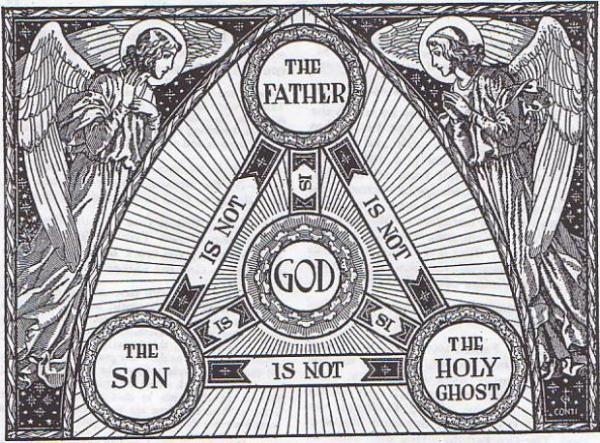
The Trinity is simply the affirmation and description of these experiences. The experiences could not be simply conflated—experiencing the Spirit among you was not the same as knowing the absolutely transcendent mind of the Creator. But neither could they be completely separated—as a matter of faith, Jesus had revealed that the core identity of the transcendent Creator was love. And so the doctrine of the Trinity was formulated to affirm that these things were distinct, but not separate.

I bring this up because it seems to tell us something about the creative process.

In the Trinitarian doctrine of creation, God the Father creates the world, God the Son is embodied within it, and God the Spirit brings new life out of it.

We can think of God the Father as creating the world in an analytical and abstract way. It is a work of construction or programming or design. It is done from the outside. But once created, the world is not complete until the Son can be incarnated within it. Then it can be experienced from the inside. Then, according to Christian doctrine, God can truly understand us and relate to us as we are.

I find it interesting that humans are so obsessed with creating virtual worlds. We’ve been doing this from the moment we started telling stories, but now we do it across all kinds of media, from books to radio to movies to virtual reality. And one thing that seems to be universal, is that when we tell a story, we have the impulse to place ourselves within it.

In fan-fiction, this is called the Mary Sue—the character whose sole reason for existence is so that we (the authors or viewers) can see ourselves interacting with our heroes and favorite characters. But that’s a little dismissive—at some level, all stories are built so that we have a way of experiencing ourselves within them. With virtual reality, we now have the ability to do it almost literally.

Why do we have such a strong desire to inhabit our created worlds?

I don’t think it’s because of the quality of experience. Many critics of virtual reality think we’re on a mission to escape real life for an experience that’s much more enjoyable. And yet virtual reality to date does not get anywhere close to the quality of real life.

I think it’s something deeper. I think, as creators, we have an impulse to incarnate within our creations. We are not drawn to virtual realities because they are better than our current experience, but because we have created them, and we are instinctively drawn to commune with our creation.

It would seem that as creators of art, of words, of worlds, we find ourselves drawn into a trinitarian relationship with our creations. We create from a position of analytic and architectural abstraction, and then seek to experience our creations from the inside.

You’ll notice that I left out the third member of the Trinity. In western Christian thought, the Spirit proceeds “from the Father and the Son”. In the biblical account, once God has incarnated in the world, once both the Father and the Son are involved in the universe, then the Spirit is set loose in creation.

Where the Father creates analytically and architecturally, and the Son experiences that creation from within, the Spirit acts to bring forth new things from the life contained in creation.

The Spirit is not analytical, but emergent. The Spirit is in a sense the feedback loop of the Father and the Son, transforming and bringing forth the creative potential of existence, surprising and delighting all with new things that were completely unforeseen.

In my own creative experience, this feedback loop is absolutely necessary. When you create from a position of analysis and abstraction, you may create something that makes sense, but has no life. When you lose yourself in the experience, you may create something amateurish and unwieldy, like a Mary Sue character, or a tearjerking song that simply recites bad things that have happened to you. But when you can maintain both—when you can analyze and create and experience all at the same time—then you experience something like inspiration. Then you’re shocked to find things emerging that you never anticipated or planned or foreknew, things which are your own creations, and yet are the surprising and spontaneous creations of new life.

When I got there with my songwriting, when I was analyzing and crying and surprising myself all at the same time—that’s when I felt that the creative process was truly at work. That’s when I created the things I’m most proud of to this day.

A few years ago, I lost my songwriting ability. Where it had come naturally to me for years, it stopped coming. And I could tell that what I had done was to stray too far, and lose myself in analysis and abstraction.

But analysis is not something you can undo, exactly. You can’t unsee the things that you’ve trained yourself to see. Trying to get myself to stop analyzing seemed even more hopeless and quixotic than anything else I had done. So eventually I gave up and moved on to other forms of self-expression.

In a sense, I may now be at a similar place with life itself. Striving to analyze too much, and losing my ability to create.

But thinking about the Trinity has changed my perspective on this. My problem is not that I have done too much analysis—it’s that I have done too little incarnation. I don’t need to try to stop analyzing, I need to learn to do more inhabiting. I need to analyze, create, and experience all at the same time. I need to create what I can simultaneously experience and enjoy. Only in doing so can I move out of abstraction angst, and move back towards understanding what things feel like. Only in doing so can I generate the feedback loop that enables true creation to come into the world. Only in doing so can I rediscover and re-embrace life.

I’m not absolutely sure what that looks like yet. But it gives me hope that the creative process isn’t doomed to self-destruction, that new things really are possible, and that abstraction doesn’t have to lead to nihilism—but when placed in its proper context, can lead to ever more beautiful art, music, stories, and worlds.

micah-reddingMicah Redding is a software developer and the Executive Director of the Christian Transhumanist Association. He’s an international TEDx speaker and educator, and a contributor to Vice Motherboard, the Huffington Post, IEET, and Humanity+. His extensive travels have taken him to Tahrir Square during the Arab Spring, and Afghanistan during the war. Micah is a member of Mensa, a teaching fellow at Exosphere Academy in South America, and the host of the Christian Transhumanist Podcast.

Addiction & Sobriety: Interviewing Dan Maurer

Speakeasy - Sobriety - Daniel Maurer

I love comic books and graphic novels. From childhood on, comics have grown with me, from the teenagers of Riverdale High to superheroes like Peter David‘s Incredible Hulk to complex tales of myth and biography. But I’ve never seen a graphic novel like Dan Maurer’s semi-autobiographical Sobriety. I was so moved by its story and even existence that I wanted to share a deeper cut of his insights with you, here.

Dan, what inspired you to write Sobriety?

There’s a story behind this. When I was in treatment at Hazelden in Center City, Minnesota, my father had given me a copy of another graphic novel. The topic (believe it or not) was Bertrand Russell’s attempt to prove the foundations of mathematics. (That book is actually a New York Times bestseller.) I was so taken by the format of comics to show such a powerful story, that I began to wonder if anything like it existed in recovery publications. There wasn’t.

There were a lot of different mediums and styles you could have chosen to talk about this journey – why on earth did you choose to do this as a graphic novel?

Now that the book is a reality, I’m convinced all the more of the potential groundswell of comics to enter into mainstream culture. Comics are simple without being simplistic. The medium itself is actually quite old, ancient really — look at the cave drawings in France or the walls inside the pyramids of Egypt. Artwork doesn’t dumb down the subject matter any; it only makes it more accessible and entertaining. Comics rock.

Sobriety SampleYou were a Lutheran pastor in another lifetime. If you don’t mind sharing, how did your faith and vocation play into getting you into addiction – and bringing you out?

Ha! In another lifetime … I like that. Yes. I initially went into ministry probably out of some innate desire to please my mother. Maybe that’s too Freudian, though. I was good at what I did back then, but being a pastor is a very lonely life. Moreover, you have to be okay with being alone, especially so in rural ministry, which was where I served in western North Dakota. But let me be honest: I abused drugs and drank, because I like to get high. That’s all there is to it in the end.  I thought all the others who we see nearly constantly in the news, or friends or relatives … they were just weak. I thought I could do both. I couldn’t. So how that plays into my faith life today is that I believe that all the sh*t I got myself into was ultimately the situation I needed in life to allow me to really live, to really understand how God genuinely loves us, despite our frailties and weaknesses. Today, I’m a believer, not because I published a book, but because I believe I’ve been given a purpose and meaning to share my story. My failings also gave me a great gift, you know. It’s the gift that no one’s story — my own included — is never really finished. God alone determines that and I remind myself of this fact daily.

Are the characters in Sobriety real people you know?

Short answer: no. But some people I’ve known (and know, present-tense) probably influenced characteristics each of the characters has. You know, everyone has mannerisms. Probably I swiped a few to give the characters more depth.

I was impressed by how your characters navigated their very different spiritual backgrounds, from devout Christian to atheist to several points in-between. Do you observe these kinds of conversations happening a lot these days in AA and NA circles?

Great question, Mike. Honestly, “in the rooms” a person sees the whole gamut. In the Midwest, where I live, the spectrum isn’t as wide, I believe. However, some of the people with the deepest spiritual lives I know wouldn’t proclaim themselves as Christians. For me, that used to be anxiety causing. Nowadays, I’m more relaxed. I guess I try to see a Christ-like existence working in others, even when they, themselves, don’t know it. It’s very freeing.

What’s one thing you wished non-addicts (or at least, non-identified addicts) understood about addicts and recovering addicts?

It’s not our fault. Really. And by that I don’t mean all the crazy crap we do. No … for that we’re culpable. That might seem contradictory, but what I’m saying is that we didn’t choose our brains. If we’re really going to embrace the illness/disease concept of addiction, we have to acknowledge that the craziness that goes with it is only expected. That doesn’t mean the legal system should give us a free ride. Not at all. In my case, the legal system was probably the “bottom” I needed to shake me into understanding who I was, and who I will always be: an addict. We’d definitely need more time to explore this topic fully, but I hope people understand that the brain, too, is an organ that can get sick. It becomes well when a spiritual conversion takes place. That’s all the Twelve Steps are about, after all, an orchestrated spiritual conversion. It doesn’t seem like it should work, but it does.

What’s one thing you know now that you wish you knew when you began your recovery journey?

That things can get better. I was a ball of nerves when I started. I had lost almost everything. It’s hard to look up to the sky when the well seems so deep, and the water you’re standing in seems to be rising. It does get better. Sometimes we need to experience a real death to know what rising again is about. That’s painful … but it gets better. Much better!

How can interested readers (whom I think will be many by now!) find out more about you and your work?

Thank you for asking! I keep a blog of transformational stories (more than only recovery-based stories) called Transformation is Real. It’s found on my website, Dan the Story Man. I hope you’ll visit!

Dan Maurer IIDan Maurer is a freelance writer and openly lives in recovery in Saint Paul, Minnesota. His current books include Sobriety: A Graphic Novel and Faraway: A Suburban Boy’s Story as a Victim of Sex Trafficking (co-written with R.K. Kline). Dan enjoys spending time with his two boys and wife, Carol. He plays the Great Highland Bagpipes and also makes a mean latté … although not at the same time. His non-fiction writing focuses on stories of transformation and how anyone’s story is never yet finished, even in times of great struggle.

The Day I Met Jesus: Interviewing Frank Viola & Mary DeMuth

DIMJFrank, Mary – why did you write  The Day I Met Jesus?

Frank: Back in 2007, I got an idea to create a new genre of Christian literature. I call that genre “biblical narrative.”

The new genre would contain autobiographical fiction closely based on the Scriptural narratives and faithful to first-century history. It would also contain a nonfiction section that practically applies the narratives to our lives. Finally, it would include a discussion guide so that readers could better digest and apply the content.

God’s Favorite Place on Earth (2013) was my first book in this genre. In it, Lazarus tells the story of when Jesus came to His hometown Bethany and all the amazing things that took place there.

The Day I Met Jesus (2015) is the second book in this genre. I wanted it to tell the story of five women whom Jesus encountered, allowing each woman tell their own story. I also wanted to draw out practical lessons and critical insights from each narrative.

Because I’m not a woman, I couldn’t do justice to the stories on my own, so I asked the top female Christian fiction writer of our time — Mary DeMuth — to coauthor it with me.

Mary: I wrote it because I love stories, and I felt that some of these encounters with Jesus didn’t get the air time they deserved. By doing careful research and weaving more of a story arc into the five women’s encounter, I hope to show people that the “characters” of the New Testament are actual, breathing people with stress and dysfunction and hopes just like us. Frank pioneered the idea of this book, so all credit goes to him for imagining it. I’m grateful he asked me to be a part.

How did you two came to coauthor this?

Mary: Frank wrote God’s Greatest Place on Earth and had long wanted to do something similar with five women of the New Testament. He approached me about writing the fiction side of The Day I Met Jesus after he found out I wrote fiction as well as nonfiction.

Frank: When I began to think about a female coauthor for the project, I wanted it to be someone who (1) writes fiction (2) is a remarkable writer, and (3) believes in the classic tenets of the Christian faith (Jesus is divine and human, He rose again from the dead, Jesus is Lord and Savior of the world, etc.)

As I investigated authors who fit the bill, I quickly thought of folks like Francine Rivers and Karen Kingsbury. But then I discovered that Mary DeMuth wrote fiction. I had known that she was a non-fiction writer, but had no idea that she could “switch hit.”

I also discovered that she was an outstanding writer of fiction as she was of nonfiction. (I regard Mary to be the Mickey Mantle of Christian literature — she has enormous power from both sides!) So Mary ended up being the only name on my “short list.”

You feature five women from the Gospels. Why pick women in particular as your subjects?

Frank: Some of the most gripping, instructive, inspiring stories in the Gospels involve women. The longest recorded conversation that Jesus ever had was with a woman. And some of the most amazing things He said and did related to women. So I thought that a book in which some of these women told their own stories about Jesus would not only bring the Gospels to life in our minds, but it would also bring Jesus alive in our hearts.

Mary: Women had significant, personal encounters with Jesus, a fact that we sometimes miss, particularly since so many stories revolve around the 12 disciples (who were men). I love that we’re elevating these stories, helping people reimagine just how radical it was that Jesus so beautifully interacted with these women.

Which one is your favorite – and why?

Mary: For me, it’s hard to say. I love them all in different ways. This week, I’ll say it’s Mary of Bethany. She didn’t have a blatant “need” for Jesus. She was just downright faithful and often misunderstood. I think a lot of people can relate to that.

Frank: Mary of Bethany is my all-time favorite disciple of Jesus. This came home to me when I wrote God’s Favorite Place on Earth. (Mary was the sister of Lazarus, so she gets ample airtime in that book.)

I love Mary because she knew Jesus better than most, anticipating His reactions and even His impending death. She also paid the price for loving Him, for she was falsely accused by both her sister and the other disciples (on two different occasions), mostly out of jealousy. In both situations, Mary embraced the spirit of the Lamb, refusing to defend herself. But Jesus Himself rose to her defense on both occasions. He also gave her an enduring honor that He gave no one else.

Why would someone want to read this book?

Frank: If someone wants a good story to get tied up into . . . or if they want to see the Bible come to life in a compelling way . . . or if they want to experience Jesus Christ anew and afresh . . . or if they want to identify with people who were far worse off than they are, and see what Jesus did for them . . . or if they want to be given hope and encouragement in their situation . . . or if they are lacking love for the Lord and want that love to be rekindled . . . or if they want new motivation and fresh inspiration to follow Jesus more closely . . . or if they want to increase their faith and expectation in the Lord, they’ll want to read The Day I Met Jesus.

Mary: Someone would want to read it because it’s truly unique. It’s biblical narrative, but in short story form, but it doesn’t end there. After you’ve been absorbed into a page-turning story, Frank exegetes the wisdom from each encounter and helps you apply it to your life.

Did I hear that there’s a course that supplements the book!

Frank: Yes. The Day I Met Jesus Master Course is designed for those who wish to delve deeper into the themes set forth in the book. It includes a workbook and 20 audio messages delivered by Mary and I. In addition, it includes 8 bonus eBooks from Mary and I. It also includes a closed forum where people can access us both directly for Q&A and dialogue. People can check it out at thedayimetjesus.com/course

Tell us what readers get if they purchase The Day I Met Jesus from March 3rd to March 17th from Parable.com.

Frank: They’ll get these 7 exclusive bonuses:

  1. An exclusive audio interview where Mary and I give a behind-the-scenes look at all the facets of the book. The interview covers where the idea of the book came from, why we wrote the book, what it was like collaborating, the hardest part about writing it, and much more.
  2. Mary’s Book Beautiful Battle in Kindle & Nook formats.
  3. My Book, Rethinking Spiritual Growth in PDF, Kindle, and Nook formats.
  4. A never-before-released audio conference message entitled “A Woman Inside of a Man.”
  5. Mary’s Book What To Do After People Poop on You in PDF.
  6. A never-before-released audio conference message entitled “He’s Not Ashamed to Call Them Brothers and Sisters.”
  7. A 15% discount off The Day I Met Jesus Master Course.

Click here to order The Day I Met Jesus from Parable before March 17th and get your 7 exclusive bonuses.

Born Twice: My Adoption Story

October 30th – it’s my birthday today. I turn 33. So it’s only appropriate that I delve into something that I’ve never said here before: I’m adopted. I was adopted from birth. And nearly two years ago, I connected with my biological parents for the first time.

I recently sat down with my friend (and parenting blogger) Jeremy Uriz to discuss what it was like to grow up as an adopted kid, and what impact this has on me now. Jeremy has a vested interest in knowing: as of earlier this year, Jeremy and his wife Jennifer became the proud adoptive parents of a toddler from China, Penelope. Let me tell you, she is a cutie, and ridiculously smart, to boot. Jeremy has been chronicling her life, and their life as parents, at Belonging Together. It’s a treasure trove of information and wisdom on parenting, adoption, cross-cultural parenting/adoption, et al.

In our two-part interview – which you can read as a transcript or listen to as a podcast – we discuss adoption and parenting from all sides. If you want, you can jump right now to part one and part two – otherwise, here are some excerpts…

Jeremy: Recently you had a unique experience among some adoptive people. We’ll discuss that in a little bit. Let me just start out and ask you how sensitive a topic is adoption now versus 10 or 20 years ago?

Mike: Do you mean how sensitive do I think it is in the culture at large?

J: Yes.

M: I would say in most corners it’s way more open now than it used to be. My impression is, and what I’ve gathered, is there used to be a culture of almost shame and secrecy around adoption and now people are far more commonly talking about adoption, either if it’s their children that they have adopted or if they are kids or adult children who were adopted it seems more common now. It’s more out in the open.

J: When did you find out you were adopted?

M: I found out I was adopted when I was, I want to say, 4 or 5 years old. I kept pestering my mom about “birds and the bees” type questions and think I point blank asked her at one point if I grew in her belly. My mom is of the “I will not tell a direct lie” school of ethics, and though it was an uncomfortable topic for her, she decided to give it to me straight. She told me then that I was adopted and that they chose me, my mom and dad chose me, and that they loved me very much because they especially chose me.

J: What were your feelings at the time?

M: …to hear my feelings, go here for the continuation of Part One.

Jeremy: That brings me to another question. Did you feel there was a piece of you that was in a sense “filled in” by this connection or did you know it was there, did you not know it was there and you only discovered it when you began speaking to [your birth mother]?

Mike: That’s such interesting question. Connecting with both her, and shortly thereafter my birth father, I did see some aspects in common in terms of they were both very opinionated people, they are both entrepreneurial, and creative. And so there were some cool resonances there but it actually wasn’t as intensely ”Oh I found this missing piece of myself” as I think I may have built it up in my mind. I think there’s a bit of allure that develops around adoption that makes you feel like there’s this sort of ache or primal wound or something that once you find these people you’re going to have a missing piece of yourself.

I was very fortunate to have a wonderful reunion experience with both of my birth parents. I know in some cases the birth parents don’t want to be in touch, or they turn out to be co-dependent, or addicts, or there’s all kind of horror stories out there. I’m really grateful that none of that was the case with me.

At the same time I think that what it confirmed that there are some ways in which I am simply unique. So in the ways in which I felt like maybe I didn’t fit in when I was growing up among my parents, my adoptive parents, that maybe if I ever imagined “well I don’t fit in with them but it’s because I’m more like my birth parents” in some ways I’ve discovered that I’m just a unique person on my own two feet. It’s great as an adult to be in a relationship with the parents I’ve always had as well as my birth parents.But I’m relating to all of them really as an adult.

Yeah, its an interesting process. It’s not over yet by any means so I’m still along for the journey in this regard.

J: So in some respects it offers you a larger palate to work from than other people.

M: Sure.

J: Not necessarily the way people would choose but it’s the hand you were dealt.

M: Yeah, it is the hand I was dealt. [I would add that this is not as grim as it sounds! By and large, I like the upbringing I had, though it’s not without its challenges. I am grateful for how things unfolded, and continue to be grateful for how they unfold today with my big, diverse, interesting family…] And I think increasingly in this day and age there are a lot of adopted children, and lots of blended families, people who have step parents of one sort or another,  I think a lot of us are getting to play with larger palates these days as we’re discovering why we’ve developed in the way we have and what’s formed our identity.

J: Now this particular question is going to be important for me and anyone reading, or for a lot of people reading this. What do you feel adoptive parents should know about their adopted children? Is there something about the experience? For Jennifer and I we can’t relate in some respects to the experience Penelope has. What is it that parents should know in this circumstance?

M: …to hear my life-changing advice for adoptive parents, continue on over to Part Two.


 How about you? Have you adopted children? ARE you adopted? What’s your story? I’d like to hear, here

Sunday Devotional: Sara Miles – Jesus Says GO!

In the midst of all the (well-deserved) hoopla surrounding the release of Brian’s A New Kind of Christianity, it is literarily crucial not to lose sight of another, equally-important book that released this month: Jesus Freak: Feeding/Healing/Raising the Dead by Sara Miles. I really think that both of these books could well define Western Christianity’s soul-searching in the second decade of the 21st-century.

I’m not going to do a full book review today – this week, God-willing! – but for now I’ll just say that Sara’s book works on the reader in a whole different way than Brian’s; whereas Brian’s adeptly takes you on a journey through Scripture, church history, and the genealogy of ideas, Sara’s book is hyper-local (rarely, if ever, venturing outside of her home city of San Francisco) and deeply embodied – it’s story after story after story, driving a central theme home: God lives in us, and Jesus gives us the authority to feed, heal, forgive, and practice resurrection. Here is Sara reading an excerpt from Jesus Freak (this is what inspired the non-technological part of my KedgeForward Theology After Google Preview Talk):

The blogosphere has been positively abuzz about Sara’s infectious story and embodied spirituality. Here are some of the highlights:

Bill Dahl

Carl McColman

Faith Matters

Father Jake

In Touch Magazine (In Touch?? Isn’t that Charles Stanley’s magazine?? Wow!)

Journey With Jesus

Matthew Paul Turner

Next-Wave

Reiter’s Block

Rhodes Network

Sarx

Spirituality & Practice

Through A Glass Darkly

Walking With God

Whatever

Weary Pilgrim

Why Is Marko

Wrecked for the Ordinary

Wounded Bird

Yearns & Groans

Left-wing Lesbian author comes out as a Jesus freak and claims power to feed the hungry, heal the sick, and raise the dead – Religion Writers. Now that’s an attention-grabbing headline!

(My previous posts about Sara are here and here.)

This was originally posted on February 14, 2010.